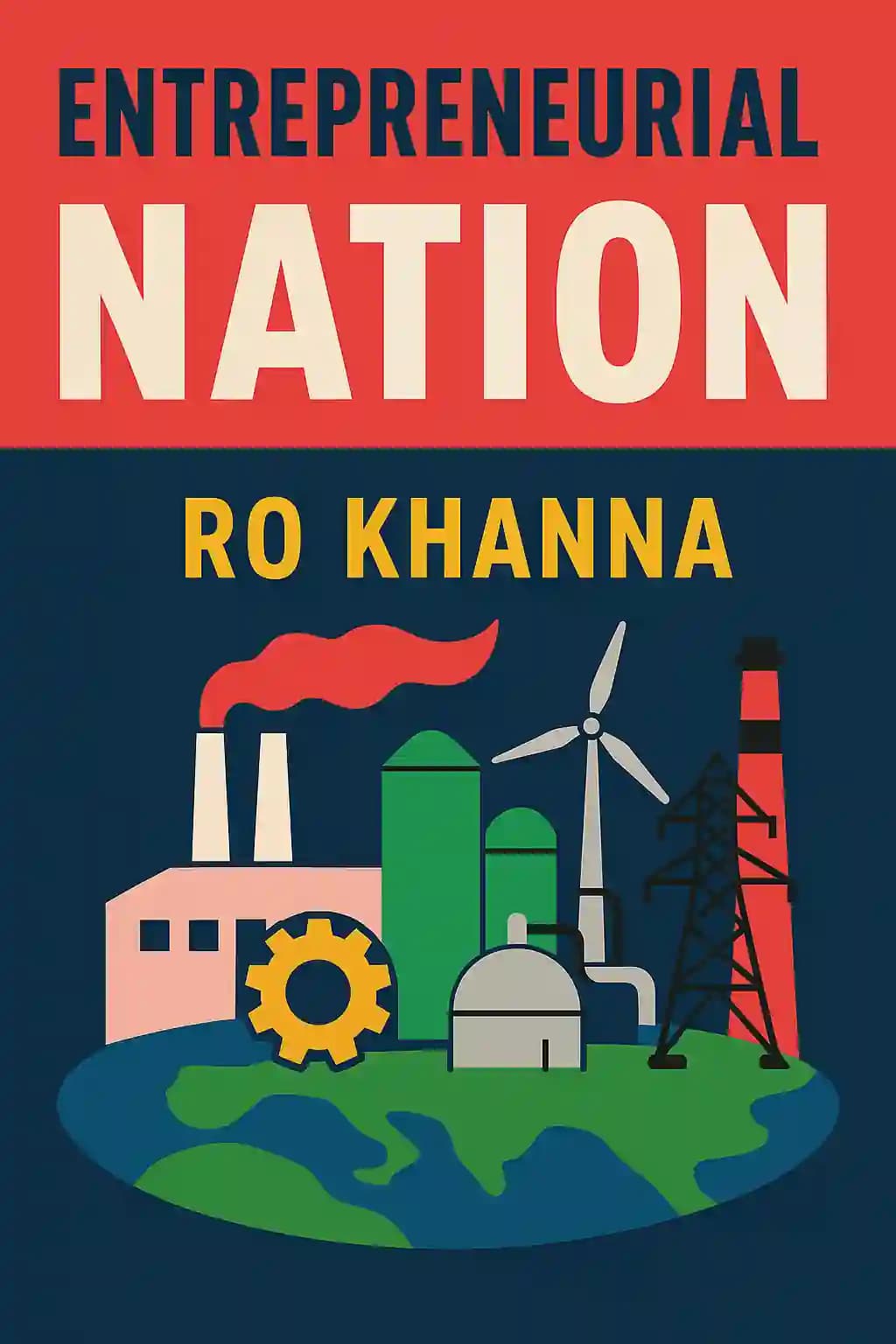
Can America reclaim its manufacturing glory? "Entrepreneurial Nation" reveals why manufacturing remains vital to America's future, endorsed by Elon Musk and praised for challenging assumptions about U.S. competitiveness. Discover how innovation, not outsourcing, is the key to economic dominance.
Ro Khanna, U.S. Representative for California’s 17th District and author of Entrepreneurial Nation: Why Manufacturing is Still Key to America’s Future, combines political insight with economic expertise to advocate for revitalizing American manufacturing. A Stanford economics lecturer and former Obama administration official, Khanna draws from his Silicon Valley constituency experience to address themes of economic equity, innovation, and job creation.
His policy-driven approach emphasizes decentralizing tech prosperity and empowering small manufacturers, reflecting his Indian-American heritage and grandfather’s influence as a Gandhi-era independence activist.
Khanna’s follow-up work, Dignity in a Digital Age, expands on democratizing technology’s benefits, featured in discussions on Brookings’ TechTank Podcast and the JFK Library Podcast. His books are widely cited in policy debates about bridging the digital divide and reimagining globalized labor markets. A University of Chicago and Yale Law graduate, Khanna’s ideas have shaped congressional tech policy, earning recognition for blending pragmatic governance with progressive economic vision.
Entrepreneurial Nation argues for revitalizing U.S. manufacturing through entrepreneurship, policy reform, and investment in small manufacturers. Ro Khanna, a Congressman and economist, highlights success stories of American innovation while proposing strategies to combat offshoring, create jobs, and foster a "new economic patriotism." The book blends economic analysis with policy ideas like strengthening supply chains and supporting STEM education.
This book is ideal for policymakers, entrepreneurs, and readers interested in economic revitalization. Khanna’s insights appeal to those seeking pragmatic solutions for rebuilding U.S. manufacturing, including advocates of bipartisan tech investment (e.g., the CHIPS Act) and professionals in innovation-driven industries. It’s also relevant for historians analyzing post-industrial economic shifts.
Yes, particularly for its optimistic, data-driven approach to American industrial renewal. Khanna offers actionable policies, such as tax incentives for domestic production and R&D funding, alongside case studies of thriving manufacturers. Critics note its focus on Silicon Valley partnerships, but the book remains a timely resource amid global supply chain debates.
Khanna advocates for:
The book critiques overreliance on offshoring but rejects isolationism. Instead, Khanna proposes "competitive globalization"—prioritizing strategic industries (e.g., semiconductors) while maintaining trade alliances. He emphasizes reciprocity in trade deals and safeguards against intellectual property theft.
Small manufacturers are framed as job creation engines and innovation hubs. Khanna highlights their agility in adopting automation and cites examples like boutique aerospace firms revitalizing Rust Belt towns. He urges policies to improve their access to capital and global markets.
While Dignity focuses on tech’s societal impacts, Entrepreneurial Nation targets industrial policy. Both emphasize equitable growth, but the latter prioritizes physical infrastructure and middle-class manufacturing jobs over digital economy reforms.
Some economists argue Khanna underestimates automation’s job displacement effects. Others note limited discussion of unionized labor’s role. However, the book is widely praised for bridging progressive ideals with pro-business pragmatism.
This term combines national investment in critical industries with worker-centric trade policies. Key pillars include reshoring pharmaceutical production, securing mineral supply chains for clean energy, and incentivizing corporate reinvestment in U.S. facilities.
Khanna cites:
As AI and automation accelerate, Khanna’s blueprint for high-skill manufacturing jobs addresses current debates about AI’s economic impact. Policies like R&D tax credits align with efforts to counter China’s tech dominance.
Khanna ties industrial renewal to green tech, advocating for federal loans to retool factories for EV components and solar panels. He highlights opportunities in recycling infrastructure and critical mineral processing.
通过作者的声音感受这本书
将知识转化为引人入胜、富含实例的见解
快速捕捉核心观点,高效学习
以有趣互动的方式享受这本书
We cannot afford to separate innovation from manufacturing.
People often do it better than machines.
Anybody can buy the tools.
Incessant innovation.
将《Entrepreneurial Nation》的核心观点拆解为易于理解的要点,了解创新团队如何创造、协作和成长。
将《Entrepreneurial Nation》提炼为快速记忆要点,突出坦诚、团队合作和创造力的关键原则。

通过生动的故事体验《Entrepreneurial Nation》,将创新经验转化为令人难忘且可应用的精彩时刻。
随心提问,选择声音,共同创造真正与你产生共鸣的见解。

"Instead of endless scrolling, I just hit play on BeFreed. It saves me so much time."
"I never knew where to start with nonfiction—BeFreed’s book lists turned into podcasts gave me a clear path."
"Perfect balance between learning and entertainment. Finished ‘Thinking, Fast and Slow’ on my commute this week."
"Crazy how much I learned while walking the dog. BeFreed = small habits → big gains."
"Reading used to feel like a chore. Now it’s just part of my lifestyle."
"Feels effortless compared to reading. I’ve finished 6 books this month already."
"BeFreed turned my guilty doomscrolling into something that feels productive and inspiring."
"BeFreed turned my commute into learning time. 20-min podcasts are perfect for finishing books I never had time for."
"BeFreed replaced my podcast queue. Imagine Spotify for books — that’s it. 🙌"
"It is great for me to learn something from the book without reading it."
"The themed book list podcasts help me connect ideas across authors—like a guided audio journey."
"Makes me feel smarter every time before going to work"

免费获取《Entrepreneurial Nation》摘要的 PDF 或 EPUB 版本。可打印或随时离线阅读。
Imagine traveling across America and discovering a startling truth: while politicians and pundits lament the death of American manufacturing, innovative entrepreneurs are quietly thriving against all odds. This is precisely what Ro Khanna found as he toured the country's industrial heartland. Despite cheaper foreign labor, currency manipulation, and intellectual property theft, American manufacturers weren't just surviving - they were reinventing themselves. Until 2009, America remained the world's manufacturing leader, with labor productivity six times higher than China or India. The narrative that American manufacturing is doomed simply doesn't match reality. "When manufacturing moves overseas, design follows." This warning from Intel's legendary chairman Andy Grove captures a fundamental truth about innovation - it thrives on proximity. Harvard researchers observed this pattern when offshoring semiconductor manufacturing disadvantaged American companies in developing solar panels. Similarly, Dow Chemical builds research facilities near their factories because they "cannot afford to separate innovation from manufacturing." The numbers tell the story: manufacturing accounts for 70% of America's $250 billion annual business R&D spending and nearly 90% of U.S. patents. Manufacturing companies innovate at nearly three times the rate of service companies. This ecosystem - with its physical proximity and face-to-face collaboration - produces unparalleled technological breakthroughs. Manufacturing also creates pathways to the middle class, with weekly wages over 20% higher than service sector jobs. And while automation has changed the landscape, the idea that manufacturing no longer needs workers is a myth.