第 1 章
The Existential Choice: A Life-Altering Philosophical Dilemma
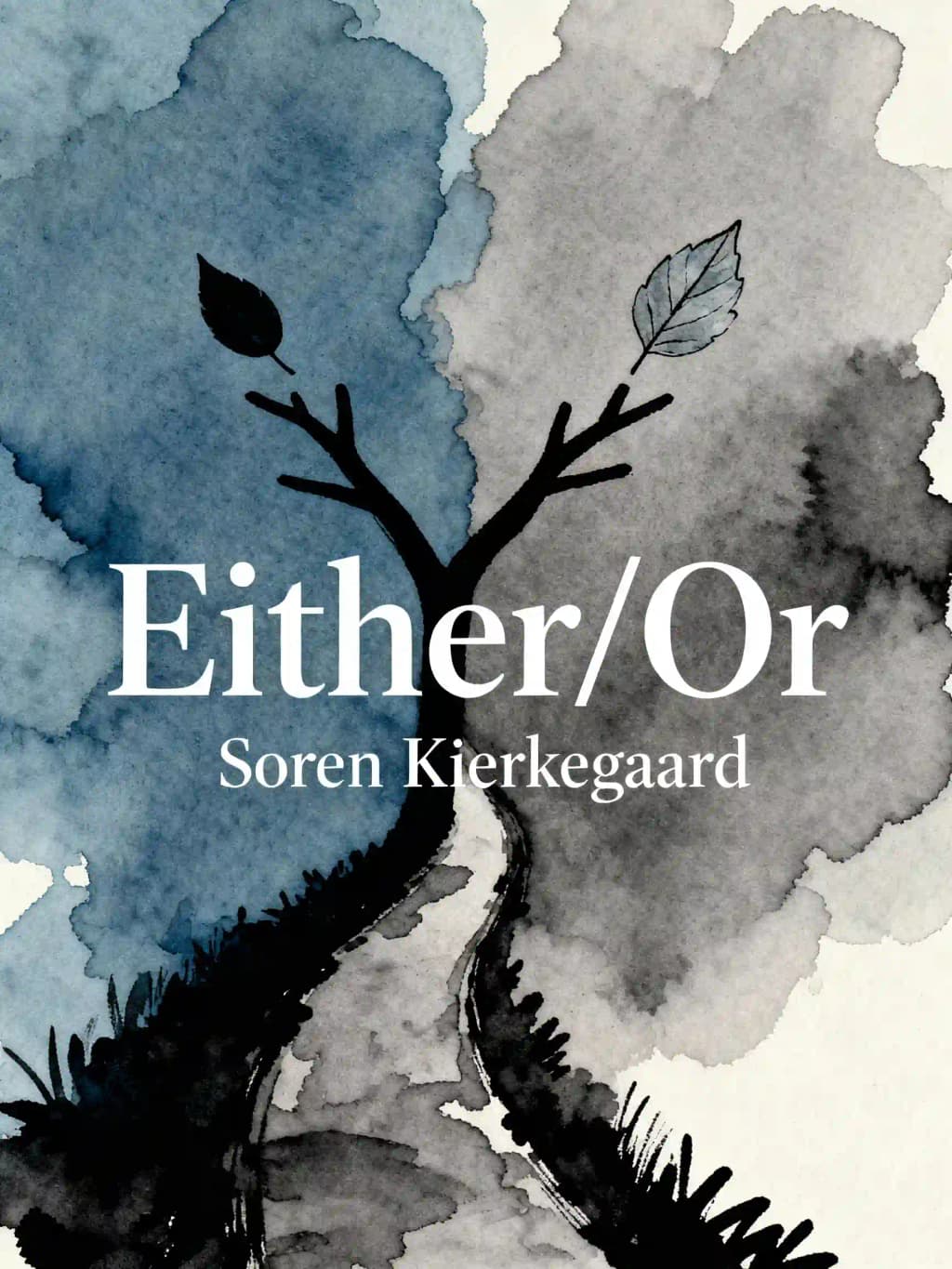
Have you ever felt trapped between two fundamentally different ways of living? Sren Kierkegaard's masterpiece "Either/Or" presents perhaps the most profound existential choice we all face: live aesthetically, pursuing pleasure and avoiding commitment, or ethically, embracing responsibility and finding meaning through choice. This revolutionary work, published in 1843 under a pseudonym, shocked Danish society with its radical challenge to comfortable mediocrity. Though nearly two centuries old, it remains startlingly relevant-influencing everyone from existentialist philosophers like Jean-Paul Sartre to modern psychologists exploring identity formation. Even David Bowie cited Kierkegaard as a major influence on his shape-shifting artistic persona. Through a fascinating literary device-presenting found papers from two opposing perspectives-Kierkegaard doesn't just explain his philosophy; he forces you to experience the tension between these life choices. Are you living authentically, or merely drifting? This question has never been more urgent than in our age of endless options and shallow commitments.
第 2 章
The Aesthetic Life: Pursuing Pleasure and Avoiding Commitment
The first part of "Either/Or" introduces us to the unnamed aesthete (referred to simply as "A"), whose papers reveal a life dedicated to the pursuit of pleasure and avoidance of boredom. The aesthete lives entirely in the moment, constantly seeking new experiences and sensations. His worldview is captured in fragmentary reflections called "Diapsalmata," where he reveals his fundamental melancholy despite his sophisticated pursuit of pleasure.
"All men are boring," the aesthete declares, identifying boredom as "the root of all evil." His solution is what he calls "crop rotation"-not physically changing locations or possessions (the "extensive method"), but rather developing the ability to find interest in anything through an "intensive method" of attention. "The more you limit yourself," he explains, "the more resourceful you become." He advocates for a detached approach to life where one remembers "poetically," transforming experiences by stripping away painful elements.
This aesthetic approach to life is further illustrated in the aesthete's analysis of Mozart's Don Giovanni. Unlike conventional seducers who calculate their conquests, Don Giovanni represents pure, unreflective desire-he doesn't seduce through cunning or speech but through "the power of sensual desire." The aesthete admires how Don Giovanni lives entirely in the moment, without reflection or ethical considerations. His life "foams like champagne," expressing an immediate, unreflective relationship to desire that the aesthete finds fascinating precisely because it represents the purest form of aesthetic existence.
The aesthete's fascination with sorrow-particularly "reflective sorrow" that turns inward rather than outward-reveals the hidden melancholy beneath his sophisticated exterior. In his "Shadowgraphs" essay, he examines three women (Marie Beaumarchais, Donna Elvira, and Margrete) who suffer from reflective sorrow after being abandoned by their lovers. Their pain fascinates him because it represents a form of aesthetic experience that can never find resolution-they are "always trying to find out how to sorrow."
第 3 章
The Seducer's Diary: The Dark Extreme of Aesthetic Existence
The most disturbing section of the aesthete's papers is "The Seducer's Diary," which chronicles Johannes' calculated seduction of a young woman named Cordelia. Unlike Don Giovanni's unreflective desire, Johannes represents a reflective form of the aesthetic life-he seduces not merely for physical pleasure but for the aesthetic enjoyment of the process itself. He is "of far too spiritual a nature" to be a conventional seducer, often desiring only arbitrary things like "a greeting" rather than physical possession.
Johannes meticulously documents his psychological manipulation of Cordelia, describing how he positions himself as her intellectual mentor while secretly planning her seduction. He manipulates another suitor, Edvard, using him as a foil to make himself more interesting by comparison. Johannes even deliberately portrays himself as a dull, practical man to Cordelia's aunt while occasionally sending "flashes" of his true self toward Cordelia, creating confusion and intrigue.
Most disturbingly, Johannes arranges a formal engagement to Cordelia specifically so he can manipulate her into breaking it off, creating the illusion that she is freely choosing him rather than being seduced. "I'm engaged; so is Cordelia," he writes mockingly, "and I suppose that's just about all she knows of the matter." After successfully seducing her, he coldly dismisses her: "Now all resistance is impossible, and only when it is there is it beautiful to love." His final musing reveals his ultimate cruelty as he wonders whether he might "poetize oneself out of a girl" by making her believe she was the one who tired of the relationship.
The Seducer's Diary represents the darkest extreme of aesthetic existence-a life dedicated to momentary pleasure without ethical commitment, where other people become mere objects for one's enjoyment. The editor who discovered these papers notes that such a seducer will ultimately "go astray himself," trapped in a circular mental labyrinth with "no support beneath him in his barren restlessness."
第 4 章
Ancient and Modern Tragedy: The Evolution of Sorrow
In his essay "Ancient Tragedy's Reflection in the Modern," the aesthete explores how tragedy has evolved from ancient to modern times. While the tragic remains conceptually consistent, he identifies an essential difference: in ancient tragedy, action proceeds not just from character but includes an element of suffering based on "substantial categories" of state, family, and destiny. The hero's downfall is both action and suffering. In modern tragedy, however, the hero "stands and falls entirely on his own deeds," with action stemming primarily from character and situation.
This difference manifests in the nature of tragic guilt. In Greek tragedy, guilt occupies an intermediate position between activity and passivity-it is "inherited guilt" that is substantial rather than merely subjective. Modern tragedy, however, transforms aesthetic guilt into ethical guilt, making the hero "bad" rather than tragically flawed.
The aesthete illustrates this distinction through his reimagining of Antigone as a modern figure. While keeping the basic facts of her story-Oedipus killed the sphinx, murdered his father, married his mother-everything is different in his version. The horrors remain concealed from the public, with only Antigone knowing the terrible secret. This secret knowledge creates anxiety in Antigone-the defining element of modern tragedy. Unlike the Greek Antigone who lives carefree until her brother's burial creates conflict, the modern Antigone's life is essentially over from the beginning, unfolding inward rather than outward.
This analysis reveals the aesthete's sophisticated understanding of how human consciousness has evolved. Modern reflective grief differs from Greek sorrow-while Philoctetes laments that no one knows his suffering (a literal truth), modern Antigone's isolation is figurative but creates deeper pain. The Greek expresses literal truth; the modern expresses figurative truth that causes real pain.
第 5 章
The Unhappiest One: Despair at the Heart of Aesthetic Existence
In "The Unhappiest One," the aesthete contemplates a mysterious grave in England bearing only this enigmatic inscription. When opened, the grave was discovered to be empty-a peculiar circumstance that becomes a powerful metaphor for existential emptiness. This haunting image raises profound questions: Was the occupant so consumed by unhappiness that they couldn't find peace even in death? Or does the empty grave await the truly unhappiest one who has yet to be found? The physical void becomes symbolic of an inner void that characterizes the deepest forms of human suffering.
The aesthete makes a crucial philosophical distinction regarding the nature of unhappiness. Death itself, he argues, cannot be considered the greatest misfortune-"we, like the Roman soldiers, do not fear death." This reference to classical stoicism emphasizes how true unhappiness transcends the mere fear of mortality. Those who merely fear death are dismissed from the competition for the title of "unhappiest one," as they fail to grasp that existence itself can be the greater burden. The truly unhappy individual bears the weight of consciousness that makes life itself unbearable.
Drawing extensively on Hegel's concept of "the unhappy consciousness," the aesthete develops a sophisticated taxonomy of suffering. The truly unhappy person exists in a state of perpetual displacement, having "the content of his life, the fullness of his consciousness" located outside himself. This displacement manifests in two primary temporal directions: either trapped in the past (remembering) or projected into the future (hoping). The most acute form of unhappiness occurs when one cannot find refuge even in these temporal escapes-when both memory and hope become sources of torment rather than comfort.
The aesthete then identifies increasingly complex manifestations of unhappiness, each more sophisticated than the last. The first category includes those who hope for what cannot possibly be realized or remember what never actually existed-a form of delusion that at least provides some psychological shelter. The second, more profound category comprises those caught in a perverse temporal reversal where "what he hopes for lies behind him, and what he remembers lies before him." This individual lives life "back-to-front in two directions," perpetually out of sync with time itself, always arriving too late or too early for their own existence.
This intricate analysis reveals the fundamental despair that lies at the heart of aesthetic existence-a life that cannot find fulfillment or meaning in the present moment but is constantly oscillating between past and future. The aesthete's remarkably nuanced understanding of unhappiness suggests his own intimate familiarity with these states, despite (or perhaps because of) his sophisticated pursuit of pleasure and systematic avoidance of commitment. His analysis becomes not just philosophical speculation but a form of indirect self-revelation, showing how the aesthetic life, despite its apparent freedoms and pleasures, contains within itself the seeds of profound unhappiness.
The empty grave thus becomes a powerful symbol for the aesthetic existence itself-a life that appears full and vibrant on the surface but contains at its core an essential emptiness, a void that no amount of sensual pleasure or intellectual sophistication can fill.
第 6 章
The Ethical Life: Finding Meaning Through Choice and Commitment
Part Two of "Either/Or" introduces Judge William, who writes letters to the aesthete urging him to choose the ethical life. The Judge represents a fundamentally different approach to existence-one based on choice, commitment, and responsibility rather than momentary pleasure. Through his letters, he systematically dismantles the aesthete's philosophy while presenting a compelling case for ethical living that doesn't sacrifice life's beauty but rather enhances it through deeper engagement.
The Judge argues that marriage represents the perfect union of the aesthetic and ethical spheres, serving as the ultimate example of how commitment enhances rather than diminishes life's pleasures. Unlike the aesthete who sees marriage as the death of romantic love, the Judge sees it as its fulfillment, arguing that the daily choice to love transforms fleeting passion into enduring joy. He challenges the aesthete's view that duty is an enemy to love, arguing instead that duty is love's "friend and confidant," providing "the blessing of having the prospect always free," while romantic love "goes astray or comes to a standstill" due to its non-historical character. Through concrete examples, he demonstrates how the ethical commitment in marriage actually deepens emotional bonds and creates a foundation for genuine intimacy that purely aesthetic relationships cannot achieve.
The Judge praises woman's natural wisdom, which often clarifies problems that confound philosophers. He illustrates this with an anecdote about a Dutch scholar distracted by what he thought was a diacritic mark, which his practical wife simply blew away as a grain of snuff. This story serves as a metaphor for how theoretical complexity often obscures simple truths. Woman possesses "an innate talent and primitive gift for clarifying finiteness," making "the interval shorter" and transforming her humble comfort into "life's richest joy." This celebration of practical wisdom challenges the aesthete's intellectual pretensions and shows how everyday understanding often surpasses abstract speculation.
The ethical perspective sees friendship as a duty, or more precisely: "It is every man's duty to become revealed." This revelation involves not just superficial disclosure but a fundamental commitment to authentic self-expression and genuine connection with others. While ethics demands revelation, the aesthete remains concealed, never abandoning himself totally to the world-and thus becomes "a mystery to oneself." The truly extraordinary person is not one who withdraws from universal human experience but one who most fully realizes it. The Judge argues that this engagement with universal human experiences - love, marriage, friendship, work - far from being mundane, represents the highest form of self-realization.
Through these arguments, the Judge presents ethical life not as a constraining force but as the path to genuine freedom and fulfillment. He shows how commitment, far from limiting life's possibilities, actually opens up deeper dimensions of experience and meaning that remain inaccessible to the purely aesthetic approach to life.
第 7 章
The Religious Perspective: Finding Edification in Being Wrong Before God
The final section of "Either/Or" introduces a third perspective beyond the aesthetic and ethical-the religious. In "The Edifying in the Thought That Against God We Are Always in the Wrong," we find a sermon exploring the paradoxical edification found in accepting that against God, we are always in the wrong. This perspective represents a radical departure from both aesthetic and ethical modes of existence, offering a unique path to spiritual fulfillment.
While being wrong is typically painful, and admitting fault merely a bitter medicine we endure hoping to improve, there's something profoundly edifying in embracing our perpetual wrongness before God. In human relationships, we find comfort in being right when wronged, but in loving relationships, we wish to be wrong rather than see our beloved at fault. This distinction reveals the difference between finite and infinite relationships-our relationship with God being the ultimate infinite one. Consider how a parent might prefer to be wrong than see their child suffer - this human example offers a glimpse into the divine dynamic.
This conviction doesn't arise from compulsion or reasoning but from love and freedom. When we freely embrace being always in the wrong before God, we find liberation from doubt's anxieties and inspiration for action. Like a child who finds security in acknowledging their parent's greater wisdom, the religious individual discovers peace in submission to divine authority. This truth doesn't paralyze but empowers, expressing that God's love always exceeds our own. Even amid suffering, disappointment, or apparent injustice, this recognition brings joy and spiritual strength.
The religious perspective transcends both the aesthetic and ethical by recognizing our fundamental dependence on something beyond ourselves. While the aesthete lives for pleasure and the ethical person lives for duty, the religious person lives in relation to the infinite, finding meaning in submission to God's will. This submission differs fundamentally from mere obedience to moral law or pursuit of pleasure. It represents a complete transformation of perspective where even apparent defeats become victories through faith.
The concept manifests in practical ways: where an aesthete might despair over life's unfairness, and an ethical person might struggle with duty's demands, the religious individual finds peace in accepting their limitations before God. This acceptance isn't passive resignation but active engagement with life's challenges through the lens of faith. It transforms ordinary experiences into opportunities for spiritual growth, seeing divine purpose even in apparent misfortune.
This perspective also resolves the tension between individual freedom and absolute commitment. Unlike ethical duty, which can feel externally imposed, or aesthetic pleasure, which can feel empty, religious conviction provides both freedom and fulfillment. It offers a paradoxical truth: that in accepting our complete dependence on God, we find our truest independence and authenticity.
第 8 章
The Existential Choice: Kierkegaard's Challenge to Modern Life
Kierkegaard's "Either/Or" presents us with a fundamental choice between two modes of existence-the aesthetic life of pleasure and the ethical life of commitment. The aesthete lives in the moment, constantly seeking new experiences to ward off boredom, but ultimately finding himself trapped in despair. This aesthetic life manifests in various forms: the social butterfly jumping from party to party, the intellectual dabbling in different fields without mastery, or the romantic pursuing endless affairs without genuine connection. The Judge, by contrast, represents the ethical life, finding fulfillment through choice, commitment, and responsibility, exemplified in marriage, career dedication, and civic duty.
What makes Kierkegaard's approach revolutionary is that he doesn't simply present these options as theoretical possibilities-he forces the reader to experience the tension between them through the literary device of the found papers. We don't just read about the aesthetic and ethical perspectives; we inhabit them through the vivid writings of their representatives. The aesthete's diary entries pulse with wit and sensuality, while the Judge's letters carry the weight of mature reflection and moral conviction. This dramatic structure creates an emotional resonance that pure philosophical argument could never achieve.
The ultimate message of "Either/Or" is that we must choose-not between specific options, but between ways of existing. The aesthete avoids choice, drifting from one pleasure to another without commitment, like a butterfly sampling different flowers but never building a nest. The ethical person embraces choice, finding meaning through commitment and responsibility, whether in marriage, profession, or community service. The religious person transcends both by choosing submission to God's will, making what Kierkegaard calls the "leap of faith" into absolute commitment.
This challenge remains profoundly relevant in our modern world of endless options and shallow commitments. Social media presents us with constant novelty and distraction, while dating apps turn relationships into a carousel of possibilities. Career paths have become increasingly fluid, making long-term professional commitment seem outdated. Are we living authentically, making real choices and accepting their consequences? Or are we merely drifting, avoiding commitment and responsibility in pursuit of momentary pleasure? The rise of "fear of missing out" (FOMO) and decision paralysis in the face of unlimited options suggests that Kierkegaard's diagnosis remains acute.
His challenge forces us to confront these questions not as abstract philosophical problems, but as the fundamental existential choices that shape our lives. Each swipe, click, and scroll represents a micro-decision between commitment and avoidance, between depth and superficiality, between authentic existence and mere aesthetic drift. The power of Kierkegaard's analysis lies in showing us that these seemingly small choices accumulate into the fundamental shape of our lives and character.
第 9 章
The Power of Indirect Communication: Kierkegaard's Authorial Strategy
One of the most fascinating aspects of "Either/Or" is Kierkegaard's sophisticated use of pseudonyms and fictional editors. The book is presented as a collection of papers discovered by Victor Eremita (Latin for "victorious hermit"), who found them in a secret compartment of an escritoire he purchased. The papers themselves are attributed to two different authors-"A" (the aesthete) and "B" (Judge William). This layered narrative structure creates a literary labyrinth that mirrors the complexity of human existence itself.
The pseudonymous authors represent distinct personalities with fully developed worldviews. The aesthete "A" writes with the passionate intensity of youth, offering seductive essays on Mozart's Don Giovanni and reflections on the nature of desire. Judge William, in contrast, writes with measured wisdom about marriage, duty, and ethical commitment. Each voice is carefully crafted to embody not just ideas, but entire ways of living.
This complex authorial strategy allows Kierkegaard to present different life perspectives without explicitly endorsing any of them. He doesn't tell us what to think; he shows us different ways of thinking and forces us to choose between them. This approach, which Kierkegaard called "indirect communication," is designed to engage the reader as an active participant rather than a passive recipient of philosophical doctrines. The method is particularly evident in how the two authors occasionally seem to directly address and critique each other's positions, creating a dynamic dialogue that the reader must navigate.
The strategy reflects Kierkegaard's fundamental belief that truth is subjective-not in the sense that there is no objective truth, but in the sense that truth must be appropriated personally through passionate commitment. We cannot simply learn the truth as an objective fact; we must live it through our choices and commitments. This belief is demonstrated in how each pseudonymous author presents compelling arguments for their respective lifestyles, forcing readers to wrestle with these competing visions of life.
This approach makes "Either/Or" not just a philosophical treatise but an existential challenge. Kierkegaard doesn't want us to merely understand the difference between aesthetic and ethical existence; he wants us to feel the tension between them and make our own choice. The book's structure-presenting opposing viewpoints without explicitly endorsing either-forces us to take responsibility for our own interpretation and, ultimately, our own lives. Even the title itself, "Either/Or," emphasizes the necessity of choice and personal commitment.
The indirect communication method also serves to protect the reader's freedom. By refusing to present himself as an authoritative voice telling readers what to think, Kierkegaard creates space for genuine self-reflection and authentic choice. This approach anticipates modern literary theories about the death of the author and reader response, while simultaneously serving Kierkegaard's deeper philosophical purpose of promoting individual responsibility and authentic existence.
第 10 章
Beyond Either/Or: Kierkegaard's Vision of Authentic Existence
While "Either/Or" presents a stark choice between aesthetic and ethical existence, Kierkegaard's broader philosophical project suggests that true authenticity lies beyond both. The religious perspective introduced in the final section points toward what Kierkegaard would later develop as the "religious stage" of existence-a mode of being that transcends both aesthetic pleasure and ethical duty through a personal relationship with God.
This religious stage isn't simply a matter of following religious rules or accepting religious doctrines. It involves what Kierkegaard calls a "leap of faith"-a passionate commitment that cannot be justified rationally but must be embraced wholeheartedly. This leap requires embracing paradox and uncertainty, recognizing the limits of human understanding while still committing oneself fully to a relationship with the divine.
Kierkegaard's vision of authentic existence challenges both the hedonistic pursuit of pleasure characteristic of modern consumer culture and the rational, duty-based ethics of Enlightenment philosophy. True authenticity, for Kierkegaard, involves recognizing our fundamental dependence on something beyond ourselves-whether we conceptualize this as God, the infinite, or the transcendent-and making a passionate commitment to living in relation to this reality.
This vision remains profoundly relevant in our postmodern age of fragmentation and relativism. Kierkegaard offers a way beyond both dogmatic certainty and nihilistic despair-a path of passionate commitment in the face of uncertainty, finding meaning not through rational certainty but through the courage to choose and the faith to embrace paradox. His challenge to us is not just to choose between aesthetic and ethical existence, but to move beyond both toward a life of authentic engagement with the deepest questions of human existence.