第 1 章
The Cult of Efficiency: How Our Obsession with Productivity is Killing Us
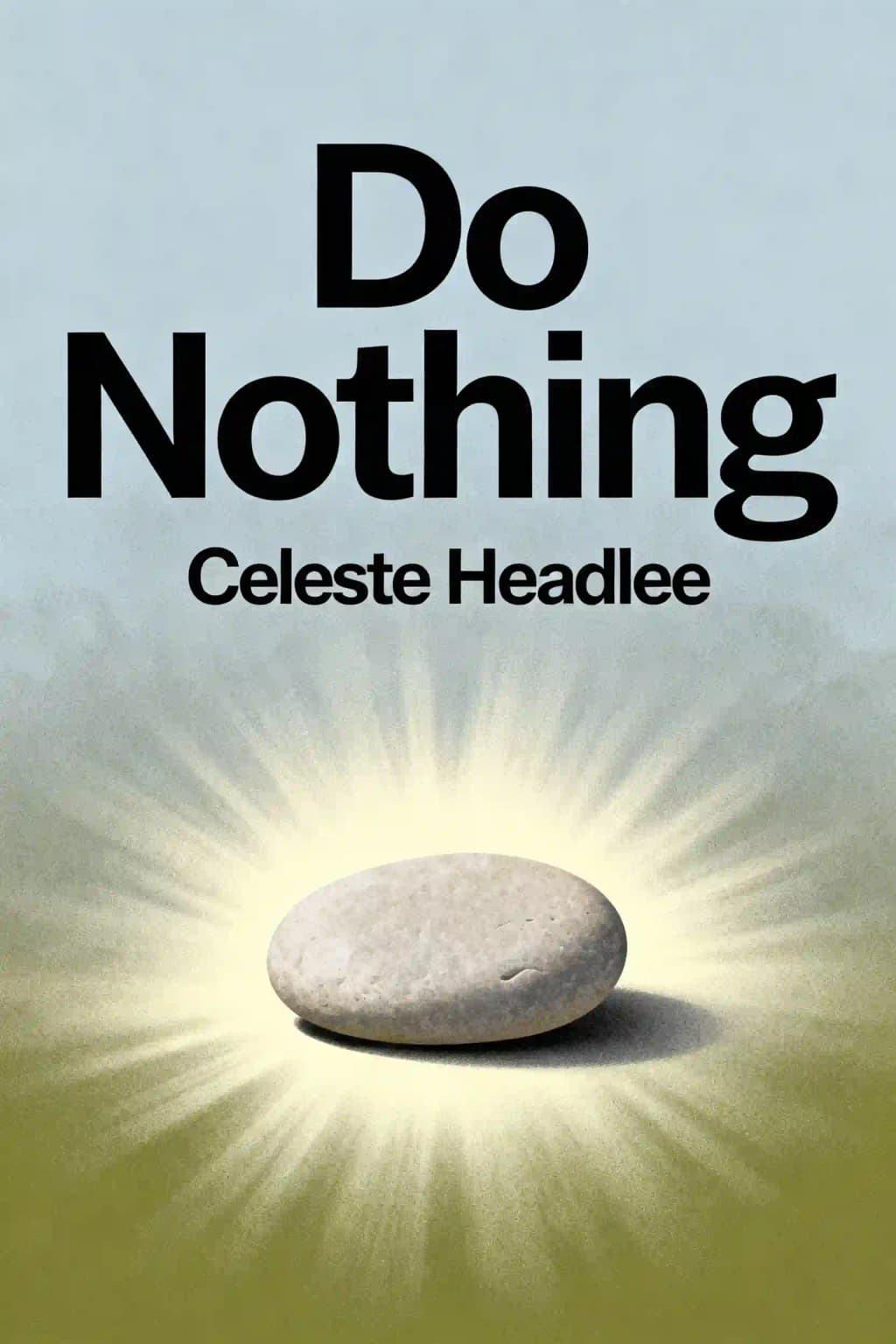
In a world where we answer work emails on Sundays and filter our social media presence for approval, Celeste Headlee's groundbreaking work has struck a chord with millions seeking balance in their hectic lives. Since its publication, this book has become a favorite among celebrities like Arianna Huffington and Adam Grant, who praise its "revolutionary perspective on work culture." The book has sparked a movement across Silicon Valley, where even tech executives now question the "always-on" mentality they helped create. What makes this work so compelling is how it challenges our fundamental assumptions about productivity with a simple yet radical proposition: what if doing nothing is actually the key to doing everything better? As burnout rates reach epidemic levels and "quiet quitting" dominates headlines, Headlee's insights have never been more culturally relevant. Her work invites us to consider a provocative question: are we working ourselves to death for reasons that don't actually serve us?
第 2 章
The Illusion of Efficiency That Keeps Us Trapped
We've become members of what Headlee calls "the cult of efficiency" - a group fervently devoted to constant activity and finding the most efficient way to do everything. We're busy all the time, taking it on faith that our efforts save time and improve our lives. But this efficiency is largely an illusion.
We're like someone trying to learn swimming by reading books, buying DVDs, and installing apps without ever getting in the water. We invest in productivity tools and time-saving devices that often end up wasting time and increasing stress without bringing us closer to our actual goals. The average American now owns 300,000 items, many purchased to "save time," yet we feel more time-starved than ever.
This problem stems from our innate drive for improvement combined with what psychologists call the hedonic treadmill - our tendency to quickly return to baseline happiness regardless of positive or negative events. No matter what we achieve or how many extra hours we work, we remain unfulfilled, making us vulnerable to promises of happiness through more products and systems.
For 500 years, we've searched for external solutions to internal problems, deluded by economics and religion to believe life's purpose is hard work. Our historical eras are now named for technological achievements rather than human development. We measure years in work products, not personal growth.
The solution isn't digital but analog - like the human body itself. Technology can extend life and provide entertainment but can't make us happy. That requires shared humanity, though we're pushing toward separation. We've lost balance between striving to improve and feeling gratitude for what we have, spending billions finding replacements for what humans naturally do well.
This toxic trend has gone too far. Social isolation has doubled since the 1990s, and teen suicide rates have risen dramatically since 2010. We've cut out expressions of basic humanity because they're "inefficient": boredom, long conversations, hobbies, neighborhood gatherings. Despite technological advances that should save time, we're more overwhelmed than ever.
第 3 章
The Historical Shift: How Work Consumed Our Lives
Working for pay isn't as ancient as we might think. Just 9,000 years ago, humans lived communally on shared land, harvesting crops that fed entire communities. The first recorded paycheck dates back only 5,000 years to what is now Iraq.
Surprisingly, medieval peasants worked fewer hours than we do today and enjoyed significantly more vacation time. For most of human existence, we didn't work forty hours weekly or 300+ days yearly. Athenians 4,000 years ago had up to sixty holidays annually, and by the fourth century BC, nearly six months were official festival days.
Before industrialization began in 1760, most people followed patterns established since ancient times - working with the sun's rhythm and taking substantial time off. Medieval peasants worked about eight hours daily and had at least a third of the year as holidays. Artisans worked nine hours but controlled their schedules and kept most profits. The pre-industrial world simply didn't revolve around work.
This changed dramatically with the Industrial Revolution, sparked when James Watt improved the steam engine in the 1770s. As factories replaced farms, people moved to unprepared cities, lost land ownership, and became dependent on employers who owned the tools and machinery. The craftsman class disappeared, social mobility stagnated, and time literally became money as workers were paid by the hour rather than by completed task.
Even our vocabulary transformed - "punctuality" shifted from meaning "exactness" to "on time." With affordable artificial light, night shifts became possible, forever changing our relationship with work. The very concept of "day" shifted from meaning "waking hours during sunlight" to simply "working hours."
Society wasn't prepared for these rapid changes. With no labor laws, the nineteenth century saw horrific exploitation. Charles Dickens, at just ten years old, worked in a rat-infested warehouse covering pots of paste-blacking for six shillings weekly. Child labor only ended due to concerns about mortality rates threatening the "physical preservation of the race."
When labor unions formed, they were fighting to recover what their ancestors had enjoyed centuries earlier. Most employers resisted these reforms, and workers' protests were often met with violence. Ironically, when employers were finally forced to cut hours, they discovered productivity increased while accidents decreased. Yet today, we've voluntarily surrendered these hard-won victories, answering work emails on weekends and staying late at the office.
第 4 章
The Religious and Cultural Roots of Our Work Obsession
The Protestant work ethic fundamentally reshaped our relationship with labor. Martin Luther's religious reforms extended far beyond the church, transforming economic life across the developed world. While Catholic doctrine had emphasized good works for salvation (with sloth being a deadly sin), Luther rejected the practice of buying salvation through charity. Instead, he taught that hard work and frugality were godly virtues, and that idleness should be enjoyed only after death.
This religious perspective gained enormous economic influence through Max Weber's 1904 book "The Protestant Ethic and the Spirit of Capitalism." Weber argued that Protestant values fueled capitalism's growth and northern Europe's success. He quoted Benjamin Franklin's famous advice that "time is money" - suggesting that idleness wasn't just lazy but financially wasteful.
Weber observed that before industrialization, farmworkers offered higher wages would simply work fewer hours to meet their needs. The Protestant ethic, however, reframed hard work as moral virtue, enabling employers to extract longer hours regardless of compensation.
The American Dream embraced this "self-made man" ideology, exemplified by Frederick Douglass's 1859 lecture claiming "there is nothing good, great, or desirable that does not come by some kind of labor." Success became attributed solely to "blood, sweat, and tears," while failure indicated insufficient effort.
Even our language evolved - "bootstrapping," originally an 1840s mockery of impossible tasks ("lifting yourself by your bootstraps"), transformed into a compliment for those achieving success through individual effort. Horatio Alger's blockbuster novel "Ragged Dick" cemented this cultural shift, telling the story of a poor shoeshine boy rising through honesty, frugality and bravery. This rags-to-riches template defined American values for generations.
Despite evidence that social mobility in America is limited - with less than one percent chance of becoming a millionaire - many Americans still believe they can rise through hard work alone. Studies show this belief actually makes people more likely to defend the status quo rather than push for change.
After World War I, economists like John Maynard Keynes predicted technology would enable 15-hour workweeks by 2030, giving humans unprecedented leisure. Instead, two factors prevented this: rising consumerism and growing income inequality. While worker pay stagnated, CEO compensation increased by over 800% since 1978. The income gap is now wider between CEOs and workers than between aristocrats and servants in previous centuries.
第 5 章
When Time Becomes Money: The Commodification of Our Lives
When time becomes monetized, our relationship with leisure fundamentally changes. As economist Gary Becker noted, "When people are paid more, they work longer hours because work is so much more profitable than leisure." This commodification of time has made leisure itself feel stressful, with the constant anxiety about money not being earned.
Despite feeling perpetually overworked, most Americans actually work fewer hours than they did decades ago - about 34 hours weekly compared to 40+ hours in countries like Mexico and South Korea. This paradox exists because our perception of time has fundamentally changed. When researchers had people listen to the beautiful "Flower Duet" opera piece after estimating their hourly wage, participants became impatient for the music to end, wanting to do something "more profitable."
The blurring of work and home boundaries creates what researchers call "polluted time" - handling work during off-hours, being perpetually on call, or mentally problem-solving work issues during personal time. While employees may spend significant workday time on personal tasks, they're also expected to immediately answer emails on weekends. This creates the sensation of never truly being off-duty.
Corporate management remains stuck in a nineteenth-century mindset despite twenty-first century technology. Parkinson's Law explains that "work expands to fill the time available for its completion" - we stretch 25 hours of actual work into 40-hour workweeks through unnecessary meetings and complexities. Since quality is harder to measure than hours worked, employees are incentivized to appear busy rather than efficient.
The tech billionaire myth cemented our worship of hard work. Gates, Jobs, Bezos, Mayer and others became famous for their grueling schedules, with "workaholic" becoming a compliment rather than concern. We've internalized these values to where many believe working without cease is not just career-advancing but the best way to live.
This is demonstrably false - studies consistently show long hours produce diminishing returns, yet Americans uniquely refuse vacation time, fearing career setbacks. Ironically, research shows those taking at least eleven vacation days are more likely to get raises than those taking fewer.
A fascinating cultural shift occurred in the late twentieth century: busyness replaced luxury as a status symbol. People stopped bragging about possessions and started "complaining" about packed schedules. Research confirms this phenomenon - we consistently rate busier people as having higher status. This reverses Thorstein Veblen's 1899 observation that "conspicuous abstention from labor" indicated success; now idleness suggests poverty.
第 6 章
The Productivity Religion and Its False Prophets
The modern productivity obsession has become almost religious, complete with high priests (time management gurus, life hack specialists), teachings (apps, tools, methods), and millions of devoted followers. With over 40 million search results for "how to be more productive," our quest for efficiency has infiltrated every aspect of our lives.
This workplace mentality began invading our homes decades ago. Remember the "quality time" movement of the 1990s? This short-lived fad suggested parents could design highly efficient hours with their children to compensate for long workdays. As sociologist Arlie Russell Hochschild observed, this transferred "the cult of efficiency from office to home," with the belief that "instead of nine hours a day with a child, we declare ourselves capable of getting the 'same result' with one more intensely focused total quality hour."
Corporate growth mentality has infiltrated our personal lives. We now believe constant self-improvement is not only possible but laudable, making checklists for eating, exercise, and meditation. Rather than embracing growth over time, we seek shortcuts, buying books promising to teach Spanish in five hours or master psychology in 30 seconds. While self-improvement is admirable, not every moment should be leveraged to make you better. This constant optimization leaves no space for rest and contentment.
The self-help industry, worth nearly $10 billion in 2016 and projected to reach $13 billion by 2022, thrives on our belief that lives, minds and bodies can be endlessly hacked and improved. We've become ruthless with ourselves in pursuit of peak productivity, often following arbitrary lists of "things successful people do" rather than determining what we actually want.
Ironically, many efficiency hacks prove counterproductive. Take note-taking: despite most students using laptops, research from Princeton and UCLA shows handwritten notes lead to better comprehension and retention. Students typing notes record more content but process less information, performing poorly on conceptual questions.
This exemplifies the danger of making efficiency an end in itself. We become so focused on speed that we lose sight of our actual goals. Is the objective to record every word, or to understand deeply? As consultant Andrew Taggart notes, "We adopt the illusion that personal productivity is itself the end of suffering, or is itself happiness, when in actuality, the aim of personal productivity is to enable the work-society to continue... The truth is that we are its tools."
第 7 章
The Gender Divide: Why Women Bear the Heaviest Burden
Women are often praised for their superior multitasking abilities, but this common belief isn't entirely accurate. Research reveals that human minds - regardless of gender - cannot truly perform two complex tasks simultaneously. What we call "multitasking" is actually rapid task-switching, and it comes at a significant cognitive cost.
Studies consistently show we complete tasks more slowly when switching between activities than when focusing on one at a time. Heavy multitaskers have impaired cognitive processes even when not multitasking, suggesting repeated task-switching damages our mental capabilities.
There is a nuance, however: while nobody is truly good at multitasking, research suggests women may be somewhat better at handling the rapid switching between tasks, possibly due to estrogen's effects on the brain. However, for complex activities like writing emails while talking on the phone, there's no evidence of female superiority, and attempting to multitask remains harmful regardless of gender.
The issue is gendered because women are more likely to believe they're good at multitasking and spend more time attempting it. Women report multitasking nearly fifty hours weekly and find it stressful, with mothers experiencing the highest stress levels. Unlike men who feel relieved when heading home, women often describe after-work hours as "arsenic time" - knowing they must handle household chores while still responding to work emails.
The "Quiet Revolution" of the 1970s saw women flooding into traditionally male-dominated fields and refusing to quit when having children. This triggered concerns about "latchkey kids" and societal pressure on working mothers. Rather than expectations decreasing when women entered the workforce, parenting standards actually rose dramatically. Helicopter parenting emerged as mothers tried to prove their careers weren't hindering their parenting, applying workplace efficiency principles to child-rearing.
While men now contribute twice as much to household duties as previously, women still handle the majority of household and childcare responsibilities. The motherhood penalty creates stark disparities - women take a 4% pay cut after having children while men see a 6% increase. Studies show mothers are viewed as less competent and offered significantly lower salaries than childless women or fathers.
Working women face impossible expectations both at work and home, often doing more labor for less pay and recognition. Our coping strategies - avoiding social activities, checking email during off-hours - often backfire, leaving us more depleted. The system demands more from women, who find home offers no refuge from work pressures.
第 8 章
Reclaiming Our Humanity: What We Actually Need to Thrive
When I tell people I'm writing a book encouraging idleness, many respond defensively: "I love to work." This raises my central question: Is work necessary for human happiness?
For generations, we've been told our life's purpose is work. The Protestant work ethic has become so embedded that unemployment causes 40% more emotional trauma among Protestants. People work long hours not just for rewards but because many feel "existentially lost" without work's driving structure.
There are compelling arguments for work's importance: it provides mood boosts, purpose, and structure. Research shows employed people are generally healthier mentally and physically than the unemployed. Some even work only four hours daily yet achieve remarkable productivity - Darwin, Dickens, and mathematician Poincare all worked brief daily hours.
But I believe work is merely a tool to fulfill other needs, not a requirement itself. Nicole Gravagna's updated list of human needs (food, water, shelter, sleep, human connection, novelty) shows none absolutely require labor. Our obsession with work has unintended consequences - it makes us less compassionate, with Protestants showing immediate decreases in empathy when prompted to think about their jobs.
Exploring what humans truly need beyond work leads us to examine whether there's a universal human nature that defines what's healthy for our species. Modern science increasingly supports the view that there is "something biologically given, unchangeable" that forms the foundation of human capabilities, though our nature involves both biology and choice.
Humans split from chimpanzees about 4 million years ago, with Homo sapiens appearing only 300,000 years ago - a brief span in evolutionary terms. We share many traits with our primate relatives; as primatologist Frans de Waal notes, "Like us, they strive for power, enjoy sex, want security and affection, kill over territory, and value trust and cooperation."
What distinguishes humans is our sophisticated language ability, which enables abstract reasoning and knowledge sharing. Our voices evolved specifically for human communication, conveying subtle emotional information that text cannot replicate. Ironically, in pursuing efficiency through text-based communication rather than conversation, we're neglecting our evolutionary advantage.
We've evolved to detect emotional gradients in voices within milliseconds, processing vast amounts of information subconsciously. Yale researcher Michael Kraus demonstrated this by having participants accurately guess speakers' educational backgrounds and employment status from just seven spoken words. Voice communication activates our capacity for mentalizing - imagining others' thoughts and emotions - which forms the neural basis for empathy.
Humans are fundamentally social creatures who need to belong to groups. As primatologist Frans de Waal explains, "Without a group, survival is hard, which is why belonging to a group is such a priority for all animals." This drive extends beyond simple defense strategy - we'll sometimes make choices benefiting others at our own expense.
第 9 章
Technology's Role: Tool or Tyrant?
While computers calculate at incredible speeds, our brains benefit from slower analog paces that foster deep thought and creative problem-solving. Daniel Kahneman's research shows slowing our thought processes accesses more reflective reasoning capacities, and techniques like coherent breathing (six breaths per minute) improve attention, decision-making and cognitive function.
Digital devices have fundamentally altered our time perception and expectations. Most emails receive responses within an hour, and 95% of texts are read within three minutes with responses averaging 90 seconds. I've tested deliberately delaying responses and discovered nothing catastrophic happens - work still gets completed without immediate replies.
Smartphones disrupt our lives in numerous ways: the blue light suppresses melatonin production and disrupts sleep cycles; notifications trigger stress hormones and fight-or-flight responses; and their mere presence increases "neuronal variability" - distracting brain static. Multitasking between devices splits our prefrontal cortex, making us three times more likely to make mistakes.
Technology creates dangerous illusions of knowledge - Yale research shows online searches significantly increase confidence without proportionally increasing actual knowledge. Tech industry insiders recognize these dangers - Steve Jobs limited his children's iPad use, Twitter founder Evan Williams gave his kids books instead of tablets, and Facebook's Athena Chavarria declared "the Devil lives in our phones and is wreaking havoc on our children."
Perhaps most concerning is technology's effect on social relationships. While designed to connect us, social media has increased isolation by substituting horizontal relationships (widespread and superficial) for vertical ones (focused and in-depth). Since 1985, Americans' average number of close confidants has dropped from three to two, with 25% reporting no intimate friendships.
Robin Dunbar's research shows humans can reasonably maintain only about 150 relationships, yet we attempt to manage thousands of online connections, creating emotional overload. Social media makes us miserable when we passively consume others' content rather than actively communicating - a pattern that describes 90% of Facebook usage. The addiction is so powerful that more people report wanting to quit social media than smoking.
第 10 章
From Life Hack to Life Back: Practical Solutions
As we struggle with our tech addiction and the culture of constant work, it's time to shift from life hacks to life backs. The underlying issues go beyond technology - they stem from a workplace culture that values productivity above all else. Even when we disconnect from devices, the anxiety and feelings of overwork remain.
Self-interest led me to this field of study when I reached a breaking point of anxiety, irritability and exhaustion. Despite following all the productivity advice and achieving career success, my well-being deteriorated. The revelation from my research is that we already know how to live better - we've just gotten off track.
Begin by keeping an honest diary of your activities, tracking everything from work to social media browsing to leisure. After three weeks of monitoring my time in half-hour chunks, I was shocked to discover I spent over a third of my waking hours on mostly useless online activities - about two and a half hours on email daily and several more on social media and idle internet shopping.
After tracking my time, I created two ideal flexible schedules that reflected both what I needed and wanted to do. These weren't meant to be restrictive but supportive frameworks. The most powerful revelation was discovering I actually had plenty of time to do everything I wanted, with hours to spare. This tangible understanding that my work wasn't unmanageable brought an immense wave of relief.
The perfectionism crisis has intensified among young people since the 1980s, driven by competitive individualism in Western countries. Today's twenty-somethings are more demanding of themselves and others, less forgiving of mistakes, and paralyzed by the pressure to be perfect. The psychological cost is severe - perfectionism correlates with high blood pressure, depression, eating disorders, and suicidal ideation.
Despite corporate leadership encouraging work-life balance, employees frequently work excessive hours. Working long hours is counterproductive - Henry Ford discovered this in the 1920s when he mandated eight-hour days and five-day weeks, finding productivity actually increased. Research consistently shows diminishing returns after excessive work hours - studies from the 1950s found scientists were most productive working just 10-20 hours weekly.
Taking breaks must be scheduled like meetings - they can't be left to chance. For effective breaks, practice psychological detachment - mentally disengage from work thoughts. When your brain isn't directed toward specific tasks, it activates the default mode network (DMN), crucial for empathy, self-reflection, and creativity.
While self-reflection is important, strengthening your community is equally vital. Rather than spending hours on social media, set aside time for in-person connections - they're not a waste but an investment. People who are less lonely often have more income. Research found that brief social interactions with service workers boost positive emotions, yet we resist these beneficial exchanges. Experiments show people expect to dislike talking with strangers but actually enjoy it when forced to do so.
We must distinguish between means goals and end goals. Means goals (like making money or getting promoted) are stepping stones, while end goals (like happiness or making the world better) are non-negotiable life directions. End goals often don't fit into frameworks like SMART because they're expansive enough to pursue for a lifetime. Focusing on ends encourages creative problem-solving and reduces stress when specific approaches fail.
Our drive to improve our lives is innate - we've dramatically increased convenience and standards of performance in just a century. While striving for improvement isn't inherently bad, our attempts to institutionalize and measure progress now interfere with genuine innovation. Creativity, essential for progress, can't be manufactured through long hours or special equipment but emerges when solving real problems.
It's time to reject the notion that we deserve stability only through constant work. This is fundamentally an ethical question - higher pay doesn't result in happiness, yet our economic systems are built on this principle. As social animals, humans thrive through connection, not productivity. I've personally experienced the benefits of changing my approach, with even my doctor noting reduced cortisol levels. But individual choices aren't enough - we need collective action to change the hard-work culture paradigm. We must reclaim what makes us uniquely human: reflective thought and social connections. As Descartes said, "I think, therefore I am" - not "I work, therefore I am."