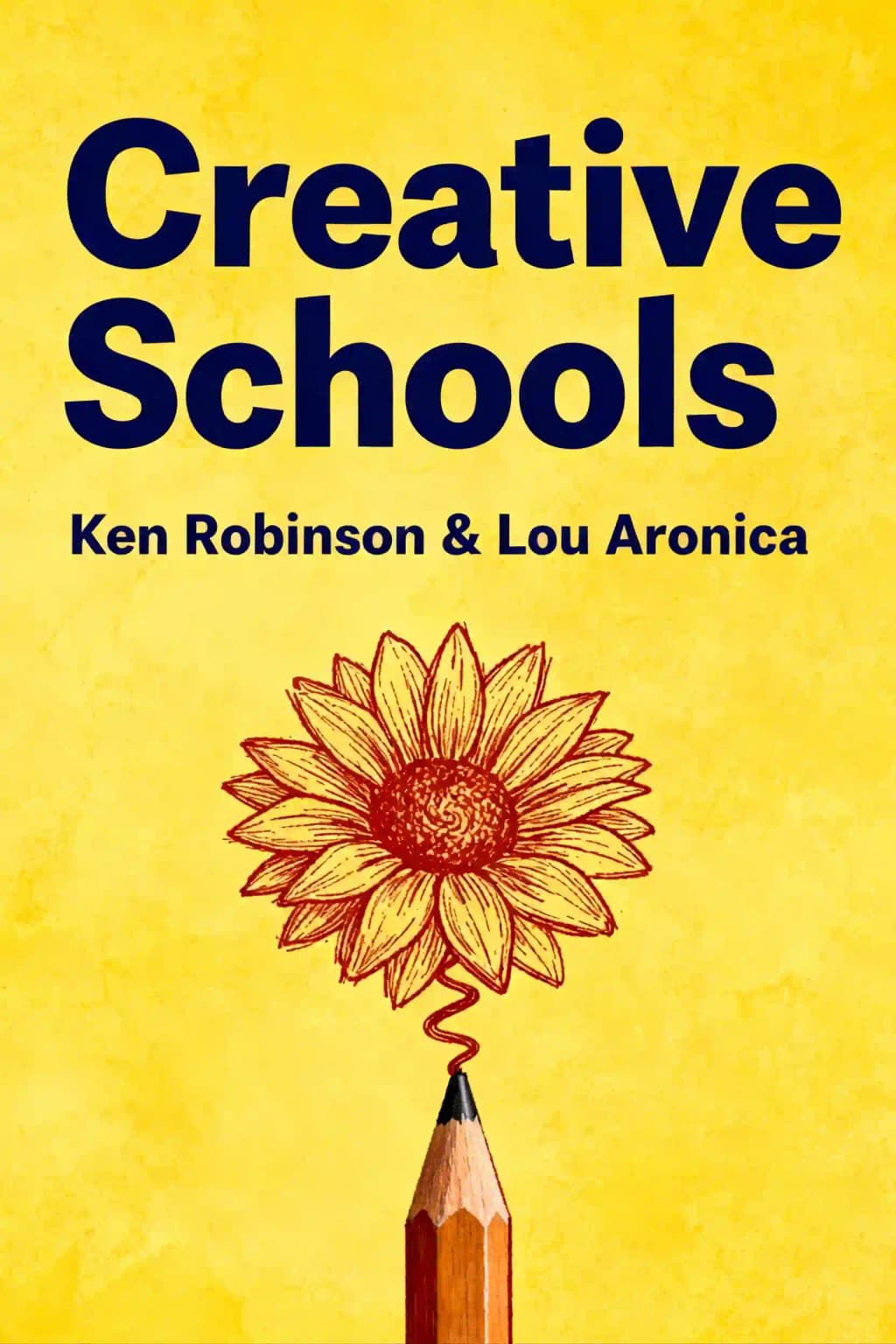
In "Creative Schools," Sir Ken Robinson challenges our outdated industrial education model with a revolutionary vision. His TED talks on creativity reached 300 million viewers worldwide. Discover how schools like "Grangetown" transformed learning through play - sparking the grassroots revolution our children desperately need.
Ken Robinson (1950–2020) and Lou Aronica are the internationally acclaimed co-authors of Creative Schools: Revolutionizing Education from the Ground Up.
Sir Ken Robinson, a British knighted educator and New York Times bestselling author, became a global advocate for transforming education systems through creativity, famously delivering the most-viewed TED Talk of all time, “Do Schools Kill Creativity?” His collaborator Lou Aronica is an award-winning novelist and nonfiction writer known for works like The Culture Code.
Together, they blend Robinson’s groundbreaking educational philosophy with Aronica’s narrative skill to address systemic challenges in modern schooling. Robinson’s influential works, including The Element and Finding Your Element, have sold millions of copies worldwide and reshaped conversations about talent development. Aronica’s cross-genre expertise adds practical depth to their exploration of personalized learning.
Creative Schools builds on Robinson’s decades of advising governments and institutions, offering actionable strategies to cultivate student creativity. Their partnership has produced multiple education bestsellers translated into over 25 languages, with Robinson’s TED Talks exceeding 100 million views.
Creative Schools critiques standardized education models and advocates for personalized, creativity-focused learning. Ken Robinson argues that the industrial-era system stifles students’ natural curiosity and proposes an organic approach leveraging technology, teacher autonomy, and student interests. The book highlights real-world examples like the Khan Academy and music workshops to illustrate transformative teaching methods.
Educators, parents, and policymakers seeking alternatives to rigid curriculum standards will find this book essential. It’s also valuable for advocates of arts education, innovation in classrooms, or systemic educational reform. Robinson’s insights resonate with anyone invested in fostering lifelong learning and adaptability in students.
Robinson condemns the “factory model” of education, which prioritizes standardized testing, uniformity, and efficiency over creativity. He compares traditional schools to industrial assembly lines, arguing they fail to prepare students for modern challenges like technological shifts and global collaboration.
Robinson’s framework emphasizes curiosity, creativity, criticism, communication, collaboration, compassion, composure, and citizenship. These skills aim to replace rote memorization, fostering critical thinking and emotional resilience. The “Eight Cs” encourage holistic development tailored to individual student needs.
The book advocates using technology to personalize learning, such as online platforms (e.g., Khan Academy) and digital tools for creative expression. Robinson stresses technology should enhance human interaction, not replace it, by enabling flexible, self-paced learning and global collaboration.
A creative school prioritizes student agency, adaptable teaching methods, and interdisciplinary projects over rigid schedules. It fosters environments where teachers act as mentors, tailoring instruction to students’ strengths and passions. Examples include project-based learning and arts-integrated curricula.
Robinson argues standardized testing undermines creativity and mismeasures student potential. He proposes alternative assessments, like portfolios and peer reviews, to evaluate problem-solving skills and practical application of knowledge. The book critiques the profitability of testing industries and their influence on policy.
Teachers are mentors and collaborators who guide students through personalized learning journeys. Robinson highlights educators who innovate, such as using music workshops or digital tools, and emphasizes professional development to empower teachers as change-makers.
Yes. The book’s focus on adaptability, technology integration, and creativity aligns with 2025 trends like AI-driven education and hybrid learning models. Its critique of one-size-fits-all systems remains pertinent amid global debates about equity and workforce readiness.
Some argue Robinson’s ideas lack concrete implementation strategies for large-scale systems. Others note the challenge of balancing structure with creativity in underfunded schools. However, the book is widely praised for inspiring grassroots educational movements.
Both criticize rigid education systems, but the book expands on solutions, offering case studies and actionable frameworks. While the TED Talk highlights the problem, Creative Schools provides a roadmap for parents and educators to cultivate change.
While direct quotes aren’t provided in sources, key ideas include:
通过作者的声音感受这本书
将知识转化为引人入胜、富含实例的见解
快速捕捉核心观点,高效学习
以有趣互动的方式享受这本书
Creativity is as important now in education as literacy, and we should treat it with the same status.
Schools don't just prepare students for tests but for life itself.
Our current education system wasn't designed for the world we live in today.
The human costs are staggering.
Children possess an innate drive to learn.
将《Creative Schools》的核心观点拆解为易于理解的要点,了解创新团队如何创造、协作和成长。
将《Creative Schools》提炼为快速记忆要点,突出坦诚、团队合作和创造力的关键原则。

通过生动的故事体验《Creative Schools》,将创新经验转化为令人难忘且可应用的精彩时刻。
随心提问,选择声音,共同创造真正与你产生共鸣的见解。

"Instead of endless scrolling, I just hit play on BeFreed. It saves me so much time."
"I never knew where to start with nonfiction—BeFreed’s book lists turned into podcasts gave me a clear path."
"Perfect balance between learning and entertainment. Finished ‘Thinking, Fast and Slow’ on my commute this week."
"Crazy how much I learned while walking the dog. BeFreed = small habits → big gains."
"Reading used to feel like a chore. Now it’s just part of my lifestyle."
"Feels effortless compared to reading. I’ve finished 6 books this month already."
"BeFreed turned my guilty doomscrolling into something that feels productive and inspiring."
"BeFreed turned my commute into learning time. 20-min podcasts are perfect for finishing books I never had time for."
"BeFreed replaced my podcast queue. Imagine Spotify for books — that’s it. 🙌"
"It is great for me to learn something from the book without reading it."
"The themed book list podcasts help me connect ideas across authors—like a guided audio journey."
"Makes me feel smarter every time before going to work"

免费获取《Creative Schools》摘要的 PDF 或 EPUB 版本。可打印或随时离线阅读。
A child enters kindergarten bursting with questions, eager to paint, build, dance, and explore. By middle school, that same child sits quietly at a desk, memorizing facts for tests, convinced they're "not smart" because they struggle with algebra. What happened? The answer lies in a system designed over a century ago to produce factory workers, not innovators-a system that treats education like manufacturing, where standardized inputs should yield predictable outputs. But here's the uncomfortable truth: children aren't widgets, and schools aren't assembly lines. The world has transformed radically, yet our education systems remain frozen in an industrial past, measuring success through narrow metrics while ignoring the creative, emotional, and practical capacities that actually determine how people thrive. Picture a massive global experiment costing hundreds of billions of dollars, consuming thirteen years of every child's life, yet producing graduates who can't find work, lack basic skills, and feel profoundly disconnected from learning. That's not a dystopian thought experiment-it's our current reality. Since 2001, the United States alone has spent over $800 billion on testing systems and accountability measures, yet 17% of high school graduates still can't read or write fluently. The numbers tell a devastating story: America has plummeted from first to 23rd in graduation rates among developed nations, with 7,000 students dropping out daily. Even those who stay are barely present-63% of North American high school students report being mentally checked out.