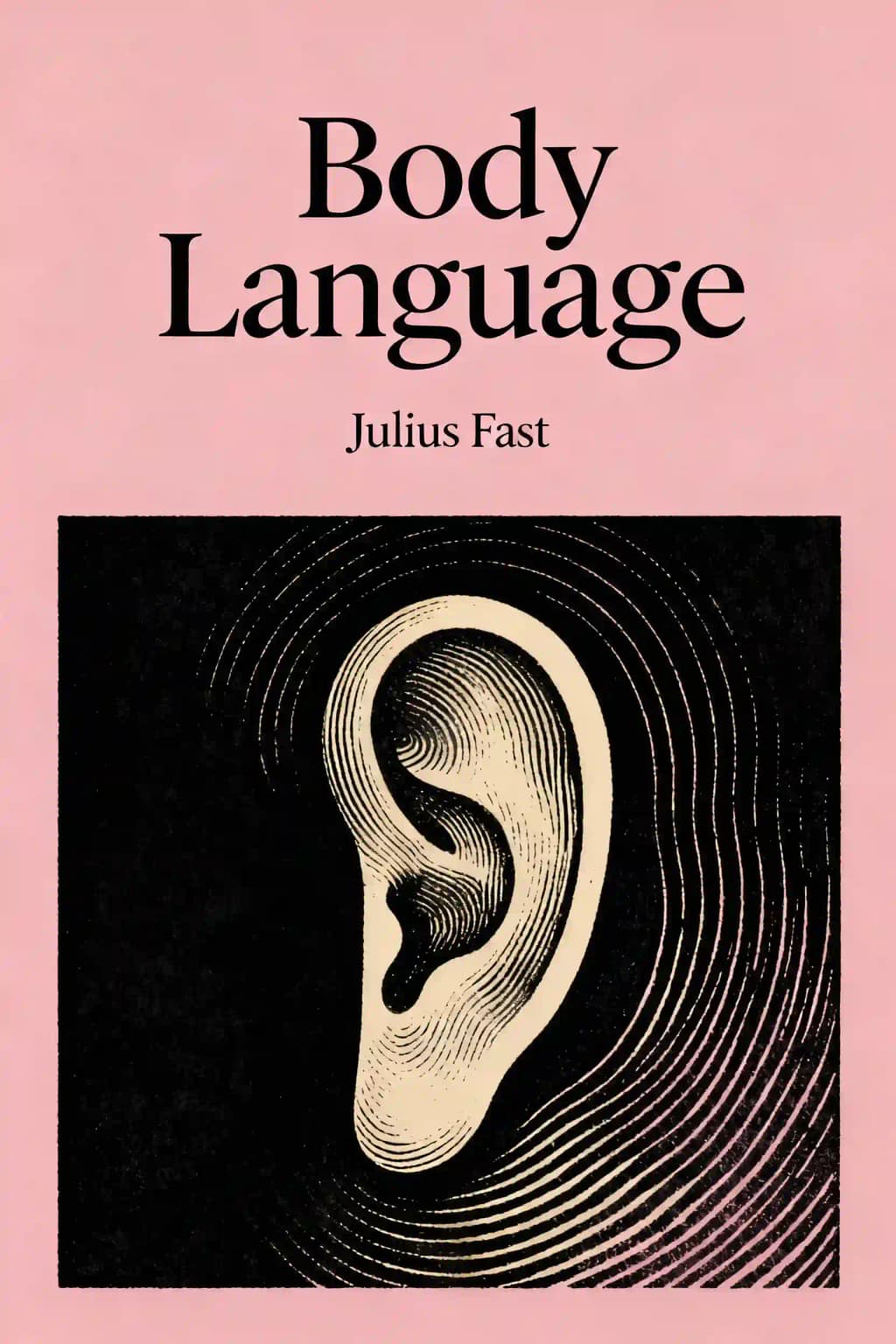
Discover the silent language that speaks volumes. "Body Language" - the pioneering bestseller that sold three million copies by introducing how we communicate without words. From business negotiations to cultural sensitivity, Fast's groundbreaking work reveals the unspoken signals that determine every human interaction.
Julius Fast (1919–2008) was the Edgar Award-winning author of Body Language. He pioneered the modern study of non-verbal communication as a bestselling author and behavioral science popularizer.
This groundbreaking 1970 work of psychology/self-help blends scientific research with accessible analysis, reflecting Fast’s talent for translating complex concepts into actionable insights. This skill was honed through editing medical journals and authoring over 20 fiction and nonfiction titles like The Beatles: The Real Story and What You Should Know About Human Sexual Response.
His 1945 debut novel Watchful at Night earned mystery literature’s highest honor, establishing dual credibility in both literary and analytical writing. Fast’s expertise extended to related works like The Body Language of Sex, Power & Aggression and Body Language in the Workplace, which remain essential reads for professionals in psychology and interpersonal communication.
Translated into 17 languages, Body Language has sold millions of copies worldwide, cementing its status as a foundational text in behavioral studies.
Body Language by Julius Fast explores the science of nonverbal communication, known as kinesics, detailing how gestures, facial expressions, posture, and eye movements convey emotions and intentions. Published in 1970, it highlights cultural variations in body language, practical applications in personal and professional relationships, and strategies to interpret unspoken cues. The book emphasizes that nonverbal signals often reveal more than words, offering tools to improve empathy, negotiation, and self-awareness.
This book is ideal for professionals in leadership, sales, or HR; individuals seeking to enhance interpersonal skills; and anyone interested in psychology or communication. It’s particularly valuable for navigating cross-cultural interactions, improving public speaking, and understanding hidden emotions in social dynamics.
Key concepts include:
Fast explains that gestures like eye contact or handshakes carry divergent meanings globally. For example, prolonged eye contact may signal respect in one culture and aggression in another. The book advises observing local norms to avoid misunderstandings in international settings.
Kinesics is the scientific study of nonverbal communication, analyzing behavioral patterns like posture shifts, micro-expressions, and gestures. Fast emphasizes its role in detecting emotional contradictions (e.g., a smile that doesn’t reach the eyes) and decoding unspoken social hierarchies.
Critics argue some examples oversimplify complex interactions or rely on outdated 1970s social norms. Others note limited discussion of gender or neurodiversity in nonverbal behavior. However, its foundational insights on kinesics remain widely cited.
Fast suggests observing partners’ micro-expressions (e.g., eyebrow flashes signaling interest) and “closed” postures (crossed arms indicating defensiveness). Aligning verbal and nonverbal cues fosters trust, while recognizing mismatches can prevent misunderstandings.
Yes—its core principles underpin modern fields like emotional intelligence training and AI-driven sentiment analysis. The book’s focus on nonverbal cues remains critical in video conferencing, where limited physical interaction heightens reliance on facial expressions and tone.
While newer books like Never Split the Difference (Chris Voss) focus on verbal tactics, Fast’s work remains unique for its pioneering analysis of nonverbal signals. It complements contemporary titles by providing a foundational lexicon for decoding physical behavior.
Examples include:
通过作者的声音感受这本书
将知识转化为引人入胜、富含实例的见解
快速捕捉核心观点,高效学习
以有趣互动的方式享受这本书
The body speaks when words fail.
Our non-verbal language is thus partly instinctive, partly taught, and partly imitative.
Touch can establish communication when words fail.
The territorial nature of man is genetic and ineradicable.
Body language reveals the truth we're all communicating constantly.
将《Body Language》的核心观点拆解为易于理解的要点,了解创新团队如何创造、协作和成长。
将《Body Language》提炼为快速记忆要点,突出坦诚、团队合作和创造力的关键原则。

通过生动的故事体验《Body Language》,将创新经验转化为令人难忘且可应用的精彩时刻。
随心提问,选择声音,共同创造真正与你产生共鸣的见解。

"Instead of endless scrolling, I just hit play on BeFreed. It saves me so much time."
"I never knew where to start with nonfiction—BeFreed’s book lists turned into podcasts gave me a clear path."
"Perfect balance between learning and entertainment. Finished ‘Thinking, Fast and Slow’ on my commute this week."
"Crazy how much I learned while walking the dog. BeFreed = small habits → big gains."
"Reading used to feel like a chore. Now it’s just part of my lifestyle."
"Feels effortless compared to reading. I’ve finished 6 books this month already."
"BeFreed turned my guilty doomscrolling into something that feels productive and inspiring."
"BeFreed turned my commute into learning time. 20-min podcasts are perfect for finishing books I never had time for."
"BeFreed replaced my podcast queue. Imagine Spotify for books — that’s it. 🙌"
"It is great for me to learn something from the book without reading it."
"The themed book list podcasts help me connect ideas across authors—like a guided audio journey."
"Makes me feel smarter every time before going to work"

免费获取《Body Language》摘要的 PDF 或 EPUB 版本。可打印或随时离线阅读。
Imagine a woman professing love while unconsciously shaking her head "no," or a family unconsciously mirroring their matriarch's crossed legs, revealing true power dynamics without a word being spoken. Body language-this silent form of communication-reveals truths we often try to hide. Up to 93% of our communication happens non-verbally through facial expressions, gestures, and posture that frequently contradict our carefully chosen words. This disconnect between verbal and non-verbal communication explains countless misunderstandings in our daily lives. When a businessman casually draped his arm around a potential client's shoulder, he unknowingly violated personal boundaries and lost the deal. Meanwhile, Aunt Grace's constant touching of her necklace, paperweight, and velvet couch screamed "I am lonely!" while her words said nothing at all. Our bodies speak with remarkable honesty because they tap into primitive brain responses we cannot fully control. When Dr. Edward Hess discovered that our pupils dilate when viewing something pleasant, he revealed a physiological response beyond conscious control-a finding that revolutionized both poker strategy (hence the dark glasses) and advertising research. Similarly, micro-expressions flash across our faces in milliseconds, revealing true emotions before we can mask them, while our feet subtly shift toward exits when we're uncomfortable in situations we verbally claim to enjoy.