第 1 章
Through the Eyes of a Machine Gunner: One Man's Journey Through Hell
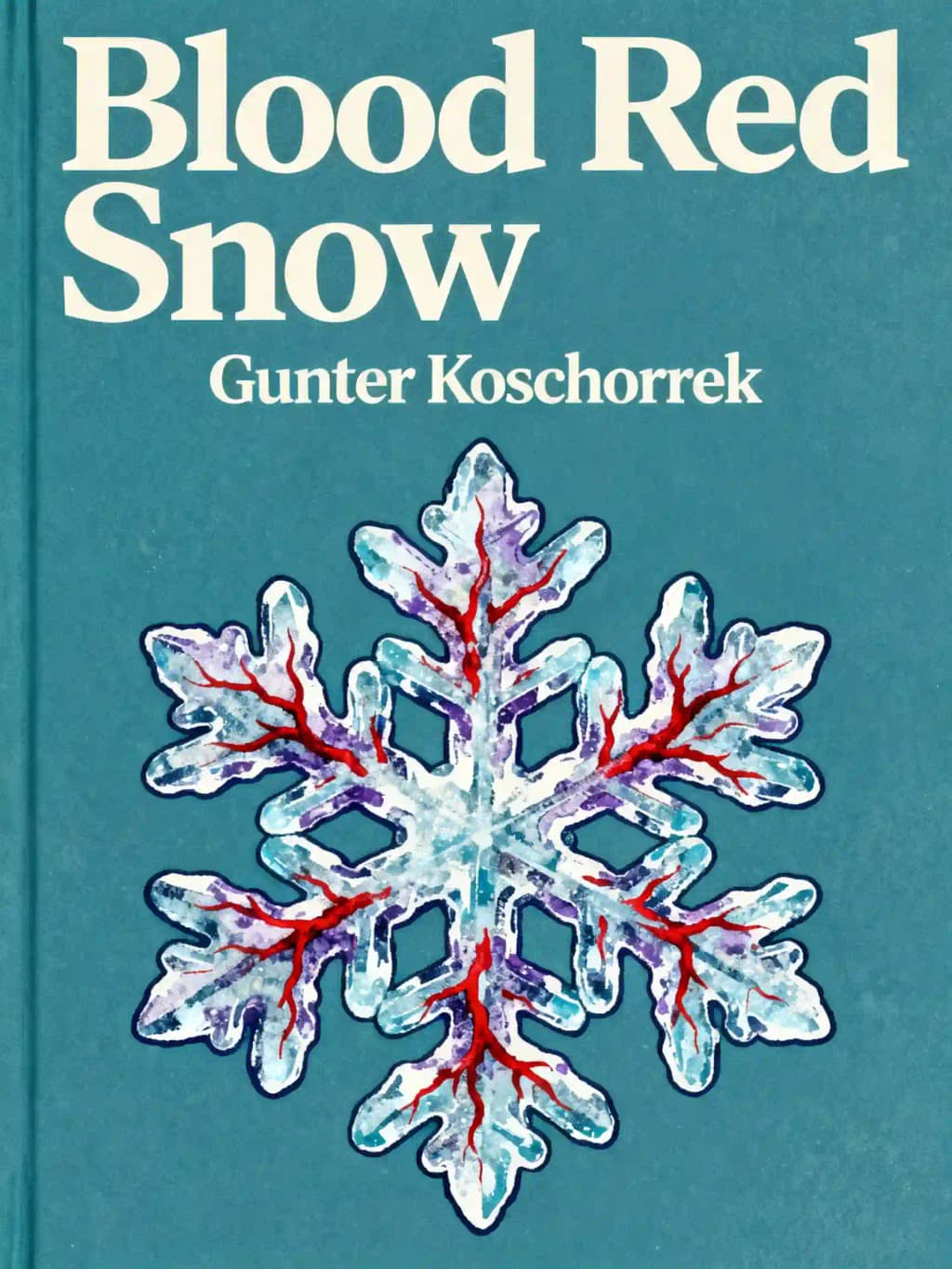
Blood Red Snow is not just another war memoir. It's a raw, unfiltered window into the soul of an ordinary German soldier caught in the machinery of World War II's Eastern Front. When Gunter Koschorrek's daughter unexpectedly returned his long-lost wartime notes decades after the conflict ended, she unknowingly delivered a historical treasure-perhaps one of the most authentic accounts of the common soldier's experience in the most brutal theater of the war. Unlike many military memoirs written by officers or with political agendas, Koschorrek's account stands apart for its brutal honesty and ground-level perspective. The book has become required reading in many military academies for its unflinching portrayal of combat psychology and the day-to-day realities of frontline warfare. Far from glorifying conflict, it serves as a powerful anti-war statement through its simple, direct depiction of what men endure when nations clash.
第 2 章
From Eager Recruits to Cannon Fodder
In October 1942, eighteen-year-old Gunter Koschorrek and his fellow recruits board a train bound for the Eastern Front, their heads filled with propaganda and patriotic fervor. Like thousands before them, these young men had been shaped by years of Nazi indoctrination, believing they were part of a historic mission to defend the Reich. The journey itself becomes a gradual stripping away of illusions, each kilometer taking them further from their comfortable lives in Germany. As their train rattles through Poland and into Russia, the young men sing Wehrmacht marching songs and "Lili Marleen," unaware of what awaits them. Their Obergefreiter, Fritz Marzog, a veteran of earlier campaigns, becomes increasingly communicative as they travel, confirming rumors they're heading to Stalingrad. His demeanor shifts from stern authority to almost paternal concern as they near the front.
The first taste of combat comes unexpectedly when Russian fighter aircraft strafe their train near Kharkov. The recruits dive under the wagons as bullets ricochet off the rails, their training forgotten in moments of pure terror. Some freeze, others pray, while a few try to return fire with their rifles - a futile gesture against aircraft. This brief encounter shatters their romantic notions of aerial combat, offering just a prelude to the horrors ahead. When railway tracks are found blown up by partisan activity, the recruits must complete the final 150 kilometers to Stalingrad on foot.
For four grueling days, they march across the Kalmuck steppe carrying 40 pounds of gear each - rifles, ammunition, mess kits, gas masks, and other equipment that seems to grow heavier with each step. The harsh conditions quickly erode their enthusiasm. Daytime temperatures soar, while nights bring bitter cold. The endless horizon offers no shelter from freezing rain and cutting winds. At villages along the way, they find no food; German units have already confiscated everything edible, leaving behind empty houses and hostile stares. Their encounters with civilians reveal the brutal nature of occupation - an old Russian man is forced to drink from a well first to ensure the water isn't poisoned, while women and children hide at their approach. These moments provide an early glimpse of the war's dehumanizing effects on both occupiers and occupied.
By the time they finally reach the outskirts of Stalingrad, seeing its red glow in the distance and hearing the rolling thunder of combat, their initial enthusiasm has been replaced by exhaustion and growing dread. The city's industrial district appears as a hellscape of flames and smoke against the night sky. Veterans they pass warn them with knowing looks, some making gallows humor jokes about "fresh meat for the grinder." The transformation from eager recruits to hardened soldiers has begun, and they haven't even fired a shot in anger yet.
"The sun beats down mercilessly, and our enthusiasm wanes as exhaustion sets in," Koschorrek writes in his diary, capturing how quickly the romantic notions of war dissolve when faced with its physical realities. His words echo the experience of countless young soldiers throughout history, as patriotic fervor collides with the brutal truth of combat. This journey foreshadows the greater journey of disillusionment that awaits them all in the ruins of Stalingrad, where few would survive to tell their tales.
第 3 章
Into the Cauldron of Stalingrad
Upon arrival near Stalingrad, Koschorrek discovers the regiment has been decimated-reduced from full strength to barely two companies. The distant sounds and red night sky from the besieged city serve as constant reminders of the nearby battle. Supply trucks return nightly carrying dead and wounded, grim evidence of the ongoing carnage.
Koschorrek volunteers to deliver hot meals to the front lines, a decision that provides his first glimpse into the hell of urban combat. Driving through Stalingrad's ruins, he navigates a landscape of craters, rubble, and burning wreckage. Thick smoke chokes his lungs as artillery shells fall around them. They barely escape a barrage from the dreaded "Stalin's Organ" rocket launcher, diving under a burnt-out tractor as explosions rain down.
"Despite the danger, we press on, zigzagging through debris and craters while Russian fire saturates the area," he recalls. They finally locate their unit in a basement hideout, where exhausted soldiers reveal they're positioned just meters from Russian forces. The men appear as ghosts-hollow-eyed, filthy, and seemingly aged beyond their years.
After delivering food and collecting ammunition, they escape the city as bombs rain down, creating a devastating inferno. Searchlights tear through the darkness and tracer fire climbs into the sky. Koschorrek realizes that even in this hellish environment, men somehow survive and continue fighting, with Russians counterattacking after each bombardment in an endless cycle of destruction.
What strikes the reader most powerfully is the matter-of-fact way Koschorrek describes scenes of almost unimaginable horror. There's no literary embellishment-just the straightforward observations of a young man witnessing the depths of human suffering and destruction for the first time. This quality makes his account all the more haunting and authentic.
The Stalingrad sequences serve as both literal and metaphorical entry points into the war's true nature. Like descending into Dante's Inferno, each level reveals new horrors and strips away more illusions about glory and heroism. What remains is simply survival-minute by minute, hour by hour.
第 4 章
The Great Escape
By late November 1942, the situation deteriorates dramatically as Russian forces break through Romanian lines, threatening to encircle the German positions around Stalingrad. Despite reassurances from their superiors that tanks and air support are engaging the Russians, uncertainty spreads through the ranks.
On November 20, the skies fill with German bombers while distant rumbling grows from both north and south. The men stand on alert as Russian T-34 tanks emerge from the haze about 100 meters away. Orders come to evacuate toward Kalatsch, abandoning their bunker shelters that had provided some comfort against the Russian winter.
Joining a stream of retreating vehicles, they endure freezing conditions with frozen rations as they race toward the Don bridge-their only escape route from the closing trap. After barely crossing the bridge before Russian tanks begin firing on it, they become separated in thick fog, hearing the threatening sound of T-34 diesel engines all around them.
"Moving carefully through the mist, we hear the threatening sound of T-34 diesel engines all around us," Koschorrek writes, capturing the claustrophobic terror of being surrounded by an invisible enemy. The fog becomes both salvation and curse-hiding them from Russian eyes but also disorienting them as they try to escape.
After miraculously reuniting with their sergeant and other separated comrades at a kolkhoz (collective farm), they devise a plan to find a gap in the Russian lines. When discovered, they make a desperate high-speed dash, narrowly escaping enemy tank fire as they break through the encirclement.
This sequence reads like a thriller, with the added weight that these events actually happened. The escape from the Stalingrad pocket represents one of the few instances of good fortune in Koschorrek's war experience-a temporary reprieve before being thrown back into the meat grinder. While over 250,000 German and allied soldiers would be trapped and ultimately destroyed in the Stalingrad pocket, Koschorrek's unit managed to slip away just before the encirclement was complete.
What makes this account particularly valuable is how it captures the confusion, terror, and chaos of a major military collapse from the perspective of ordinary soldiers who have little understanding of the strategic situation. They operate on fragments of information, rumors, and what they can see directly in front of them-a reminder that war is experienced very differently at the tactical level than how it appears in history books.
第 5 章
Blood Red Snow
The title of Koschorrek's memoir comes from one of its most haunting passages. After joining a counterattack against retreating Russians, he encounters dead enemy soldiers for the first time. Their blood has frozen in red puddles on the snow-a sight that affects him deeply.
"The ground between the soldiers and the hillock is churned up, covered with mangled human flesh," he writes. "These aren't just bodies with wounds; they're dismembered lumps of flesh from arms, legs, buttocks, and in one case a head with part of a damaged helmet still attached."
This profound confrontation with death marks a turning point in Koschorrek's war experience. The beautiful white snow, stained with frozen blood, becomes a powerful metaphor for innocence destroyed by violence. He and his comrades avoid looking at the corpses, unable to process the reality of what they're seeing.
During this action, he witnesses a black Unteroffizier executing wounded Soviet soldiers who were playing dead-a practice the sergeant justifies as necessary protection against ambush. Though disturbed by this brutality, Koschorrek vows never to shoot an unarmed soldier, maintaining a moral line he refuses to cross despite the dehumanizing environment.
Their positions face daily sniper attacks and tank assaults, including a close encounter with a T-34 that nearly destroys their position before being disabled by pioneers with improvised charges. Morale wavers as news arrives that Hitler has declared Stalingrad a fortress, effectively trapping the surrounded forces.
The "blood red snow" imagery recurs throughout the memoir, becoming more than just a vivid description but a symbol of the Eastern Front itself-a place where nature's purity is corrupted by human violence on an industrial scale. The contrast between the pristine white landscape and the crimson stains of death creates a visual representation of war's fundamental obscenity.
What makes Koschorrek's account so valuable is his ability to capture both the physical horror of combat and its psychological impact. He doesn't shy away from describing the most disturbing sights, yet also reveals how soldiers develop psychological defenses-looking away, focusing on immediate tasks, or finding dark humor in the absurd-to continue functioning in an environment that would otherwise break their minds.
第 6 章
The Human Element: Friendships Forged in Fire
Amid the horror and chaos of the Eastern Front, Koschorrek's memoir shines brightest when illuminating the bonds formed between soldiers. These relationships transcend the political and ideological dimensions of the war, revealing the fundamentally human story beneath the grand strategic narrative.
Particularly moving is Koschorrek's friendship with Paul Adam, his machine gun assistant. When they're billeted with a Russian woman and her eighteen-year-old daughter Katya in a village called Dnyeprovka, we see a brief window into how humanity persists even in wartime. Despite orders against close contact with civilians, Katya becomes their "guardian angel," keeping their quarters warm and clean. The soldiers show their appreciation with chocolate and clothing.
A romance develops between Paul and Katya, adding a bittersweet element to their war experience. When Paul is later killed by a sniper-shot through the head while peering from their foxhole-the loss is devastating both to Koschorrek and to Katya, who somehow senses Paul's death before being officially informed.
"Blood streams from Paul's wound in dark red rivers, forming a pool on the ground," Koschorrek writes. "My first-aid bandages do nothing to stop the bleeding. Panicked, I yell for a medic, but I'm told no one can reach us."
Upon returning to quarters after Paul's death, they find Katya has placed a wreath with a candle on his bed. Her uncanny premonition unsettles Koschorrek, highlighting the mysterious connections that form between people even across enemy lines.
The memoir is filled with similar vignettes-moments of connection, loss, and grief that remind us we're reading about real people, not just historical figures or statistics. Koschorrek's comrades Warias, Grommel, Fritz Hamann, and others become familiar to readers through their distinct personalities and quirks. When they die-as many do-each death carries emotional weight.
Perhaps most poignant is Koschorrek's description of how the motivation for fighting evolves over time. Early patriotic fervor gives way to a simpler, more primal motivation: keeping oneself and one's comrades alive. "At the front, we no longer fight for 'Fuhrer, Volk und Vaterland'-these ideals have long vanished," he writes. "We fight to keep ourselves and our comrades alive."
This transformation-from fighting for abstract ideals to fighting for the man beside you-is a universal aspect of the combat experience that transcends the particular war or side being fought for. It's what makes Koschorrek's account relevant beyond its historical context, offering insights into the human condition under extreme duress.
第 7 章
The Grinding Retreat
By early 1944, the tide of war has turned decisively against Germany. Koschorrek's memoir captures the long, grinding retreat from Russia through Ukraine, Romania, and Poland-a fighting withdrawal that would continue for more than a year.
The retreat is characterized by constant movement, temporary defensive positions, and increasingly desperate attempts to slow the Soviet advance. Koschorrek describes marching through sticky mud to the River Bug, with feet blistered and bloody, constantly fighting off pursuing enemies. "This demoralizing march-trudging through gluey slime without sleep or food-leaves me no time to make notes," he writes.
Equipment shortages become critical. When Koschorrek complains that they're sending "hastily trained cannon fodder" instead of needed weapons, he captures the fundamental problem facing the German army in the war's later years-a shortage of everything except enemies.
The narrative takes on an increasingly fatalistic tone. Soldiers develop premonitions about their deaths, which often prove accurate. Waldemar "Waldi" Krekel, after drinking brandy from a local distillery, makes strange, sentimental remarks about dead comrades and claims to have heard his long-dead grandmother's funeral bell. The next morning, Waldi is caught by enemy machine-gun fire and falls dead-his premonition fulfilled.
By August 1944, Koschorrek himself develops an inexplicable fear: "An inexplicable fear rises within me like a heatwave, creating nervous unrest throughout my being. I've experienced this restlessness before previous injuries, but this time the premonition feels stronger than ever before."
Days later, his premonition proves accurate when a shell splinter tears into his upper right arm. This wound eventually removes him from frontline service, likely saving his life as the war enters its final, most desperate phase.
What makes this section of the memoir particularly valuable is its depiction of an army in decline-not just in terms of territory lost, but in terms of morale, equipment, and leadership. The retreat becomes not just a physical movement but a psychological one, as hope gives way to the certainty of defeat, yet the fighting continues because there seems no alternative.
第 8 章
The Face of the Enemy
One of the memoir's most striking aspects is its complex portrayal of the enemy. Koschorrek avoids simplistic demonization of Russian soldiers, instead showing them as human beings caught in the same terrible circumstances as himself.
Early in the memoir, he has his first close encounter with Russian prisoners-"dirty, unshaven men with 'foreign' appearances" who help him dig a new latrine. Later, after battles, he describes salvaging supplies from Russian corpses-felt boots, earflaps, bread, and tobacco-a grim necessity of survival that creates an intimate connection with the enemy even in death.
The portrayal grows more complex as the war progresses. Koschorrek notes how Russian soldiers are often driven forward by commissars who force them into suicidal attacks. He observes them dancing drunkenly in a Romanian village, then fleeing in panic from a swarm of bees-a comical incident that results in nineteen Russians becoming prisoners.
As the tide of war turns, however, the Russians are increasingly portrayed as a terrifying, vengeful force. The atrocities at Nemmersdorf in East Prussia represent a turning point. When German forces recapture the village, they discover horrific crimes committed against German civilians-mutilated women, children with dissected bodies, and an old man impaled through the throat with a pitchfork. "The sights are so terrible some recruits vomit," Koschorrek writes.
This incident transforms the nature of the conflict for many German soldiers, including Koschorrek. What began as an ideological war becomes an existential struggle, with German troops fighting not for conquest but out of fear of what will happen if they lose.
By the war's end, this fear drives Koschorrek to extreme measures. When faced with transfer to Russian forces on May 13, 1945 (after Germany's surrender), he deliberately reinfects his wound with a rusty nail, "preferring death from blood poisoning to Siberian imprisonment."
The portrayal of the enemy thus evolves from initial curiosity to grudging respect to existential fear-mirroring the arc of the German-Soviet conflict itself. What makes Koschorrek's account valuable is that it never loses sight of the enemy's humanity, even while acknowledging the atrocities committed by both sides.
第 9 章
The Bitter End
As the war enters its final months, Koschorrek's narrative takes on an increasingly desperate tone. After recovering from a wound, he finds himself assigned as a motorcycle courier at Regimental Headquarters-a supposedly advantageous position that actually exposes him to more danger than fighting in a foxhole. Racing through artillery fire and bullet storms to deliver orders, he navigates treacherous terrain while watching his fellow couriers suffer injuries.
After only five days in this role, a grenade splinter pierces his left arm above the elbow. This injury grants him a "Heimatschuss"-a wound ticket home-causing envy among his comrades who, though tired of war, continue fighting out of sworn obligation to their oath.
The final stages of the war reveal a broken German military where fear dominates. "No one dares openly admit the war is lost," Koschorrek writes, "as military police brutally execute dissenters." The idealism that launched the war has been completely replaced by terror-not just of the enemy, but of one's own side.
When Germany finally surrenders in May 1945, Koschorrek finds himself in an American hospital. The doctor who treats his self-inflicted wound knowingly remarks that he understands why Koschorrek did it-a small moment of human connection across enemy lines.
By June, Koschorrek has traded his military decorations to American soldiers for cigarettes-"medals mean nothing now that we've lost the war." This simple act symbolizes the complete collapse of the value system that sustained German soldiers through years of brutal combat.
Released from the hospital on June 6th, he's sent to a POW camp-"a barbed-wire field where American guards amuse themselves by tossing cigarette butts to desperate prisoners." After securing release papers, he walks away from the camp, savoring his newfound freedom, only to be confronted by a Czech soldier who forces him to trade his good shoes for worn ones at gunpoint.
This final indignity serves as a powerful metaphor for Germany's position at war's end-stripped of power, dignity, and even basic possessions. "This encounter starkly reminds me of the helplessness of the defeated and the depth of hatred that remains," Koschorrek writes.
The memoir concludes with a philosophical reflection that transcends the specific conflict: "The war may be over on paper, but I wonder how long before it ends in people's hearts, and whether mankind will ever stand together against those power-hungry leaders who sacrifice others while staying safe themselves."
This final thought elevates Blood Red Snow beyond a simple war memoir to a universal statement about the nature of conflict and the responsibility of leadership-a lesson as relevant today as it was in 1945.
第 10 章
Legacy of Blood and Snow
Koschorrek's memoir ends with a commitment: "I'll never forget my fallen comrades-telling their story is my obligation." This sense of obligation-to bear witness, to remember those who didn't return-forms the emotional core of Blood Red Snow.
The book stands as one of the most authentic accounts of the Eastern Front experience from the German perspective. Unlike memoirs by generals or political figures, it offers no self-justification, no strategic analysis, and no ideological framework. It simply shows what it was like to be there-in the mud, the snow, the blood, and the terror.
What makes Blood Red Snow particularly valuable is its honesty about the psychological impact of combat. Koschorrek doesn't portray himself as a hero but as an ordinary young man trying to survive extraordinary circumstances. He admits to fear, to moments of weakness, and to the overwhelming desire to simply stay alive. When he refuses to execute prisoners or deliberately wounds himself to avoid Soviet captivity, we see moral choices made under the most extreme pressure.
The memoir also provides insight into how ordinary soldiers cope with the knowledge they're fighting for a losing cause. By 1944, most German soldiers on the Eastern Front understood the war was lost, yet they continued fighting-partly from fear of their own leadership, partly from fear of the enemy, but mostly from a sense of obligation to their immediate comrades.
Perhaps most importantly, Blood Red Snow serves as a powerful anti-war statement without ever explicitly condemning war. By simply showing the reality-the frozen corpses, the blood-soaked snow, the terror of being hunted by tanks-it makes its point more effectively than any political treatise could.
In our modern era of sanitized warfare and clinical terms like "collateral damage," Koschorrek's unflinching account reminds us what combat really means at the human level. It stands as both historical document and warning-a legacy written in blood on snow that continues to speak powerfully across the decades.