第 1 章
The Pursuit of Pleasure, The Inevitability of Death
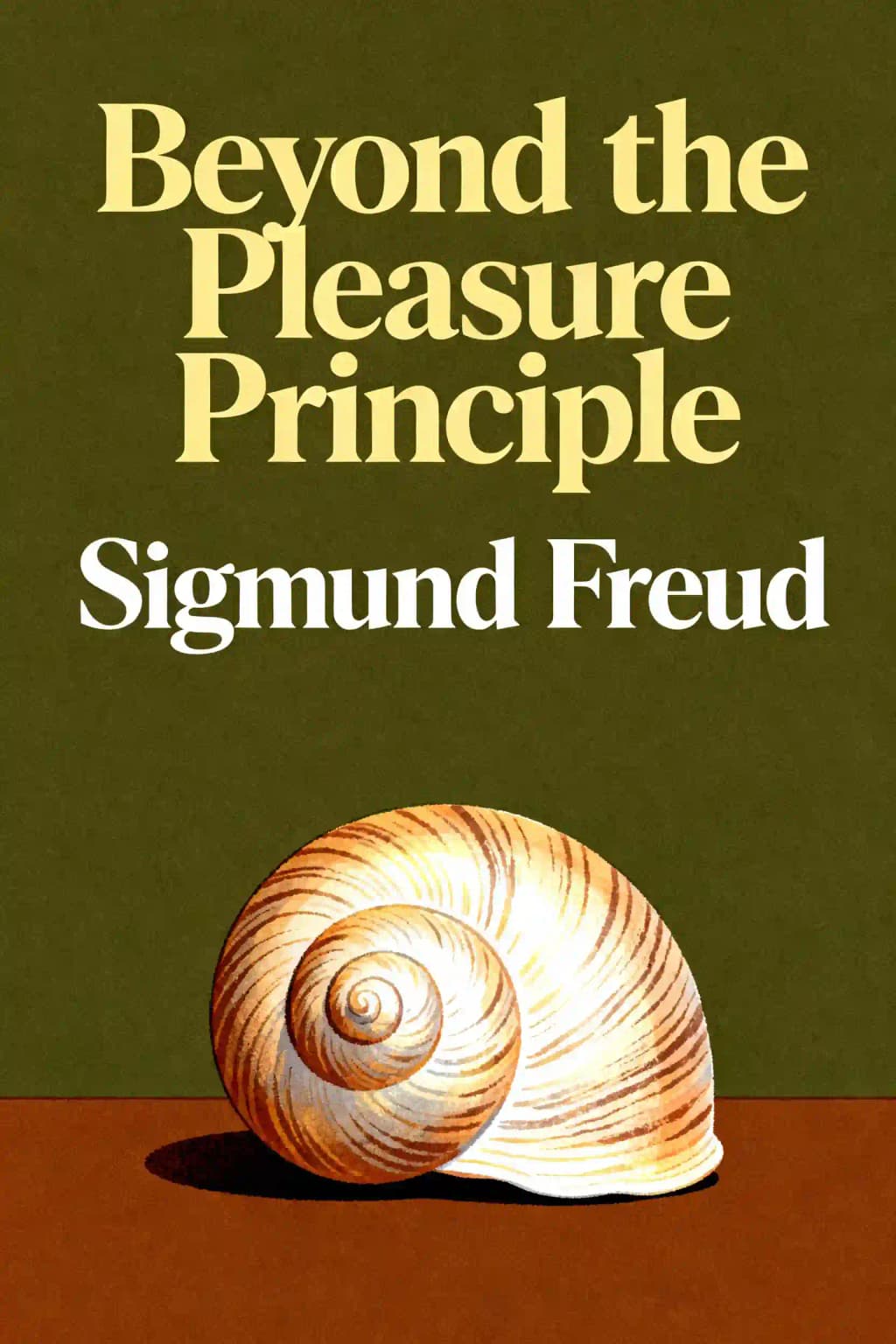
Imagine waking up one morning to discover that your most basic assumptions about human motivation are fundamentally incomplete. What if our deepest psychological drives aren't simply about seeking pleasure and avoiding pain, but include something more primal-perhaps even a mysterious pull toward death itself? This is the revolutionary territory Sigmund Freud explores in "Beyond the Pleasure Principle," a work that shattered conventional understanding of human psychology when published in 1920. The book represents a pivotal turning point in psychoanalytic theory, introducing the controversial concept of the death drive that would influence fields ranging from philosophy to literature. While many of Freud's theories have faced scientific scrutiny, this particular work continues to captivate intellectual circles-from Michel Foucault citing it as transformative to modern neuroscientists finding surprising parallels in contemporary research on neurological repetition patterns. Even filmmaker David Lynch has acknowledged its influence on his exploration of the human psyche through cinema. What makes this slim volume so enduringly powerful is its willingness to venture beyond comfortable explanations into the most unsettling aspects of human existence.
第 2 章
The Pleasure Principle and Its Limitations
The foundation of psychoanalytic theory rests on the pleasure principle-the idea that our mental processes fundamentally seek to increase pleasure and avoid pain. This economic perspective suggests that our psychic apparatus works to maintain low levels of excitation, with pain corresponding to increased tension and pleasure to its release. The pleasure principle explains much of our behavior, from basic biological drives like hunger and thirst to complex psychological mechanisms such as fantasy formation and dream states. For instance, when we feel hunger, we experience tension that drives us to seek food; when we eat, we experience pleasure through tension reduction.
Yet this principle alone cannot account for the full spectrum of human experience. If we were governed solely by pleasure-seeking, most of our psychic processes would consistently produce pleasure-something our everyday experience clearly contradicts. Instead, we observe that the pleasure principle faces significant opposition from other forces within the psyche, including cultural demands, moral constraints, and the requirements of civilization itself.
The reality principle represents the first major limitation, emerging as a developmental achievement in early childhood. Serving the interests of self-preservation, it forces us to postpone immediate gratification and temporarily endure discomfort to achieve longer-term security and satisfaction. Think about studying for an exam instead of watching television, or saving money rather than spending it impulsively. These behaviors don't provide immediate pleasure but serve our long-term interests. The reality principle also helps us navigate social relationships, career development, and personal growth, often requiring us to delay gratification for months or even years.
Additional sources of pain emerge from conflicts during ego development and from repressed instincts seeking expression. The process of socialization often requires us to suppress desires that conflict with social norms, creating internal tension. For example, aggressive impulses must be channeled into socially acceptable forms, and sexual desires must conform to cultural expectations. These repressed impulses don't simply disappear but continue to exert pressure from the unconscious, seeking gratification in disguised forms through dreams, slips of the tongue, or neurotic symptoms.
Most significantly, we encounter pain through perception-either from unsatisfied internal instincts or external dangers. Our psychic apparatus must respond to these perceptions, following either the pleasure principle or the reality principle. The complexity of modern life creates numerous situations where these principles come into conflict. Consider the professional who must choose between a high-paying but unfulfilling job and a more satisfying but financially risky career change.
When we observe people repeatedly placing themselves in painful situations, returning to traumatic memories, or engaging in self-destructive behaviors, we must ask: What drives these patterns that seem to contradict our fundamental pleasure-seeking nature? Examples include individuals who repeatedly choose abusive partners, those who sabotage their own success, or trauma survivors who compulsively revisit their painful experiences. This paradox opens the door to a more complex understanding of human motivation-one that acknowledges forces potentially more primitive and powerful than the pursuit of pleasure itself, such as the repetition compulsion and the death drive. These phenomena suggest that our psychic life operates according to principles that go beyond simple pleasure-seeking and pain-avoidance, pointing to deeper psychological mechanisms that shape human behavior.
第 3 章
Trauma and the Compulsion to Repeat
The devastating experiences of World War I brought unprecedented attention to psychological trauma. Soldiers returned from battle with what was then called "shell shock"-a condition we now recognize as traumatic neurosis. These men exhibited symptoms similar to hysteria: severe subjective suffering and weakened mental functioning, without evidence of physical brain injury. What distinguished these cases was their apparent cause: not physical damage but psychological shock-the experience of encountering life-threatening danger without psychological preparation.
This observation highlights a crucial distinction between three emotional states: apprehension (expectation with preparation), fear (requiring a specific object), and fright (encountering danger without preparation). The protective value of apprehension becomes clear-it shields us from the traumatic impact of unexpected threats. When we can anticipate danger, we mobilize psychological defenses that buffer the shock.
Dreams offer a fascinating window into trauma's psychological aftermath. While ordinary dreams typically fulfill wishes, traumatic dreams repeatedly return patients to their disaster, awakening them in terror. This pattern contradicts the normal pleasure-seeking function of dreams and suggests a psychological fixation on the trauma. Yet curiously, these same patients often avoid thinking about their traumatic experiences while awake. Why would the mind repeatedly revisit in sleep what it actively avoids in waking life?
This paradox extends beyond clinical cases to everyday behavior. Consider children's play-particularly the famous example of Freud's eighteen-month-old grandson playing with a wooden reel on a string. The child would throw the reel over his cot's edge saying "o-o-o-oh" (meaning "go away"), then pull it back with a joyful "Da" (there). Through this simple game, he mastered the painful experience of his mother's departures by actively recreating it. Interestingly, he played the "disappearance" part more frequently than the joyful return, suggesting that mastery-not pleasure-was his primary motivation.
Children commonly transform unpleasant experiences into play. A child who dislikes a doctor's visit might later "play doctor" with friends or dolls, subjecting them to the same procedures they endured passively. This pattern reveals something profound: even disagreeable experiences become objects of psychological preoccupation and mastery through repetition.
This repetition-compulsion extends into adult life and psychoanalytic treatment. Patients don't simply remember repressed material-they repeat it as current experience, often recreating painful childhood patterns in their relationship with the analyst. These repetitions bring no pleasure, yet a powerful compulsion drives them. We see similar patterns in everyday life: people who repeatedly choose partners who betray them, benefactors whose proteges inevitably desert them, or individuals whose friendships always follow identical destructive arcs.
These observations suggest a principle more primitive than pleasure-seeking-a compulsion to repeat that operates independently of pleasure and sometimes in direct opposition to it. This compulsion appears to serve a more fundamental need: to master overwhelming experiences by actively recreating them, to bind excessive stimulation, and perhaps to return to earlier states of existence.
第 4 章
The Psychic Apparatus and Consciousness
To understand how the mind processes trauma and repetition, we must examine the structure of the psychic apparatus itself. Consciousness, contrary to common assumption, isn't the defining characteristic of mental processes but merely a special function of a particular system called perception-consciousness (Bw). This system occupies a unique position at the boundary between outer and inner worlds, receiving both external perceptions and internal feelings of pleasure and pain. Anatomically, this aligns with consciousness being localized in the brain's cortical layer-the outermost covering that interfaces with the external world.
A fundamental insight from psychoanalytic experience is that excitation processes in most psychic systems leave permanent memory traces, which are often strongest when they never reach consciousness. However, the perception-consciousness system appears incapable of forming lasting traces while remaining receptive to new stimuli. If consciousness and memory-trace formation occurred in the same system, the continual formation of new traces would eventually render the system incapable of receiving fresh impressions. This incompatibility explains why consciousness arises without forming permanent traces, while memory traces develop in deeper psychic layers.
Imagine the simplest living organism as an undifferentiated vesicle of sensitive substance. Its surface, exposed to the external world, serves as a stimulus-receiving organ. The constant impact of external stimuli would modify this surface layer differently from deeper layers, creating a protective "rind" that filters incoming stimulation. This protective barrier ensures that only manageable amounts of external energy reach the sensitive inner layers. For organisms, protection against overwhelming stimuli is often more important than reception itself.
Interestingly, this protective barrier exists only against external stimuli. Toward the inner world-where instinctual excitations originate-no such protection is possible. This explains why pleasure-pain feelings (indices of internal processes) predominate in consciousness and why we tend to project internal pain-producing excitations outward to apply defensive measures against them.
When external excitations are strong enough to break through the stimulus barrier, we experience trauma. Such breaches provoke extensive disturbance in the organism's energy system, temporarily suspending the pleasure principle. The psyche must then mobilize to "bind" the invading stimulus mass before it can return to normal functioning. Physical pain likely results from local breaches in this stimulus barrier, creating peripheral excitations that stream to the central psychic apparatus.
This model helps explain why unconscious mental processes are "timeless"-not chronologically arranged or altered by time. Our abstract conception of time itself appears derived from the perception-consciousness system's functioning, which processes stimuli sequentially rather than simultaneously. The deeper layers of the psyche, operating without this constraint, exist in a timeless realm where past, present, and future lose their distinction.
第 5 章
Instincts and Their Dual Nature
The organism's internal excitations-instincts-represent forces arising within the body and transmitted to the psychic apparatus. Despite their fundamental importance, instincts remain among the most obscure elements in psychological research. What we can observe is that instinctual excitations conform not to "bound" nerve processes but to freely moving ones seeking discharge.
The unconscious system processes these instinctual excitations according to what Freud calls the "primary process," where psychic energy flows freely, allowing complete transfer, displacement, and condensation. The preconscious and conscious systems operate according to the "secondary process," where energy becomes bound and controlled. This distinction explains the peculiar character of dreams, where unconscious elaboration transforms preconscious day residues according to primary process mechanisms.
A crucial function of the higher layers of the psychic apparatus is to "bind" instinctual excitation that reaches the primary process. This binding transforms freely mobile energy into a quiescent state, preparing it for controlled discharge. Until this binding occurs, the pleasure principle cannot fully assert dominance-the psychic apparatus must first control or bind excitation before it can pursue pleasure efficiently.
This binding function helps explain the repetition-compulsion we observe in traumatic neuroses, children's play, and psychoanalytic treatment. When overwhelming experiences exceed the psyche's capacity for immediate binding, repetition serves to gradually master and bind the excess stimulation. Each repetition strengthens this mastery, eventually allowing the experience to be integrated into the secondary process.
But what drives this repetition-compulsion? Here Freud proposes his most revolutionary hypothesis: that instincts fundamentally represent an innate tendency in organic matter to reinstate earlier conditions abandoned due to external disturbances. Rather than driving toward change and development, instincts essentially express a kind of organic elasticity or inertia-a conservative force seeking to preserve or return to previous states.
This conception seems counterintuitive since we typically associate instinct with progress and development. Yet evidence supports this conservative view: migratory fish and birds return to ancestral habitats, embryological development recapitulates evolutionary stages, and organisms can regenerate lost organs according to their original pattern.
If all organic instincts conservatively seek regression to earlier states, then all development must result from external influences rather than internal drives. The primitive organism never wanted to change but merely to repeat its existence under constant conditions. Earth's evolution and its relationship to the sun have ultimately shaped organismic development, forcing adaptations that were then incorporated into instinctual patterns.
Following this logic to its ultimate conclusion, if everything living dies from internal causes and returns to the inorganic, then "the goal of all life is death" and "the inanimate was there before the animate." Life first awakened in lifeless matter through some unknown force, creating tension that sought equilibrium-the first instinct was to return to lifelessness. The circuitous paths to death, faithfully preserved by conservative instincts, constitute what we recognize as life itself.
第 6 章
The Opposition of Life and Death Instincts
This theoretical framework establishes a profound antithesis between two fundamental instinctual drives: ego-instincts (later called death instincts) and sexual instincts (life instincts). The former impel toward death-the return to an inorganic state-while the latter preserve and propagate life through sexual reproduction. This duality represents one of psychoanalysis's most significant theoretical developments, fundamentally reshaping understanding of human motivation and behavior.
The ego-instincts uniquely demonstrate the conservative, regressive character of the repetition-compulsion. These instincts originate from inanimate matter becoming vitalized and aim to reinstate lifelessness, reflecting an inherent tendency of organic life to return to its original state. This manifests in various ways, from cellular degradation to psychological withdrawal. Sexual instincts, while also reproducing primitive states, operate differently by striving for the union of specifically differentiated germ cells. Without this union, these cells would die like all elements of multicellular organisms. Sexual reproduction not only prolongs life but creates the semblance of immortality through genetic continuation.
This fundamental opposition provides fresh insight into complex psychological phenomena, particularly sadism and masochism. Sadism can now be understood as a death-instinct driven from the ego by narcissistic libido, becoming manifest in relation to objects. Its development follows a clear progression: at the oral stage, it appears as annihilation of the object; during intermediate stages, it separates from sexual aims; and finally, at genital primacy, it overpowers the sex-object as needed for reproduction. When original sadism remains unfused, the expelled sadism guides the libidinous components toward the object, creating the characteristic hate-love ambivalence seen in many relationships.
Masochism, previously conceptualized simply as sadism turned back upon the ego, emerges as potentially primary rather than secondary. This revolutionary understanding reverses Freud's earlier view that masochism could not be primary. Both sadism and masochism represent different manifestations of the death instinct, either directed outward toward objects or inward toward the self, operating through complex psychological mechanisms of displacement and internalization.
Biological evidence from studies of protozoa provides fascinating support for these theoretical constructs. Conjugation-the temporary union of two unicellular organisms-demonstrates clear strengthening and rejuvenating effects. The blending of slightly different cellular material appears to renew life by introducing new stimulus masses and increasing chemical tensions. This biological observation aligns with what Freud terms the "Nirvana-principle"-the fundamental struggle to reduce inner stimulus tension-supporting the concept of death-instincts as basic to organic life.
Freud draws on classical mythology, specifically Plato's Symposium, to provide a metaphorical framework: originally whole beings were split into halves that eternally seek reunion through sexual instincts. This poetic image suggests that living substance was once unified, then fragmented into particles that continuously strive for reunion. This process manifests through chemical affinities in inanimate matter, continues through protozoa, overcomes environmental dangers through protective adaptations, achieves multicellular organization, and ultimately transfers reunion instincts to germ cells.
This comprehensive theoretical framework offers new perspectives on the relationship between pleasure and repetition. If reinstating earlier conditions truly characterizes all instincts, then processes operating independently of the pleasure-principle become comprehensible as manifestations of more fundamental instinctual patterns. The binding of instinctive excitations-substituting secondary process for primary process-serves the pleasure-principle by preparing excitation for controlled discharge, revealing the complex interplay between life's fundamental drives.
第 7 章
The Hierarchy of Psychic Processes
Understanding how various psychic processes relate to each other reveals a hierarchical structure in mental functioning. The pleasure principle, while significant, doesn't reign supreme but operates within constraints imposed by more fundamental processes. Before the pleasure principle can function effectively, the psychic apparatus must first bind instinctive excitations, transforming freely mobile energy into quiescent charge. This binding process is essential for psychological stability and forms the foundation for higher mental functions.
The binding process substitutes the "secondary process" for the "primary process" and transforms unbound energy into bound energy. Secondary processes represent more mature, regulated mental functioning characterized by logical thinking and reality testing. In contrast, primary processes are more primitive, operating through mechanisms like displacement and condensation typical of dreams and unconscious thought. Rather than opposing the pleasure principle, binding prepares for and secures its sovereignty by creating the conditions necessary for controlled pleasure-seeking behavior.
The pleasure principle functions to free the psychic apparatus from excitation or maintain minimal excitation levels. This reflects all living matter's tendency to return to inorganic peace-what might be called the "Nirvana principle." This fundamental drive manifests in various ways, from basic cellular processes to complex psychological mechanisms. The greatest attainable pleasure, sexual discharge, involves temporarily quenching heightened excitation, demonstrating how even intense pleasures ultimately serve the goal of tension reduction. Binding prepares excitation for pleasurable discharge adjustment, creating a regulated pathway for tension release.
Primary (unbound) processes generate more intense pleasure and pain sensations than secondary (bound) ones, explaining why early childhood experiences and primitive mental states can produce such powerful emotional responses. Being chronologically earlier, primary processes must have been subject to the pleasure principle first, suggesting pleasure-seeking manifests more intensely but less restrictedly in early psychic life. This helps explain why children experience emotions more intensely and have difficulty regulating their responses to pleasure and pain.
The relationship between life-instincts and death-instincts reveals itself in our conscious experience. Life-instincts appear as peace disturbers, bringing tension states that are resolved as pleasure, while death-instincts function unobtrusively in the background. This dynamic creates a complex interplay where the pleasure principle serves both forces: it directly serves death-instincts by maintaining low excitation levels, yet also protects against premature death by regulating stimulation and preserving the organism's integrity.
The hierarchical structure helps explain phenomena that previously seemed contradictory. Repetition-compulsion, often observed in trauma survivors who unconsciously recreate painful situations, doesn't oppose the pleasure principle but operates at a more fundamental level. It serves as a primitive binding mechanism, preparing the psychic apparatus for pleasure principle functioning. Similarly, the reality principle represents an adaptive modification of the pleasure principle, allowing for delayed gratification and consideration of real-world consequences while ultimately serving the same goal of tension reduction.
This layered relationship between processes reflects the evolutionary history of the psychic apparatus, from its most primitive to its most sophisticated functions. The foundation consists of the death instinct seeking return to inorganic existence. Above this lies the repetition-compulsion, binding excessive stimulation and creating patterns of response. The pleasure principle then emerges to regulate excitation levels in a more sophisticated manner. Finally, the reality principle develops as the highest layer, modifying pleasure-seeking to accommodate external conditions while preserving the underlying functions of more primitive layers.
第 8 章
The Philosophical Implications
Beyond its clinical significance, Freud's theory carries profound philosophical implications about human nature and existence. By positing death as life's ultimate goal, Freud challenges the traditional Western emphasis on progress, growth, and development. If our most fundamental instinct seeks return to an inorganic state, then life itself represents not a purposeful journey forward but a circuitous detour back to our origins.
This perspective resonates with Eastern philosophical traditions that emphasize the cessation of desire and return to nothingness. The "Nirvana principle"-reducing inner stimulus tension to zero-parallels Buddhist concepts of liberation from suffering through detachment from desire. Similarly, the tension between life and death instincts echoes ancient philosophical dualities like Empedocles' love and strife or Schopenhauer's will and representation.
The theory also challenges our understanding of human agency and motivation. If our deepest drives operate beyond conscious awareness and sometimes against our apparent self-interest, how much control do we really have over our lives? The repetition-compulsion suggests that we may be driven by forces more powerful than rational choice or pleasure-seeking, forces that compel us to recreate painful situations despite our conscious intentions.
Moreover, the concept of timelessness in the unconscious challenges linear conceptions of time and causality. If the deepest layers of our psyche exist outside temporal ordering, then past, present, and future may coexist psychologically in ways that defy conventional understanding. This has implications for how we conceptualize memory, identity, and psychological change.
Perhaps most significantly, Freud's theory suggests that conflict is inherent to human existence-not merely a result of social conditions or individual pathology but a fundamental aspect of our biological nature. The opposition between life and death instincts creates an irresolvable tension that drives human behavior and culture. Civilization itself might be understood as an elaborate compromise formation between these opposing forces-channeling destructive impulses into socially acceptable forms while preserving enough life energy to sustain society.
As Freud acknowledges, many questions remain unanswered. His speculative framework represents not a definitive explanation but an invitation to further exploration. With characteristic intellectual humility, he reminds us that scientific progress often moves slowly, requiring patience and willingness to abandon unproductive paths. For consolation regarding this slow pace, he turns to a poet's words: "Whither we cannot fly, we must go limping... The Scripture saith that limping is no sin."
This openness to uncertainty, combined with bold theoretical innovation, exemplifies Freud's enduring contribution to human self-understanding. By venturing beyond the pleasure principle, he opened new territories for exploring the depths of human motivation and the complex relationship between life, death, and the mysterious forces that drive us through existence.