第 1 章
A Year of Food, Family, and Finding Our Place on Earth
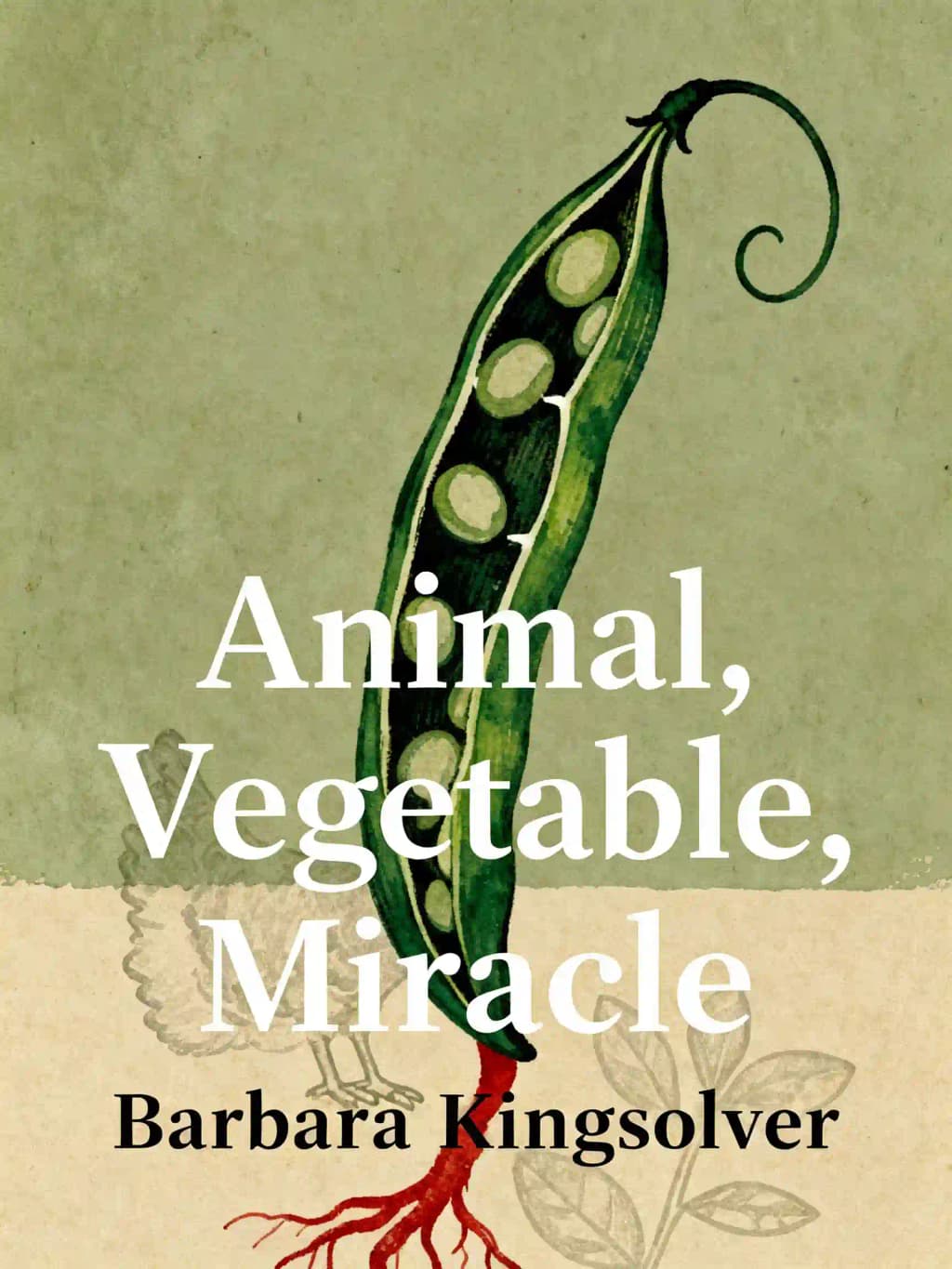
Have you ever wondered what would happen if you disconnected from the global food chain and ate only what grows within your immediate surroundings? This question drove Barbara Kingsolver and her family to embark on a radical experiment: spending one year eating only food they grew themselves or sourced from within their local foodshed. "Animal, Vegetable, Miracle" chronicles this journey with humor, scientific insight, and mouthwatering descriptions that have made it a cornerstone text in the sustainable food movement. Since its 2007 publication, the book has influenced countless readers to reconsider their relationship with food, inspired farm-to-table restaurants across America, and earned praise from food activists like Michael Pollan, who called it "a profound, graceful, and literary work." What makes this story particularly compelling is that it doesn't come from lifelong farmers but from a family making a deliberate choice to reconnect with the ancient human tradition of knowing exactly where their food comes from.
第 2 章
The Great Food Migration: Leaving the Desert for Fertile Ground
After twenty-five years in the Arizona desert, Barbara Kingsolver and her family made a countercultural decision. While millions of Americans were flocking to the Sun Belt, they packed up and moved to southern Appalachia-a place where "water falls from the sky." The irony wasn't lost on them that their first stop on this journey toward food self-sufficiency was a convenience store for junk food and fossil fuel.
Their Arizona life had become increasingly unsustainable. Living in the desert meant depending on "borrowed water," creating a moral dilemma: "Rob Mexico's water or guzzle Saudi Arabia's gas?" Though they had been part of a Tucson community raising chickens and vegetables, their gardens had a constant "drinking problem" that couldn't be solved without massive resource consumption.
The contrast between their old and new homes was immediately apparent. In Arizona, a cashier scowled at approaching rain clouds, hoping they wouldn't interfere with car-washing plans. Five days later in Virginia, a waitress welcomed the rain with a simple "Don't we need it!" This agricultural mindset-understanding that rain means life, not inconvenience-signaled to the family that they had found their place.
The Kingsolver family's relocation wasn't just about moving to a wetter climate. It represented a profound shift in how they related to food and the land that produces it. They were swimming against the tide of modern American culture, where in just two generations, we've transformed from a rural society with intuitive agricultural knowledge to an urban population disconnected from basic food facts-when fruits ripen, what grows locally, and how to preserve the harvest.
Their goal was threefold: to remove petroleum from their food chain, to know personally who grew their food (often themselves), and to learn to produce more of their own sustenance. This wasn't about returning to some primitive existence but about reclaiming knowledge that most humans throughout history considered essential for survival-knowledge that has "vanished from our culture" because "we've convinced ourselves it wasn't important."
第 3 章
The American Food Disconnect: How We Lost Our Way
Americans have developed a uniquely dysfunctional relationship with food. We've become so disconnected from food origins that we rename meat animals after death (cow becomes beef, pig becomes pork), fear garden soil as dirty, and many don't know that potatoes grow underground. This agricultural ignorance spans from city to countryside as we've collectively abandoned farming knowledge.
The economics of our food system reveal this disconnect: we now give 85 cents of every food dollar to processors and marketers while complaining about organic food prices that might return more than fifteen cents to actual farmers. Post-WWII chemical fertilizers created crop surpluses, while policy changes transformed corn and soybeans from food into industrial raw materials. Factory farms replaced pastures, and 70% of Midwestern farmland shifted to monocrops.
The result? American farmers now produce 3,900 calories per person daily-twice what we need-while the food industry devises ingenious ways to make us consume them through processed foods, larger portions, and aggressive marketing, especially to children. Unlike other cultures that maintain traditional food relationships, Americans have developed what can only be described as an eating disorder.
This disorder manifests in contradictory ways. We follow fad diets that dictate what to give up rather than celebrating food positively. Government policy advises eating more fruits and vegetables while simultaneously subsidizing commodity crops for soda and cheap burgers. Our children may be the first generation with shorter life expectancy than their parents due to diet-related diseases.
The global implications are equally troubling. Despite 800 million chronically underfed people worldwide, global farms already produce enough food to make everyone fat. Hunger persists because of poverty and distribution problems, not insufficient production. Industrial farming methods cause soil erosion, salinization, and fertility loss affecting 25% of global arable land, while most industrial crops become animal feed or processed foods for wealthy consumers rather than feeding the hungry.
Yet amid this bleak landscape, a positive food movement is emerging. Twenty-five percent of U.S. households grow some of their own produce. City dwellers flock to farmers' markets. Restaurants dedicate themselves to local food. Family farms diversify with organic or specialty crops. Schools bring food-growing curricula to classrooms. This grassroots revolution represents what Kingsolver calls "a genuine food culture"-an affinity between people and the land that feeds them.
第 4 章
The Vegetannual: Nature's Calendar for Eating
To understand seasonal eating, Kingsolver introduces a brilliant conceptual tool: the "vegetannual"-an imaginary plant that produces all vegetables in sequence through one growing season. This plant follows nature's unvarying order: first come spring's leafy greens (spinach, kale, lettuce); then mature leaf and flower heads (cabbage, broccoli, cauliflower); followed by tender young fruits (snow peas, baby squash); then green beans and small tomatoes; later fully ripened fruits (beefsteak tomatoes, eggplants, peppers); then hard-shelled fruits with developed seeds (melons, winter squash, pumpkins); and finally root crops.
This progression isn't arbitrary-it's the necessary biological sequence for annual plants, which cannot produce fruit before flowering or roots before leaves. Nearly all our non-animal foods come from flowering plants (angiosperms) that evolved during the Cretaceous era and have become Earth's most successful terrestrial life forms. All follow the same life cycle: sprouting, leafing out, blooming, reproduction, seed formation, and death.
Our culture has normalized the "botanically outrageous condition" of having every food available year-round. Well-heeled diners enjoy meals where "whole continents collide discreetly on a white tablecloth" regardless of calendar date. Yet this comes at a steep environmental cost-transporting a single calorie of fresh fruit from California to New York requires about 87 calories of fuel, an efficiency comparable to "driving between cities to walk on a treadmill."
When we buy imported produce, we're not necessarily helping farmers in developing countries. The primary beneficiaries are corporations, processors, brokers, shippers, and oil companies. Developed nations' overproduction of subsidized commodity crops sold below market price undermines local economies in developing countries, often driving small farmers to urban areas and decreasing agricultural self-sufficiency.
The emerging "locavore" movement and organizations like Slow Food International are working to reframe seasonal eating not as deprivation but as pleasure, keeping grocery money in local communities while delivering superior taste. Eating according to this natural cycle means accepting that watermelon belongs to summer's end, not April, and understanding that out-of-season produce requires extensive transportation from distant growing regions-a practice that's both environmentally costly and culinarily disappointing.
第 5 章
The Asparagus Moment: Beginning the Local Food Year
As March arrived, the family faced a crucial question: when exactly should they begin their year-long local food experiment? They decided to wait for asparagus, the first real vegetable of spring, to mark their "New Year's Day" of local eating. Having moved to their Appalachian farm with its steep terrain, they'd carved terraced gardens into the south-facing mountainside and planted asparagus three years earlier. Now they scrutinized the blackened patch for signs of life, knowing the distinctive spears would soon emerge rapidly from the ground.
Asparagus has a 2,500-year culinary history, with earliest recipes appearing in ancient Greek and Egyptian hieroglyphics. Romans were so passionate about asparagus they chartered ships to find the best spears and even created an early frozen-food industry by burying asparagus in Alpine snow to serve months later at the Feast of Epicurus. The shoots emerge snake-like from the ground, growing visibly fast, and contrary to popular belief, fat spears aren't more tender than thin ones-each shoot simply begins with its own particular girth.
Asparagus demands respect from its cultivator. Harvest too young and the plant sinks into "vegetable despair" and dies. Even mature plants can only be harvested for about eight weeks before the farmer must "let the plant win," allowing spears to grow into the lanky plants they're meant to be. This makes fresh asparagus season extraordinarily brief-typically March through May in the northern hemisphere.
Asparagus possesses what Japanese food scientist Kikunae Ikeda identified as "the fifth taste" or umami, derived from glutamic acid-a flavor beyond sweet, sour, bitter and salty. This distinctive tang quickly deteriorates after harvest as the tight bud scales loosen and the plant metabolizes its own sugars. Fresh-cut asparagus has a "tight, shiny sex appeal" that rapidly diminishes, making transported asparagus inferior.
Waiting for foods to come into season transforms eating from "routine maintenance" to "recreation." Eating home-cooked meals from whole, in-season ingredients obtained locally is "eating well in every sense"-good for habitat and body alike. The paradox of food culture: restraint equals indulgence. By limiting ourselves to what's in season, we actually enhance our pleasure rather than diminish it.
That first Saturday morning at the farmers' market, the family headed back to their car clutching their bags with a heady sense of accomplishment, having found more local food than they'd hoped for. They chatted with their farmer friends who were closing shop, all of them ready to return to warm kitchens, keeping their fingers crossed during "dogwood winter" for the fruits of the coming year.
第 6 章
The Heritage Harvest: Saving Seeds and Stories
Heirloom vegetables captivate not just for their poetic names but because these titles represent real stories. These varieties earn their historical status by being saved as seeds for generations, carefully maintained and passed from gardener to gardener. Unlike hybrids-the one-time products of forced crosses between plant varieties-heirlooms are open-pollinated, yielding the same characteristics when their seeds are saved and grown year after year.
Modern consumers now taste less than 1% of vegetable varieties grown a century ago. This catastrophic loss of agricultural diversity extends globally-Peruvian farmers who once cultivated 4,000 potato varieties now grow just dozens; Indian villages lost countless indigenous oil crops when small mills were closed and imported soy oil flooded markets. According to crop ecologist Vandana Shiva, humans have historically eaten 80,000 plant species, but three-quarters of all human food now comes from just eight species.
A pivotal factor in this loss was the 1970 Plant Variety Protection Act, which established plant varieties as patentable properties. Six corporations-Monsanto, Syngenta, DuPont, Mitsui, Aventis, and Dow-now control 98% of global seed sales. The case of Canadian farmer Percy Schmeiser illustrates the dangers of this corporate control. Schmeiser was sued by Monsanto when their patented genes appeared in his canola plants through wind-carried pollen, despite his fifty-year history of saving his own seeds.
Plant geneticist Jack Harlan warned that these vanishing genetic resources "stand between us and catastrophic starvation." The thousands of locally adapted crop varieties contain broad genetic heritage that allows them to coevolve with environmental challenges. This follows the Red Queen principle: predators and prey must continually evolve to survive, like the fox and rabbit both getting faster over generations. Plant diseases similarly evolve new ways to attack, making genetic variability crucial for crop resilience.
Fortunately, a revival is underway as heirloom vegetables appear on restaurant menus and become staples at farmers' markets. Organizations like Seed Savers' Exchange (with 8,000 members exchanging 11,000 varieties) are preserving agricultural heritage. Similar efforts include Native Seeds/SEARCH for Native American crops and Slow Food International, which protects traditional foods from extinction through its Ark of Taste initiative.
Unlike endangered wildlife, rare domesticated foods can be saved by eating them. Consumers become conservation links by seeking out heirloom vegetables, learning to appreciate their exceptional tastes, and creating demand that encourages farmers to grow them. Many Ark of Taste foods have made remarkable recoveries thanks to "seed savers and epicurean desperadoes who defy the agents of gene control."
第 7 章
Raising Food with Reverence: The Ethics of Animal Husbandry
The Kingsolver family's commitment to ethical eating extended to their animal husbandry practices. Barbara raised heritage Bourbon Red turkeys, while her daughter Lily started a chicken egg business with Partridge Rock hens. Unlike the Broad-Breasted Whites that constitute over 99% of America's 400 million annual turkeys-birds so overbred they can't fly, forage, or even mate naturally-heritage breeds retain natural behaviors and genetic diversity.
Industrial animal food production in concentrated animal feeding operations (CAFOs) has one goal: converting creatures into meat as quickly and cheaply as possible. Animals are chosen for rapid growth and confinement tolerance, packed tightly together without seeing grass or sunlight. Critics raise three main concerns: inhumane treatment, massive pollution (CAFO animals produce six times the fecal matter of all humans on Earth), and health risks (nearly 75% of U.S. antibiotics go to CAFOs).
The family's approach stood in stark contrast. Their turkeys enjoyed pampered childhoods and freedom on open pasture unknown to conventionally raised poultry. When harvest day arrived, they approached the task with solemnity and respect. The children-Lily and her friends Abby and Eli-helped carry the first rooster, which they quickly dispatched with an ax stroke. After bleeding out, the birds were scalded and plucked meticulously by hand. The children moved quickly from "eeew gross" to scientific curiosity, with Abby later giving an award-winning 4-H presentation titled "You Can't Run Away on Harvest Day."
Research shows grass-finished beef and free-range eggs have significantly different nutrient compositions than their factory-farmed counterparts-containing lower saturated fats, higher vitamin E, beta-carotene, omega-3 fatty acids, and less risk of bacterial contamination. Free-range grazing produces an entirely different product, with grass-fed beef having normal stomach acidity that prevents dangerous acid-resistant E. coli strains common in grain-fed cattle.
The family's approach to meat-eating wasn't about moral superiority but about making conscious choices. As Camille explains, "I only eat free-range meat, recognizing that all meat is not created equal. Animals raised outdoors on natural diets produce fundamentally different meat than feedlot animals on antibiotics." This perspective acknowledges both the nutritional reality that humans evolved as omnivores and the ethical imperative to treat food animals with dignity.
第 8 章
The Kitchen Revolution: Reclaiming the Art of Cooking
Despite being a working mother for nineteen years, Barbara rejected the "get it over with quick" approach to feeding her family. Dinnertime became the cornerstone of their family's mental health, where "75% of crucial parenting happens." It's no coincidence, she notes, that National Merit scholars share one common thread: regular family dinners.
Cooking has become a dying art in our culture, partly because her generation of women fought against being defined by kitchen duties. They sought education and careers to escape domestic servitude, but the food industry exploited this liberation with a devil's bargain: convenience foods that created a nutritional crisis. We traded the aroma of warm bread and nurturing routines for minivans and Lunchables. Now both parents work full-time jobs organized around the presumption that someone is handling domestic duties, yet "June Cleaver has left the premises."
The solution isn't returning to full-time homemaking, but approaching mealtimes as creative opportunities rather than chores, with required participation from the whole family. The household developed efficient cooking routines-simple weekday meals like frittatas, stir-fries, and pasta variations, with more labor-intensive recipes saved for weekends. Friday nights were always pizza-movie nights, providing structure and eliminating decision fatigue.
Cooking is the great divide between good eating and bad. Despite perceptions about cost, home cooking with quality ingredients is pennies on the dollar compared to restaurant or factory-prepared meals. It helps control weight by monitoring what goes into our food. It's good citizenship-supporting local farms and teaching children practical skills that promote health and independence.
Most importantly, households that have lost cooking have lost something profound: the sensory experience of rising dough, sizzling stir-fries, and the choreography of family members working together in the kitchen. Once you start cooking, one thing leads to another. The family made pasta from scratch, raised turkeys, created chutneys-all for the satisfaction of controlling an entire process of manufacture. Marx called it the antidote to alienation. In modern food culture, our only role has become "poking the thing in our mouths," creating alimentary alienation where we can't feel how or why bad food hurts us.
This reconnection with cooking led to unexpected adventures, like making homemade cheese. Though this seems preposterous to most Americans, it takes less time to make mozzarella than to bake a cobbler. At a workshop with "Cheese Queen" Ricki Carroll, they made five different cheeses in one day-queso blanco, whole milk ricotta, mascarpone, mozzarella, and farmhouse cheddar. The workshop revealed how many of our most useful foods-yogurt, wine, bread, and cheese-rely on controlled microbe growth, challenging our culture's germophobic tendencies.
第 9 章
Seasonal Abundance: The Rhythm of Harvest and Preservation
As the seasons progressed, the family experienced both the joys and challenges of living by nature's calendar. July brought overwhelming squash abundance-nineteen squash one day, thirty-three more the next week. They stuffed and baked them, made chocolate chip zucchini cookies that fooled Lily's birthday party guests, and gave away bagfuls to dinner guests (carefully selecting those without gardens). The squash abundance became so overwhelming that Barbara joked about getting a hog to consume the excess and checked door locks to prevent neighbors from sneaking more squash into their house.
By August, their garden had moved "beyond hobby scale," producing 302 pounds of tomatoes compared to July's 50 pounds. Tomatoes occupied every horizontal surface in the kitchen-countertops end to end, sink full of red orbs bobbing in wash water, stovetop covered with baking sheets of halved tomatoes waiting for the oven. They roasted them slowly, especially the sweet orange Jaune Flammes, which they froze for pizzas and panini. They dried them, made sauce in huge quantities, and filled pantry shelves with quarts of whole tomatoes, juice, spaghetti sauce, chutney, and several kinds of salsa.
Canning doesn't deserve its reputation as an archaic enterprise "murderous to women's freedom." It's straightforward, and acidic fruits and tomatoes can safely be water-bath canned. Barbara sees canning as fast food, paid for in time up front-"a steamy kitchen full of women discussing our stuff isn't so different from a book group, except we end up with future meals."
By winter, their efforts had created an impressive larder: over forty jars each of tomato products and pickles/jams, fifty quarts of dried vegetables, freezer boxes full of produce and fruits, frozen edamame snacks, meats, hanging onions and garlic, and root cellar storage of potatoes, squash, beets, carrots, melons, and cabbages. This food security provided Barbara with a deeply satisfying feeling of connection to their land.
Late February marked the official end of "Hungry Month," when winter tests both humans and animals. In earlier times, this season brought genuine risk as bitter cold and limited diets compromised immunities. The family watched their pantry jars dwindle from "army to platoon to lonely sentries," counting weeks until spring harvests and the farmers' market reopening. But March didn't feel hungry because spring's promise was visible. Lily and Barbara were starting seeds indoors under fluorescent lights, preparing for the growing season ahead-completing the annual cycle that would begin again with asparagus.
第 10 章
The Ripple Effect: How Local Food Choices Change the World
As their year of local eating concluded, the Kingsolver family realized they weren't eagerly counting down to its end-they didn't want to return to their old ways. The experience had changed them all, with even the children developing new perspectives on food systems and connections. What once seemed like an extraordinary experiment had become their new normal.
Their journey revealed that local food availability directly responds to consumer demand. Simple actions like telling grocery cashiers you're looking for local produce can make a difference. Smaller stores and food co-ops are especially receptive to such requests. Restaurants also understand local food's freshness advantage and can be influential participants in the local food movement.
The economics of their experiment proved surprising. Calculating the retail value of their homegrown produce, poultry, and preserved foods, they saved approximately $7,500 on their annual food budget. Their grocery expenses dropped dramatically, with only $83.70 spent on organic flour in six months, similar amounts on olive oil, about $5 weekly on fair-trade coffee, and minimal non-local necessities. Even accounting for $100 monthly at farmers' markets, their meals cost under 50 each in cash outlay.
Beyond personal benefits, the family came to understand how their choices impacted larger systems. Our "inexpensive" conventional food actually carries hidden costs. Tax dollars subsidize petroleum used in food production ($22 billion), corn and wheat subsidies ($3 billion), food-related illness treatments ($10 billion), agricultural chemical cleanup ($17 billion), pesticide use collateral costs ($8 billion), and nutrient loss from erosion ($20 billion). This amounts to at least $725 per household annually beyond the sticker price.
Kingsolver challenges critics who label local food as naive or elitist while portraying industrial agriculture as the solution to feeding the world. She argues this perspective is "perfectly backward," using "golden rice" as an example of misguided industrial solutions. This genetically modified rice containing beta-carotene is promoted to address vitamin A deficiency that causes blindness in half a million Asian children annually. However, she points out that most malnourished children already live in countries producing surplus food, and that golden rice represents another monoculture solution to problems caused by monocultures and disappearing diversity.
The family's experience taught them that eating locally isn't about deprivation but about developing a relationship with food that encompasses its entire story-from soil to table. As Wendell Berry writes, "Eaters must understand, how we eat determines how the world is used." Through their year-long experiment, the Kingsolver family discovered that individual choices about food can indeed change the world-one meal at a time.