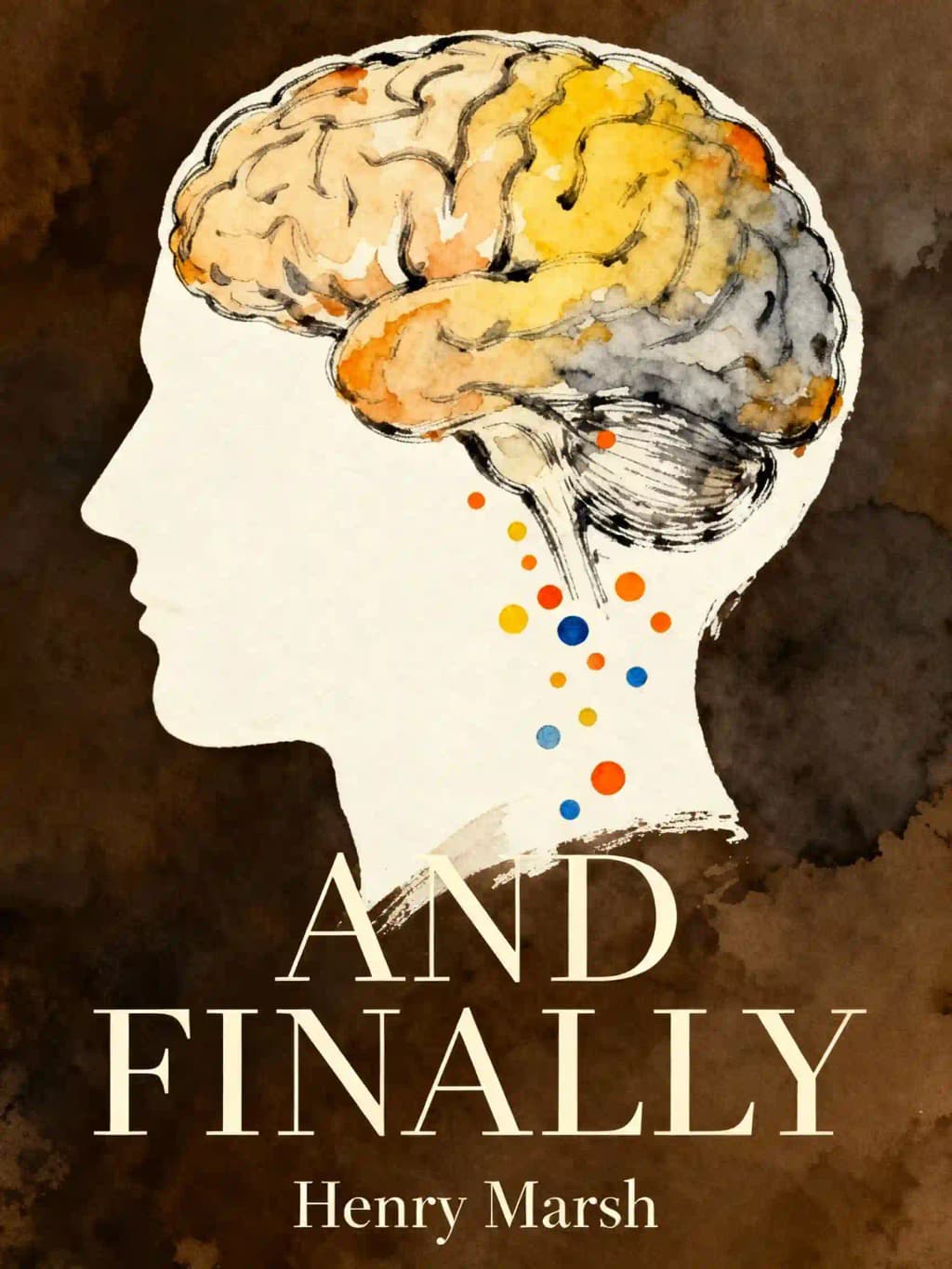
Renowned neurosurgeon Henry Marsh confronts his own mortality in this powerful memoir where the doctor becomes patient. Praised by Philip Pullman as "courageous" and Abraham Verghese as "thought-provoking," Marsh's candid reflections reveal what truly matters when facing life's final chapter.
Henry Thomas Marsh, CBE FRCS, is the bestselling author of And Finally: Matters of Life and Death and a pioneering British neurosurgeon renowned for his candid reflections on medicine’s ethical complexities.
A graduate of Oxford University and the Royal Free Hospital School of Medicine, Marsh spent over three decades as a consultant neurosurgeon at London’s Atkinson Morley Hospital. During his tenure, he pioneered awake craniotomy techniques and advanced neurosurgical practices in Ukraine.
His memoirs, including Do No Harm: Stories of Life, Death and Brain Surgery and Admissions: A Life in Brain Surgery, blend clinical precision with philosophical inquiry. Marsh explores themes of mortality, human fallibility, and the intersection of science and empathy.
Marsh’s work has been featured in Emmy-winning documentaries like The English Surgeon and translated into over 20 languages. Honored with a CBE in 2010 for services to medicine, his books have collectively sold more than 1 million copies worldwide, cementing his status as a leading voice in medical literature.
And Finally: Matters of Life and Death is a memoir by retired British neurosurgeon Henry Marsh, exploring his transition from doctor to terminal cancer patient. It reflects on mortality, the complexities of medicine, and the emotional weight of confronting his own diagnosis while balancing scientific curiosity with personal vulnerability.
This book is ideal for readers interested in medical memoirs, existential reflections on life and death, or neuroscience. It appeals to those who appreciate candid narratives about healthcare, resilience, and the human condition, particularly fans of Marsh’s prior works like Do No Harm.
Yes—critics praise its raw honesty and lyrical prose, calling it “elegaic, candid, and luminous.” Marsh’s unique perspective as both a pioneering neurosurgeon and a patient offers profound insights into medicine and mortality, making it a standout in medical memoirs.
Marsh’s terminal diagnosis forces him to confront his own mortality, shifting his role from healer to vulnerable patient. He grapples with regrets, unresolved professional ambitions, and a renewed awe for science and family, weaving personal struggles with broader philosophical questions.
Central themes include the fragility of life, the tension between scientific rationality and emotional vulnerability, the ethics of medical practice, and the search for meaning in suffering. Marsh also reflects on aging, legacy, and the natural world.
Unlike Do No Harm (focused on neurosurgery), And Finally delves deeper into Marsh’s personal life and mortality. It retains his sharp clinical insights but adds introspective layers, revealing his fears and hopes as a patient.
Some readers might find Marsh’s clinical detachment occasionally jarring, and the heavy medical details could overwhelm general audiences. However, most praise its unflinching honesty and emotional depth.
Both emphasize the duality of Marsh’s journey.
Marsh critiques simplistic notions of resilience, arguing that facing death involves acknowledging fear and fragility rather than mere stoicism. He highlights the role of love, curiosity, and humility in navigating suffering.
As debates about healthcare, aging populations, and AI-driven medicine intensify, Marsh’s humanistic reflections remind readers of the irreplaceable value of empathy and the limits of technology in addressing existential crises.
Marsh likens life to a “neuronal maze” and cancer to an “uninvited teacher,” blending neuroscientific imagery with existential metaphors to illustrate his journey from control to surrender.
Marsh critiques the emotional detachment often required in medicine, admitting his diagnosis made him rethink his bedside manner. He advocates for greater humility and transparency in healthcare.
通过作者的声音感受这本书
将知识转化为引人入胜、富含实例的见解
快速捕捉核心观点,高效学习
以有趣互动的方式享受这本书
Thinking illness happened to patients, not doctors.
Hope remains among medicine's most precious medicines.
What he considered stoicism was actually fear.
Worse than detachment is complacency.
The simplest way to limit empathy is dividing people into "Us and Them."
将《And Finally》的核心观点拆解为易于理解的要点,了解创新团队如何创造、协作和成长。
将《And Finally》提炼为快速记忆要点,突出坦诚、团队合作和创造力的关键原则。

通过生动的故事体验《And Finally》,将创新经验转化为令人难忘且可应用的精彩时刻。
随心提问,选择声音,共同创造真正与你产生共鸣的见解。

"Instead of endless scrolling, I just hit play on BeFreed. It saves me so much time."
"I never knew where to start with nonfiction—BeFreed’s book lists turned into podcasts gave me a clear path."
"Perfect balance between learning and entertainment. Finished ‘Thinking, Fast and Slow’ on my commute this week."
"Crazy how much I learned while walking the dog. BeFreed = small habits → big gains."
"Reading used to feel like a chore. Now it’s just part of my lifestyle."
"Feels effortless compared to reading. I’ve finished 6 books this month already."
"BeFreed turned my guilty doomscrolling into something that feels productive and inspiring."
"BeFreed turned my commute into learning time. 20-min podcasts are perfect for finishing books I never had time for."
"BeFreed replaced my podcast queue. Imagine Spotify for books — that’s it. 🙌"
"It is great for me to learn something from the book without reading it."
"The themed book list podcasts help me connect ideas across authors—like a guided audio journey."
"Makes me feel smarter every time before going to work"

免费获取《And Finally》摘要的 PDF 或 EPUB 版本。可打印或随时离线阅读。
A seventy-year-old neurosurgeon volunteers for a brain scan out of curiosity and vanity. Months later, viewing the results, he confronts an image that devastates him more than any diagnosis could: his brain appears shrunken and withered, riddled with white spots indicating ischemic damage. He's staring at his own decay, death foretold in clinical images. For four decades, Henry Marsh inhabited medicine's world, witnessing fear, suffering, and death without truly considering what it would feel like when his turn came. Twenty months after this confrontation with mortality through imaging, a prostate cancer diagnosis shatters the deep-seated denial that protected him throughout his career. What he'd considered stoicism was actually fear. The symbolic skull he'd kept in his study for years-a memento mori imitating Durer's famous painting-suddenly becomes too painfully concrete. He gives it away. The abstract reminder of death has become unbearably real, transforming him from observer to participant in mortality's inevitable dance.
