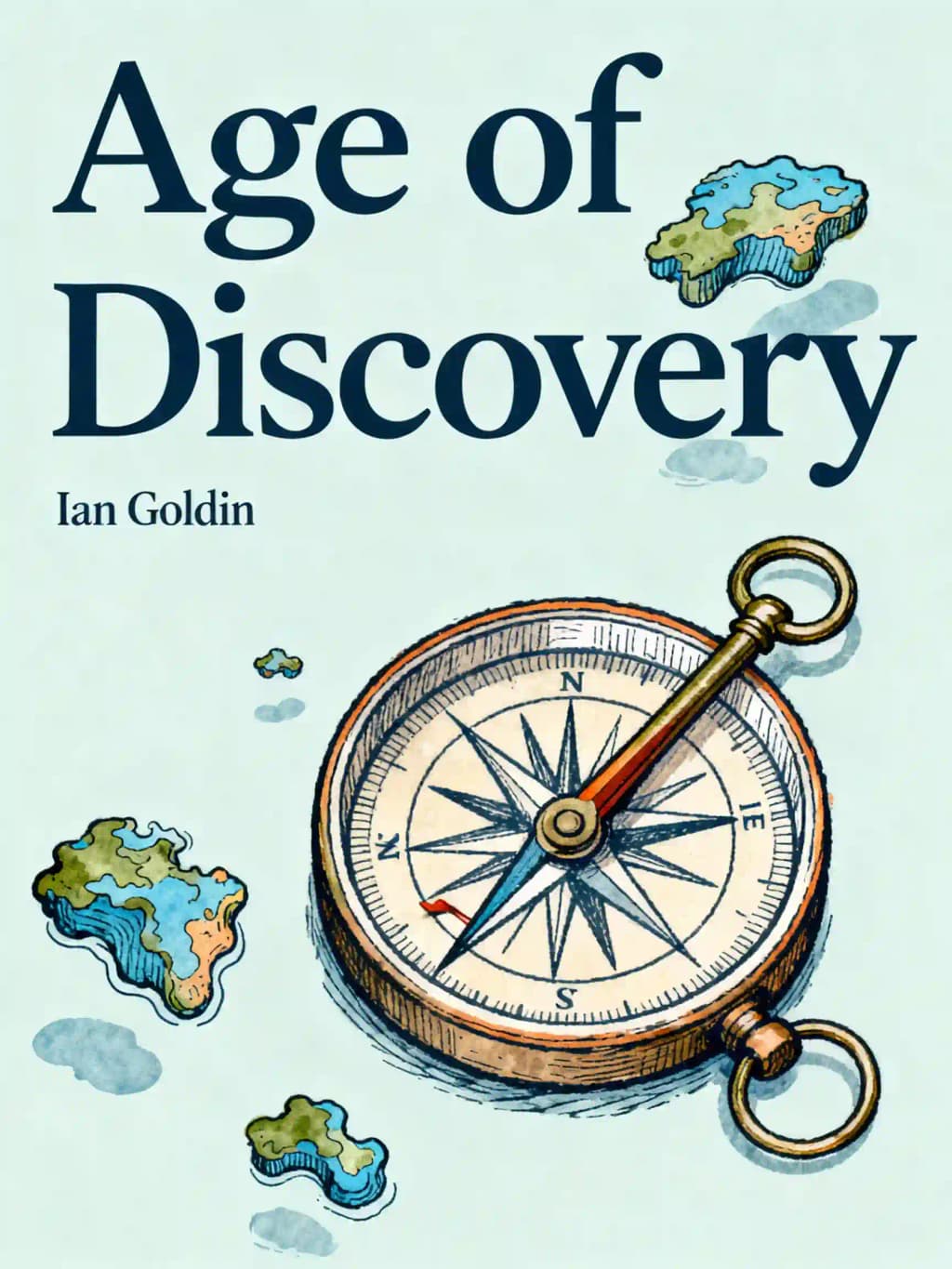
In "Age of Discovery," Goldin and Kutarna brilliantly compare today's turbulent era to the Renaissance. With global literacy soaring and lifespans extending by decades, are we witnessing humanity's second Renaissance - or heading toward unprecedented crisis? Oxford Martin School's provocative analysis challenges everything.
Ian Goldin, Oxford University Professor of Globalization and Development and bestselling author of Age of Discovery, is a leading authority on global crises, technological change, and societal evolution.
His book, which examines modern challenges through the lens of historical renaissance periods, draws on his decades of expertise as former Vice President of the World Bank, advisor to Nelson Mandela, and founding director of Oxford Martin School—the world’s premier interdisciplinary research hub.
A prolific author of 25 books, including Terra Incognita: 100 Maps to Survive the Next 100 Years and The Shortest History of Migration, Goldin combines academic rigor with real-world policymaking experience. His three BBC documentary series, including The Pandemic That Changed the World, amplify his research for global audiences.
Knighted by France for contributions to development, Goldin’s work is frequently featured in Financial Times, which named his 2023 release Age of the City one of its annual best books.
Age of Discovery examines today’s rapid technological, economic, and social changes by comparing the modern era to the 15th-century Renaissance. Ian Goldin and Chris Kutarna highlight parallels in innovation, globalization, and upheaval, while addressing risks like inequality, cybersecurity, and political instability. The book argues that humanity must leverage creativity and cooperation to navigate these challenges and shape a prosperous future.
This book is ideal for policymakers, business leaders, and readers interested in global trends, technological disruption, or historical parallels. It offers insights for those grappling with modern challenges like AI, climate change, and geopolitical shifts, providing frameworks to balance risks and opportunities in a turbulent world.
Yes, particularly for its interdisciplinary analysis of today’s crises through a Renaissance lens. Goldin and Kutarna blend history, economics, and futurism to make complex trends accessible, though some may find the historical comparisons oversimplified. The book’s actionable advice on fostering resilience and innovation makes it valuable for strategic thinkers.
The “New Renaissance” frames the 21st century as a period mirroring the 15th-century Renaissance, marked by breakthroughs in technology, science, and culture. Like the original era, today’s advancements (e.g., AI, gene editing) bring unprecedented opportunities but also existential risks, requiring deliberate stewardship to avoid chaos.
Key risks include widening inequality, job displacement from automation, cybersecurity threats, pandemics, and political fragmentation. The authors warn that unchecked technological progress and globalization could exacerbate these issues without ethical governance and international cooperation.
The book argues that AI and green tech could drive progress akin to Gutenberg’s press or Copernican theory but warns against misuse. It advocates for policies ensuring AI benefits society broadly and climate solutions that prioritize equity.
While Sapiens explores human history broadly and The Fourth Industrial Revolution focuses on tech trends, Age of Discovery uniquely ties current disruptions to Renaissance-era patterns, offering a blended historical-futuristic lens for understanding global shifts.
Some may argue the Renaissance analogy oversimplifies modern complexities or understates systemic barriers to progress. Critics might also note the book’s optimistic tone downplays the difficulty of achieving global cooperation.
Ian Goldin is an Oxford University professor and former director of the Oxford Martin School, specializing in globalization and development. His expertise in economics and policy lends credibility to the book’s analysis of global trends.
In 2025, as AI, climate policies, and geopolitical tensions dominate headlines, the book’s lessons on ethical innovation and collaborative problem-solving remain critical. Its framework helps readers contextualize crises like AI ethics debates or renewable energy transitions.
The book encourages proactive skill development (e.g., digital literacy) and flexibility in navigating automation-driven job markets. It advises embracing interdisciplinary thinking, mirroring Renaissance polymaths, to thrive in evolving industries.
通过作者的声音感受这本书
将知识转化为引人入胜、富含实例的见解
快速捕捉核心观点,高效学习
以有趣互动的方式享受这本书
The stakes couldn't be higher, and the potential rewards more magnificent.
Our world isn't merely connected-it's entangled.
The simple mercantilist model...is obsolete.
Emerging economies now compete globally for capital, customers, and talent.
We're witnessing an unprecedented flourishing of human potential.
将《Age of Discovery》的核心观点拆解为易于理解的要点,了解创新团队如何创造、协作和成长。
将《Age of Discovery》提炼为快速记忆要点,突出坦诚、团队合作和创造力的关键原则。

通过生动的故事体验《Age of Discovery》,将创新经验转化为令人难忘且可应用的精彩时刻。
随心提问,选择声音,共同创造真正与你产生共鸣的见解。

"Instead of endless scrolling, I just hit play on BeFreed. It saves me so much time."
"I never knew where to start with nonfiction—BeFreed’s book lists turned into podcasts gave me a clear path."
"Perfect balance between learning and entertainment. Finished ‘Thinking, Fast and Slow’ on my commute this week."
"Crazy how much I learned while walking the dog. BeFreed = small habits → big gains."
"Reading used to feel like a chore. Now it’s just part of my lifestyle."
"Feels effortless compared to reading. I’ve finished 6 books this month already."
"BeFreed turned my guilty doomscrolling into something that feels productive and inspiring."
"BeFreed turned my commute into learning time. 20-min podcasts are perfect for finishing books I never had time for."
"BeFreed replaced my podcast queue. Imagine Spotify for books — that’s it. 🙌"
"It is great for me to learn something from the book without reading it."
"The themed book list podcasts help me connect ideas across authors—like a guided audio journey."
"Makes me feel smarter every time before going to work"

免费获取《Age of Discovery》摘要的 PDF 或 EPUB 版本。可打印或随时离线阅读。
Five hundred years ago, a young sculptor carved a figure frozen in that electric moment before battle-muscles tensed, eyes fixed on an unseen giant. Today, we stand in the same suspended instant. The world has been rewired, redrawn, and reimagined faster than at any point in human history. We're living through a transformation as profound as the Renaissance itself, complete with its breathtaking genius and terrifying risks. The question isn't whether change is coming-it's already here. The question is whether we'll shape it or be shaped by it.