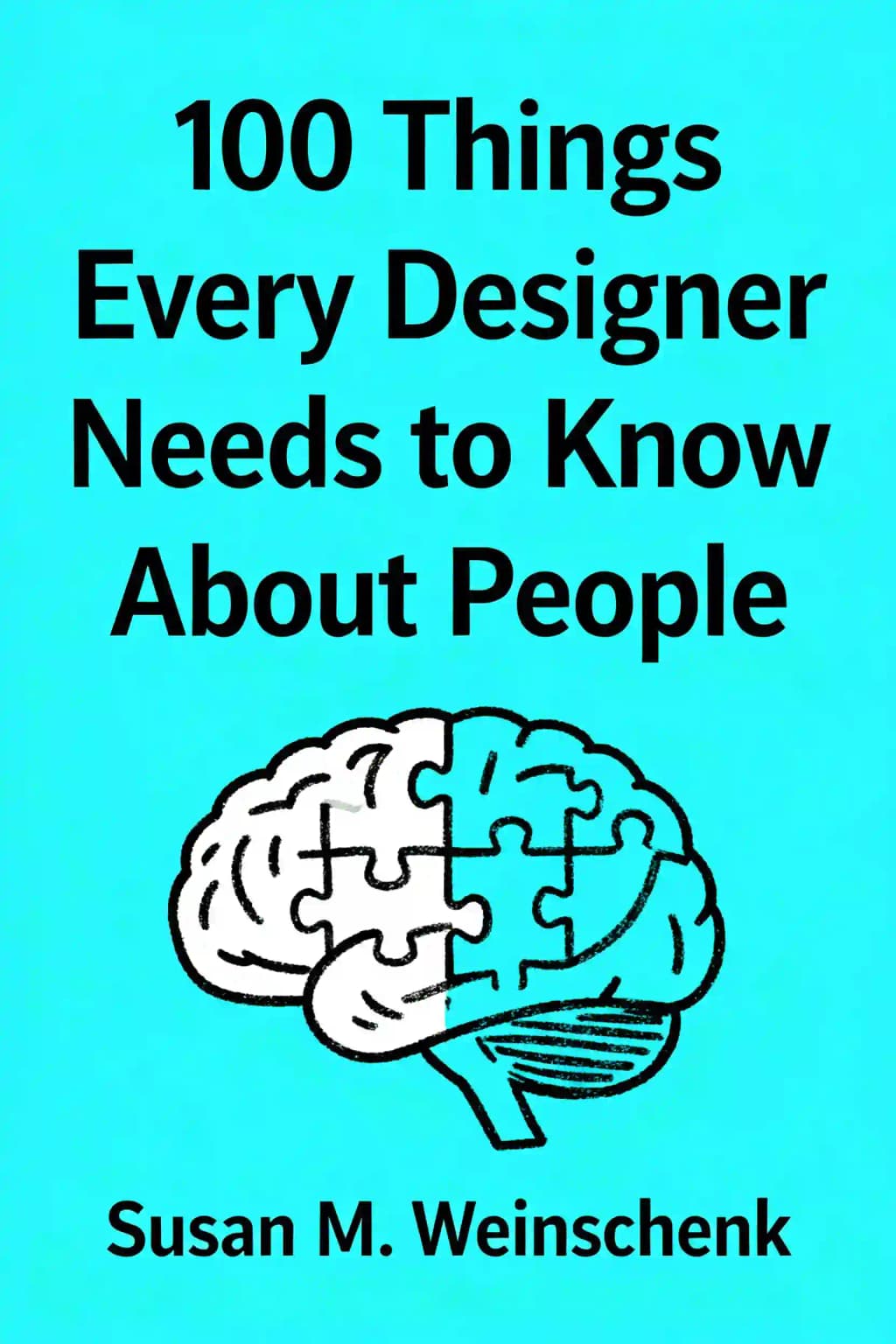
Decode the psychology behind every click, swipe, and interaction. This design bible - consistently ranked among top UX resources - distills cognitive research into 100 actionable insights. Why do Fortune 1000 companies consult its author? Because understanding how people think transforms good design into irresistible experiences.
Susan M. Weinschenk is a behavioral psychologist, bestselling author of 100 Things Every Designer Needs to Know About People, and a pioneering figure in applying psychology to user experience design. With a Ph.D. in psychology and over three decades of experience, she bridges cognitive science and practical design strategies, helping professionals create intuitive, human-centered digital products.
Her book—a staple in UX education—explores perception, motivation, and decision-making, drawing from her work with Fortune 1000 companies and her role as Chief Behavioral Scientist at The Team W, her consultancy firm.
Weinschenk’s expertise extends to her other influential works, including Neuro Web Design: What Makes Them Click? and How To Get People To Do Stuff, which delve into behavioral science and persuasive design. A sought-after speaker, she has presented at global conferences like UX Brighton and Convey UX, while her insights shape curricula in design programs and corporate training.
Recognized for translating complex research into actionable guidelines, 100 Things Every Designer Needs to Know About People has been widely adopted by designers and product teams, solidifying its status as a definitive resource in the field.
100 Things Every Designer Needs to Know About People by Susan M. Weinschenk bridges psychology and design, offering 100 research-backed principles to create user-centric products. It covers perception, motivation, memory, and decision-making, providing actionable insights for designing intuitive interfaces, websites, and experiences. Each principle is supported by real-world examples and academic references, making complex behavioral science accessible to designers.
This book is ideal for UX/UI designers, web developers, and product managers seeking evidence-based strategies to improve usability and engagement. It’s also valuable for marketers and educators aiming to apply cognitive psychology principles to their work. Beginners gain foundational knowledge, while experienced designers use it as a quick-reference guide.
Yes, particularly for designers new to psychology. It distills complex theories into digestible tips, such as optimizing attention-grabbing layouts and reducing decision fatigue. However, seasoned professionals may find some concepts basic, as it prioritizes breadth over depth. The practical examples and citation of peer-reviewed studies add credibility.
Key principles include:
Weinschenk translates neuroscience into actionable design rules, such as using variable rewards (e.g., surprise notifications) to boost engagement. She explains how font choices impact readability and why shorter line lengths improve comprehension. Her focus on storytelling over data helps designers create emotionally resonant experiences.
Some reviewers note the tips can feel superficial for experts, and the focus on web design may limit appeal for other disciplines. The lack of advanced case studies and occasional oversimplification of research are also cited. Despite this, its structured format remains a strength for quick troubleshooting.
The 100 principles are divided into 10 chapters, such as “How People See” and “How People Decide.” Each concept is explained in 1–2 pages with visuals, examples, and direct applications. This modular format lets designers quickly reference topics like typography best practices or error-prevention strategies.
Weinschenk emphasizes aligning designs with intrinsic drivers like autonomy (customizable interfaces) and mastery (progress tracking). She advises against overusing extrinsic rewards (e.g., points), which can reduce long-term engagement. Case studies show how gamification and personalized feedback boost motivation.
With AI-driven interfaces and VR environments requiring deeper user understanding, the book’s psychology-first approach remains critical. Its principles on attention economy and cognitive load are essential for designing voice-activated systems and immersive metaverse experiences. Updated editions could address emerging tech, but the core insights stay foundational.
通过作者的声音感受这本书
将知识转化为引人入胜、富含实例的见解
快速捕捉核心观点,高效学习
以有趣互动的方式享受这本书
Your brain is constantly playing tricks on you.
Our brains are pattern-making machines.
What designers create isn't necessarily what users perceive.
Forward-facing faces create the strongest emotional connection.
将《100 Things Every Designer Needs to Know about People》的核心观点拆解为易于理解的要点,了解创新团队如何创造、协作和成长。
通过生动的故事体验《100 Things Every Designer Needs to Know about People》,将创新经验转化为令人难忘且可应用的精彩时刻。
随时提问,选择你的学习方式,共创真正适合你的洞察。

"Instead of endless scrolling, I just hit play on BeFreed. It saves me so much time."
"I never knew where to start with nonfiction—BeFreed’s book lists turned into podcasts gave me a clear path."
"Perfect balance between learning and entertainment. Finished ‘Thinking, Fast and Slow’ on my commute this week."
"Crazy how much I learned while walking the dog. BeFreed = small habits → big gains."
"Reading used to feel like a chore. Now it’s just part of my lifestyle."
"Feels effortless compared to reading. I’ve finished 6 books this month already."
"BeFreed turned my guilty doomscrolling into something that feels productive and inspiring."
"BeFreed turned my commute into learning time. 20-min podcasts are perfect for finishing books I never had time for."
"BeFreed replaced my podcast queue. Imagine Spotify for books — that’s it. 🙌"
"It is great for me to learn something from the book without reading it."
"The themed book list podcasts help me connect ideas across authors—like a guided audio journey."
"Makes me feel smarter every time before going to work"

免费获取《100 Things Every Designer Needs to Know about People》摘要的 PDF 或 EPUB 版本。可打印或随时离线阅读。
The digital experiences we encounter daily - from apps to websites - aren't just about aesthetics or functionality. They're psychological interfaces designed to work with (or against) the natural tendencies of our minds. Susan Weinschenk's groundbreaking work reveals that successful design isn't about what looks good, but what feels intuitive to our brains. Our minds didn't evolve for digital interfaces; they evolved for survival in natural environments. Yet understanding these evolutionary patterns helps explain why certain designs captivate us while others frustrate us to the point of abandonment. When you tap an app icon expecting an immediate response but encounter a delay, the disappointment you feel isn't just impatience - it's a neurological reaction. Your brain predicted a specific outcome and received something different, triggering a cascade of negative emotions. This gap between expectation and reality lies at the heart of user experience. The most successful designs aren't necessarily the most beautiful or feature-rich - they're the ones that align seamlessly with our psychological wiring.
What you "see" isn't what's actually there. Your brain actively constructs your visual experience, filling in gaps and making educated guesses based on past experiences-your pattern-recognition system often jumps to conclusions before gathering all evidence. Vision is active construction, not passive reception. Your visual cortex processes fragments of information and creates a coherent picture based on expectations. The Kanizsa triangle demonstrates this-you perceive a white triangle that doesn't physically exist because your brain completes the pattern. Our brains are efficient pattern-matching machines that instantly recognize familiar shapes, faces, and arrangements rather than analyzing every visual element individually. This survival-evolved ability now powers our digital interactions. We recognize about 24 basic geometric components-called geons-that form the building blocks of all objects. Faces receive special processing through the fusiform face area, enabling instant recognition and interpretation of expressions. This explains why interfaces with human faces grab attention and why we anthropomorphize simple arrangements of circles and lines. Eye-tracking studies show we naturally follow the gaze direction of faces in images. For designers, these insights enable strategic use of visual hierarchy. Large elements grab attention before small ones, high-contrast items stand out, and movement captures attention automatically-explaining why animated ads are so distracting even when you're trying to ignore them.
Your attention is your most precious and limited cognitive resource. Your brain can focus on only one cognitive task at a time-what feels like multitasking is actually rapid task-switching with significant performance costs. This limitation explains the "gorilla experiment," where 50% of viewers counting basketball passes miss a person in a gorilla costume walking through. When focused on specific tasks, we filter out vast amounts of visual information, even unusual events happening right before us. This selective attention applies to screen interactions too. Users frequently miss interface updates when focused elsewhere. Even dramatic changes can go unnoticed during screen refreshes or when concentrating on specific tasks. Color combinations also impact attention. Red and blue elements together create chromostereopsis-an optical effect where colors appear at different depths, causing visual strain. Additionally, about 9% of men have some form of color deficiency, mostly affecting distinction between reds, yellows, and greens. For effective design, never assume users will notice changes automatically. Add visual or auditory cues for important updates. Avoid placing red and blue elements adjacent to each other. Implement redundant coding schemes that combine color with pattern or texture to ensure information remains accessible to everyone.
Our working memory holds just three to four items simultaneously - not the commonly cited "seven plus or minus two." This explains why phone numbers are chunked and why we struggle with multiple information pieces. Memory isn't stored like computer files but reconstructed with each recall, changing subtly each time. Elizabeth Loftus showed how easily memories can be manipulated - simply changing "hit" to "smashed" when describing an accident altered speed estimates and even created false memories of broken glass. Forgetting isn't a flaw but a necessary feature preventing us from being overwhelmed by lifetime sensory inputs. Hermann Ebbinghaus's forgetting curve shows memories rapidly degrade unless reinforced through repetition or connected to existing knowledge. These limitations suggest clear design principles: provide information at the point of need, break content into manageable chunks, use progressive disclosure, and favor recognition over recall through dropdown menus, autocomplete fields, and visual cues. The best designs work with our memory constraints rather than against them.
Humans are inherently social beings with brain regions specialized for social processing. During conversations, our brains synchronize with speakers through neural coupling - explaining why audio and video create deeper understanding than text. Our brains process information about friends and strangers differently. The medial prefrontal cortex activates when thinking about friends but remains inactive with strangers, even those sharing interests. This suggests platforms connecting existing relationships generate more engagement than those linking strangers with common interests. Online interactions follow the same social expectations as face-to-face encounters. Unresponsive websites, premature personal information requests, or failure to remember previous interactions create the same discomfort as awkward human conversations. Social proof significantly influences decision-making. While expert opinions matter, reviews from "regular people like me" prove most influential. Amazon's review system works because when uncertain about purchases, we naturally look to others' experiences for guidance.
Despite our self-image as rational beings, emotions fundamentally drive our decision-making. People with damaged emotion-processing brain regions struggle with even simple decisions, proving feelings' essential role in choices. Our brains respond strongly to specific emotional triggers. Unexpected experiences activate the nucleus accumbens more intensely than predictable ones, explaining why strategic surprise in design is neurologically rewarding. Music creates another powerful emotional pathway. Brain scans show personally meaningful music releases dopamine-the same neurotransmitter involved in pleasure from food or sex. Different brain regions activate during anticipation versus actual listening, creating a reward system that increases engagement and return visits. For designers, these emotional mechanisms are valuable tools. Combining facts with stories engages multiple brain regions for stronger recall. Customizable music options leverage the dopamine system, while natural imagery reduces cognitive strain and improves well-being.
The most effective designs embrace our cognitive limitations rather than fighting against them. We have specific strengths and constraints - limited attention spans, inability to truly multitask, automatic attention triggers, and cognitive deterioration under stress. The best designs provide just enough information at the right time, leverage our pattern recognition abilities without overwhelming working memory, and acknowledge our social nature and emotional decision-making. When we design with human psychology in mind, technology becomes an extension of ourselves rather than an obstacle. The most intuitive interfaces aren't necessarily the simplest - they're the ones that align with how we naturally think, feel, and behave. Understanding these psychological principles creates technology that truly serves human needs.