Best TTS Models in 2026: Ranked & Compared
Compare the 8 best TTS models in 2026 — from Fish Audio to ElevenLabs. Find the right AI voice for your project.

AI-generated voices have reached a point where most listeners can't tell them apart from real humans. That shift has turned text-to-speech from a novelty into a core production tool — for YouTube creators, podcast producers, audiobook publishers, and app developers alike. Platforms like BeFreed are already using top-tier TTS models to generate personalized AI podcasts from 50,000+ book titles, proving that the technology is ready for real products at scale. But with dozens of TTS platforms competing for your attention (and your budget), picking the right one takes more than a quick demo.
We tested and compared eight of the top TTS platforms available right now. Here's how they stack up.
Key Takeaways
- Choose Fish Audio if you want top-tier quality at the lowest cost. Its S2 model leads major benchmarks — including a 0.515 Audio Turing Test score and 91.61% win rate on EmergentTTS-Eval — and costs a fraction of ElevenLabs.
- Pick ElevenLabs for English narration that demands maximum expressiveness. The v3 model handles breath patterns, pacing, and emotion better than most competitors.
- Use Amazon Polly or Google Cloud TTS if you're building at enterprise scale. Pay-per-character pricing keeps costs predictable for high-volume apps.
- Consider Murf AI for video-first workflows. Its built-in video editor and stock asset library save time on production.
- Try LOVO AI for multilingual projects with emotional range. Over 500 voices across 100+ languages with 30+ emotion presets.
- Start with free tiers before committing. Every platform on this list offers either a free plan or a trial period.
- Explore BeFreed's AI podcasts to understand how voice AI is reshaping content. Books like AI 2041 and AI Superpowers provide deep context on where this technology is heading.
Top 8 TTS Models in 2026
1. Fish Audio – Best Overall Quality-to-Price Ratio (Our Top Pick)
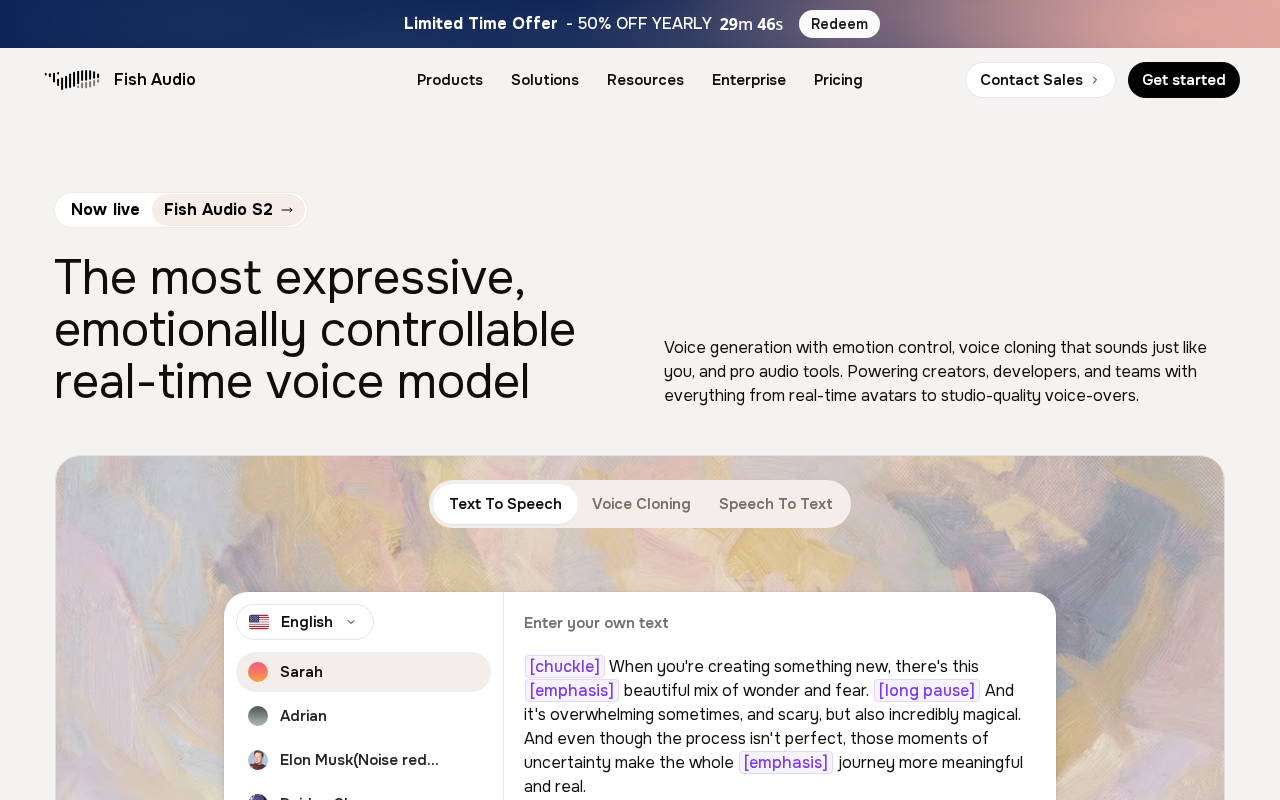
Fish Audio's S2 model — released in March 2026 — introduces word-level voice direction using inline tags written in plain language. Embed instructions like [whispering] Don't let them hear you or [long pause] Then she looked up directly in your script, and S2 adjusts delivery mid-sentence without post-production editing. Tags are open-domain: you write them in natural language rather than picking from a fixed list, and they work across all 80 supported languages.
Trained on over 10 million hours of audio, S2 delivers strong voice cloning with a real-time factor of 0.195 on a single H200 GPU, time-to-first-audio of ~100ms, and throughput exceeding 3,000 acoustic tokens per second. For creators producing non-English content — particularly Chinese, Japanese, Korean, and Arabic — Fish Audio delivers the most consistent results in the market, achieving best word error rate in 11 of 24 languages and best speaker similarity in 17 languages on the MiniMax Multilingual benchmark.
Benchmark results back up the quality leap. S2 scored 0.515 on the Audio Turing Test (24% above Seed-TTS, 33% above MiniMax-Speech), a 91.61% win rate on EmergentTTS-Eval for paralinguistics, and the lowest word error rate on Seed-TTS Eval (0.77%/1.24%). The model weights, fine-tuning code, and SGLang-based inference engine are all open-sourced — a rare move among top-tier TTS providers. Multi-speaker dialogue generation and batch comparison of delivery versions are coming soon.
Why It Stands Out: Word-level inline control, open-source model weights, benchmark-leading quality across 80 languages, and aggressive pricing make Fish Audio the best all-around pick for most creators and developers.
Pricing: Free tier available. Plus plan starts at ~$60–90/year for mid-volume creators.
2. ElevenLabs – Best for English Expressiveness
ElevenLabs built its reputation on producing some of the most natural-sounding English speech available. The Eleven v3 model, released in February 2026, supports 70+ languages, multi-speaker dialogue, and audio tags like [excited], [whispers], and [sighs]. In blind listening tests, v3 consistently ranks near the top for audiobook-style delivery where subtle breath patterns and pacing are critical.
The platform offers four models for different use cases: v3 for maximum expressiveness, Multilingual v2 for production-grade multi-language work, Flash v2.5 for ~75ms real-time latency, and Turbo v2 for fastest English generation. Instant voice cloning needs just 1–5 minutes of audio.
Why It Stands Out: If your project is English-first and emotional nuance matters more than price, ElevenLabs remains the gold standard.
Pricing: Free (10K chars/mo). Starter $5/mo, Creator $22/mo, Pro $99/mo, Scale $330/mo.
3. Murf AI – Best for Video Creators
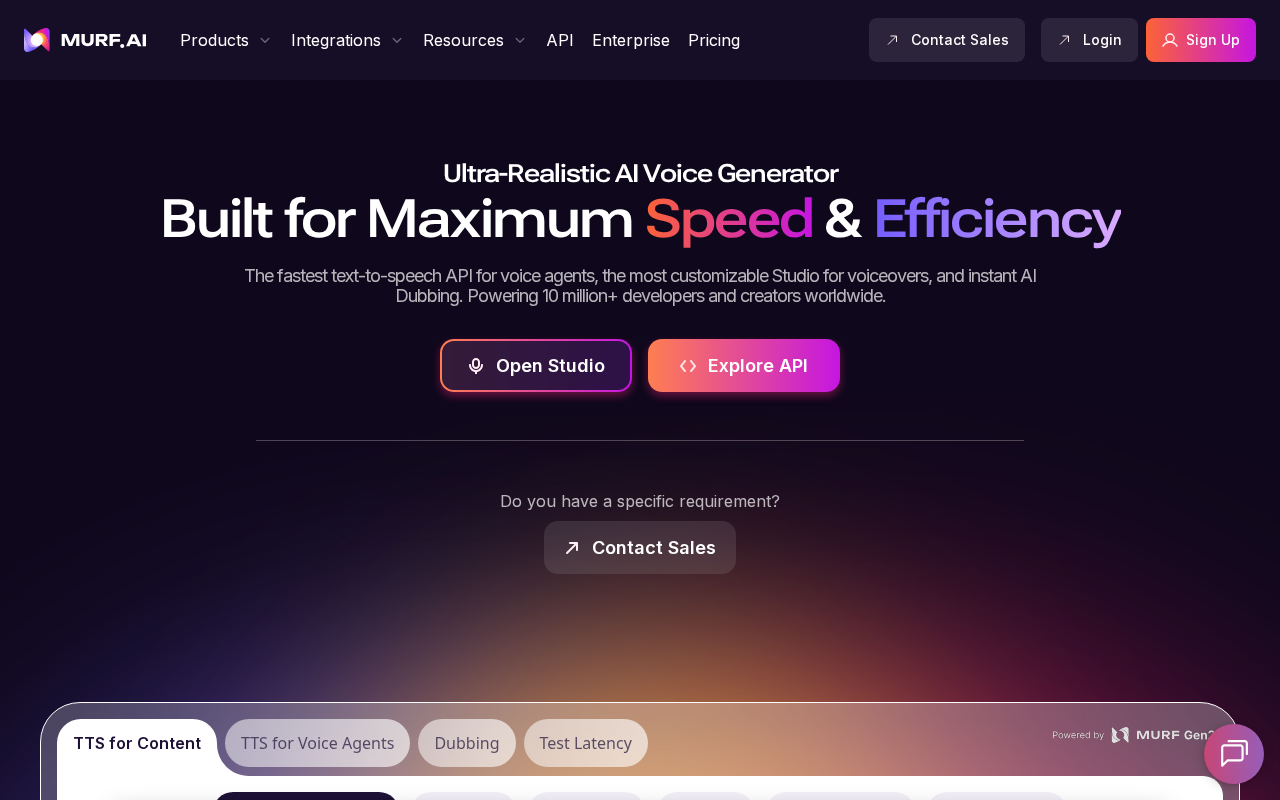
Murf isn't just a TTS tool — it's a voiceover production suite. The platform includes a built-in video editor, access to millions of stock music, image, and video assets, and a timeline editor for syncing audio to visuals. You get 120+ AI voices across 20 languages with controls for pitch, speed, emphasis, and pronunciation.
For creators who produce video content and need voiceovers that match their footage, Murf eliminates the need for separate editing software. The workflow from script to finished voiceover-video takes minutes instead of hours.
Why It Stands Out: The integrated video editor and stock asset library make Murf a one-stop shop for video creators who don't want to juggle multiple tools.
Pricing: Free plan (10 min). Creator plan $19/mo with commercial rights.
4. LOVO AI – Best Multilingual Emotion Control
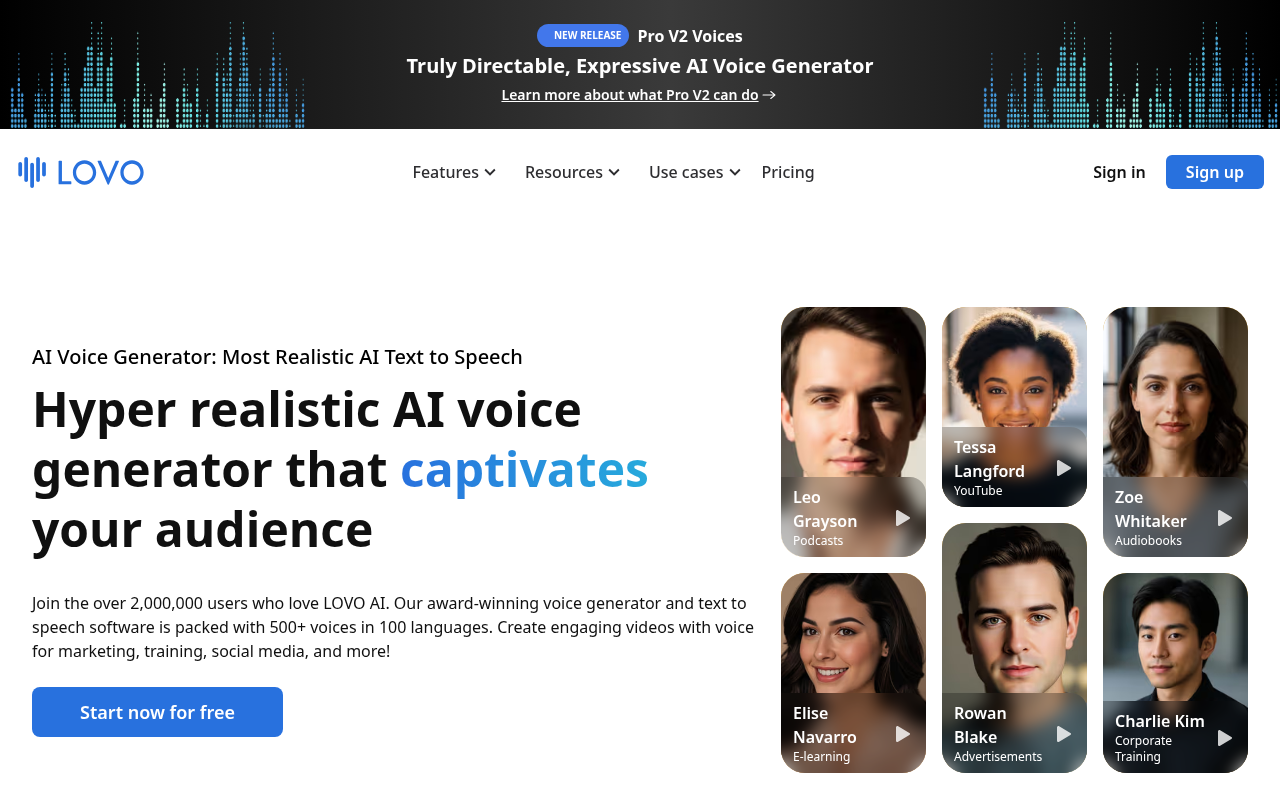
LOVO stands out with 500+ voices across 100+ languages and 30+ emotion presets. Voice cloning takes just one minute of sample audio. The emotion library goes beyond basic happy/sad — you get granular control over how the AI delivers each line.
For teams producing content in multiple languages who need consistent emotional delivery across all of them, LOVO handles the complexity well. The Pro plan includes a 14-day trial so you can test the full feature set before committing.
Why It Stands Out: The deepest emotion preset library in the market, paired with one of the widest language selections.
Pricing: Free plan (20 min with 14-day Pro trial). Paid plans from $24/mo.
5. PlayHT – Best Voice Variety
PlayHT gives you access to 800+ AI voices across 142+ languages and accents, pulling from multiple providers including Google, Amazon, IBM, and Microsoft. Voice cloning is available on all plans, including the free tier. The online text-to-audio editor lets you fine-tune output with multiple export options.
If your project requires niche accents or very specific voice characteristics, PlayHT's massive library gives you the widest selection to browse.
Why It Stands Out: Sheer voice variety. No other platform offers 800+ voices across this many languages and accents.
Pricing: Free tier with voice cloning. Paid plans vary by usage.
6. Amazon Polly – Best for Enterprise Developers
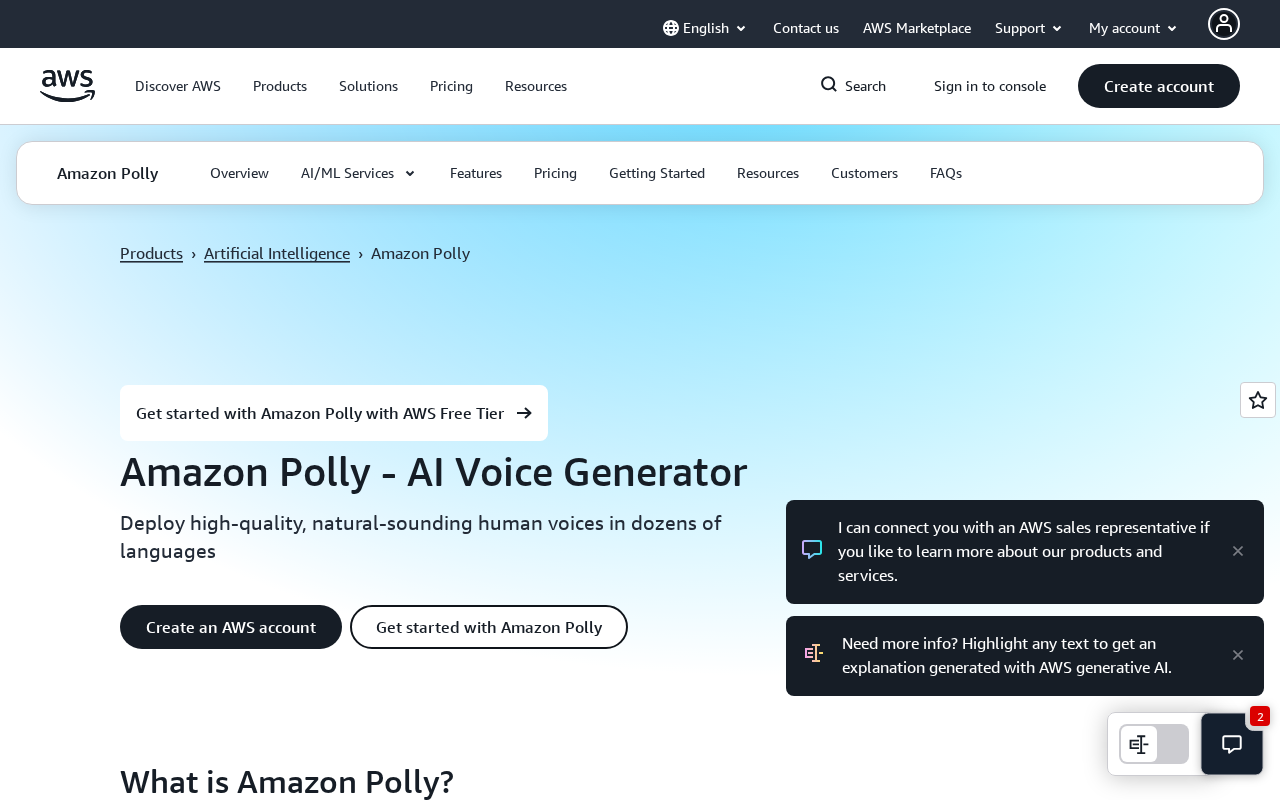
Amazon Polly is the TTS service built into AWS. It's not trying to win naturalness awards — it's built for reliability and scale. Standard voices cost $4 per million characters, neural voices $16, and the newer generative voices $30. The free tier gives you 5 million characters per month for the first year.
For development teams already in the AWS ecosystem, Polly integrates seamlessly with Lambda, S3, and other services. It handles high-volume, predictable workloads where uptime matters more than vocal personality.
Why It Stands Out: Deep AWS integration, predictable pay-per-character pricing, and a generous free tier make Polly the safe enterprise choice.
Pricing: Standard $4/1M chars. Neural $16/1M chars. Generative $30/1M chars. 5M chars/mo free (first year).
7. Google Cloud TTS – Best Free Tier for Developers
Google's Cloud TTS offers WaveNet and Neural2 voices with 1 million free characters per month — the most generous ongoing free tier among cloud providers. The voices sound polished and work well for app integrations, IVR systems, and notification audio.
The trade-off is less creative control compared to Fish Audio or ElevenLabs. You won't get fine-grained emotion tags or artistic voice cloning. But for production workloads where clean, professional speech is enough, Google delivers.
Why It Stands Out: 1 million free characters per month with no expiration date. Hard to beat for ongoing development and testing.
Pricing: 1M chars/mo free (WaveNet). Standard voices from $4/1M chars.
8. Narakeet – Best for Presentation-to-Video
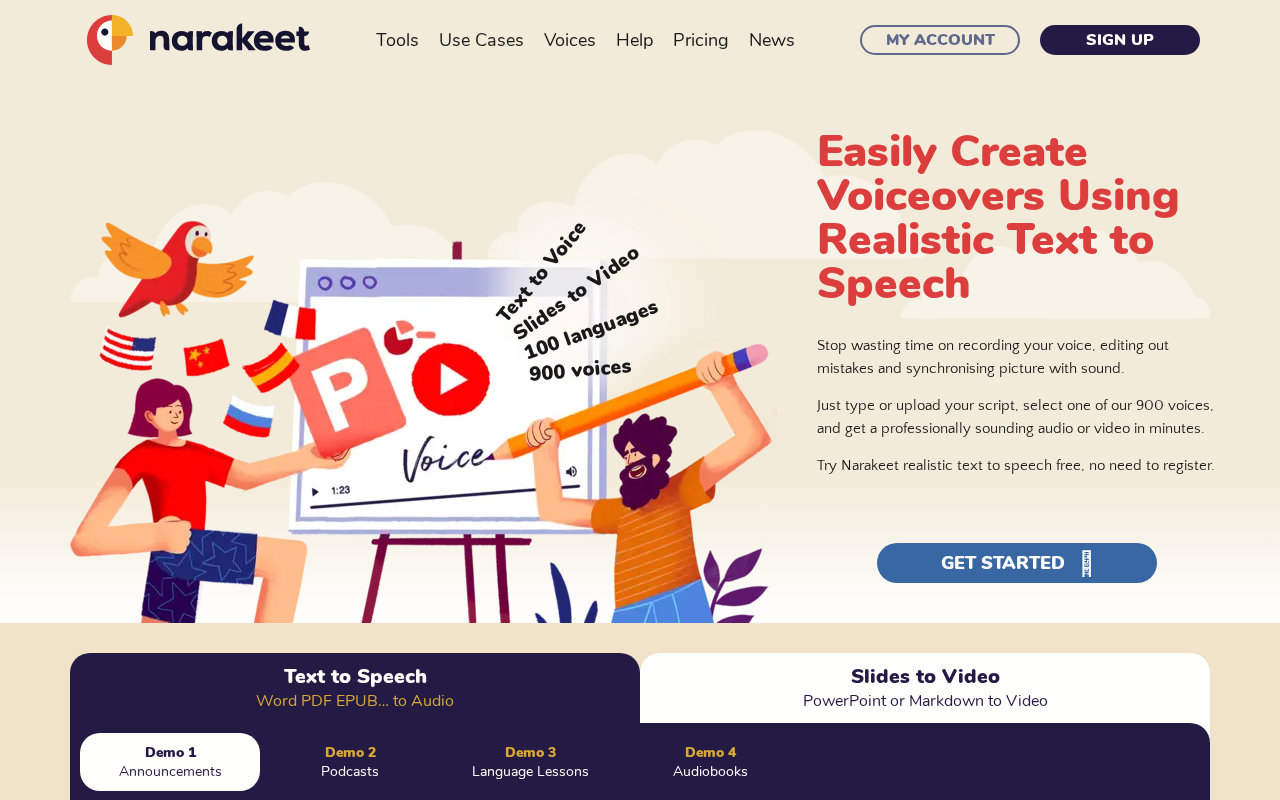
Narakeet does one thing well: it turns your PowerPoint, Google Slides, or Keynote presentations into narrated videos with AI voiceover. Upload your deck, add speaker notes, and Narakeet generates a finished video with synchronized narration. No editing required.
For educators, trainers, and corporate communicators who already have slide decks and just need audio on top, Narakeet is the fastest path from script to finished video.
Why It Stands Out: The fastest way to turn existing presentations into narrated videos. Zero learning curve.
Pricing: Pay-as-you-go: $0.20/min (30 min for $6), scaling down to $0.10/min at volume.
TTS Models Comparison Table
| Feature | Fish Audio | ElevenLabs | Murf AI | LOVO AI | PlayHT | Amazon Polly | Google Cloud TTS | Narakeet |
|---|---|---|---|---|---|---|---|---|
| Voice Quality | ★★★★★ | ★★★★★ | ★★★★ | ★★★★ | ★★★★ | ★★★ | ★★★★ | ★★★ |
| Voice Cloning | Yes (open-source) | 1-5 min | No | 1 min | Yes (all plans) | No | No | No |
| Languages | 80 | 70+ | 20 | 100+ | 142+ | 30+ | 40+ | 90+ |
| Emotion Control | Inline tags (open-domain) | Audio tags | Pitch/speed | 30+ presets | Basic | None | None | None |
| Free Tier | Yes | 10K chars | 10 min | 20 min | Yes | 5M chars/yr | 1M chars/mo | No |
| Best For | All-around | English narration | Video creators | Multilingual | Voice variety | Enterprise | Developers | Presentations |
How to Choose the Right TTS Model
Your choice comes down to three factors: what language you're producing in, how much control you need over emotional delivery, and your budget.
If you're creating content primarily in English and need the most human-sounding output, ElevenLabs v3 and Fish Audio S2 are your top two options. Fish Audio wins on price, multilingual quality (especially Asian languages), and open-source availability; ElevenLabs wins on raw English expressiveness.
For developers building voice into products, the cloud providers (Amazon Polly, Google Cloud TTS) offer the most predictable pricing and the easiest infrastructure integration. You trade creative control for reliability and scale. And if you're in a specific workflow niche — video production (Murf), presentations (Narakeet), or massive voice variety (PlayHT) — the specialized tools will save you time over the general-purpose platforms.
If you want to hear what production-quality TTS actually sounds like before committing to a platform, BeFreed is a good reference — its AI-powered book podcasts use Fish Audio and ElevenLabs to turn 50,000+ titles into audio you can listen to on the go. No API keys or setup required, just hit play.
Why Fish Audio Is the Best TTS Model in 2026
Fish Audio's rise to the top of TTS benchmarks accelerated with S2. The model's inline tag system lets you direct delivery at the word level — write [sarcastically] Oh, great or [breathes deeply] anywhere in your script and S2 adjusts on the fly. Because the tags are open-domain (plain language, not a fixed menu), the creative ceiling is effectively unlimited.
Voice cloning in S2 is built for production speed: ~100ms time-to-first-audio, 3,000+ acoustic tokens per second, and an 86.4% KV cache hit rate for repeated voice use. The cloned voice retains your speech patterns across all 80 supported languages. A Spanish narration in your cloned voice sounds like you actually speak Spanish — the model preserves your vocal identity while adapting to the target language's phonetics.
What makes S2 unique in the market is the combination of open-source weights and top-tier quality. You can self-host the model, fine-tune it on your own data, and deploy it with the included SGLang inference engine — all without per-character API fees. For teams who need full control over their TTS pipeline, no other model at this quality level offers that option.
For anyone exploring how AI voice technology fits into the bigger picture, AI 2041 by Kai-Fu Lee and Chen Qiufan paints a vivid picture of where these tools are heading. The book blends expert analysis with science fiction scenarios that explore AI's impact over the next two decades — including how synthetic voice and personalized content delivery will reshape media. Read AI 2041 on BeFreed. For a quick audio deep-dive, listen to The Voice AI Revolution: Audio Agents Reshaping Technology — it covers how AI voice agents are transforming human-computer interaction.


The Voice AI Revolution: Audio Agents Reshaping Technology
Lena and Eli explore how AI voice agents are transforming human-computer interaction, diving deep into the technology stack, architectural approaches, and real-world applications that are making conversation the future of AI.

Kai-Fu Lee's earlier book AI Superpowers is also worth your time — it explains how China's approach to AI deployment (including voice technology) differs from Silicon Valley's, and why that competition is driving faster innovation for everyone. Read AI Superpowers on BeFreed.

AI Superpowers
A thought-provoking exploration of AI's future, comparing China and Silicon Valley's approaches and their global impact.
Our Final Verdict
Fish Audio takes the top spot for its unmatched combination of quality, emotion control, and value. ElevenLabs remains the best choice for English-heavy projects where expressiveness justifies the premium. Murf AI and LOVO AI serve specific workflows (video and multilingual) better than the generalists. And the cloud providers — Polly and Google Cloud TTS — are the safe picks for teams building voice into production applications at scale.
The TTS space is moving fast. Whatever you pick today, test it against your actual use case — most platforms let you try before you buy. And if you want to experience what top-tier TTS sounds like in a finished product, give BeFreed a listen — it's the fastest way to hear these models doing real work.
FAQ
发现更多

Best TTS Model 2026: Top 9 AI Voice Generators Ranked
Compare the best TTS models in 2026. From Fish Audio to ElevenLabs and open-source picks, find the right AI voice generator for your needs.
BeFreed Team

8 Best Speechify Alternatives in 2026
Compare the 8 best Speechify alternatives in 2026. Find cheaper, better TTS apps for reading, learning, and content creation.
BeFreed Team

12 Best AI Podcast Generators 2026: In-Depth Tested Review
Discover the 12 best AI podcast generator 2026 apps. Ranked, tested, and verified. See why BeFreed is #1 for personalized AI learning podcasts.
BeFreed Team

Top 10 AI Tools for Learning & Productivity in 2026
Discover the 10 best AI tools for learning and productivity in 2026. From smart task managers to AI book summaries—boost your skills and save hours every week.
BeFreed Team

Oboe用的语音模型是什么
Oboe用的语音模型是什么
随着语音AI技术的飞速发展,理解其背后的模型架构已成为技术从业者的必修课。本方案适合希望从零开始系统掌握神经网络、Transformer模型及语音克隆技术的学习者,助力其在智能语音领域建立深厚的理论与实践基础。

我想知道oboe用的语音模型是哪个,你帮我研究一下
我想知道oboe用的语音模型是哪个,你帮我研究一下
本学习计划专为希望揭开特定语音产品技术底层的研究者设计,通过系统化的路径分析AI模型。它不仅能帮助你识别类似Oboe的语音模型,还能让你掌握从底层架构到应用分析的完整技术调研能力。

GPT Image 2: Complete Guide to OpenAI's Image Model in 2026
GPT Image 2 delivers near-perfect text rendering, 4K resolution, and reasoning-powered generation. See our hands-on comparison with SeeDream, Nano Banana 2, and more.
BeFreed Team

MTF transition, code game & Vocaloid engine
MTF transition, code game & Vocaloid engine
This plan is designed for individuals seeking to align their personal transition journey with high-level technical skills in software and music. It is ideal for aspiring trans creators who want to master game development and AI music production simultaneously.