The Zero-Failure Mindset: High-Speed Rail Lessons for Developers
Explore the Zero-Failure Mindset and lessons from high-speed rail engineering to improve software reliability and overcome the normalization of deviance.
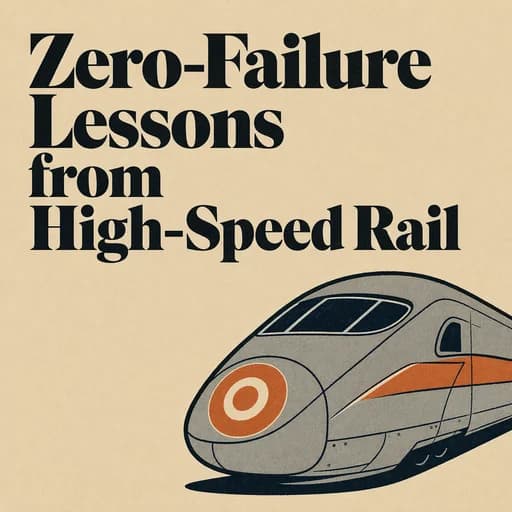
The Zero-Failure Mindset: High-Speed Rail Lessons for Developers 베스트 인용
The secret to a zero-failure reality is a structure of consequences where the institutional cost of a failure is designed to be higher than the cost of maintenance.
Generated by tractive
Why High-Speed Rail Engineers Sleep Better Than Tech Bros (Zero-Failure Mindset Secrets)






자주 묻는 질문
The Zero-Failure Mindset is a philosophy exemplified by Japan's Shinkansen, where even a 49-second delay is treated as a significant crisis requiring a formal apology. Unlike the common software industry attitude where service crashes are seen as routine, this mindset views any deviation from perfect operation as a signal of a leak in institutional design. It challenges developers to move beyond simply restarting failed services and instead investigate the deeper systemic issues that allow failures to occur.
Normalization of deviance occurs when developers begin to accept recurring service crashes or errors as normal parts of a workday, such as repeatedly restarting a container instead of fixing the root cause. This podcast discusses how this mental filing of failures as 'normal' contrasts sharply with high-speed rail engineering. By accepting these small deviations, software teams may ignore critical signals that their institutional design is failing, leading to a constant state of being on edge for the next alert.
Developers can learn that high reliability is often a result of deeper institutional design rather than just having better tools. While software teams often struggle with frequent pageduty alerts and service instability, high-speed rail engineers utilize a mindset where every second of delay is analyzed. By adopting these high-speed rail lessons, founders and developers can shift their perspective on system failure, moving away from ignoring issues and toward a more rigorous, zero-failure approach to software reliability.
샌프란시스코에서 컬럼비아 대학교 동문들이 만들었습니다
"Instead of endless scrolling, I just hit play on BeFreed. It saves me so much time."


"I never knew where to start with nonfiction—BeFreed’s book lists turned into podcasts gave me a clear path."


"Perfect balance between learning and entertainment. Finished ‘Thinking, Fast and Slow’ on my commute this week."
"Crazy how much I learned while walking the dog. BeFreed = small habits → big gains."
"Reading used to feel like a chore. Now it’s just part of my lifestyle."

"Feels effortless compared to reading. I’ve finished 6 books this month already."
"BeFreed turned my guilty doomscrolling into something that feels productive and inspiring."

"BeFreed turned my commute into learning time. 20-min podcasts are perfect for finishing books I never had time for."
"BeFreed replaced my podcast queue. Imagine Spotify for books — that’s it. 🙌"

"It is great for me to learn something from the book without reading it."
"The themed book list podcasts help me connect ideas across authors—like a guided audio journey."
"Makes me feel smarter every time before going to work"
 Ask ChatGPT
 Ask Claude
샌프란시스코에서 컬럼비아 대학교 동문들이 만들었습니다
"Instead of endless scrolling, I just hit play on BeFreed. It saves me so much time."
"I never knew where to start with nonfiction—BeFreed’s book lists turned into podcasts gave me a clear path."
"Perfect balance between learning and entertainment. Finished ‘Thinking, Fast and Slow’ on my commute this week."
"Crazy how much I learned while walking the dog. BeFreed = small habits → big gains."
"Reading used to feel like a chore. Now it’s just part of my lifestyle."
"Feels effortless compared to reading. I’ve finished 6 books this month already."
"BeFreed turned my guilty doomscrolling into something that feels productive and inspiring."
"BeFreed turned my commute into learning time. 20-min podcasts are perfect for finishing books I never had time for."
"BeFreed replaced my podcast queue. Imagine Spotify for books — that’s it. 🙌"
"It is great for me to learn something from the book without reading it."
"The themed book list podcasts help me connect ideas across authors—like a guided audio journey."
"Makes me feel smarter every time before going to work"
"Instead of endless scrolling, I just hit play on BeFreed. It saves me so much time."
"I never knew where to start with nonfiction—BeFreed’s book lists turned into podcasts gave me a clear path."
"Perfect balance between learning and entertainment. Finished ‘Thinking, Fast and Slow’ on my commute this week."
"Crazy how much I learned while walking the dog. BeFreed = small habits → big gains."
"Reading used to feel like a chore. Now it’s just part of my lifestyle."
"Feels effortless compared to reading. I’ve finished 6 books this month already."
"BeFreed turned my guilty doomscrolling into something that feels productive and inspiring."
"BeFreed turned my commute into learning time. 20-min podcasts are perfect for finishing books I never had time for."
"BeFreed replaced my podcast queue. Imagine Spotify for books — that’s it. 🙌"
"It is great for me to learn something from the book without reading it."
"The themed book list podcasts help me connect ideas across authors—like a guided audio journey."
"Makes me feel smarter every time before going to work"
"Instead of endless scrolling, I just hit play on BeFreed. It saves me so much time."
"I never knew where to start with nonfiction—BeFreed’s book lists turned into podcasts gave me a clear path."
"Perfect balance between learning and entertainment. Finished ‘Thinking, Fast and Slow’ on my commute this week."
"Crazy how much I learned while walking the dog. BeFreed = small habits → big gains."
"Reading used to feel like a chore. Now it’s just part of my lifestyle."
"Feels effortless compared to reading. I’ve finished 6 books this month already."
"BeFreed turned my guilty doomscrolling into something that feels productive and inspiring."
"BeFreed turned my commute into learning time. 20-min podcasts are perfect for finishing books I never had time for."
"BeFreed replaced my podcast queue. Imagine Spotify for books — that’s it. 🙌"
"It is great for me to learn something from the book without reading it."
"The themed book list podcasts help me connect ideas across authors—like a guided audio journey."
"Makes me feel smarter every time before going to work"