1장
When Exceptional Becomes the New Normal: The Revolution in Customer Experience
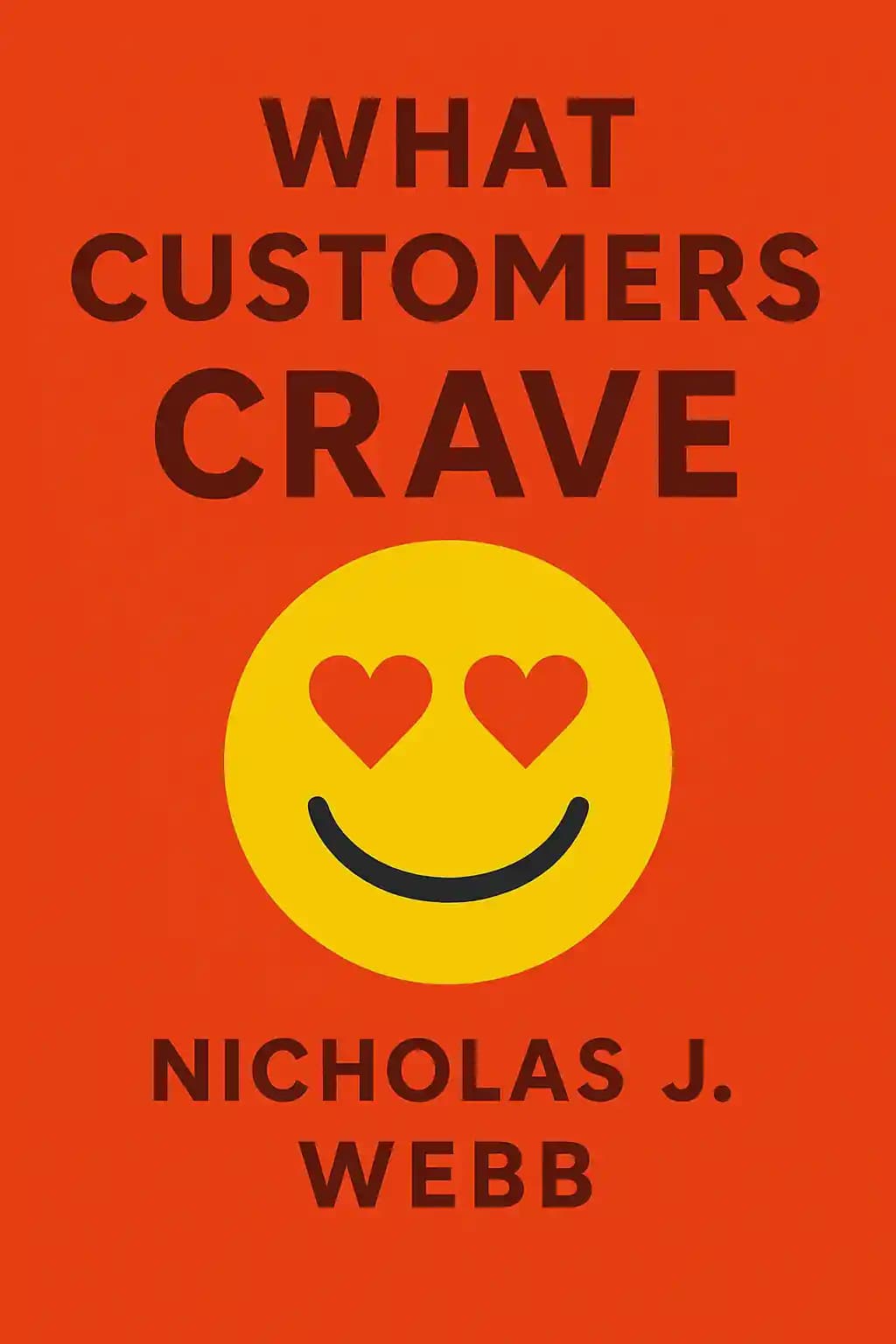
In a world where consumers have unlimited options at their fingertips, the concept of "good enough" customer service is a death sentence for businesses. Nicholas J. Webb's "What Customers Crave" has become a cornerstone text for forward-thinking companies seeking to thrive in today's hyper-connected marketplace. The book has garnered praise from industry leaders like Tony Robbins and has influenced customer experience strategies at companies ranging from startups to Fortune 500 corporations. What makes this book particularly relevant is its timing-published just as businesses began to recognize that traditional demographic-based customer segmentation was failing to deliver meaningful results in an era where consumers expect personalized experiences across all touchpoints.
2장
The Death of Traditional Customer Service
The customer service landscape has undergone a seismic shift that has fundamentally altered how businesses and consumers interact. For nearly half a century, large organizations controlled the narrative through one-way communication, telling consumers what their experience would be like. This "customer service-industrial complex" began with good intentions in the post-war era, built on principles of efficiency and standardization, but gradually evolved into a self-focused system rather than a customer-focused one. Companies created elaborate phone trees, standardized scripts, and rigid policies that served their internal needs while frustrating customers.
The internet changed everything, democratizing information and shifting power dynamics permanently. In the early 2000s, connection points like Yelp, TripAdvisor, and Amazon emerged where people could rate experiences and share detailed opinions about products and services. Social media platforms amplified these voices further, allowing a single customer complaint to potentially reach millions. This power shifted irreversibly from businesses to consumers, creating a new paradigm where reputation management became crucial for survival. Today, we've reached digital ubiquity-customers have unlimited options to buy anything, anywhere, anytime, with varying prices and quality. They can praise or condemn with a few thumb flicks, and their reviews carry more weight than any corporate marketing message.
Most organizations still believe they deliver exceptional customer service, but their customers overwhelmingly disagree. Studies show that while 80% of companies believe they provide "superior" service, only 8% of customers agree. This dramatic disconnect exists because companies haven't transitioned from the old industrial complex mindset to today's connected world. They remain internally focused on profit metrics, call center efficiency, and cost reduction rather than externally focused on what customers truly value - like time, convenience, and personalized attention.
Traditional customer segmentation by age, ethnicity, economic status, gender, and geography has become increasingly ineffective in predicting behavior or preferences. Think of high school cliques-despite similar demographics, students form groups based on shared interests, values, and attitudes. These patterns continue throughout life, with people connecting across traditional demographic boundaries through shared passions and preferences. To create exceptional experiences, businesses must understand specific customer types and deliver relevant experiences across both digital and non-digital channels, from social media to in-store interactions.
The solution isn't found in complex algorithms or big data alone, but in three fundamental principles: 1) Understand customers through their passions and pain points, not just demographics - what they love, hate, and value most; 2) Invent exceptional experiences across all five critical touchpoints (pre-touch, first-touch, core-touch, last-touch, and in-touch), ensuring consistency and quality at each interaction; and 3) Express these experiences through both digital and non-digital means, recognizing that different customers prefer different channels of interaction. Success requires implementing these principles systematically while maintaining authenticity and personal connection in an increasingly digital world.
3장
The Power Shift: What Today's Customers Really Crave
Three fundamental shifts determine your business's future: the innovation shift, the customer shift, and the connection shift. These transformative forces have completely reshaped the business landscape and must be incorporated across all customer touchpoints to create experiences that truly resonate in today's market.
The innovation shift has transformed how businesses compete. In the past, organizations invented products and dictated customer experiences through traditional marketing channels. Today, with extreme competition and value/price saturation, successful companies use disruptive innovation to create incredible human experiences. Uber revolutionized transportation not by inventing new vehicles, but by reimagining the entire service delivery model. Netflix disrupted entertainment by understanding that convenience and personalization matter more than physical media. Companies like Airbnb and DoorDash similarly succeeded by innovating the experience rather than the core product.
The customer shift has placed unprecedented power in consumers' hands, creating a dramatic reversal in the traditional business-customer dynamic. Today's customers have unlimited purchasing options, instant access to comparative pricing, and can vet businesses through reviews and ratings within seconds. Control has decisively moved from businesses to customers - there's nowhere to hide with poor products or service. A single negative experience can spread virally across social platforms within hours. Conversely, exceptional service gets broadcast across social media, creating powerful word-of-mouth marketing. Amazon illustrates this shift perfectly by obsessing over customer needs, creating frictionless shopping experiences, implementing customer-based rating systems, and maintaining transparency in their operations.
The connection shift has made customers constantly accessible while simultaneously making businesses perpetually accountable. Google research shows mobile searches trigger immediate follow-up actions, with 55% of conversions happening within an hour and 73% resulting in additional actions like store visits, phone calls, or purchases. Your business is likely being researched right now, with potential customers checking your online reputation, reviews, and social media presence. While this constant connectivity puts tremendous power in customers' hands, providing exceptional experiences remains firmly in yours. Companies like Apple and Starbucks excel by ensuring consistent quality across both digital and physical touchpoints.
Most organizations live in a "reality distortion field," deluding themselves that good service at one or two touchpoints is sufficient for success. This complacency is dangerous - one gap in exceptional service at any touchpoint can destroy your business in today's hyperconnected world. The key is to apply deep customer knowledge across their entire journey, from initial awareness through post-purchase support, both digitally and non-digitally. Organizations that master this comprehensive approach, like Ritz-Carlton and Disney, consistently outshine competitors by delivering seamless, exceptional experiences at every interaction point.
4장
Understanding Customer Types: The Key to Relevance
Customer types are defined by beliefs-what people really love and really hate. Understanding customers at this emotional level reveals how to make them feel special and relevant, leading to more business and referrals. Most organizations mistakenly treat customers as a "monolithic demographic" rather than identifying distinct types with unique preferences.
The Power Shift Insights Formula provides a straightforward approach: knowing what a customer Hates (H) plus what they Love (L) equals their Customer Type (CT). For example, at a burrito restaurant, some customers love the food but hate waiting in line, while others love the food enough to tolerate the wait-making them different customer types requiring different experiences.
Traditional market segmentation remains useful for basic targeting but falls short in designing exceptional customer experiences. Simply categorizing customers by demographics (like "thirty-something, affluent, Hispanic female") fails to reveal their true preferences. The best way to fail in today's hypercompetitive marketplace is attempting to deliver one-size-fits-all customer experiences.
When we get granular about what different customer types hate and love, value stacking naturally occurs. As we invent better experiences for one customer type, we often create benefits that work for other types too. This layering effect is how we achieve perfect human experiences. A fast food restaurant that creates both a great burger and an efficient service system can satisfy customers who love burgers but hate long lines, effectively stacking value across different customer preferences.
To identify your customer types, conduct brainstorming sessions to identify potential customer attributes that might impact their experience. Test and refine these types using digital analytics and contact point innovation-experiencing what customers experience at the actual service point rather than theorizing in boardrooms. Undergo the entire customer journey yourself, sitting with customers, talking to employees, and identifying what different types love and hate across all touchpoints.
5장
The Anatomy of Exceptional Customer Experiences
To simplify customer typing, consider three key building blocks: ESP (Expectation, Sensory Experience, and Price/Value). These components form the foundation of understanding what customers hate and love. Customers arrive with expectations that must be exceeded at every touchpoint, from initial contact through post-purchase support. They experience your offerings through their senses, and they evaluate value against price in increasingly sophisticated ways.
Each customer arrives with preconceived expectations about their experience, shaped by past experiences, marketing messages, competitor offerings, and word-of-mouth recommendations. If you deliver at or below that expectation, you fail-it's just a matter of when. Even the best product won't matter if customers expect something different. While great technology was once a differentiator, it's now simply table stakes. Today's competitive advantage lies in creating exceptional customer experiences that surprise and delight at every interaction point.
Humans gather information through multiple sensory inputs-sight, sound, smell, touch, and taste-which we aggregate to form opinions about experiences. The best companies ensure customers have amazing experiences across each sensory input at every touchpoint. Hollister brilliantly demonstrates this with their signature scent pumped throughout stores, attractive staff, beach-themed design with live video feeds, and carefully selected music-all creating an immersive story that drives sales. Similarly, Singapore Airlines creates a distinctive sensory experience with their signature scent worn by flight attendants, custom-designed cabin lighting, and carefully curated meal service. Apple stores utilize minimalist design, specific lighting temperatures, and precise table angles to create a consistent sensory experience worldwide.
What customers expect to receive correlates directly with what they pay, but this relationship is increasingly complex in today's market. If price is less than the expected value, you'll increase sales and customer satisfaction. If price exceeds expected value-the "Price/Value Slip"-customers will leave in droves and share their disappointment across social media platforms. Hampton Inn exemplifies the price/value equation by keeping prices low while offering amenities that make the experience feel upscale, such as free breakfast, clean rooms, and friendly service. They deliver more than expected, creating loyal customers who become brand advocates. Other successful examples include Costco's high-quality private label products at competitive prices and Southwest Airlines' free baggage policy combined with friendly service, both of which consistently exceed customer value expectations for their price points.
The most successful companies understand that these three elements - expectations, sensory experiences, and price/value relationships - must work in harmony. They systematically audit each touchpoint against these criteria and continuously innovate to stay ahead of evolving customer expectations. Regular feedback loops and customer journey mapping help identify areas where the ESP framework can be strengthened to create truly exceptional experiences.
6장
The Five Touchpoints: Mapping the Complete Customer Journey
The customer journey can be broken down into five critical touchpoints: pre-touch, first-touch, core-touch, last-touch, and in-touch. Each represents a distinct phase of customer interaction that must be carefully designed to create exceptional experiences.
The pre-touchpoint occurs when potential customers haven't yet engaged with your product or service and are researching whether to give it a try. Google's "Zero Moment of Truth" describes this pre-touch information phase where customers can conduct complete background searches on your business in seconds. If you're bad, there's nowhere to hide; if you're great, customers will promote you. Your digital reputation is the most critical part of the pre-touch journey, but physical pre-touchpoints remain important for many businesses. The appearance of your location-parking lot, signage, landscaping, windows-creates expectations.
The first touchpoint is crucial-it sets the trajectory for your entire customer relationship. If you fail at this touchpoint, fixing the damage becomes extremely problematic and expensive. The human brain forms powerful opinions about brands both consciously and subconsciously. At non-digital touchpoints, customers rapidly absorb smells, sounds, tastes and sights. At digital touchpoints, they process design, color and navigation. First impressions determine customer trajectories-like a golf swing where being millimeters off can send the ball hundreds of yards in the wrong direction.
The core touchpoint occurs when customers engage directly with your product, brand, or service after navigating through pre-touch research and first touchpoint engagement. Most organizations focus exclusively on this touchpoint but deliver inconsistent experiences. The core experience consists of multiple internal touchpoints-like a restaurant visit where excellent service is undermined by an unclean restroom. One poor core touchpoint can unravel everything positive in the customer experience.
The last touchpoint is crucial for creating memorable customer experiences. Like exceptional TED talks that engage audiences through authentic dialogue rather than one-way communication, businesses must connect emotionally with customers throughout their journey. The effectiveness of your last touchpoint is measured by whether customers want to return. A successful last touch leaves customers feeling great about themselves and their purchase. Nordstrom exemplifies powerful yet subtle last touchpoints-their checkout attendants walk around the counter to personally hand customers their shopping bags, a simple gesture with strong emotional impact.
The in-touchpoint occurs when businesses leverage their knowledge of customer interests to provide ongoing value through content and information, even after the purchase. This approach transforms companies into thought leaders and value providers for both current and past customers. The key is resisting the temptation to sell customers more products. Instead, deliver thoughtfully designed packets of value without asking for anything in return. This completes the cycle that began with the pre-touch moment.
7장
Innovation: The Secret Weapon for Customer Experience Excellence
Innovation is the secret weapon for delivering world-class customer experiences. Rather than creating "bright shiny objects" to drive sales, disruptive innovators use powerful tools to transform customer insights into exceptional experiences across touchpoints. Organizations can't afford to dismiss innovation infrastructure in today's disruptive marketplace where customers demand more-there's a direct correlation between incremental innovation and mediocre customer experience. Companies like Apple and Amazon have demonstrated that continuous innovation in customer experience can create lasting competitive advantages and foster deep customer loyalty.
The innovation process can be distilled into three simple but powerful steps: assessment, roadmap, and execution. Just as doctors shouldn't prescribe medication without examination, organizations shouldn't implement innovation programs without thorough assessment. This assessment phase includes evaluating current capabilities, analyzing competitor offerings, and gathering detailed customer feedback through multiple channels. After completing your innovation readiness assessment and identifying resource gaps, you must create a customized innovation roadmap that outlines specific initiatives, timelines, and success metrics. Finally, focus on execution and measurement, determining how much your innovation improved a specific strategic initiative. This might involve A/B testing, customer satisfaction scores, or revenue impact analysis.
For innovation programs to succeed, six critical elements must be present: Complete (having all ecosystem components in place), Customized (tailored to your specific organization), Culture (the life support system that encourages courage and collaboration), Collaborate (creating environments for idea exchange), Connect (building relationships through technology and activities), and Customer-Centric (focusing outward on customers rather than inward on enterprise benefits). Companies like Google and 3M have mastered these elements by allowing employees dedicated time for innovation projects, creating cross-functional teams, and maintaining strong feedback loops with customers.
Every new customer experience is fundamentally an innovation. Like a stock portfolio, innovation requires balancing risk and reward. Incremental innovations are low-risk but deliver correspondingly low value, while disruptive innovations offer higher rewards. Most organizations create only accidental, incremental improvements because they lack formal innovation processes. Netflix exemplifies disruptive innovation by completely reimagining movie rental rather than making incremental improvements to existing systems. Similarly, Uber revolutionized transportation by focusing on customer pain points rather than traditional taxi service improvements. Other successful examples include Amazon's one-click ordering, Disney's MagicBand, and Starbucks' mobile ordering system - all innovations that significantly enhanced customer experience while creating new industry standards.
Innovation success also requires establishing clear metrics and accountability systems. Organizations should track both leading indicators (number of ideas generated, prototype development time) and lagging indicators (customer adoption rates, revenue impact) to ensure their innovation efforts are delivering real value. Regular innovation reviews, similar to quarterly business reviews, help maintain momentum and ensure resources are allocated effectively.
8장
The Power of Collaboration in Customer Experience Design
Creating incredible customer solutions requires connecting and collaborating with others. No individual can know everything or have the most creative ideas alone. Exceptional innovation demands incorporating diverse life skills and insights from different collaborators to maximize customer value.
There are four primary collaborative customer types that each bring unique perspectives to designing exceptional experiences: consumers, stakeholders, partners, and even competitors. The consumer is one of the most important collaborators in your innovation strategic alliance. There are four key ways to cocreate with customers: Digital Sandboxes like Southwest Airlines' "Nuts About Southwest" blog where customers express what they love and hate; Online Challenges that reward customers for improvement ideas; Innovation Safaris where you experience each touchpoint from the customer's perspective; and Customer Brainstorming Meetings that gather feedback directly from customers.
After customers, employees are the next most important collaborators. They're problem-, opportunity-, and customer-facing, with frontline knowledge about delivering on enterprise strategy. Organizations must leverage stakeholder participation through innovation best practices and internal social networks that drive engagement and collaboration.
Some of the best innovations come from creating integrated value with strategic partners. One hospital chain conducted brainstorming sessions with vendors that resulted in new technologies and services worth $15 million in benefits at zero cost, while also increasing vendor profits and involvement.
Open innovation can mean partnering with everyone-even competitors. Sierra Nevada Brewing Company founder Ken Grossman exemplifies this approach, collaborating with competing brewers for special projects like the company's thirtieth anniversary beer series. Businesses with an abundance mindset can find opportunities to collaborate with competitors for mutual benefit, while those with a scarcity perspective see only enemies.
9장
Technology and the Future of Customer Experience
Technology in customer experience can be a double-edged sword. Many organizations rely on outdated tools like Net Promoter Scores, CRM systems, and digital surveys that provide incomplete insights about customer preferences. While installing technology often gives executives comfort, it can remove the responsibility of truly understanding customers.
Rather than focusing on specific technologies that would quickly become outdated, consider five key drivers that will determine your enterprise's success with technology and customer experience for decades to come:
Digital Ubiquity means customers can find, research, and engage with us through connected devices-currently mobile, soon wearable technologies. Organizations often create separate silos for digital and non-digital experiences, but the key is building these experiences concurrently with your entire team to ensure products, services, channels and branding create one integrated solution.
Granularity allows us to deliver more relevant messaging and better products. We've evolved from macro-customer experience designers to micro-designers creating experiences for specific subsegments. The foundation of excellent customer experience is relevance, which requires granular understanding of unique customer segments.
Meaningful Data comes from cognitive computing (formerly artificial intelligence) which is revolutionizing big data analytics. We need to understand what our data means-every data signal has meaning. Organizations that tap into unsolicited social data gain advantages over those relying solely on traditional, solicited data.
Actionable Insights come from meaningful data-information we can actually use. Many companies waste millions on one-dimensional insights that mean virtually nothing. The true value of technology will be our ability to understand the meaning behind customer behaviors, words, and actions.
Measurability is essential because "what gets measured gets done." Most organizations either can't measure their initiatives or use incorrect measurement tools, leaving them unable to determine success. Executive dashboards are powerful tools that display complex data in simple graphic interfaces, allowing leaders to see the effects of customer experience initiatives and identify improvements.
10장
Your Roadmap to Customer Experience Excellence
Creating exceptional customer experiences isn't a box to check-it must become part of your organizational DNA. Companies fall into two categories: those that treat customer experience as an annual event and those that live it daily. Like fitness, the theory is simple but execution requires sustained focus, the right team, leadership commitment, and proper measurements to prove ROI.
To build an effective customer experience roadmap: 1) Construct a team of stakeholders; 2) Hold brainstorming sessions to identify customer types and touchpoints; 3) Conduct innovation safaris both digitally and non-digitally; 4) Cross-pollinate ideas by borrowing engagement strategies from other companies; 5) Implement technology intelligently as a servant of good strategy; 6) Talk to both lovers and haters of your brand for insights; 7) Make your roadmap visual, fun, and easy to understand with infographics; 8) Get expert help rather than trying to do everything yourself; and 9) Measure everything to prove ROI and secure continued funding.
To lead your industry in customer satisfaction, hire great people based on character rather than just skills; be a great leader worthy of great employees; encourage smart risk-taking and innovation; truly understand what different customer types love and hate; complete the entire customer journey with exceptional experiences at all touchpoints; create a perfect blend between digital and non-digital experiences; develop customer experience design as a core competency; pursue disruptive rather than incremental innovation; and build a complete ecosystem of tools, systems, and processes.
Remember that serving customers well isn't just good business-it's about living a meaningful life by making others happy. In today's hypercompetitive marketplace, the companies that will thrive are those that truly understand what customers crave and deliver experiences that exceed expectations at every touchpoint.