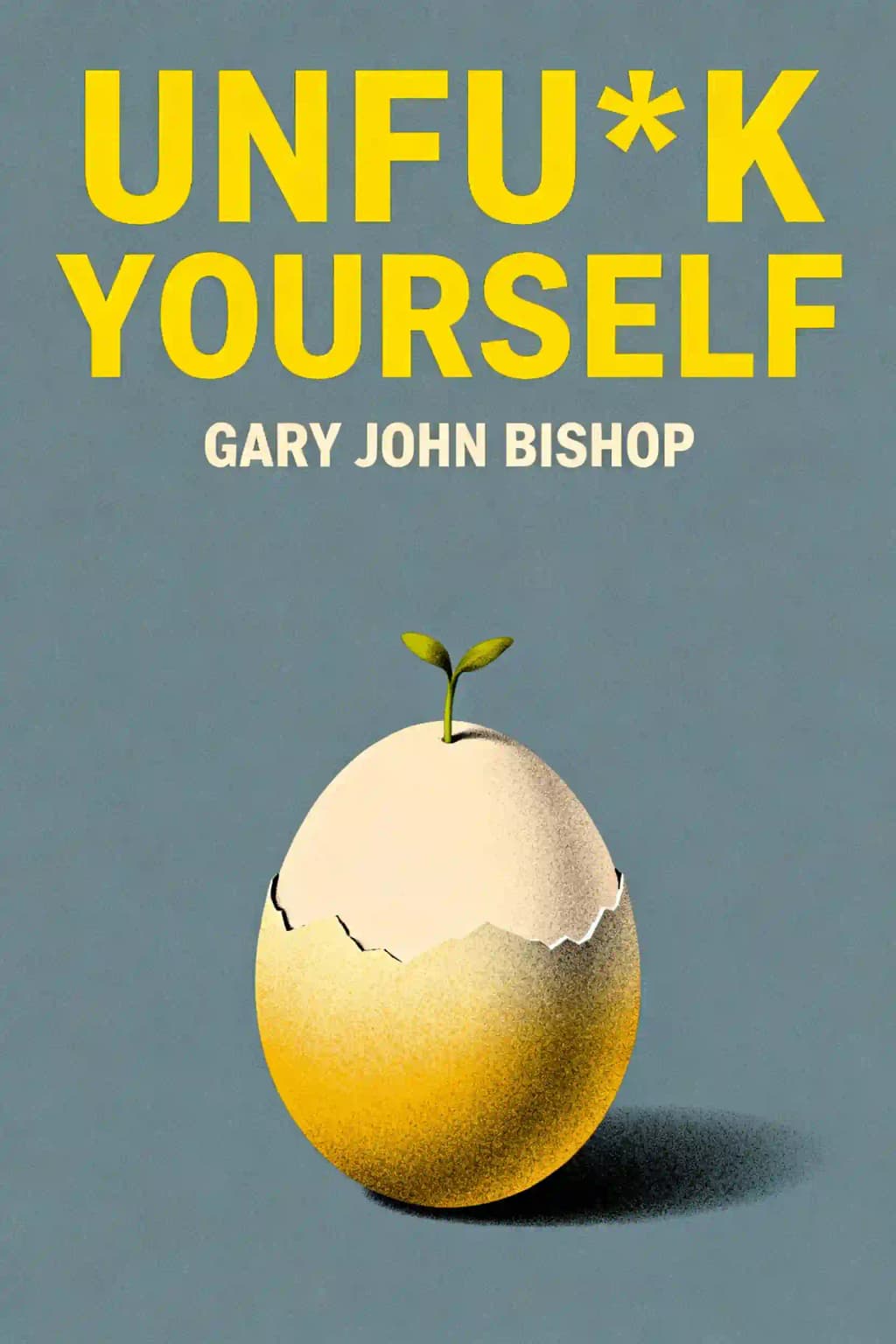
Blunt, profane, and life-changing, this 2-million-copy NYT bestseller challenges you to stop overthinking and start doing. Hailed as a "refreshing, BS-free guide," Bishop's tough-love approach asks one powerful question: Are you willing to transform your life today?
Gary John Bishop is the New York Times bestselling author of Unfu*k Yourself and a leading voice in modern self-help, renowned for his gritty, no-nonsense approach to personal transformation.
Born in Glasgow, Scotland, his working-class roots and experience as a Senior Program Director for a global personal development company shaped his signature "urban philosophy"—a blend of existential principles and actionable strategies for overcoming self-limiting behaviors. The book distills his 25+ years of coaching experience into a guide for breaking mental patterns, emphasizing personal accountability and pragmatic action over positive thinking.
A sought-after speaker and podcast host, Bishop has expanded his impact with follow-up works like Stop Doing That Sh*t and Love Unfu*ked, which tackle relationship dynamics and sustained behavioral change. His methods are embraced by CEOs, athletes, and individuals seeking unfiltered advice, with Unfu*k Yourself selling over 2 million copies worldwide and translated into 35+ languages.
Originally self-published in 2016, its viral success led to a HarperCollins deal, cementing Bishop’s status as a disruptive force in the personal growth space.
Unfuk Yourself* is a no-nonsense guide to breaking free from self-sabotage by confronting negative self-talk and taking decisive action. Bishop argues that overthinking fuels inertia, and real change comes from shifting internal dialogue to empower behavioral shifts. The book’s seven core assertions, like “I am wired to win,” serve as mantras to reframe mindset and spur tangible progress.
This book suits individuals feeling stuck in self-doubt, overthinkers paralyzed by analysis, and readers tired of overly polished self-help advice. It’s ideal for those who resonate with blunt, action-oriented strategies rather than abstract theories. Bishop specifically targets people ready to “stop being a passenger in their own life.”
Yes—ranked a New York Times bestseller, the book’s strength lies in its actionable, no-fluff approach. Readers praise its direct language and relatable examples, though some critique its repetitive tone. If you respond well to tough-love motivation (e.g., “You are not your thoughts; you are what you do”), it offers fresh perspective.
Unlike gentler guides like Atomic Habits, Bishop’s approach prioritizes blunt accountability over incremental habit-building. It shares similarities with David Goggins’ intensity but focuses more on cognitive rewiring than physical endurance. The book’s distinct edge makes it stand out in crowded self-help spaces.
Some reviewers argue the approach oversimplifies complex mental health issues or dismisses systemic barriers. The relentless tone may alienate readers preferring empathetic guidance. However, supporters counter that its unapologetic style effectively shocks complacent thinkers into action.
These lines encapsulate the book’s emphasis on proactive self-determination.
In an era of remote work and social media comparison, Bishop’s message counters analysis paralysis and perfectionism. The rise of AI-driven life coaching has renewed interest in human-authored, gritty wisdom that prioritizes grit over algorithms.
A Scottish-born personal development expert, Bishop blends working-class Glasgow grit with 20+ years coaching experience. His “urban philosophy” rejects theoretical fluff, focusing instead on actionable mindset shifts. Prior to writing, he directed programs for a major training firm.
The “inner critic” represents self-sabotaging thoughts that magnify fear and doubt. Bishop teaches readers to confront this voice head-on through deliberate language changes (e.g., swapping “What if I fail?” with “Failure is feedback”).
Consider Can’t Hurt Me (David Goggins) for extreme accountability or The Subtle Art of Not Giving a Fck* (Mark Manson) for comparable bluntness. However, Bishop’s fusion of cognitive psychology and street-smart advice remains unique.
This approach merges academic personal development principles with real-world pragmatism. It emphasizes that transformation occurs not through ideal conditions, but through leveraging current circumstances—a stance refined from Bishop’s own working-class roots.
저자의 목소리로 책을 느껴보세요
지식을 흥미롭고 예시가 풍부한 인사이트로 전환
핵심 아이디어를 빠르게 캡처하여 신속하게 학습
재미있고 매력적인 방식으로 책을 즐기세요
I am wired to win.
I embrace the uncertainty.
I am not my thoughts; I am what I do.
I expect nothing and accept everything.
I am relentless.
Unfu*K Yourself의 핵심 아이디어를 이해하기 쉬운 포인트로 분해하여 혁신적인 팀이 어떻게 창조하고, 협력하고, 성장하는지 이해합니다.
Unfu*K Yourself을 빠른 기억 단서로 압축하여 솔직함, 팀워크, 창의적 회복력의 핵심 원칙을 강조합니다.

생생한 스토리텔링을 통해 Unfu*K Yourself을 경험하고, 혁신 교훈을 기억에 남고 적용할 수 있는 순간으로 바꿉니다.
무엇이든 물어보고, 목소리를 선택하고, 진정으로 공감되는 인사이트를 함께 만들어보세요.

샌프란시스코에서 컬럼비아 대학교 동문들이 만들었습니다
"Instead of endless scrolling, I just hit play on BeFreed. It saves me so much time."
"I never knew where to start with nonfiction—BeFreed’s book lists turned into podcasts gave me a clear path."
"Perfect balance between learning and entertainment. Finished ‘Thinking, Fast and Slow’ on my commute this week."
"Crazy how much I learned while walking the dog. BeFreed = small habits → big gains."
"Reading used to feel like a chore. Now it’s just part of my lifestyle."
"Feels effortless compared to reading. I’ve finished 6 books this month already."
"BeFreed turned my guilty doomscrolling into something that feels productive and inspiring."
"BeFreed turned my commute into learning time. 20-min podcasts are perfect for finishing books I never had time for."
"BeFreed replaced my podcast queue. Imagine Spotify for books — that’s it. 🙌"
"It is great for me to learn something from the book without reading it."
"The themed book list podcasts help me connect ideas across authors—like a guided audio journey."
"Makes me feel smarter every time before going to work"
샌프란시스코에서 컬럼비아 대학교 동문들이 만들었습니다

Unfu*K Yourself 요약을 무료 PDF 또는 EPUB으로 받으세요. 인쇄하거나 오프라인에서 언제든 읽을 수 있습니다.
Ever notice how that voice in your head never shuts up? That ongoing commentary isn't just background noise-it's actively shaping your reality. The conversations we have with ourselves are the most influential dialogues we'll ever experience, architects of our emotions, decisions, and ultimately, our lives. When you tell yourself "I can't do this" or "This always happens to me," you're not describing reality-you're creating it. These statements become self-fulfilling prophecies. Your brain doesn't distinguish between what's objectively true and what you've convinced yourself is true. It simply responds to your internal dialogue. Neuroplasticity explains why negative thought patterns become so difficult to break. Repeated thoughts carve neural pathways in your brain. The more you think a particular thought, the deeper that neural pathway becomes, making it your brain's default route. It's like walking through a meadow-the first time is difficult, but with each pass, the path becomes more defined. The language you use matters tremendously. Notice how different "I am struggling with this" feels compared to "I am a failure." One acknowledges a temporary state; the other defines your entire identity. This distinction fundamentally alters how you approach challenges. What if you started speaking to yourself with the same compassion you'd offer a friend? What if, instead of focusing on what went wrong, you asked what you learned? These simple shifts can transform not just how you feel, but who you become.