In Nietzsche's explosive final works, he dismantles religion, morality, and "truth" itself. From influencing Freud's psychology to inspiring Nine Inch Nails, these philosophical hand grenades still detonate minds today. What dangerous idea within made Nietzsche declare: "I am not a man, I am dynamite"?
Friedrich Wilhelm Nietzsche (1844–1900), the iconoclastic German philosopher behind Twilight of the Idols and The Antichrist, remains a towering figure in existential and moral philosophy. A classical philologist turned radical thinker, Nietzsche’s works—including Thus Spoke Zarathustra, Beyond Good and Evil, and On the Genealogy of Morals—interrogate the foundations of morality, religion, and cultural norms, championing self-determination and “life-affirmation.”
His nomadic lifestyle during the 1880s, marked by debilitating health struggles, fueled his critiques of societal dogmas, crystallized in Twilight of the Idols’ dismantling of Western philosophy and The Antichrist’s polemic against Christianity.
Nietzsche’s tenure as a professor at the University of Basel and his influence on existentialism, postmodernism, and psychology underscore his intellectual legacy. His aphoristic style and concepts like the “will to power” and “Übermensch” permeate modern discourse on ethics and individualism. Translated into over 50 languages, Nietzsche’s provocative ideas continue to ignite debate, with Twilight of the Idols often cited as a gateway to his broader philosophical project.
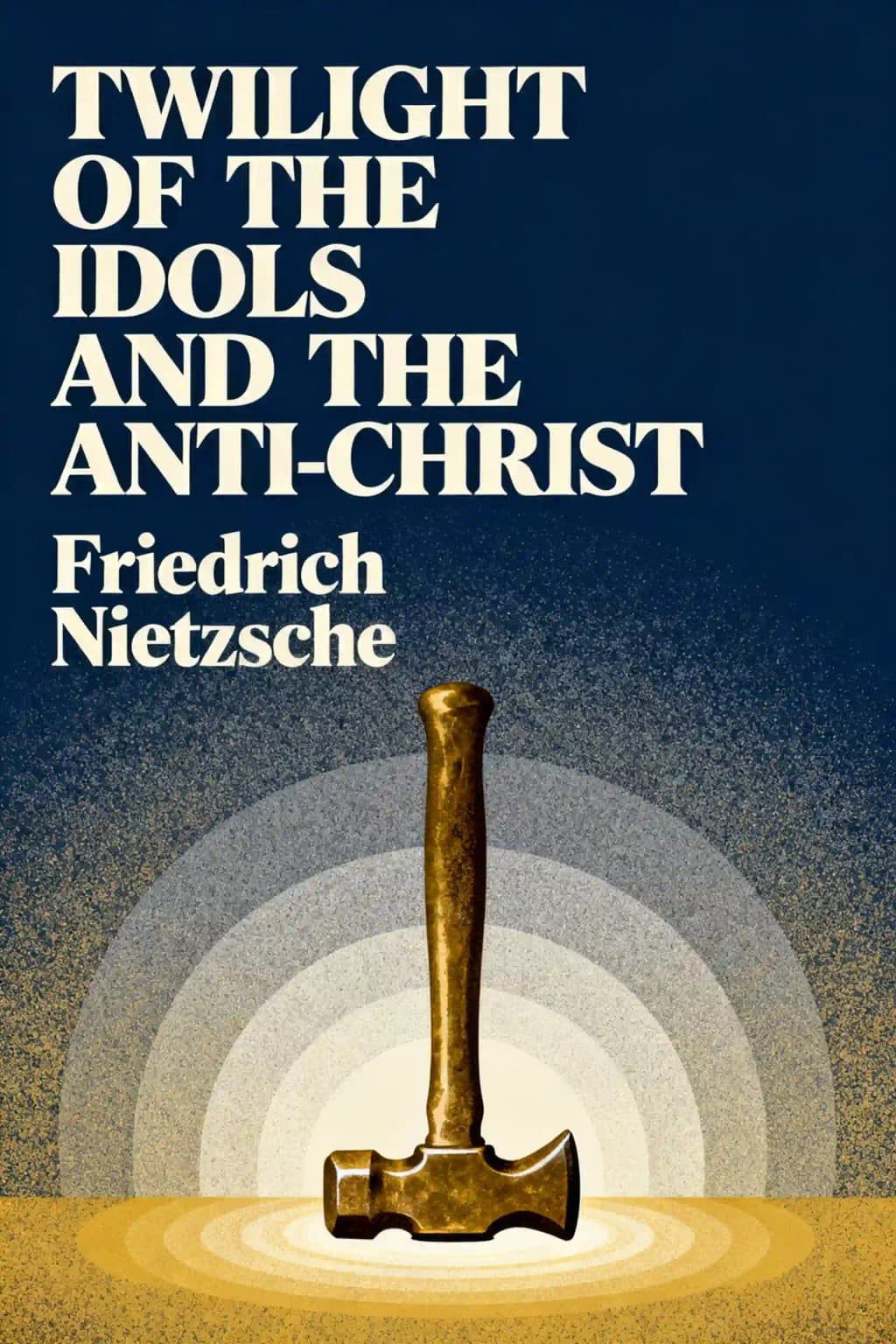
Twilight of the Idols and The Anti-Christ critiques traditional morality, religion, and societal norms, advocating for a radical "revaluation of all values." Twilight dismantles philosophical and cultural idols like Socrates and Christianity, while The Anti-Christ condemns institutional religion as life-denying. Nietzsche champions Dionysian vitality, embodied by figures like Goethe, and contrasts it with what he calls the "weakness" of Christian morality.
This book suits philosophy enthusiasts, critics of institutional religion, and readers exploring existentialism or Nietzsche’s late works. Its provocative ideas appeal to those questioning societal norms, moral frameworks, and the role of religion in Western culture.
Yes, for its incisive critique of dogma and its influence on modern thought. Nietzsche’s razor-sharp prose and uncompromising analysis of human motivation make it essential for understanding 19th-century philosophy and debates on morality’s psychological roots.
Nietzsche condemns Christianity as a “slave morality” born from resentment, arguing it glorifies weakness and denies life’s vitality. He distinguishes Jesus’ teachings, which he admires, from Pauline doctrine, which he blames for institutionalizing guilt and repression.
Décadence refers to societal and intellectual degeneration caused by denying natural instincts. Nietzsche links this to Socratic rationalism, Christian asceticism, and democratic ideals that prioritize equality over individual greatness.
He argues morality emerges from power dynamics: “master morality” celebrates strength and creativity, while “slave morality” vilifies these traits as evil. Traditional ethics, he claims, stem from the weak resenting the strong.
The Dionysian symbolizes life-affirming chaos, creativity, and acceptance of suffering. Nietzsche contrasts this with Apollonian order, praising figures like Goethe and Cesare Borgia as embodiments of this vibrant, unrestrained spirit.
He accuses Socrates of prioritizing rationalism over instinct, fueling a “décadent” distrust of life’s spontaneity. This critique extends to Western philosophy’s reliance on logic at the expense of artistic or bodily wisdom.
Critics highlight Nietzsche’s hyperbole, unfair portrayals of historical figures, and oversimplification of Christianity. Some argue his dismissal of compassion and equality risks justifying authoritarianism.
They synthesize his late-period themes: rejecting nihilism, championing self-overcoming, and diagnosing cultural decline. The books lay groundwork for his unfinished “Revaluation of All Values” project.
Its analysis of morality’s psychological roots resonates in debates about secularism, individualism, and institutional critiques. Nietzsche’s warnings about dogma mirror modern discussions on ideology and power.
He argues suffering is inseparable from growth and creativity. Christianity’s attempt to abolish suffering through pity, he claims, stifles human potential by pathologizing struggle.
저자의 목소리로 책을 느껴보세요
지식을 흥미롭고 예시가 풍부한 인사이트로 전환
핵심 아이디어를 빠르게 캡처하여 신속하게 학습
재미있고 매력적인 방식으로 책을 즐기세요
What does not kill me makes me stronger.
There are no facts, only interpretations.
Man is the cruelest animal.
That which is falling should also be pushed.
I mistrust all systematizers and I avoid them. The will to a system is a lack of integrity.
Twilight of the Idols and the Anti-Christ의 핵심 아이디어를 이해하기 쉬운 포인트로 분해하여 혁신적인 팀이 어떻게 창조하고, 협력하고, 성장하는지 이해합니다.
Twilight of the Idols and the Anti-Christ을 빠른 기억 단서로 압축하여 솔직함, 팀워크, 창의적 회복력의 핵심 원칙을 강조합니다.

생생한 스토리텔링을 통해 Twilight of the Idols and the Anti-Christ을 경험하고, 혁신 교훈을 기억에 남고 적용할 수 있는 순간으로 바꿉니다.
무엇이든 물어보고, 목소리를 선택하고, 진정으로 공감되는 인사이트를 함께 만들어보세요.

샌프란시스코에서 컬럼비아 대학교 동문들이 만들었습니다
"Instead of endless scrolling, I just hit play on BeFreed. It saves me so much time."
"I never knew where to start with nonfiction—BeFreed’s book lists turned into podcasts gave me a clear path."
"Perfect balance between learning and entertainment. Finished ‘Thinking, Fast and Slow’ on my commute this week."
"Crazy how much I learned while walking the dog. BeFreed = small habits → big gains."
"Reading used to feel like a chore. Now it’s just part of my lifestyle."
"Feels effortless compared to reading. I’ve finished 6 books this month already."
"BeFreed turned my guilty doomscrolling into something that feels productive and inspiring."
"BeFreed turned my commute into learning time. 20-min podcasts are perfect for finishing books I never had time for."
"BeFreed replaced my podcast queue. Imagine Spotify for books — that’s it. 🙌"
"It is great for me to learn something from the book without reading it."
"The themed book list podcasts help me connect ideas across authors—like a guided audio journey."
"Makes me feel smarter every time before going to work"
샌프란시스코에서 컬럼비아 대학교 동문들이 만들었습니다

Twilight of the Idols and the Anti-Christ 요약을 무료 PDF 또는 EPUB으로 받으세요. 인쇄하거나 오프라인에서 언제든 읽을 수 있습니다.
What happens when a philosopher completes his most dangerous work in just over a week, then collapses into madness months later? Friedrich Nietzsche's "Twilight of the Idols" emerged from a creative frenzy in the Swiss Alps during 1888-a slim volume that would detonate through Western thought like intellectual dynamite. This wasn't mere philosophy; it was a declaration of war against everything sacred in our intellectual tradition. Nietzsche wielded his ideas like a hammer, striking at the foundations of truth, morality, and reason itself. The book's title playfully mocks Wagner's "Twilight of the Gods," signaling Nietzsche's intention to topple not divine beings but the philosophical idols worshipped for millennia. What makes this text extraordinary isn't just its radical ideas but its style-aphoristic, witty, dancing between profound insight and provocative humor. Nietzsche doesn't build systems; he shatters them, forcing readers to think rather than passively absorb doctrine.