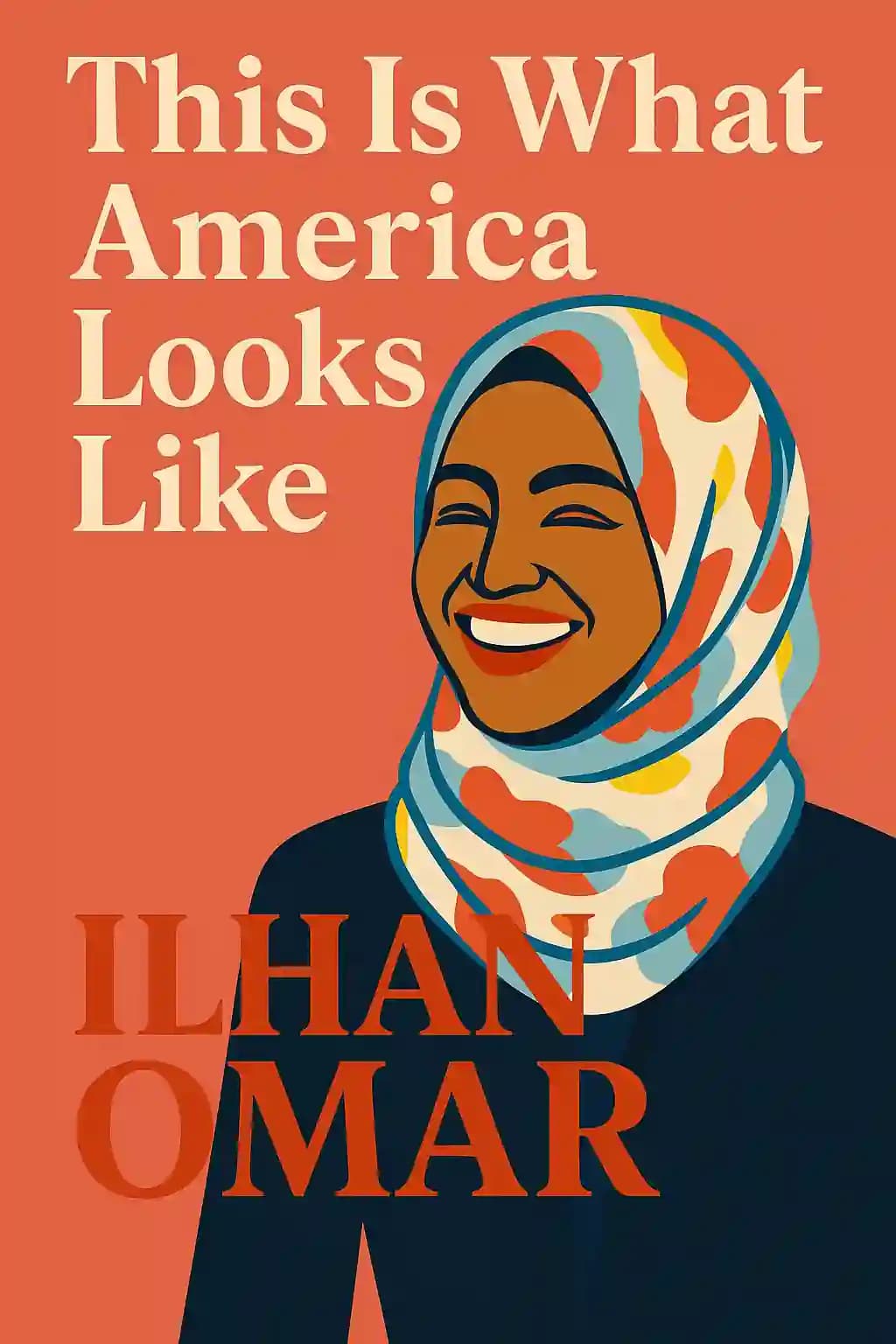
From refugee camp to Congress, Ilhan Omar's memoir challenges America's identity narrative with raw honesty. Speaker Pelosi calls her journey a "badge of honor" while her daughter Isra Hirsi champions its impact. What makes this Muslim woman's story so threatening to some - yet inspiring to millions?
Ilhan Omar, progressive congresswoman and bestselling author of This Is What America Looks Like: My Journey from Refugee to Congresswoman, draws from her groundbreaking political career and lived experience as a Somali-American refugee to craft this memoir.
The book intertwines themes of immigration, identity, and grassroots activism, reflecting Omar’s trajectory from a Kenyan refugee camp to becoming the first Somali-American U.S. representative and one of the first Muslim women in Congress. A member of the influential "Squad," Omar’s policy work focuses on climate justice, Medicare for All, and workers’ rights, informed by her roles on the House Education and Workforce Committee and as vice chair of the Progressive Caucus.
Her story gained national attention through the documentary Time for Ilhan, chronicling her historic 2016 Minnesota House campaign. Before Congress, Omar served in the Minnesota legislature and was a Policy Fellow at the University of Minnesota’s Humphrey School of Public Affairs.
The memoir, praised for its candid exploration of American democracy, highlights her historic 2018 election—which overturned a 181-year-old hijab ban in Congress—and has been cited in academic discussions on intersectional political leadership.
This Is What America Looks Like chronicles Ilhan Omar’s journey from fleeing Somalia’s civil war as a child to becoming one of the first Muslim women in Congress. The memoir highlights her refugee experience, resilience amid bullying and discrimination, and her rise in U.S. politics. It intertwines personal anecdotes with calls for solidarity, progressive reform, and inclusive democracy.
This book appeals to readers interested in immigrant narratives, political memoirs, and social justice. It’s ideal for those exploring themes of identity, resilience, and grassroots activism. Progressives, aspiring policymakers, and individuals navigating cultural adaptation will find Omar’s insights on combating systemic inequities particularly impactful.
Yes, the book offers a compelling blend of personal triumph and political commentary. Omar’s candid reflections on trauma, faith, and public service provide a unique lens into modern American politics. Its timely themes—immigrant rights, intersectional advocacy, and democratic participation—make it a relevant read for 2025.
Central themes include resilience (overcoming war, displacement, and discrimination), identity (navigating race, religion, and gender in America), and inclusive democracy. Omar critiques systemic barriers while emphasizing community organizing and policy-driven change. The memoir also underscores the role of family and cultural heritage in shaping her activism.
Omar frames her politics around progressive ideals: healthcare access, climate action, and economic equity. She advocates for dismantling institutional racism and Islamophobia, drawing parallels between her refugee background and policy priorities. The book critiques xenophobic rhetoric while championing bipartisan collaboration on humanitarian issues.
Omar credits her father and grandfather for instilling democratic values and resilience. Their support during her transition to the U.S.—from learning English via Baywatch reruns to navigating school bullying—shaped her advocacy. Her Somali heritage and Muslim faith remain central to her identity and policymaking.
Omar reflects on becoming the first Somali American in Congress, the first woman of color to represent Minnesota, and the first legislator to wear a hijab on the House floor. She connects these milestones to broader struggles for representation, urging readers to challenge exclusionary norms in politics.
Omar emphasizes grassroots mobilization, coalition-building, and persistence amid backlash. She shares practical insights into legislative challenges, media scrutiny, and balancing public service with personal life. Her story underscores the power of marginalized voices in reshaping policy agendas.
Unlike traditional political memoirs, Omar’s focuses on intersectional identity and refugee resilience. It contrasts with titles by career politicians by centering marginalized perspectives. Fans of Becoming by Michelle Obama or My Own Words by Ruth Bader Ginsburg will appreciate its blend of personal and political narrative.
Amid ongoing debates over immigration, racial equity, and representation, Omar’s journey exemplifies the impact of diverse leadership. The book provides a roadmap for addressing polarization through empathy and policy innovation, resonating with contemporary discussions on democracy and inclusion.
While not explicitly detailing controversies, Omar discusses navigating hate speech and misinformation. She frames critiques as part of systemic resistance to marginalized voices in politics, advocating for dialogue over division. The memoir stresses staying anchored in community needs despite opposition.
Notable moments include Omar’s childhood in a Kenyan refugee camp, her grandfather’s democratic teachings, and confronting bullies in Virginia. While direct quotes aren’t excerpted in sources, her storytelling emphasizes themes like “solidarity over scarcity” and redefining American identity through shared struggle.
저자의 목소리로 책을 느껴보세요
지식을 흥미롭고 예시가 풍부한 인사이트로 전환
핵심 아이디어를 빠르게 캡처하여 신속하게 학습
재미있고 매력적인 방식으로 책을 즐기세요
When the mouth of the shark is safer than home.
The war pitted two commanders from the same Hawiye clan against each other.
Her childhood in Somalia wasn't just a prelude to her refugee experience-it was the crucible that forged her fighting spirit.
She never quite fit conventional expectations.
This loss taught Omar a devastating lesson about the refugee experience-that there is no escape from destiny.
This Is What America Looks Like의 핵심 아이디어를 이해하기 쉬운 포인트로 분해하여 혁신적인 팀이 어떻게 창조하고, 협력하고, 성장하는지 이해합니다.
This Is What America Looks Like을 빠른 기억 단서로 압축하여 솔직함, 팀워크, 창의적 회복력의 핵심 원칙을 강조합니다.

생생한 스토리텔링을 통해 This Is What America Looks Like을 경험하고, 혁신 교훈을 기억에 남고 적용할 수 있는 순간으로 바꿉니다.
무엇이든 물어보고, 목소리를 선택하고, 진정으로 공감되는 인사이트를 함께 만들어보세요.

샌프란시스코에서 컬럼비아 대학교 동문들이 만들었습니다
"Instead of endless scrolling, I just hit play on BeFreed. It saves me so much time."
"I never knew where to start with nonfiction—BeFreed’s book lists turned into podcasts gave me a clear path."
"Perfect balance between learning and entertainment. Finished ‘Thinking, Fast and Slow’ on my commute this week."
"Crazy how much I learned while walking the dog. BeFreed = small habits → big gains."
"Reading used to feel like a chore. Now it’s just part of my lifestyle."
"Feels effortless compared to reading. I’ve finished 6 books this month already."
"BeFreed turned my guilty doomscrolling into something that feels productive and inspiring."
"BeFreed turned my commute into learning time. 20-min podcasts are perfect for finishing books I never had time for."
"BeFreed replaced my podcast queue. Imagine Spotify for books — that’s it. 🙌"
"It is great for me to learn something from the book without reading it."
"The themed book list podcasts help me connect ideas across authors—like a guided audio journey."
"Makes me feel smarter every time before going to work"
샌프란시스코에서 컬럼비아 대학교 동문들이 만들었습니다

This Is What America Looks Like 요약을 무료 PDF 또는 EPUB으로 받으세요. 인쇄하거나 오프라인에서 언제든 읽을 수 있습니다.
In a third-grade classroom in Mogodishu, a tiny girl watched a bully humiliate a smaller, poorer orphan. What happened next wasn't typical childhood drama-it was the first chapter of a story that would eventually reach the halls of Congress. Despite her size, she challenged the bully to meet after school, pulled him down, and rubbed his face in the sand. This wasn't just playground justice. It was the beginning of Ilhan Omar's lifelong pattern: seeing injustice and refusing to look away. Growing up in her mother's family compound-unusual in patrilineal Somalia-she learned that everyone's voice mattered, even the youngest. Her grandfather Baba raised her mother as an equal to her brothers, creating a foundation for Omar's later advocacy. She climbed trees, played soccer, and never quite fit conventional expectations. Within her family's walls, these differences weren't deficiencies but strengths. That fierce little girl who defended the vulnerable would carry the same spirit into congressional hearings decades later, proving that sometimes the most powerful political movements begin with a single act of courage in a schoolyard.
