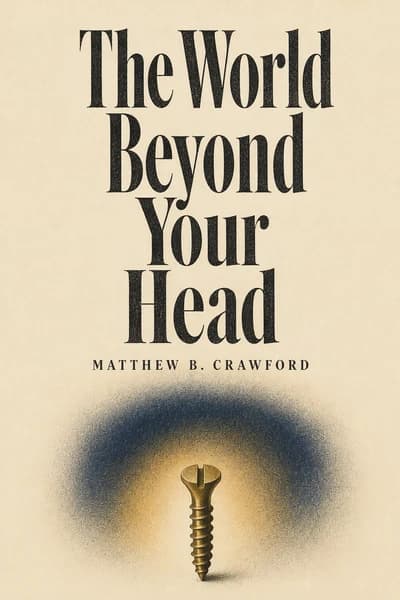
In "The World Beyond Your Head," Matthew Crawford challenges our modern obsession with autonomy, revealing how distraction erodes our freedom. Named "one of the most influential thinkers" by The Sunday Times, Crawford asks: What if true liberation comes from engaging with reality's constraints?
Matthew B. Crawford, author of The World Beyond Your Head: On Becoming an Individual in an Age of Distraction, is a philosopher-mechanic and New York Times bestselling writer renowned for exploring the intersection of craftsmanship, human agency, and modernity.
A University of Chicago PhD in political philosophy, Crawford’s work bridges academic rigor and hands-on experience. He owns Shockoe Moto, a motorcycle repair shop in Richmond, Virginia, and served as a fellow at the University of Virginia’s Institute for Advanced Studies in Culture. His books, including Shop Class as Soulcraft and Why We Drive, critique technological overreach while championing embodied skills and self-reliance.
Crawford’s 2015 treatise on attention and distraction blends cultural criticism with philosophical inquiry, informed by his background in physics, ancient political thought, and disillusionment with think-tank politics. A contributor to The New Atlantis and featured speaker on PBS’s Merchants of Doubt, his ideas are cited in MBA curricula and tech ethics debates. The World Beyond Your Head has been translated into 12 languages and praised for its “groundbreaking” analysis of autonomy in a hyper-mediated world, solidifying Crawford’s reputation as a leading voice in reclaiming human-centered practices.
The World Beyond Your Head by Matthew B. Crawford examines how modern distractions erode our ability to focus, arguing that true individuality emerges through skilled engagement with the physical world. Crawford critiques technology-driven isolation and champions embodied practices—like craftsmanship—to reclaim agency. The book blends philosophy, cognitive science, and cultural analysis to address attention’s role in shaping identity and society.
This book is ideal for readers interested in philosophy, psychology, or self-improvement, particularly those grappling with digital overload. Educators, designers, and policymakers will value its insights into fostering focus and meaningful work. Fans of Crawford’s earlier work, Shop Class as Soulcraft, will appreciate its deepened exploration of human agency.
Yes, for its timely critique of distraction culture and innovative linking of attention to personal fulfillment. Crawford’s analysis of how technology fragments cognition—and his solutions rooted in skilled practices—offers actionable wisdom. The book’s blend of academic rigor and real-world examples makes it essential for understanding modern mental strains.
Key concepts include:
Crawford views attention as a sculpting force for the self, requiring protection from commodification. It’s not just focus but a gateway to agency—shaped by physical interactions (e.g., craftsmanship) and eroded by passive tech use. He argues distraction isn’t personal failure but a structural issue in modern design.
Crawford condemns technologies like the Mickey Mouse Clubhouse’s “Handy Dandy Machine,” which teaches passive problem-solving. He argues such tools foster narcissism by prioritizing convenience over skill, creating a false autonomy that disconnects users from reality.
Like Shop Class as Soulcraft, it champions manual competence but expands to address attention’s philosophical stakes. Both books critique abstraction in modern life but The World Beyond Your Head adds cognitive science and cultural criticism to argue for re-embodied living.
Mastery—whether in cooking or mechanics—requires submitting to external realities, fostering humility and resilience. This “voluntary submission” to disciplines counteracts modern narcissism, grounding identity in tangible competence rather than curated online personas.
Its themes resonate with debates about AI’s impact on cognition, remote work’s isolation, and mental health crises. Crawford’s warnings about attention exploitation remain urgent as apps increasingly monetize focus through algorithms.
Some readers find Crawford’s academic tone dense, and his solutions (e.g., craftsmanship) impractical for non-specialists. Critics also note limited discussion of systemic economic barriers to achieving his vision of focused living.
저자의 목소리로 책을 느껴보세요
지식을 흥미롭고 예시가 풍부한 인사이트로 전환
핵심 아이디어를 빠르게 캡처하여 신속하게 학습
재미있고 매력적인 방식으로 책을 즐기세요
Silence is now a luxury good.
Attention will be used by some in ways that make it unusable for others.
Mental distractibility parallels obesity.
Our assumed link between free choice actually produces a monoculture.
The environment doesn't compromise the self but actively constitutes it.
The World Beyond Your Head: On Becoming an Individual in an Age of Distraction의 핵심 아이디어를 이해하기 쉬운 포인트로 분해하여 혁신적인 팀이 어떻게 창조하고, 협력하고, 성장하는지 이해합니다.
The World Beyond Your Head: On Becoming an Individual in an Age of Distraction을 빠른 기억 단서로 압축하여 솔직함, 팀워크, 창의적 회복력의 핵심 원칙을 강조합니다.

생생한 스토리텔링을 통해 The World Beyond Your Head: On Becoming an Individual in an Age of Distraction을 경험하고, 혁신 교훈을 기억에 남고 적용할 수 있는 순간으로 바꿉니다.
무엇이든 물어보고, 목소리를 선택하고, 진정으로 공감되는 인사이트를 함께 만들어보세요.

샌프란시스코에서 컬럼비아 대학교 동문들이 만들었습니다
"Instead of endless scrolling, I just hit play on BeFreed. It saves me so much time."
"I never knew where to start with nonfiction—BeFreed’s book lists turned into podcasts gave me a clear path."
"Perfect balance between learning and entertainment. Finished ‘Thinking, Fast and Slow’ on my commute this week."
"Crazy how much I learned while walking the dog. BeFreed = small habits → big gains."
"Reading used to feel like a chore. Now it’s just part of my lifestyle."
"Feels effortless compared to reading. I’ve finished 6 books this month already."
"BeFreed turned my guilty doomscrolling into something that feels productive and inspiring."
"BeFreed turned my commute into learning time. 20-min podcasts are perfect for finishing books I never had time for."
"BeFreed replaced my podcast queue. Imagine Spotify for books — that’s it. 🙌"
"It is great for me to learn something from the book without reading it."
"The themed book list podcasts help me connect ideas across authors—like a guided audio journey."
"Makes me feel smarter every time before going to work"
샌프란시스코에서 컬럼비아 대학교 동문들이 만들었습니다

The World Beyond Your Head: On Becoming an Individual in an Age of Distraction 요약을 무료 PDF 또는 EPUB으로 받으세요. 인쇄하거나 오프라인에서 언제든 읽을 수 있습니다.
Stand at any airport gate and watch. Hundreds of people staring downward, bathed in blue light, each inhabiting their own digital bubble while CNN blares overhead. This isn't just modern life-it's a fundamental crisis in how we experience reality. Your attention has become the most valuable commodity in the world, and everyone wants a piece. Gas pumps now force you to watch ads while filling your tank. Social media algorithms fight invisible wars for milliseconds of your consciousness. We've arrived at a strange moment: the silence needed for thinking has become a luxury good, available only to those who can afford business-class lounges. Meanwhile, the rest of us have our minds strip-mined like natural resources, our capacity for sustained thought auctioned off to the highest bidder. Ever notice how you instinctively look away when trying to remember something important? That blank stare into space isn't your brain randomly wandering-it's desperately trying to suppress environmental input so it can think. This ability emerged around age two or three, when you first learned to organize experience into coherent stories. Unlike other animals who simply react to whatever's in front of them, humans developed this remarkable capacity to recall memories not triggered by immediate surroundings. But here's the catch: this only works when your environment isn't screaming for attention. The average person checks their phone 96 times daily, roughly once every ten minutes. Your brain is trying to maintain an integrated sense of self while a thousand notifications compete for dominance. It's like trying to have a deep conversation at a rock concert. The evolutionary mechanism that made human consciousness possible is being systematically dismantled by technologies that treat your attention as an extractable resource. We're not just distracted; we're losing the cognitive infrastructure that makes coherent selfhood possible.