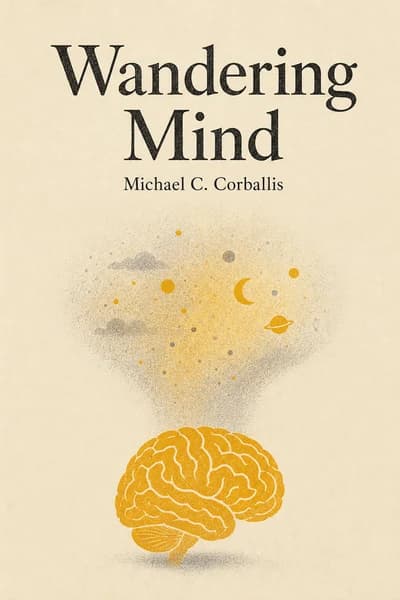
Discover why your wandering mind isn't a flaw but your greatest asset. Acclaimed neuroscientist Michael Corballis reveals how daydreaming drives creativity and shapes our humanity. "A pleasure to read" - Michael Gazzaniga. Could mental time travel be your untapped superpower?
Michael C. Corballis, acclaimed psychologist and cognitive neuroscientist, explores the science of spontaneous thought in The Wandering Mind: What the Brain Does When You’re Not Looking. A professor emeritus at the University of Auckland and former president of the International Neuropsychological Society, Corballis built a distinguished career studying cerebral asymmetry, memory, and the evolutionary origins of language. His groundbreaking hypothesis linking human speech to gestural communication, detailed in From Hand to Mouth, reshaped interdisciplinary debates about cognition’s evolution.
Corballis authored 14 books bridging psychology, neuroscience, and biology, including The Recursive Mind (on language’s role in civilization) and The Truth About Language. As founding co-editor of Laterality and contributor to over 400 peer-reviewed studies, his work has been cited 27,000+ times.
The Wandering Mind distills decades of research into accessible insights about daydreaming, creativity, and brain default networks, solidifying his reputation for translating complex science into engaging prose. His legacy endures through extensive academic influence, with an h-index of 77 and mentored researchers spanning three generations.
The Wandering Mind explores the brain’s activity during periods of inattention, arguing that mind-wandering is not a flaw but a feature linked to creativity, memory, and mental time travel. Corballis connects daydreaming to storytelling, empathy, and self-identity, blending neuroscience, anthropology, and psychology to reframe distraction as a vital cognitive tool.
This book suits psychology enthusiasts, students seeking productivity insights, and creatives chasing inspiration. It’s ideal for readers curious about brain mechanics, professionals navigating focus challenges, or anyone interested in how mind-wandering fuels innovation.
Yes, for its fresh perspective on inattention as a cognitive asset. Corballis combines scientific rigor with accessible storytelling, though some critiques note repetitive sections. The book’s insights into creativity and mental time travel make it valuable for understanding the mind’s hidden productivity.
Mental time travel refers to the brain’s ability to simulate past and future scenarios, enabling planning, memory consolidation, and self-awareness. Corballis ties this to mind-wandering, showing how it underpins storytelling and empathy.
Corballis distinguishes productive mind-wandering (linked to creativity and problem-solving) from passive distraction. He argues modern tech bombardment risks overwhelming this natural process, unlike self-directed mental exploration that fuels innovation.
Language enables complex thought transmission and storytelling, which Corballis links to mind-wandering’s evolutionary purpose. It allows humans to share mental simulations, fostering social cohesion and cultural development.
Some reviewers note repetitive chapters and undersupported claims about tech’s impact on attention. Corballis acknowledges mind-wandering’s benefits but leaves open how constant digital stimuli alter this process.
It expands on themes from A Very Short Tour of the Mind and The Recursive Mind, focusing on language, memory, and cognition. Fans of his accessible neuroscience style will find continuity here.
While not a self-help guide, it implies embracing mindful wandering for creativity. Balancing focused work with unstructured mental breaks can harness daydreaming’s problem-solving potential.
Corballis warns that smartphone-induced distraction may disrupt natural mind-wandering patterns. He urges intentional unplugging to preserve mental space for innovation and self-reflection.
While direct quotes are limited in summaries, central ideas include:
Unlike Kahneman’s dual-process theory, Corballis focuses on idle brain states. Both books decode cognition but diverge on whether inattention is a bug (Kahneman) or a feature (Corballis).
저자의 목소리로 책을 느껴보세요
지식을 흥미롭고 예시가 풍부한 인사이트로 전환
핵심 아이디어를 빠르게 캡처하여 신속하게 학습
재미있고 매력적인 방식으로 책을 즐기세요
Mind-wandering has been dismissed as laziness.
Our minds are built to wander.
Memory is a poet, not an historian.
Remembering is mind-wandering into the past.
Our minds wander approximately 46.7% of our waking hours.
Wandering Mind의 핵심 아이디어를 이해하기 쉬운 포인트로 분해하여 혁신적인 팀이 어떻게 창조하고, 협력하고, 성장하는지 이해합니다.
Wandering Mind을 빠른 기억 단서로 압축하여 솔직함, 팀워크, 창의적 회복력의 핵심 원칙을 강조합니다.

생생한 스토리텔링을 통해 Wandering Mind을 경험하고, 혁신 교훈을 기억에 남고 적용할 수 있는 순간으로 바꿉니다.
무엇이든 물어보고, 목소리를 선택하고, 진정으로 공감되는 인사이트를 함께 만들어보세요.

샌프란시스코에서 컬럼비아 대학교 동문들이 만들었습니다
"Instead of endless scrolling, I just hit play on BeFreed. It saves me so much time."
"I never knew where to start with nonfiction—BeFreed’s book lists turned into podcasts gave me a clear path."
"Perfect balance between learning and entertainment. Finished ‘Thinking, Fast and Slow’ on my commute this week."
"Crazy how much I learned while walking the dog. BeFreed = small habits → big gains."
"Reading used to feel like a chore. Now it’s just part of my lifestyle."
"Feels effortless compared to reading. I’ve finished 6 books this month already."
"BeFreed turned my guilty doomscrolling into something that feels productive and inspiring."
"BeFreed turned my commute into learning time. 20-min podcasts are perfect for finishing books I never had time for."
"BeFreed replaced my podcast queue. Imagine Spotify for books — that’s it. 🙌"
"It is great for me to learn something from the book without reading it."
"The themed book list podcasts help me connect ideas across authors—like a guided audio journey."
"Makes me feel smarter every time before going to work"
샌프란시스코에서 컬럼비아 대학교 동문들이 만들었습니다

Wandering Mind 요약을 무료 PDF 또는 EPUB으로 받으세요. 인쇄하거나 오프라인에서 언제든 읽을 수 있습니다.
Have you ever found yourself staring out the window during an important meeting, only to feel a pang of guilt for your "unproductive" daydreaming? For centuries, mind-wandering has been dismissed as laziness or inattention. But what if these mental journeys are not just normal but essential to what makes us human? Michael Corballis's exploration reveals that our tendency to mentally time-travel forms the foundation of creativity, empathy, and innovation. From Einstein's thought experiments to J.K. Rowling conceiving Harry Potter during a delayed train journey, history's greatest breakthroughs often emerged not from focused attention but from minds allowed to wander freely. That daydream you feel guilty about might actually be your brain's most sophisticated evolutionary adaptation.