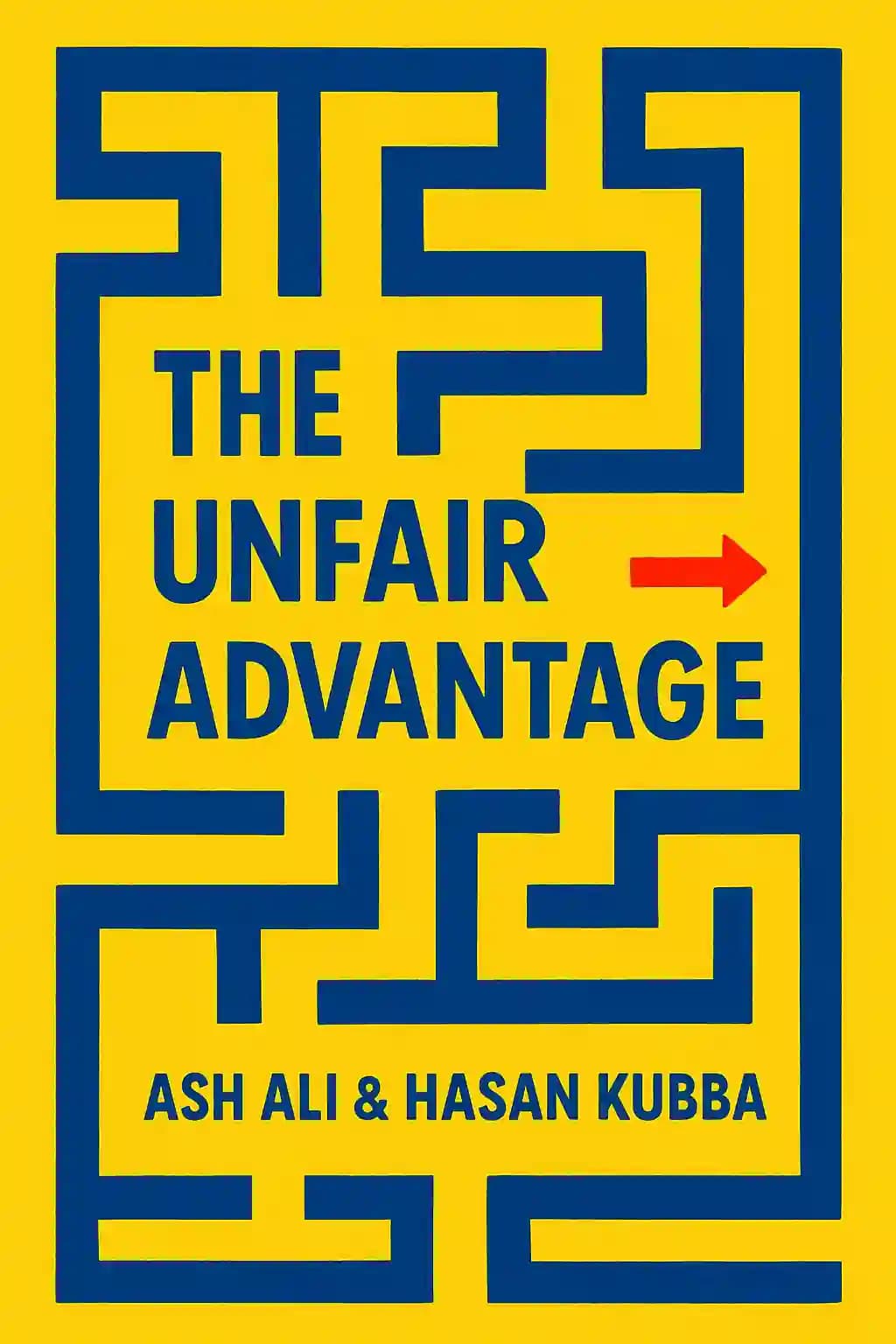
Unfair Advantage
How You Already Have What It Takes to Succeed
Unfair Advantage 개요
Discover why "The Unfair Advantage" won UK's Business Book of the Year 2021. Ali and Kubba shatter success myths with their groundbreaking MILES framework, proving entrepreneurial triumph isn't just luck or hard work - it's identifying the unique advantages you already possess but haven't recognized.

Unfair Advantage의 핵심 주제
- miles framework
- meritocracy myth
- competitive edge
- strategic networking
- resource leverage
Unfair Advantage의 명언
Life isn't fair.
It's not about working harder. It's about working the system.
MASSIVELY BOTH.
Wild success is attributable to variance.
Mind over matter, but matter still matters.
Unfair Advantage의 등장인물
- Ash AliCo-author and startup entrepreneur
- Hasan KubbaCo-author and startup strategist
- Evan SpiegelSnapchat founder used as a case study on luck
- Jan KoumWhatsApp founder used as a case study on expertise
저자 소개
Unfair Advantage의 저자 소개
Ash Ali and Hasan Kubba are the international bestselling authors of The Unfair Advantage: How You Already Have What It Takes to Succeed. They are award-winning serial entrepreneurs and startup growth experts in the business strategy genre.
Their book merges practical frameworks with personal anecdotes to help readers identify unique competitive edges. This draws from Ash’s experience as the first marketing director of unicorn startup JustEat (valued over £5 billion) and Hasan’s journey building a successful business from his bedroom using online courses.
Both regularly share insights through TEDx talks, keynote speeches at organizations like Salesforce and EY, and podcasts like Escape the Rat Race Radio. Their work emphasizes the MILES framework (Money, Intelligence & Insight, Location & Luck, Education & Expertise, Status) to decode success in unequal systems.
The Unfair Advantage became an instant global bestseller, translated into 12 languages, and is frequently cited in top business school curricula for its actionable strategies.
Unfair Advantage 요약 다운로드
Unfair Advantage 요약을 무료 PDF 또는 EPUB으로 받으세요. 인쇄하거나 오프라인에서 언제든 읽을 수 있습니다.
이 책에 대한 FAQ
The Unfair Advantage challenges the myth of meritocracy by arguing success stems from leveraging unique advantages (Money, Intelligence, Location, Education, Status). Authored by entrepreneur Ash Ali, it combines startup strategies with personal stories to show how readers can identify and maximize their inherent strengths. The book emphasizes smart execution over originality and provides frameworks like MILES to turn disadvantages into opportunities.
Aspiring entrepreneurs, startup founders, and professionals seeking career growth will benefit most. The book offers actionable insights for those navigating competitive industries or pivoting careers. It’s particularly valuable for readers interested in non-traditional success paths or overcoming systemic barriers.
Yes—it’s praised for blending practical startup advice with real-world examples from Ali’s journey as a dropout-turned-entrepreneur. The MILES framework helps readers audit their unique strengths, making it a actionable guide for business strategy and personal development.
The MILES framework categorizes unfair advantages as:
- Money: Financial resources to scale quickly
- Intelligence & Insight: Problem-solving skills or niche expertise
- Location & Luck: Geographic benefits or serendipitous opportunities
- Education & Expertise: Formal training or hands-on experience
- Status: Reputation, network, or social capital
The book rejects binary views, arguing success requires both effort and leveraging fortunate circumstances. Examples like Oprah Winfrey show how individuals can overcome bad luck by pairing grit with strategic advantage-seeking. However, systemic factors (e.g., race, birthplace) still limit pure meritocracy.
Ali argues media overemphasizes hustle culture while ignoring how advantages like wealth or connections disproportionately impact outcomes. For instance, Evan Spiegel’s Snapchat success relied partly on family funding—an unfair advantage many lack.
When pitching investors, clarify your unique strengths using the MILES framework. Highlight traction, market size, and team credentials—but also explain irreplicable advantages like patented tech or elite industry partnerships.
“Your unfair advantage isn’t what you wish you had—it’s what you already have.” This underscores the book’s core message: Success comes from maximizing existing assets rather than chasing others’ strengths.
While Atomic Habits focuses on incremental behavior change, Ali’s book emphasizes strategic advantage-seeking. Both value consistency, but The Unfair Advantage prioritizes context—directing effort toward areas where you have natural or situational edges.
Some argue it downplays systemic barriers (e.g., racism, poverty) that can’t be overcome through individual advantage-seeking alone. Others note the MILES framework overlaps with existing business concepts like SWOT analysis.
As a school dropout who built and sold multiple startups, Ali draws from 20+ years of entrepreneurial experience. His role as Just Eat’s first marketing director (IPO: £1.5B) grounds the advice in real-world scaling challenges.
Yes—readers apply its principles to career transitions, creative projects, and skill development. The book’s core idea (maximize unique strengths) applies to negotiating salaries, networking, and personal branding.





