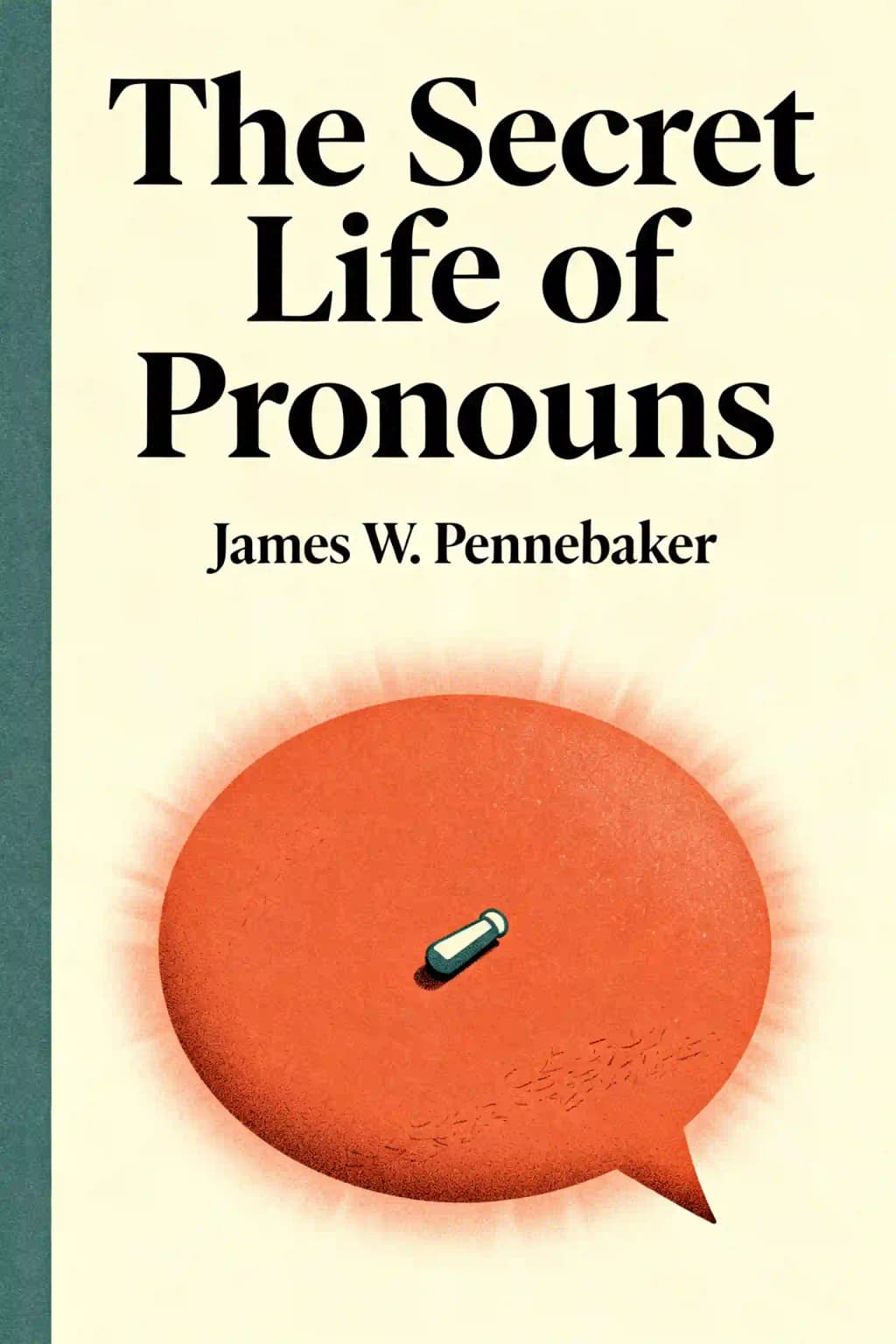
Your seemingly innocent pronouns secretly reveal your status, power, and psychology. In "The Secret Life of Pronouns," Pennebaker's groundbreaking research shows how function words predict everything from academic success to world leaders' war tendencies. The New York Times called it "penetrating" - your words expose you.
James W. Pennebaker, Regents Centennial Professor Emeritus of Psychology at the University of Texas at Austin, is the acclaimed author of The Secret Life of Pronouns: What Our Words Say About Us. A pioneering social psychologist and linguistic researcher, Pennebaker bridges psychology, linguistics, and data science to decode how everyday language reveals hidden patterns in personality, relationships, and health.
His groundbreaking work on expressive writing therapy—detailed in Opening Up and Expressive Writing: Words That Heal—demonstrates how writing about trauma improves mental and physical well-being, supported by decades of peer-reviewed studies.
As creator of the LIWC text-analysis software used across academia and industry, Pennebaker has shaped modern computational linguistics. His 12 books and over 300 research articles have earned him the University of Texas’s prestigious Academy of Distinguished Teachers award. The Secret Life of Pronouns has become a staple in psychology and communication courses, praised for transforming how we understand language’s role in social dynamics. Pennebaker’s insights continue to influence fields from education to AI, with his frameworks applied by researchers and Fortune 500 companies alike.
The Secret Life of Pronouns explores how everyday language—particularly function words like pronouns (I, you, they), articles (the, a), and prepositions—reveals hidden insights about personality, social dynamics, and emotional health. Pennebaker uses computational text analysis to show how subtle word choices reflect power dynamics, honesty, trauma coping mechanisms, and relationship quality, offering a scientific lens to decode human communication.
This book suits psychology enthusiasts, writers, marketers, and anyone interested in how language shapes identity and relationships. It’s particularly valuable for professionals in therapy, education, or AI-driven text analysis seeking data-backed methods to interpret communication patterns.
Key concepts include:
Pennebaker’s research helps:
LIWC (Linguistic Inquiry and Word Count) is Pennebaker’s text-analysis tool that categorizes words into psychological themes. It’s widely used to study emotional states, personality traits, and group dynamics in emails, social media, literature, and clinical settings.
Yes. The book reveals women use more first-person singular pronouns (I, me) and emotion words, while men favor articles (a, the) and impersonal language. These differences reflect socialization patterns, not inherent traits.
Some argue Pennebaker’s focus on algorithmic text analysis oversimplifies context-dependent communication. Critics note language patterns may correlate with behaviors but don’t always imply causation. The book also leans heavily on English-language examples.
The book expands on Pennebaker’s discovery that writing about trauma using shifting pronouns (I → they → we) improves health. It connects this finding to broader patterns in how function words signal cognitive processing and emotional resolution.
These emphasize how unnoticed language elements reveal hidden truths about identity and intent.
Unlike pop-linguistics books (e.g., Because Internet), Pennebaker’s work blends peer-reviewed research with practical applications. It’s closer to Malcolm Gladwell’s data-driven storytelling but focuses exclusively on computational language analysis.
With AI chatbots and social media dominating communication, understanding algorithmic text analysis helps professionals decode digital interactions. The book also aids in addressing mental health crises through scalable writing-based interventions.
저자의 목소리로 책을 느껴보세요
지식을 흥미롭고 예시가 풍부한 인사이트로 전환
핵심 아이디어를 빠르게 캡처하여 신속하게 학습
재미있고 매력적인 방식으로 책을 즐기세요
Words as windows to the soul.
Function words are inherently social.
Context matters tremendously.
Writers tend to project their own gendered language style onto all characters.
Despite these clear differences, most people remain blind to these patterns due to deeply ingrained stereotypes.
Secret Life of Pronouns의 핵심 아이디어를 이해하기 쉬운 포인트로 분해하여 혁신적인 팀이 어떻게 창조하고, 협력하고, 성장하는지 이해합니다.
Secret Life of Pronouns을 빠른 기억 단서로 압축하여 솔직함, 팀워크, 창의적 회복력의 핵심 원칙을 강조합니다.

생생한 스토리텔링을 통해 Secret Life of Pronouns을 경험하고, 혁신 교훈을 기억에 남고 적용할 수 있는 순간으로 바꿉니다.
무엇이든 물어보고, 목소리를 선택하고, 진정으로 공감되는 인사이트를 함께 만들어보세요.

샌프란시스코에서 컬럼비아 대학교 동문들이 만들었습니다
"Instead of endless scrolling, I just hit play on BeFreed. It saves me so much time."
"I never knew where to start with nonfiction—BeFreed’s book lists turned into podcasts gave me a clear path."
"Perfect balance between learning and entertainment. Finished ‘Thinking, Fast and Slow’ on my commute this week."
"Crazy how much I learned while walking the dog. BeFreed = small habits → big gains."
"Reading used to feel like a chore. Now it’s just part of my lifestyle."
"Feels effortless compared to reading. I’ve finished 6 books this month already."
"BeFreed turned my guilty doomscrolling into something that feels productive and inspiring."
"BeFreed turned my commute into learning time. 20-min podcasts are perfect for finishing books I never had time for."
"BeFreed replaced my podcast queue. Imagine Spotify for books — that’s it. 🙌"
"It is great for me to learn something from the book without reading it."
"The themed book list podcasts help me connect ideas across authors—like a guided audio journey."
"Makes me feel smarter every time before going to work"
샌프란시스코에서 컬럼비아 대학교 동문들이 만들었습니다

Secret Life of Pronouns 요약을 무료 PDF 또는 EPUB으로 받으세요. 인쇄하거나 오프라인에서 언제든 읽을 수 있습니다.
Have you ever noticed how differently your boss speaks compared to your friends? Or how your text messages change when you're happy versus sad? While we obsess over finding the perfect nouns and verbs, it's actually the tiny, forgettable words-the pronouns, articles, and prepositions-that reveal our deepest truths. These "function words" make up less than 0.1% of our vocabulary but account for nearly 60% of what we say. They operate below our conscious awareness, making them impossible to manipulate and perfect windows into our psychological states. When you use "I" frequently, you're likely feeling insecure or depressed. When you shift to "we," you're signaling group identity and connection. These patterns are so reliable that computer programs analyzing only function words can determine your gender, age, social status, emotional state, and even whether you're telling the truth-often with greater accuracy than trained humans.