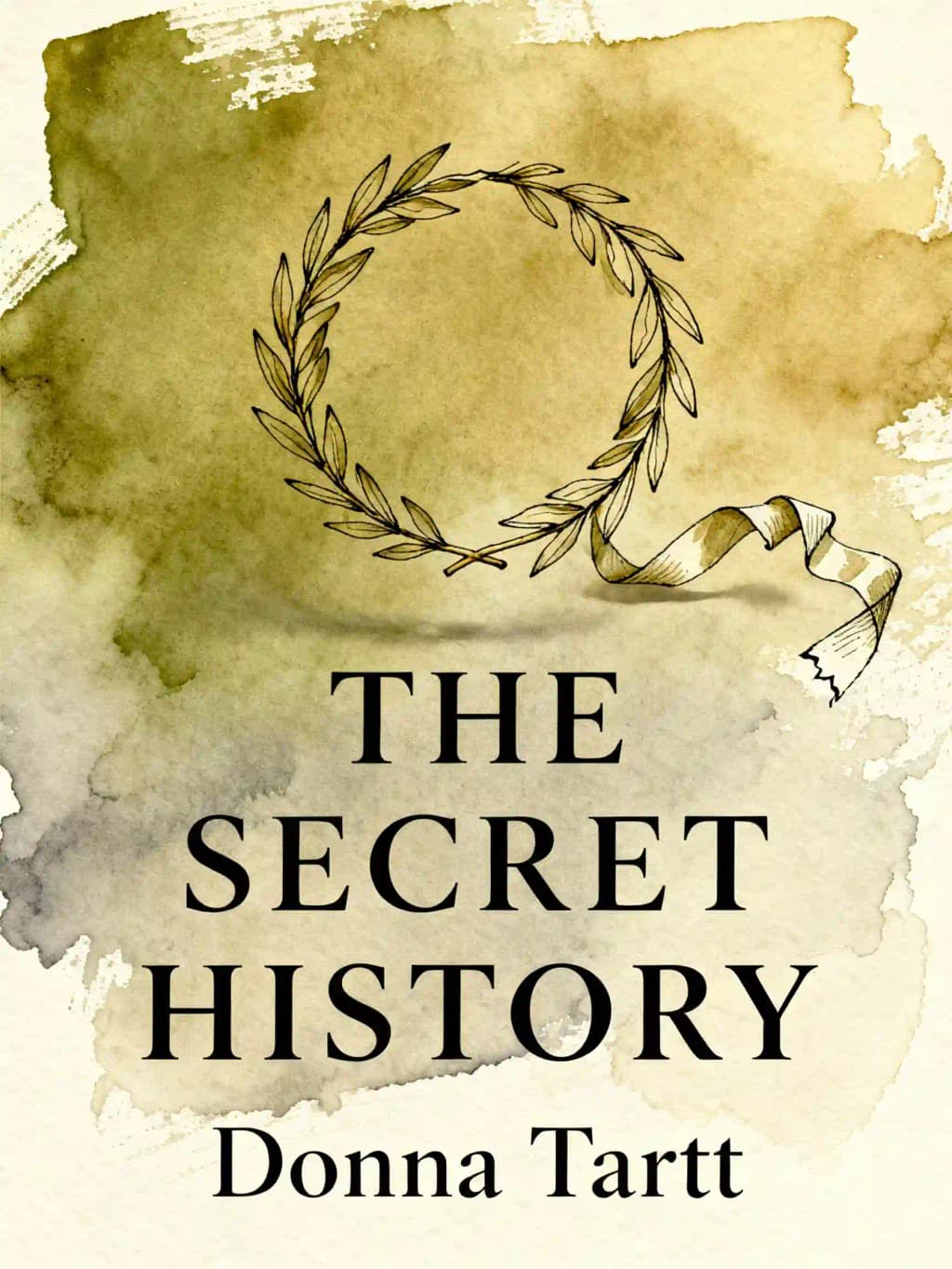
A murder revealed on page one, yet Donna Tartt's "The Secret History" - an 8-year labor that captivated Bret Easton Ellis and reached #4 on NYT's bestseller list - isn't about who did it, but the dark, seductive why that pulls readers into its elite academic underworld.
Donna Louise Tartt is an acclaimed American novelist and the author of The Secret History. She is renowned for her psychologically immersive literary thrillers that captivate readers with their depth and complexity.
Born in Greenwood, Mississippi, in 1963, Tartt’s Southern upbringing and classical education at Bennington College have deeply influenced her writing. Her work often explores themes of morality, obsession, and the interplay between ancient philosophies and modern elite culture.
Tartt's debut novel, The Secret History (1992), redefined the campus thriller genre with its tale of clandestine Greek studies students unraveling under the weight of a murder plot. The novel quickly became a modern classic, establishing Tartt as a significant voice in contemporary literature.
Her Pulitzer Prize-winning novel, The Goldfinch (2013), is a sweeping coming-of-age story centered on art and trauma, while The Little Friend (2002) is a Southern Gothic mystery. These works further showcase her mastery of intricate narratives and rich character studies.
In 2014, Tartt was honored as one of Time magazine's 100 Most Influential People, a testament to her significant impact on the literary world. Her work has been translated into more than 40 languages, reaching readers across the globe. The Goldfinch was adapted into a film in 2019, underscoring her enduring cultural influence.
The Secret History follows Richard Papen, a transfer student at an elite Vermont college, who becomes entangled with a secretive group of Classics students. Their obsession with ancient Greek philosophy leads to a bacchanalian ritual murder, followed by a second killing to conceal the crime. The novel explores guilt, moral corruption, and the consequences of intellectual elitism as the group unravels under the weight of their actions.
Fans of dark academia, psychological thrillers, and character-driven narratives will appreciate this novel. Its complex themes of morality, beauty, and existential disillusionment resonate with readers interested in literary fiction with philosophical depth. Those drawn to unreliable narrators, atmospheric campus settings, and explorations of human darkness will find it compelling.
Yes—Donna Tartt’s debut novel is celebrated for its lush prose, intricate plotting, and morally ambiguous characters. It balances intellectual themes with suspense, offering a gripping exploration of how privilege and obsession distort reality. Over 30 years after publication, it remains a defining work of dark academia and a cult classic.
Henry Winter, the group’s calculating leader, orchestrates both murders but ultimately shoots himself to protect the others after a confrontation with Charles. His death catalyzes the group’s dissolution. Henry’s arc underscores the novel’s themes of self-destruction and the futility of escaping consequences, despite his attempts to control every outcome.
Guilt manifests as paranoia, addiction, and self-sabotage. Francis struggles with hypochondria, Charles turns to alcoholism, and Richard battles pill dependency. Their fraying relationships and psychological collapse illustrate Tartt’s focus on the corrosive effects of concealed sin and the impossibility of true absolution.
Julian Morrow, the group’s charismatic Classics professor, cultivates their intellectual superiority and detachment from conventional morality. His abrupt abandonment of the students after discovering their crimes highlights the hypocrisy of elitism—he privileges abstract ideals over human responsibility, leaving them to face the fallout alone.
The bacchanal—a Dionysian ritual that results in an accidental murder—sets the plot in motion. It symbolizes the group’s descent from intellectual curiosity into primal violence, blurring the line between ancient philosophy and modern brutality. This event also establishes their collective guilt, making Bunny’s later blackmail inevitable.
The characters’ wealth and education insulate them from accountability, allowing them to rationalize murder as an intellectual exercise. Tartt critiques elitism through their entitlement (e.g., Francis’s country estate, Henry’s fluency in Greek) and the contrast with Richard’s working-class background, which amplifies his desperation to belong.
Edmund “Bunny” Corcoran is pushed off a cliff by Henry and the group after threatening to expose their first murder. His death—premeditated and cold-blooded—serves as the novel’s central crime, exposing the fragility of loyalty among the friends and marking their irreversible moral decay.
After Henry’s suicide, the group disintegrates: Francis attempts suicide, Charles becomes an alcoholic, and Camilla withdraws. Richard graduates alone, haunted by unrequited love for Camilla and dreams of Henry. The bleak conclusion emphasizes the futility of their attempts to evade emotional and ethical consequences.
Richard selectively recounts events to romanticize the group and minimize his culpability. His California upbringing, outsider status, and drug use color his perceptions, while his admiration for Henry leads him to overlook red flags. This narrative bias invites readers to question the truth of key events.
Unlike later dark academia works, Tartt’s novel prioritizes psychological depth over plot twists, using its Ivy League setting to explore timeless themes of beauty, corruption, and existential dread. Its focus on Greek tragedy parallels distinguishes it from more mystery-driven peers like The Maidens or Ninth House.
저자의 목소리로 책을 느껴보세요
지식을 흥미롭고 예시가 풍부한 인사이트로 전환
핵심 아이디어를 빠르게 캡처하여 신속하게 학습
재미있고 매력적인 방식으로 책을 즐기세요
Does such a thing as 'the fatal flaw,' that showy dark crack through the heart of otherwise flawless heroes, exist outside literature? I used to think it didn't. Now I think it does. And I think that mine is this: a morbid longing for the picturesque at all costs.
Beauty is terror. Whatever we call beautiful, we quiver before it.
When you've spent your life as an outsider, what wouldn't you do to remain an insider?
I was charmed by them. Charmed by their singularity and their sameness, their very exclusivity.
How glorious to release these destructive passions in a single burst!
The secret history의 핵심 아이디어를 이해하기 쉬운 포인트로 분해하여 혁신적인 팀이 어떻게 창조하고, 협력하고, 성장하는지 이해합니다.
생생한 스토리텔링을 통해 The secret history을 경험하고, 혁신 교훈을 기억에 남고 적용할 수 있는 순간으로 바꿉니다.
무엇이든 묻고, 학습 스타일을 선택하고, 나에게 맞는 인사이트를 함께 만들어보세요.

샌프란시스코에서 컬럼비아 대학교 동문들이 만들었습니다
"Instead of endless scrolling, I just hit play on BeFreed. It saves me so much time."
"I never knew where to start with nonfiction—BeFreed’s book lists turned into podcasts gave me a clear path."
"Perfect balance between learning and entertainment. Finished ‘Thinking, Fast and Slow’ on my commute this week."
"Crazy how much I learned while walking the dog. BeFreed = small habits → big gains."
"Reading used to feel like a chore. Now it’s just part of my lifestyle."
"Feels effortless compared to reading. I’ve finished 6 books this month already."
"BeFreed turned my guilty doomscrolling into something that feels productive and inspiring."
"BeFreed turned my commute into learning time. 20-min podcasts are perfect for finishing books I never had time for."
"BeFreed replaced my podcast queue. Imagine Spotify for books — that’s it. 🙌"
"It is great for me to learn something from the book without reading it."
"The themed book list podcasts help me connect ideas across authors—like a guided audio journey."
"Makes me feel smarter every time before going to work"
샌프란시스코에서 컬럼비아 대학교 동문들이 만들었습니다

The secret history 요약을 무료 PDF 또는 EPUB으로 받으세요. 인쇄하거나 오프라인에서 언제든 읽을 수 있습니다.
The snow in the mountains was melting and Bunny had been dead for several weeks before we came to understand the gravity of our situation. This haunting opening line of "The Secret History" establishes the novel's reverse mystery structure-we know immediately who died and who killed him. What unfolds is not a whodunit but a psychological exploration of how a group of elite college students become murderers. Set at fictional Hampden College in Vermont, this dark academia tale follows Richard Papen, a working-class California transplant desperate to reinvent himself among the privileged and intellectual. The story seduces readers into complicity with its protagonists, making us question how far we might go to protect a world we've created for ourselves.
Richard arrives at Hampden as the quintessential outsider-fabricating a sophisticated past to hide his humble origins. When he encounters five Classics students mentored by the charismatic professor Julian Morrow, he becomes obsessed with joining their ranks. This exclusive circle exists in a different era altogether: Henry Winter, the wealthy polyglot intellectual; Francis Abernathy, elegant and homosexual with family money; the beautiful twins Charles and Camilla Macaulay; and Edmund "Bunny" Corcoran, boisterous and entitled. Julian has created a hermetically sealed world for them, teaching ancient Greek and philosophy while encouraging them to live by classical rather than modern values. When Richard finally breaks through, he discovers weekends at country houses, philosophical discussions by firelight, and a sense of being special. He willingly adopts their affectations-their old-fashioned clothing, disdain for popular culture, and reverence for ancient texts. The novel brilliantly captures the intoxication of finding one's tribe. When you've spent your life as an outsider, what wouldn't you do to remain an insider? The cost of belonging, as Richard will discover, can be devastatingly high.
The group's fascination with Dionysus-god of wine, ecstasy, and ritual madness-moves beyond theoretical study when Henry, the twins, and Francis attempt a Dionysian ritual. They seek bakcheia, the frenzy that allows followers to transcend ordinary consciousness. Julian had lectured: "How glorious to release these destructive passions in a single burst! To sing, to scream, to dance barefoot in the woods in the dead of night, with no more awareness of mortality than an animal!" When they succeed, the experience brings complete dissolution of self. But transcendence exacts a terrible price. In their frenzy, they encounter a farmer and, mistaking him for an apparition, kill him. Henry strikes the man repeatedly, leaving "his brains all over his face." This incident exposes the dangerous gap between academic theory and real-world consequences. Julian's romantic notions about ancient practices turn deadly when enacted without proper boundaries. The group's hubris in believing they could safely channel such primal forces reveals their intellectual arrogance-knowledge pursued without considering its potential impact.
Bunny, excluded from the ritual, discovers the truth when he finds the blood-soaked group returning. Though initially accepting their lie about hitting a deer, weeks later he connects the dots when a newspaper reports a "Mysterious Death in Battenkill County." Rather than reporting his friends, Bunny begins a campaign of psychological torture-making jokes about murder, pretending to call police tip lines, and leaving newspaper clippings where they'll find them. His behavior grows increasingly erratic and cruel. His casual bigotry reveals itself as genuine prejudice. He torments Francis about his sexuality, Charles about his drinking, and Richard about his humble background. The psychological pressure becomes unbearable as Bunny threatens exposure while simultaneously expecting them to finance his extravagant lifestyle. What makes this section so compelling is how it illustrates the way small cruelties accumulate to justify terrible actions. As Richard reflects: "What was I thinking as I watched his eyes widen with startled incredulity for the last time? Not of saving my friends, not of fear or guilt-but of small things. Insults, innuendos, petty cruelties."
Henry begins formulating plans to silence Bunny permanently. After considering poisonous mushrooms, they shift to a simpler solution. Knowing Bunny takes regular walks along a ravine, they decide to push him to his death, making it appear accidental. The cold calculation behind their planning is chilling-they choose a Sunday afternoon when campus will be empty, position themselves along Bunny's route, and wait. The murder itself happens with disturbing simplicity. When Bunny appears, Henry steps forward and pushes him over the edge. "Bunny fell quickly, arms windmilling, hand clawing at a branch and missing, as crows exploded from the underbrush." What's most disturbing is not the violence itself but the rational, methodical way these educated young people approach murder. They discuss alibis, weather conditions, and timing with the same analytical precision they might apply to a Greek translation. Their classical education has created a dangerous moral relativism. As Julian had taught them through Nietzsche: "A thing is neither good nor bad, except if one thinks it so."
After Bunny's death, Hampden College erupts in what Richard calls "grief theater"-a bizarre display of public mourning by people who barely knew Bunny in life. The flag flies at half-mast, counselors are on call, and memorial services proliferate. Even the hippies, who had been at "perpetual war" with Bunny, perform rituals with mandalas and drums. This performative grief creates a surreal backdrop against which the actual killers must play their parts. They attend vigils, speak at memorials, and comfort Bunny's family while carrying the weight of their guilt. The contrast between public displays of sorrow and their private knowledge creates an almost unbearable tension. The funeral scene represents the emotional climax of this aftermath. Surrounded by Bunny's grieving family, the full weight of their crime finally descends. The most haunting moment comes when Henry-serving as pallbearer-picks up a handful of dirt, lets it trickle into the grave, and absently drags his hand across his chest, smearing mud on his immaculate clothes.
The once-inseparable group disintegrates. Charles sinks into alcoholism, Francis develops severe anxiety, Richard escapes through pill addiction, and Henry suffers debilitating migraines. When Julian discovers the truth about Bunny's murder, he resigns from the college - collapsing their intellectual justification for the crime. Under mounting pressure, Charles accidentally shoots Richard during an argument. In the chaos, Henry makes a decision consistent with his classical logic: rather than face arrest, he commits suicide - a final assertion of control over his fate. The survivors scatter, each burdened by guilt. Richard pursues graduate studies, drawn to Jacobean dramatists with their "candlelit and treacherous universe" of "sin unpunished." Francis attempts suicide rather than enter a loveless marriage. Charles disappears into alcoholism, cutting all contact with Camilla, who lives alone in Virginia, still carrying her love for Henry. "The Secret History" questions whether we can escape the consequences of our actions. Though they evade legal justice, each suffers an internal punishment more severe than imprisonment. The novel suggests that classical education without moral grounding is dangerous - that knowledge without wisdom leads to tragedy. Like the ancient texts it references, it explores timeless themes of hubris, nemesis, and the fatal flaw that destroys even the most promising individuals.