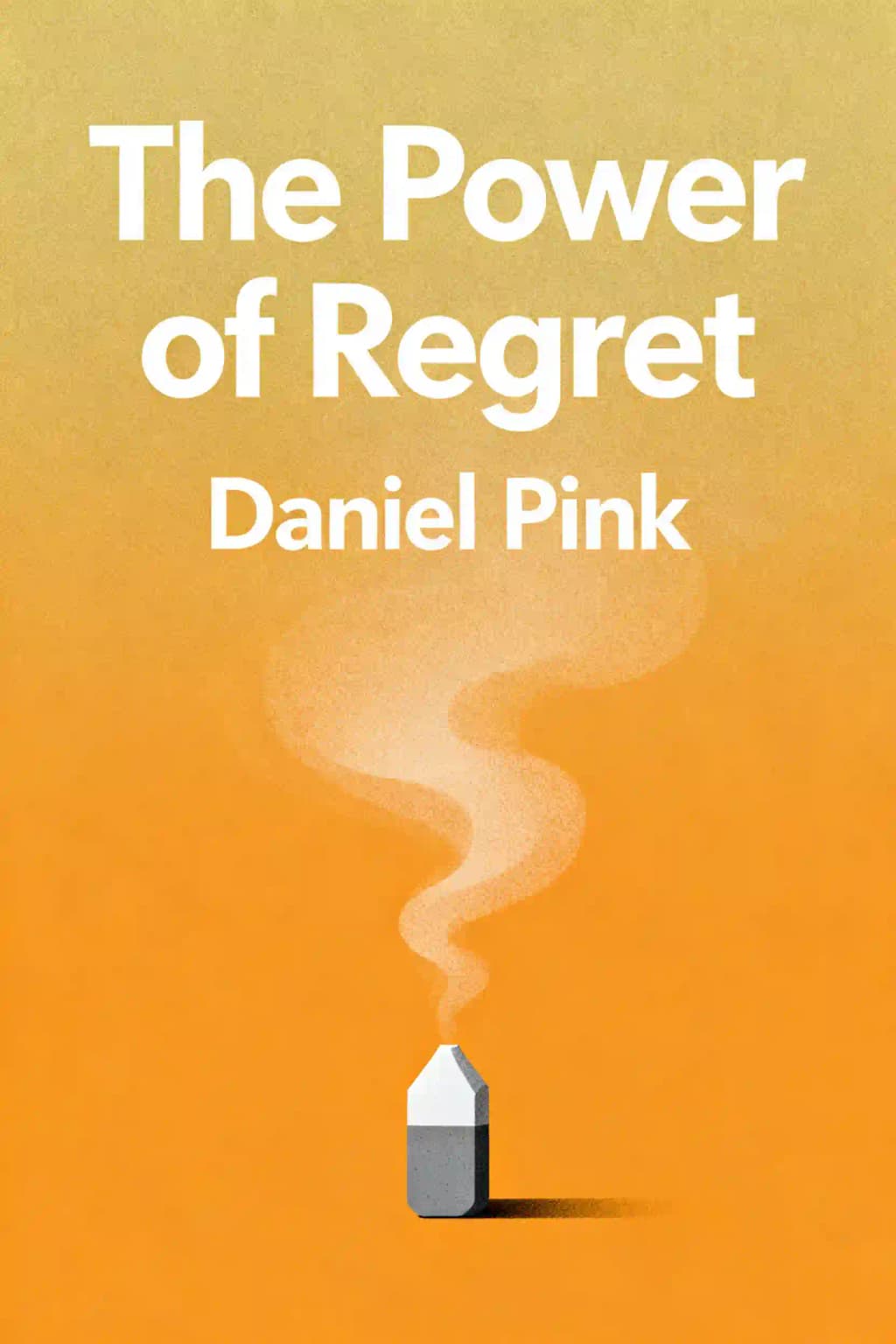
Forget "no regrets" - Daniel Pink's research spanning 20,000 people reveals regret is actually valuable. Bronze Olympic medalists outsmile silver ones, and near-miss scientists outperform grant recipients. Discover how looking backward propels you forward in ways you never imagined.
Daniel H. Pink, bestselling author of The Power of Regret: How Looking Backward Moves Us Forward and a leading expert in behavioral science, explores the transformative potential of regret in this psychology-driven work. A former chief speechwriter for Vice President Al Gore, Pink bridges his political experience with decades of research on human motivation, evidenced in his #1 New York Times bestsellers Drive: The Surprising Truth About What Motivates Us and To Sell is Human. His insights on workplace dynamics and decision-making have been featured in his record-breaking TED Talk (38+ million views) and National Geographic’s Crowd Control series.
Pink’s books, translated into 42 languages and endorsed by institutions like the U.S. Department of Labor, blend behavioral psychology with practical strategies for personal growth. The Power of Regret builds on his signature theme of redefining conventional emotions, offering actionable frameworks to harness regret as a catalyst for clarity. Recognized among the world’s top 15 business thinkers by Thinkers50, Pink combines academic rigor with accessible storytelling—a approach that has sold over 2 million copies globally.
The Power of Regret explores how regrets—often seen as negative—can serve as catalysts for growth. Daniel Pink synthesizes psychology, neuroscience, and global surveys (including his 15,000-person World Regret Survey) to identify four universal regrets: foundation (poor life choices), boldness (inaction), moral (ethical lapses), and connection (broken relationships). The book reframes regret as a tool for smarter decisions and a more meaningful life.
This book is ideal for anyone seeking personal growth, professionals navigating career decisions, or individuals struggling with past choices. Pink’s actionable insights benefit leaders aiming to improve workplace motivation and readers interested in behavioral science. Its blend of storytelling and research appeals to fans of Pink’s prior works like Drive and When.
Yes—Pink’s evidence-based approach and practical framework make regret actionable. Unlike generic self-help, it offers specific strategies like self-disclosure (sharing regrets) and at-least thinking (reframing outcomes). With 20,000+ regret stories analyzed, it provides relatable, data-driven guidance for turning hindsight into progress.
Pink advocates a three-step process:
It combines large-scale data (like Pink’s global surveys) with neuroscience, avoiding oversimplified “no regrets” advice. Instead, it provides a structured system to harness regret’s motivational power, illustrated by real-world stories and tactical strategies like the Regret Optimization Framework.
Some note the book focuses heavily on Western perspectives and may oversimplify complex emotions. However, its reliance on diverse global data (105 countries surveyed) and pragmatic exercises strengthens its applicability.
It builds on Pink’s signature theme—human motivation—seen in Drive (intrinsic vs. extrinsic rewards) and When (timing’s role in decisions). This book adds a nuanced layer by examining how past decisions shape future behavior.
Absolutely. Boldness regrets often involve career risks not taken (e.g., rejecting a promotion or startup idea). Pink’s strategies, like prospective hindsight (“Imagine future regret”), help clarify priorities and reduce decision paralysis.
Pink distinguishes open-door (fixable) and closed-door (irreparable) connection regrets. For open doors, he stresses proactive reconciliation (e.g., apologizing). For closed doors, he advises acceptance rituals, like writing unsent letters.
Yes. Techniques include:
저자의 목소리로 책을 느껴보세요
지식을 흥미롭고 예시가 풍부한 인사이트로 전환
핵심 아이디어를 빠르게 캡처하여 신속하게 학습
재미있고 매력적인 방식으로 책을 즐기세요
Regret is not dangerous or abnormal, a deviation from the steady path to happiness. It is healthy and universal, an integral part of being human.
If only I’d taken that risk.
Regret clarifies. Regret instructs. Done right, it needn’t drag us down; it can lift us up.
Far from being a sign of psychological strength, the absence of regret often indicates serious cognitive impairment.
Power of Regret의 핵심 아이디어를 이해하기 쉬운 포인트로 분해하여 혁신적인 팀이 어떻게 창조하고, 협력하고, 성장하는지 이해합니다.
생생한 스토리텔링을 통해 Power of Regret을 경험하고, 혁신 교훈을 기억에 남고 적용할 수 있는 순간으로 바꿉니다.
무엇이든 묻고, 학습 스타일을 선택하고, 나에게 맞는 인사이트를 함께 만들어보세요.

샌프란시스코에서 컬럼비아 대학교 동문들이 만들었습니다
"Instead of endless scrolling, I just hit play on BeFreed. It saves me so much time."
"I never knew where to start with nonfiction—BeFreed’s book lists turned into podcasts gave me a clear path."
"Perfect balance between learning and entertainment. Finished ‘Thinking, Fast and Slow’ on my commute this week."
"Crazy how much I learned while walking the dog. BeFreed = small habits → big gains."
"Reading used to feel like a chore. Now it’s just part of my lifestyle."
"Feels effortless compared to reading. I’ve finished 6 books this month already."
"BeFreed turned my guilty doomscrolling into something that feels productive and inspiring."
"BeFreed turned my commute into learning time. 20-min podcasts are perfect for finishing books I never had time for."
"BeFreed replaced my podcast queue. Imagine Spotify for books — that’s it. 🙌"
"It is great for me to learn something from the book without reading it."
"The themed book list podcasts help me connect ideas across authors—like a guided audio journey."
"Makes me feel smarter every time before going to work"
샌프란시스코에서 컬럼비아 대학교 동문들이 만들었습니다

Power of Regret 요약을 무료 PDF 또는 EPUB으로 받으세요. 인쇄하거나 오프라인에서 언제든 읽을 수 있습니다.
Imagine scrolling through Instagram and seeing yet another "No Regrets" tattoo. From Edith Piaf's defiant anthem to celebrity mantras, our culture celebrates living regret-free. But what if this popular philosophy is fundamentally wrong? What if regret isn't something to avoid but rather one of our most valuable emotional tools? Drawing from groundbreaking research including the World Regret Survey (16,000+ regrets from 105 countries) and the American Regret Project (4,489 Americans), we discover that regret is not only universal but potentially transformative - if we know how to harness it properly. The evidence is clear: 82% of people occasionally look back wishing they'd done things differently, with 43% doing so frequently. Far from being something to banish, regret might be our most powerful teacher.
Regret is distinctly human, requiring two remarkable mental abilities: time travel and storytelling. Unlike basic emotions like fear or anger, regret demands sophisticated cognitive processing-we must revisit past decisions, negate what happened, substitute alternatives, and project different outcomes. This cognitive ability emerges around age six. People with certain brain injuries or conditions like Huntington's, Parkinson's, or schizophrenia often lose this capacity. Rather than indicating psychological strength, the absence of regret frequently signals cognitive impairment. What distinguishes regret from disappointment is its unique combination of comparison (contrasting reality with imagined alternatives) and self-blame (recognizing personal responsibility). When Michele Mayo got an Edith Piaf-inspired tattoo reading "Non, Je Ne Regrette Rien" for her fiftieth birthday, she claimed to live without regrets while acknowledging "mistakes" that taught valuable lessons. Ironically, Piaf herself died with apparent regrets, her final words suggesting accountability for her choices.
Olympic bronze medalists often appear happier than silver medalists, revealing a fascinating aspect of our minds. When processing outcomes, we engage in "counterfactual thinking" - imagining alternatives to reality. A study of the 1992 Olympics showed bronze medalists appeared significantly happier (7.1 on an "agony-to-ecstasy" scale) than silver medalists (4.8). Why? Bronze medalists think "at least I got a medal!" (downward counterfactuals or "At Leasts") while silver medalists dwell on nearly winning gold (upward counterfactuals or "If Onlys"). Though comfort seems preferable to pain, research shows "If Onlys" dominate our thinking - comprising up to 80% of our counterfactual thoughts. This paradox exists because regret serves an evolutionary purpose: painful "If Only" thoughts improve future performance. Studies consistently show that upward counterfactual thinking enhances subsequent task performance. As Leonard Cohen wrote, "There is a crack in everything/That's how the light gets in" - regret's discomfort illuminates better paths forward.
Rather than being an emotion to avoid, regret functions as a cognitive tool that improves our lives in three key ways: First, regret improves our "decision hygiene" by making us more thorough. When we feel the sting of regret from hasty decisions, we prepare more carefully next time. Studies show regretful negotiators prepare better, make stronger offers, and create more value. Second, regret boosts performance. Experiments show that inducing regret - encouraging "If Only" thinking - leads to improved performance and persistence. Even hearing others' regrets helps: participants exposed to regret stories scored 10% higher on LSAT questions and solved complex puzzles more effectively. Third, regret deepens meaning in our lives. Northwestern students who reflected on alternative university or friendship choices found their actual experiences more meaningful. Considering "what might have been" often creates greater meaning than directly contemplating an event's significance. The healthiest approach is "feeling is for thinking" - using emotions as catalysts for improved behavior. Like stress, regret becomes productive when framed as an evaluation of specific behaviors rather than character judgments.
While regrets appear different on the surface, they share deeper structural similarities. Like Chomsky's linguistic "deep structure," regrets across cultures reveal four fundamental categories: **Foundation regrets** arise from failures to be responsible, undermining stability through poor choices in education, finances, or health. They stem from temporal discounting and failure to understand compounding effects. Small poor decisions accumulate until their impact becomes "gradually and then suddenly" devastating. **Boldness regrets** stem from chances not taken in life. People regret inactions more than actions - in the American Regret Project, inaction regrets outnumbered action regrets nearly two to one. At their core is thwarted growth - failing to become who one could have been. **Moral regrets** occur when we compromise our principles. Unlike boldness regrets, these typically involve actions rather than inactions. They cluster around harm, cheating, disloyalty, subversion, and desecration. Though the smallest category numerically, moral regrets reveal our deep desire to be good. **Connection regrets**, the largest category, arise when relationships fracture or remain incomplete. They follow a common plotline: a relationship that was once intact, or should have been, no longer is. People avoid reconnecting fearing awkwardness, but we consistently overestimate the discomfort and underestimate others' positive responses.
When facing regrets, particularly those of inaction, we can convert them into fuel for progress through three steps: **Step 1: Self-Disclosure** - Writing or talking about regrets for just fifteen minutes daily increases life satisfaction. Language transforms abstract emotions into concrete thoughts, moving experiences from emotional to cognitive realms. Even private writing about difficulties improves health, mood, immunity, academic performance, and employment prospects. **Step 2: Self-Compassion** - After disclosure, avoid self-criticism (which leads to rumination) or excessive self-esteem (which can foster narcissism). Instead, extend to yourself the same warmth you'd offer others. Self-compassion correlates with greater optimism, happiness, curiosity, wisdom, emotional intelligence, and deeper connections, while reducing depression, anxiety, and stress. **Step 3: Self-Distancing** - View your situation as a detached observer rather than immersing in negative emotions. This transforms your role from "scuba diver to oceanographer" - from swimming in regret to examining it from above. Practice self-distancing through space (the "fly-on-the-wall technique"), time (imagining your perspective in ten years), or language (using third-person pronouns when addressing yourself).
When Alfred Nobel read his mistakenly published obituary labeling him "the merchant of death," he established the Nobel Prizes to transform his legacy. Glimpsing how history might remember him motivated Nobel to avoid future regret. We are both authors and actors in our life stories. Psychologist Dan McAdams identifies two narrative patterns: "contamination sequences" (good turning bad) and "redemption sequences" (negative transforming into positive). Research shows people who construct redemption narratives tend to be more satisfied with life and find greater meaning in their experiences. This redemptive quality appears in Cheryl Johnson's story, who reconnected with her friend Jen after 25 years. When Cheryl expressed regret over lost time, Jen replied, "But we still have a lot of years left" - transforming regret into future possibility. Understanding what we truly regret reveals what we truly value, pointing toward a life well lived - one built on a solid foundation, enriched by boldness, guided by morality, and deepened through connection. When embraced rather than denied, regret transforms from a source of pain into our most powerful teacher.