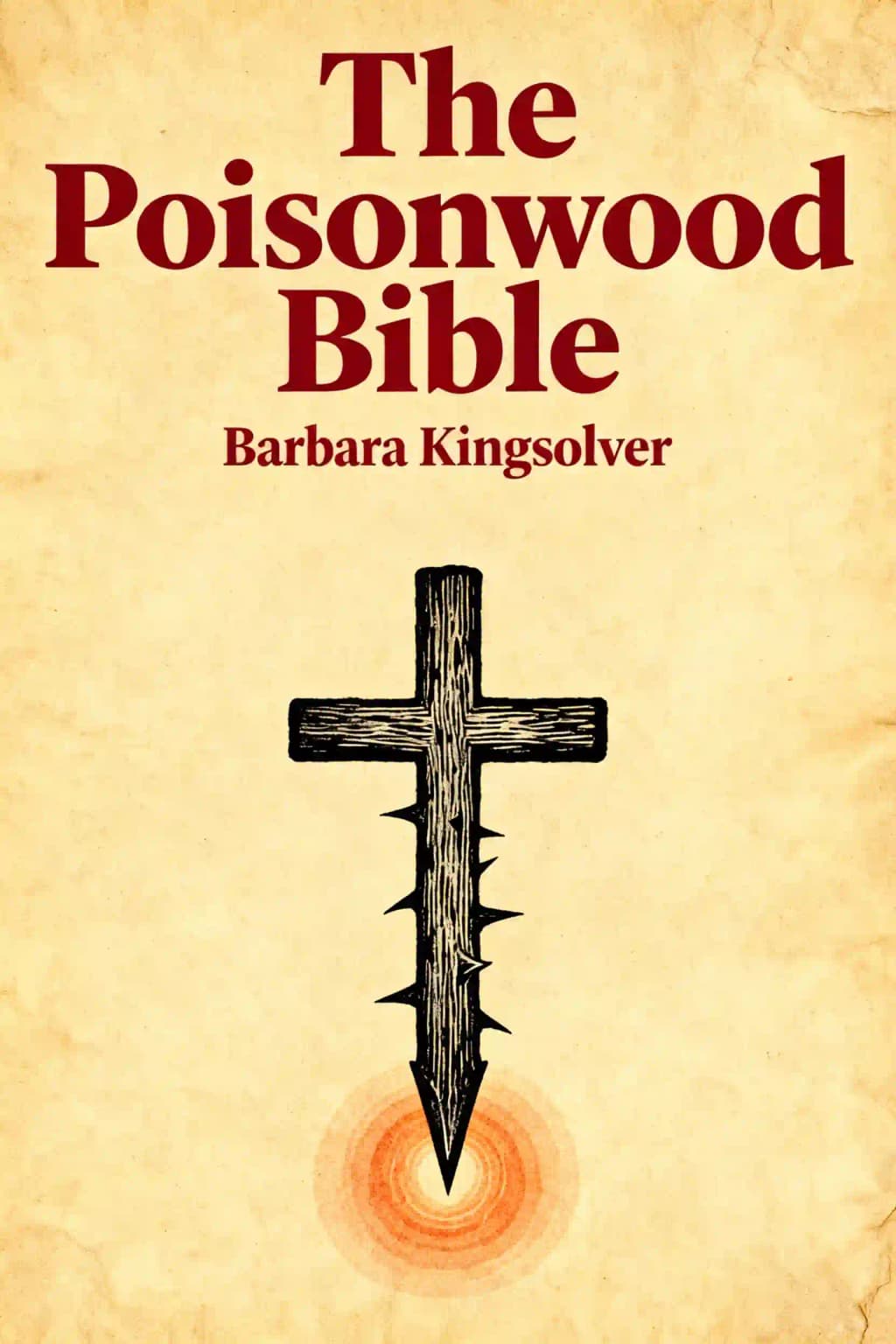
A missionary family's Congo journey unravels amid postcolonial chaos in Kingsolver's Pulitzer finalist. Oprah-endorsed and frequently banned, this provocative tale told through five female voices confronts American imperialism and religious zealotry, asking: whose truth survives when empires crumble?
Barbara Ellen Kingsolver is the Pulitzer Prize-winning author of The Poisonwood Bible, a literary masterwork exploring colonialism, faith, and cultural collision in post-colonial Africa.
Born in 1955 and raised in rural Kentucky, Kingsolver earned biology degrees from DePauw University and the University of Arizona, bringing scientific depth to her storytelling. Her childhood year in the Congo (1963) profoundly shaped this 1998 novel about a missionary family's harrowing African journey.
The book became an Oprah's Book Club selection, won the National Book Prize of South Africa, and was shortlisted for the Pulitzer Prize. Kingsolver's other acclaimed works include Demon Copperhead (2023 Pulitzer Prize winner), The Bean Trees, Animal Dreams, and Prodigal Summer. She is the first author to win the Women's Prize for Fiction twice. Her books have been translated into more than thirty languages, and every novel since Pigs in Heaven has appeared on The New York Times Best Seller list.
The Poisonwood Bible by Barbara Kingsolver follows a Baptist missionary family who moves from Georgia to the Belgian Congo in 1959. Zealous preacher Nathan Price drags his wife Orleanna and four daughters into the African jungle to evangelize locals, but his cultural arrogance and refusal to adapt lead to tragedy. Narrated by the five women, the novel spans three decades and explores how each family member grapples with guilt, colonialism, and the consequences of Western interference in Africa.
The Poisonwood Bible is ideal for readers interested in postcolonial literature, family dynamics, and historical fiction set in Africa. Barbara Kingsolver's novel appeals to those who appreciate multi-perspective narratives and complex female characters navigating themes of guilt, cultural imperialism, and personal transformation. It's particularly valuable for readers exploring how Western missionary work impacted African independence movements and anyone drawn to literary fiction that examines the long-term consequences of cultural arrogance.
The Poisonwood Bible is widely considered one of Barbara Kingsolver's finest works and a powerful indictment of colonialism. The novel's strength lies in its multi-narrator structure, giving voice to five distinct women with contrasting perspectives on the same events. Kingsolver's rich prose, symbolic depth, and unflinching examination of Western guilt make it a compelling read. The book resonates particularly with readers interested in exploring how personal family trauma intersects with broader political and cultural devastation.
Barbara Kingsolver wrote The Poisonwood Bible, publishing it in 1998 as her first novel set outside the United States. As a child, Kingsolver briefly lived in the Democratic Republic of the Congo with her parents, who were public health workers. She wrote the novel after learning about the United States' secret plot to sabotage Congo's independence in the 1960s, specifically to address and explore Western manipulation in other countries and the lasting damage of colonialism.
The Poisonwood Bible delivers a powerful critique of Western colonialism, cultural arrogance, and the destructive nature of imposing foreign values on indigenous cultures. Barbara Kingsolver illustrates how Nathan Price's missionary zealotry mirrors Western nations' exploitative treatment of Africa—both claim noble intentions while causing devastating harm. The novel argues that true understanding requires humility, adaptation, and respect for local wisdom rather than blind adherence to one's own beliefs, regardless of consequences.
The poisonwood in Barbara Kingsolver's novel carries dual symbolic meaning. Nathan Price repeatedly says "Jesus is bangala" in Kikongo, intending to say "beloved" but mispronouncing it as "poisonwood" due to wrong vocal inflection. Additionally, poisonwood refers to an actual African tree Nathan was warned not to touch but ignored, suffering painful swelling. This dual symbolism represents how Nathan's "beloved" mission becomes poisonous through cultural ignorance and stubborn refusal to listen to local knowledge.
The Poisonwood Bible centers on the Price family: Nathan, the arrogant Baptist preacher; his wife Orleanna, who narrates with crushing guilt; and their four daughters. Rachel is the vain beauty queen; Leah, the idealistic tomboy who later marries local teacher Anatole; Adah, Leah's twin who is physically disabled but intellectually brilliant and becomes an epidemiologist; and Ruth May, the precocious youngest who dies from a snake bite, catalyzing the family's disintegration.
Ruth May, the youngest Price daughter, is killed by a poisonous snake planted by the village's religious leader who opposes Nathan's missionary work. Her death at approximately age five to eight occurs during a period of village tensions over allowing Leah to join a hunt despite traditional prohibitions. Ruth May's death becomes the pivotal tragedy that finally gives Orleanna strength to leave Nathan and the Congo with her three surviving daughters, and all family members spend their remaining lives grappling with guilt over her loss.
The Poisonwood Bible concludes by following the Price women across three decades after leaving the Congo. Rachel marries three times and inherits a hotel near Brazzaville. Leah marries Anatole and dedicates herself to African independence work, raising four sons who represent the erasure of whiteness. Adah rejects religion for science, becoming an epidemiologist. Orleanna lives consumed by guilt over Ruth May's death and her complicity in Congo's destruction. Nathan remains in Africa, disappearing into the jungle, symbolizing the ultimate failure of cultural imperialism.
The Poisonwood Bible explores colonialism and post-colonialism, examining how Western nations exploited Africa under the guise of bringing "civilization." Barbara Kingsolver weaves themes of cultural arrogance, guilt, religion as both destruction and redemption, motherhood, and feminism throughout the narrative. The novel also examines different responses to trauma—Leah chooses political activism, Adah embraces science, Rachel practices denial, and Orleanna withdraws. Pantheism versus Christianity, the exploitation of natural resources, and intergenerational guilt form additional thematic layers.
Barbara Kingsolver deliberately excludes Nathan Price's voice, allowing only Orleanna and her four daughters to narrate The Poisonwood Bible. This structure emphasizes how the women experience and process Nathan's destructive zealotry differently while highlighting their marginalization in a patriarchal system. Each narrator brings unique perspectives—Rachel's vanity, Leah's idealism, Adah's intellectualism, Ruth May's innocence, and Orleanna's retrospective guilt—creating a multifaceted portrait of how one man's arrogance devastates multiple lives across generations.
Methuselah, the parrot in The Poisonwood Bible, symbolizes the nation of Congo itself and its relationship with Western powers. Like the bird who was caged and dependent on its owners, Congo became dependent on Belgian colonial rule. When freed, Methuselah struggles to survive independently, mirroring Congo's difficulties achieving true independence after colonial withdrawal. The parrot's eventual death from predation represents how supposedly "liberated" nations remain vulnerable to exploitation by new powers replacing old colonial masters.
저자의 목소리로 책을 느껴보세요
지식을 흥미롭고 예시가 풍부한 인사이트로 전환
핵심 아이디어를 빠르게 캡처하여 신속하게 학습
재미있고 매력적인 방식으로 책을 즐기세요
"Jesus is bangala!"
Western hubris.
Missionary zeal.
Cultural collision.
The Poisonwood Bible의 핵심 아이디어를 이해하기 쉬운 포인트로 분해하여 혁신적인 팀이 어떻게 창조하고, 협력하고, 성장하는지 이해합니다.
The Poisonwood Bible을 빠른 기억 단서로 압축하여 솔직함, 팀워크, 창의적 회복력의 핵심 원칙을 강조합니다.

생생한 스토리텔링을 통해 The Poisonwood Bible을 경험하고, 혁신 교훈을 기억에 남고 적용할 수 있는 순간으로 바꿉니다.
무엇이든 물어보고, 목소리를 선택하고, 진정으로 공감되는 인사이트를 함께 만들어보세요.

샌프란시스코에서 컬럼비아 대학교 동문들이 만들었습니다
"Instead of endless scrolling, I just hit play on BeFreed. It saves me so much time."
"I never knew where to start with nonfiction—BeFreed’s book lists turned into podcasts gave me a clear path."
"Perfect balance between learning and entertainment. Finished ‘Thinking, Fast and Slow’ on my commute this week."
"Crazy how much I learned while walking the dog. BeFreed = small habits → big gains."
"Reading used to feel like a chore. Now it’s just part of my lifestyle."
"Feels effortless compared to reading. I’ve finished 6 books this month already."
"BeFreed turned my guilty doomscrolling into something that feels productive and inspiring."
"BeFreed turned my commute into learning time. 20-min podcasts are perfect for finishing books I never had time for."
"BeFreed replaced my podcast queue. Imagine Spotify for books — that’s it. 🙌"
"It is great for me to learn something from the book without reading it."
"The themed book list podcasts help me connect ideas across authors—like a guided audio journey."
"Makes me feel smarter every time before going to work"
샌프란시스코에서 컬럼비아 대학교 동문들이 만들었습니다

The Poisonwood Bible 요약을 무료 PDF 또는 EPUB으로 받으세요. 인쇄하거나 오프라인에서 언제든 읽을 수 있습니다.
In 1959, the Price family arrives in the Belgian Congo like unwitting characters in a Greek tragedy, destined for a fall they cannot yet imagine. Reverend Nathan Price-stern, unyielding, and haunted by wartime guilt-leads his wife Orleanna and four daughters into the remote village of Kilanga with missionary zeal and cultural blindness. The girls form a kaleidoscope of American perspectives: fifteen-year-old Rachel clings desperately to her beauty products and American identity; twins Leah and Adah (one devoted to her father, the other silently brilliant and partially paralyzed) process their new reality through dramatically different lenses; and five-year-old Ruth May approaches village life with innocent curiosity that bridges cultural divides. Their arrival is a study in absurdity-stepping off a small missionary plane wearing multiple layers of clothing to circumvent baggage restrictions, carrying Betty Crocker cake mixes that will never rise in the humid air and garden seeds unsuited to tropical soil. The villagers gather to observe these strange white apparitions with barely concealed amusement. Nathan's first sermon, delivered during the welcome feast, reveals the depths of his misunderstanding as he lectures about nakedness and sin to a bewildered audience who have welcomed him with genuine hospitality.