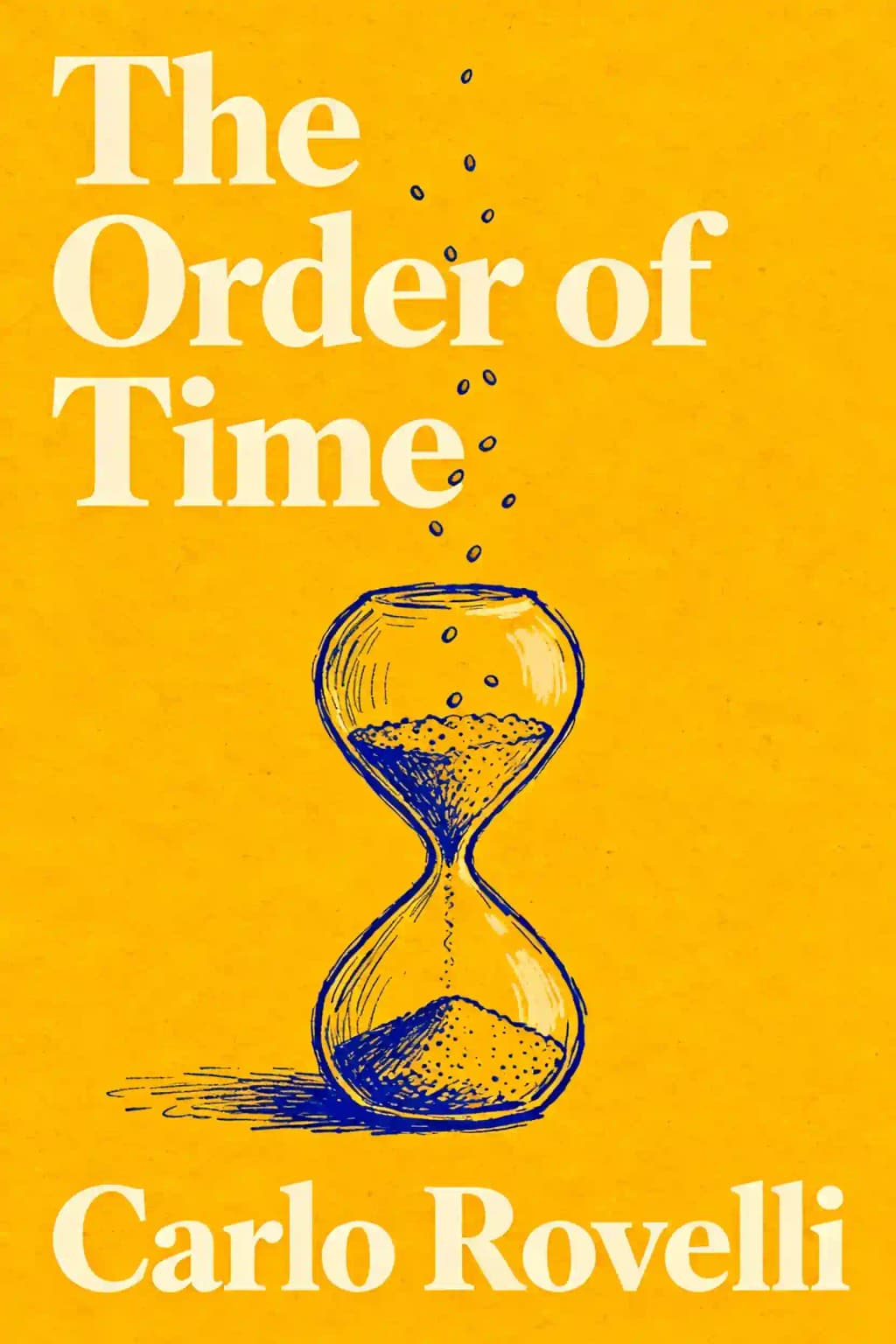
Time isn't what you think. Carlo Rovelli's mind-bending journey through physics reveals how time flows differently across the universe. Einstein's relativity comes alive in this 15-minute Blinkist favorite, challenging our perception of reality through events, not things.
Carlo Rovelli, theoretical physicist and bestselling author of The Order of Time, is renowned for translating complex scientific concepts into accessible narratives.
A pioneer of loop quantum gravity, Rovelli bridges physics and philosophy in his exploration of time’s elusive nature. His insights draw from decades of research at Aix-Marseille University and previous roles at the University of Pittsburgh and Yale.
His works, including Seven Brief Lessons on Physics and Reality Is Not What It Seems, have sold millions worldwide, with Seven Brief Lessons translated into 41 languages.
Recognized as one of Foreign Policy’s 100 Most Influential Global Thinkers (2019), Rovelli frequently contributes to major publications like The New York Times and The Guardian. The Order of Time has been a global bestseller since its 2018 release, praised for merging scientific rigor with poetic reflection.
The Order of Time explores the illusory nature of time through physics and philosophy, arguing that time isn’t fundamental but emerges from quantum interactions. Rovelli dismantles concepts like chronological flow, explaining entropy, quantum gravity, and relativity. The book blends scientific rigor with poetic reflections on human temporality, proposing a “thermal time” hypothesis where time arises from thermodynamic processes.
This book suits readers fascinated by theoretical physics, philosophy, or accessible science writing. It’s ideal for those seeking insights into quantum gravity, spacetime, or existential questions about reality. Fans of Rovelli’s Seven Brief Lessons on Physics or works by Stephen Hawking will appreciate its balance of clarity and depth.
Yes—it’s a New York Times bestseller praised for making complex physics engaging. While some critics dispute Rovelli’s conclusions, the book’s exploration of time’s subjectivity and its ties to human emotion offers profound interdisciplinary value. Over 500,000 copies sold globally attest to its impact.
Rovelli argues time isn’t inherent to reality but emerges from thermodynamic entropy (“thermal time”). This framework suggests time flows because we perceive irreversible heat dispersion, not from fundamental laws. It’s central to his work reconciling quantum mechanics and general relativity.
Entropy—the measure of disorder—drives time’s arrow. Rovelli illustrates how low-entropy early universe conditions create the illusion of time’s unidirectional flow. He links this to quantum gravity, showing entropy’s role in shaping spacetime structure.
These lines encapsulate Rovelli’s view of time as a human-constructed narrative.
While Seven Brief Lessons introduces foundational physics concepts, The Order of Time delves deeper into quantum gravity and temporal philosophy. Both blend lyrical prose with science, but The Order of Time offers more technical detail suited for advanced readers.
Some physicists argue Rovelli overstates time’s illusory nature, dismissing phenomenological experiences. Critics also note his thermal time hypothesis remains speculative, lacking experimental proof. Philosophers challenge his rejection of objective temporality.
Rovelli argues our brains construct time’s flow by stitching fragmented quantum events into narratives. Emotional experiences like anticipation or memory reinforce this illusion, making time feel personal despite its physical absence.
Rovelli, a founder of loop quantum gravity theory, describes spacetime as a granular “spin network” of quantized loops. This framework replaces smooth continuity with discrete quantum interactions, challenging classical views of time.
Rovelli explains relativity shows no universal “now”—simultaneity depends on observers’ motion. Quantum interactions further fragment locality, making the present a subjective construct rather than an objective reality.
By reframing time as emergent, the book encourages mindfulness about temporal anxieties. It suggests embracing life’s transient events rather than fixating on chronological progress, aligning with Stoic and Buddhist philosophies.
저자의 목소리로 책을 느껴보세요
지식을 흥미롭고 예시가 풍부한 인사이트로 전환
핵심 아이디어를 빠르게 캡처하여 신속하게 학습
재미있고 매력적인 방식으로 책을 즐기세요
The difference between past and future, between cause and effect, between memory and hope, between regret and intention… in the elementary laws that describe the mechanisms of the world, there is no such difference.
The world isn't a collection of things, it's a collection of events.
Time is perhaps humanity's greatest enigma.
The world isn't a platoon marching to one commander's pace but a network of events.
The Order of Time의 핵심 아이디어를 이해하기 쉬운 포인트로 분해하여 혁신적인 팀이 어떻게 창조하고, 협력하고, 성장하는지 이해합니다.
The Order of Time을 빠른 기억 단서로 압축하여 솔직함, 팀워크, 창의적 회복력의 핵심 원칙을 강조합니다.

생생한 스토리텔링을 통해 The Order of Time을 경험하고, 혁신 교훈을 기억에 남고 적용할 수 있는 순간으로 바꿉니다.
무엇이든 물어보고, 목소리를 선택하고, 진정으로 공감되는 인사이트를 함께 만들어보세요.

샌프란시스코에서 컬럼비아 대학교 동문들이 만들었습니다
"Instead of endless scrolling, I just hit play on BeFreed. It saves me so much time."
"I never knew where to start with nonfiction—BeFreed’s book lists turned into podcasts gave me a clear path."
"Perfect balance between learning and entertainment. Finished ‘Thinking, Fast and Slow’ on my commute this week."
"Crazy how much I learned while walking the dog. BeFreed = small habits → big gains."
"Reading used to feel like a chore. Now it’s just part of my lifestyle."
"Feels effortless compared to reading. I’ve finished 6 books this month already."
"BeFreed turned my guilty doomscrolling into something that feels productive and inspiring."
"BeFreed turned my commute into learning time. 20-min podcasts are perfect for finishing books I never had time for."
"BeFreed replaced my podcast queue. Imagine Spotify for books — that’s it. 🙌"
"It is great for me to learn something from the book without reading it."
"The themed book list podcasts help me connect ideas across authors—like a guided audio journey."
"Makes me feel smarter every time before going to work"
샌프란시스코에서 컬럼비아 대학교 동문들이 만들었습니다

The Order of Time 요약을 무료 PDF 또는 EPUB으로 받으세요. 인쇄하거나 오프라인에서 언제든 읽을 수 있습니다.
Stand still for a moment and listen. Can you hear it? That subtle sensation of time passing, seconds ticking away, the inexorable march from past to future. Now here's the unsettling truth: what you're experiencing doesn't actually exist in the fundamental fabric of reality. Time, as we know it, is an illusion-not in some mystical sense, but in a precise, scientific way that transforms how we understand existence itself. This isn't philosophy or poetry. It's physics, revealed through decades of careful observation and mathematical rigor. And it changes everything. Picture a simple experiment: place two atomic clocks side by side, one on your floor, one on a table. Wait. The clock on the floor will run measurably slower than the one above it. This isn't malfunction-it's reality. Time literally passes at different rates depending on where you are. Someone living in the mountains ages faster than someone at sea level. The difference is tiny, but absolutely real.