1장
A Mysterious Odyssey of Survival and Discovery
When Jules Verne published "The Mysterious Island" in 1875, he created what would become one of the most beloved adventure novels of all time. This masterful sequel to "Twenty Thousand Leagues Under the Sea" captivated readers with its blend of survival narrative and scientific ingenuity. The book has influenced countless works of fiction and inspired real-world innovators, including spaceflight pioneer Robert Goddard, who credited Verne's visionary ideas as motivation for his revolutionary rocket designs. Even today, the novel's themes of human resilience, technological innovation, and the moral complexities of isolation continue to resonate with readers across generations. What makes this story so enduring is not just its thrilling adventure, but its profound exploration of what humans can accomplish when pushed to their limits in the face of nature's challenges.
2장
Castaways in the Storm: The Dramatic Arrival
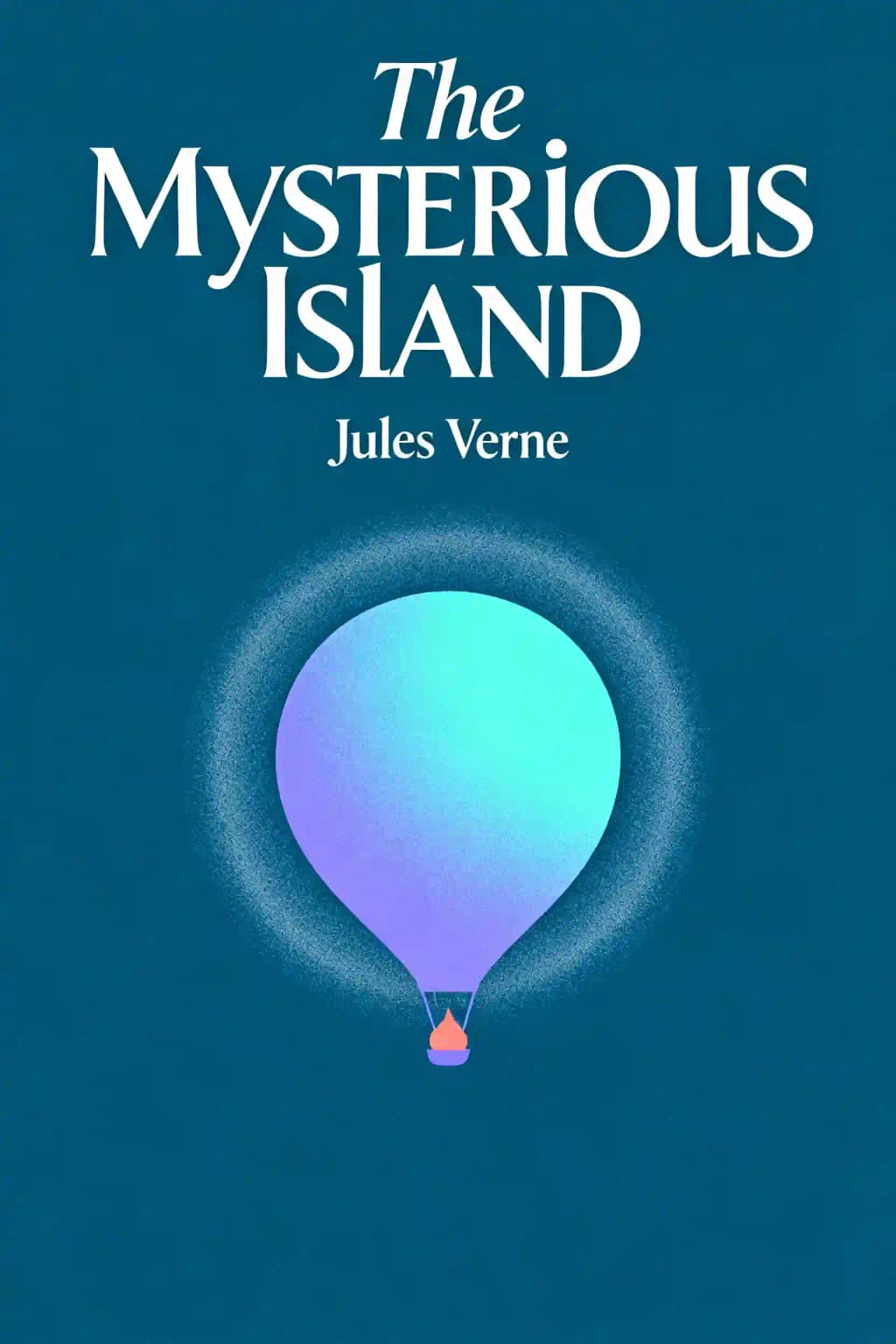
The story opens with a scene of heart-stopping intensity that immediately thrusts readers into a life-or-death struggle. Five men and a dog desperately grip the rain-slicked netting of a storm-battered balloon, suspended precariously above the raging Pacific Ocean in March 1865. Their gondola car - along with vital supplies and equipment - has already been sacrificed to the howling winds in a last-ditch effort to maintain altitude. Through sheets of driving rain, they catch their first glimpse of land just as their failing craft begins its final, terrifying descent.
The diverse group of castaways represents a remarkable cross-section of skills and personalities. Cyrus Harding stands out as their natural leader - a brilliant engineer whose scientific knowledge ranges from geology to chemistry, and whose calm demeanor inspires confidence even in dire circumstances. Gideon Spilett brings the sharp observational skills and quick thinking that made him a respected reporter for the New York Herald. Neb, whose deep loyalty to Harding stems from their shared experiences before and after his emancipation from slavery, possesses both physical strength and unwavering determination. The seasoned sailor Pencroft contributes vital maritime expertise and practical knowledge, while fifteen-year-old Herbert Brown - Pencroft's ward - combines youthful energy with a passionate interest in natural history.
These men are far from ordinary castaways - they are escaped Union prisoners who fled Richmond during the American Civil War's final months. Their daring escape involved commandeering a Confederate observation balloon intended for military reconnaissance, but their bid for freedom took an unexpected turn when a massive hurricane swept them across the continent and far out over the Pacific. The violence of this storm - with winds exceeding 100 miles per hour - carried them thousands of miles off course, destroying their navigation equipment and leaving them completely disoriented.
Their arrival on the mysterious island unfolds as a scene of both salvation and tragedy. As the balloon makes its final approach, massive waves crash against rocky cliffs, creating treacherous conditions. In the chaos of their landing, Cyrus Harding is swept away by a towering wave - disappearing into the churning seas before his companions' horrified eyes. This loss strikes a devastating blow to the group's morale, particularly affecting Neb, who immediately begins a solitary search along the shoreline for any sign of his former master.
The survivors find themselves stranded on what initially appears to be a small, barren islet. Unlike traditional castaway narratives where characters salvage provisions and tools from convenient shipwrecks, these men face their situation with absolutely nothing - no tools, no weapons, no supplies, not even a single match. Their only possessions are the clothes they wear and their collective knowledge and skills. Yet in these opening moments, we see the emergence of the qualities that will define their struggle for survival: Pencroft steps up to provide temporary leadership, Spilett begins methodically assessing their situation, Herbert's knowledge of natural resources proves invaluable, and Neb's unwavering faith drives him to continue searching for Harding. This opening sequence establishes the core themes that will resonate throughout the narrative: the triumph of human ingenuity over adversity, the strength found in loyalty and cooperation, and the remarkable resilience of the human spirit when faced with seemingly impossible odds.
3장
From Nothing to Something: The Triumph of Human Ingenuity
The heart of "The Mysterious Island" lies in its celebration of human ingenuity and scientific knowledge. Nowhere is this more evident than in the colonists' remarkable journey from absolute destitution to relative comfort through applied intelligence. When Cyrus Harding mysteriously reappears - rescued by his dog Top under circumstances that remain unexplained - the group's capabilities expand exponentially under his leadership.
Harding represents the ideal of nineteenth-century scientific man. When the colonists need fire but have only a single match, he doesn't risk using it directly. Instead, he creates a burning glass using watch crystals filled with water to focus the sun's rays. When they need bricks, he teaches them to make a kiln. When they need iron tools, he constructs a primitive blast furnace to smelt ore. Each solution builds on the previous one in a remarkable chain of technological advancement.
"We have nothing," Harding declares early in their ordeal, "but we will make everything." This statement becomes the group's operating principle. Without matches, they make fire. Without weapons, they fashion bows and arrows. Without pottery, they build kilns and create their own. Without bread, they cultivate a single grain of corn found in Herbert's pocket, calculating how it will multiply into millions of grains within years.
Perhaps most impressive is Harding's creation of nitroglycerine to blast open an outlet for the lake, revealing the magnificent cavern they name Granite House. This dramatic transformation of their circumstances - from sleeping in drafty caves to inhabiting a secure, comfortable home - symbolizes the colonists' overall journey from vulnerability to self-sufficiency.
What makes these achievements so compelling is that Verne grounds them in actual science and practical knowledge. Unlike many adventure tales that rely on convenient coincidences or magical solutions, "The Mysterious Island" presents a credible progression of problem-solving that feels earned through human effort and intelligence. The message is clear: knowledge is the most valuable resource in overcoming adversity.
4장
A Society in Microcosm: Building Civilization from Scratch
Beyond mere survival, the castaways create a functioning society that mirrors nineteenth-century ideals of civilization and progress. They name their new home "Lincoln Island" in honor of the American president fighting to preserve the Union, and refer to themselves not as castaways but as "colonists" - people building something lasting rather than merely waiting for rescue.
Their social structure reflects Verne's vision of an ideal community. Cyrus Harding serves as the natural leader, respected for his knowledge and judgment rather than through force or formal authority. Each member contributes according to his abilities: Neb handles domestic duties, Pencroft manages maritime affairs, Spilett documents their experiences, Herbert applies his knowledge of natural history, and Ayrton (when he joins them) tends to the livestock. Their division of labor creates efficiency while respecting individual talents.
The colonists establish all the hallmarks of civilization: agriculture, animal husbandry, manufacturing, and even primitive industry. They build bridges to connect different parts of the island, construct a telegraph system for communication with the corral, and eventually plan to build a larger vessel for exploration. Their creation of a windmill, pottery kiln, brick factory, forge, and other infrastructure transforms the island from wilderness to settlement.
Verne presents this microcosm of society as fundamentally harmonious. Despite occasional disagreements, the colonists operate with remarkable unity of purpose. They make decisions democratically, with Harding guiding rather than commanding. Even when they debate whether to hunt down the pirates who threaten their settlement, they resolve their differences through reasoned discussion rather than conflict.
This idealized community reflects nineteenth-century beliefs about progress and the virtues of industriousness, scientific knowledge, and moral character. Yet it also contains surprisingly progressive elements. The relationship between Harding and Neb - a former master and slave who now work as equals - suggests a post-Civil War vision of racial reconciliation. The redemption of Ayrton, a former criminal transformed by isolation and then welcomed into their society, speaks to beliefs about rehabilitation and second chances.
5장
The Mystery Deepens: Unexplained Events and Hidden Presence
While the colonists work to establish their settlement, a series of inexplicable events suggests they may not be alone on the island. These mysterious occurrences create a suspenseful subplot that weaves through the narrative, challenging both the characters' and readers' understanding of their situation.
The first unexplained event occurs during the initial landing, when Cyrus Harding inexplicably survives being swept away in the storm. Found miles from where he should have drowned, Harding has no memory of his rescue - the first hint that someone or something is watching over the castaways. This incident sets a pattern of mysterious interventions that become increasingly difficult to dismiss as mere coincidence.
The series of unexplained events continues to mount:
• Top's sudden projection from the lake when attacked by a dugong, as if lifted by an invisible force
• The perfectly timed appearance of a waterproof chest containing precisely the tools and weapons they desperately need
• A modern rifle bullet discovered embedded in a peccary they've hunted - despite no one having fired such a weapon
• Their canoe's mysterious return across the river, found perfectly moored when they were stranded on the opposite bank
• A guiding fire that appears on the horizon when they're lost at sea in complete darkness
• Life-saving quinine that materializes beside Herbert's sickbed when he's dying of tropical fever
• The destruction of the pirate ship by what witnesses describe as a sophisticated submarine weapon
Each intervention occurs at a moment of crisis, suggesting not only presence but intelligence behind these acts. The timing is too precise, the aid too specific to their needs, to be dismissed as luck. The colonists find themselves in the unusual position of being both grateful for and unsettled by this unseen benefactor.
The mystery creates complex dynamics within the group. Some, like Pencroff, argue they should mount an expedition to find their protector. Others, particularly Cyrus Harding, advocate respecting the being's apparent desire for privacy. This tension leads to philosophical debates about gratitude, privacy, and the nature of benevolence - whether true charity can exist when the giver remains anonymous.
This element transforms the narrative from a straightforward survival story into a multilayered mystery. Verne masterfully balances scientific rationality with seemingly supernatural events, creating a cognitive dissonance that drives the plot forward. The hidden presence serves multiple narrative functions: it provides plausible aid when needed, maintains suspense throughout the story, and raises questions about human independence versus interdependence.
The mystery also highlights the colonists' fundamental vulnerability despite their technological achievements. For all their ingenuity in building their settlement, these moments remind them - and the reader - that survival sometimes depends on factors beyond human control or understanding.
6장
The Moral Journey: Redemption and Second Chances
Beyond physical survival, "The Mysterious Island" explores profound themes of moral redemption and second chances. This dimension is most powerfully embodied in the character of Ayrton, the castaway the colonists rescue from Tabor Island.
When first discovered, Ayrton has regressed to an animal-like state after twelve years of isolation. Once a criminal named Ben Joyce who participated in piracy and murder, he was marooned on Tabor Island as punishment, with the promise that someone would return for him if he proved worthy of rejoining society. The extreme solitude gradually eroded his humanity until he lost the ability to speak or reason.
Under the colonists' care, Ayrton slowly regains his human faculties and eventually confesses his criminal past. Rather than rejecting him, Cyrus Harding offers simple but powerful words: "You have been a great criminal, but Heaven must certainly think that you have expiated your crimes! Ayrton, you are forgiven!" This moment of grace transforms Ayrton, who becomes a devoted and valuable member of their community.
Ayrton's redemption arc parallels the revelation of Captain Nemo's identity as their mysterious benefactor. Nemo, too, has committed acts of violence in his war against oppression, sinking warships and causing many deaths. His secret assistance to the colonists represents his own path toward redemption - a way of reconnecting with humanity after years of misanthropic isolation.
When Nemo reveals himself on his deathbed, he seeks Harding's moral judgment about his past actions. The engineer's response acknowledges Nemo's errors while affirming his fundamental humanity: "Your error was in believing that the past can be resurrected... You fought against inevitable progress... But you have nothing to fear from the judgment of history." This nuanced moral assessment - neither wholesale condemnation nor uncritical approval - reflects the novel's sophisticated approach to questions of guilt, atonement, and forgiveness.
7장
Nature's Power and Human Limitations
For all their ingenuity and resilience, the colonists ultimately confront forces beyond their control when Lincoln Island's volcano reawakens. This final section of the novel serves as a humbling reminder of nature's overwhelming power and the limits of human capability - a theme Verne explores with increasing intensity as the story reaches its climax.
The volcanic eruption begins gradually but with unmistakable warning signs. First comes the thin wisps of smoke from the crater, then increasingly violent tremors that shake the earth beneath their feet. Soon, volcanic ash begins falling like black snow, coating their carefully tended gardens and darkening the sky. These initial disturbances, while concerning, pale in comparison to what follows - explosive eruptions, rivers of molten lava, and toxic gases that force the colonists to abandon parts of their settlement.
When Cyrus Harding, after careful geological investigation, discovers that seawater will inevitably breach the weakening wall separating Dakkar Grotto from the volcano's central shaft, he must deliver the devastating news to his companions: Lincoln Island is doomed to destruction, and no human intervention can prevent it. The very forces that helped create their paradise - the volcanic soil's fertility, the natural harbor, the mineral-rich caves - will now be instruments of its destruction.
This revelation transforms the narrative's final chapters into a desperate race against time. Everything the colonists have built over years of determined effort - their comfortable dwelling at Granite House, their meticulously cultivated fields, their workshops and factories, their domesticated animals - will soon be swallowed by the earth. Even their nearly completed vessel, the culmination of their shipbuilding skills and their only hope of escape, might not be finished before the island's destruction.
The volcanic cataclysm serves multiple narrative purposes beyond mere spectacle. It creates heart-pounding suspense and urgency in the story's final act, forcing characters to make difficult choices under extreme pressure. It provides a dramatic backdrop for Captain Nemo's death and the revelation of his identity, lending gravity to these crucial plot points. Most importantly, it places the colonists' remarkable achievements in stark perspective. For all their success in harnessing nature's resources and overcoming seemingly impossible obstacles, they remain vulnerable to nature's most powerful forces.
When the final explosion obliterates Lincoln Island, leaving only a single rock formation where the colonists desperately cling to life, the message is clear and profound: human ingenuity, while remarkable, has definite limits. Their survival ultimately depends not on their own resources or technological achievements but on the foresight of Captain Nemo, who had left information about their location on Tabor Island, leading to their rescue by the Duncan. This ending reinforces Verne's complex view of human progress - celebrating our capacity for innovation while acknowledging our fundamental dependence on and vulnerability to the natural world.
8장
The Power of Community and Cooperation
Throughout their extraordinary ordeal, the colonists' greatest strength lies in their remarkable unity and collective spirit. Unlike many survival narratives that emphasize individual heroism or descend into conflict and competition, "The Mysterious Island" presents cooperation as the fundamental key to overcoming seemingly insurmountable adversity. Each colonist brings unique skills and perspectives to their collective enterprise, creating a microcosm of effective social organization that enables them to thrive rather than merely survive.
The group's carefully crafted composition reflects different vital aspects of nineteenth-century society and expertise: Cyrus Harding embodies scientific knowledge and leadership, applying engineering principles to solve complex problems; Gideon Spilett represents communication and documentation, maintaining detailed records of their experiences and discoveries; Bonadventure Pencroft contributes practical seamanship and mechanical skills essential for their maritime survival; Neb demonstrates unwavering loyalty and domestic expertise that maintains their daily life; Herbert brings youthful enthusiasm coupled with an encyclopedic knowledge of natural history; and eventually Ayrton adds crucial agricultural expertise to their collective knowledge base. These diverse capabilities complement each other seamlessly, allowing them to address challenges that would overwhelm any individual acting alone - from constructing complex machinery to establishing sustainable food sources.
This emphasis on cooperation extends beyond practical matters to their moral and ethical decisions. When confronted with the serious threat of pirates threatening their settlement, they engage in thoughtful debate about whether to hunt them down preemptively or wait until attacked. Though opinions initially differ strongly, they reach consensus through respectful discussion and careful consideration of all viewpoints rather than through conflict or power struggles. Their unanimous decision to welcome and rehabilitate Ayrton despite his criminal past particularly demonstrates their commitment to compassion, redemption, and inclusive community building.
The colonists' unity stands in sharp contrast to the pirates who temporarily occupy their island. These escaped convicts, bound only by temporary alliances of convenience and mutual self-interest, quickly turn on each other when faced with external threats. Their inability to establish genuine trust or cooperative relationships ultimately contributes to their downfall and defeat, serving as a powerful counterpoint to the colonists' successful social model.
By the story's conclusion, the colonists have formed bonds so profound and unshakeable that they choose to remain together even after their rescue and return to America. Using the considerable treasure bestowed upon them by Captain Nemo, they establish a thriving new colony in Iowa, carefully naming its features after their lost island paradise - Granite House, Prospect Heights, and Lincoln Island become touchstones in their new home. This final image - of a community that survives and flourishes not just physically but socially and emotionally - powerfully reinforces the novel's central message about the fundamental importance of human connection and cooperative spirit in overcoming life's greatest challenges. Their success demonstrates that true civilization isn't built on technological advancement alone, but on the strength of human bonds and collective purpose.
9장
Captain Nemo: The Enigmatic Benefactor Revealed
The revelation of Captain Nemo as the colonists' mysterious benefactor provides a satisfying conclusion to the novel's central mystery while connecting "The Mysterious Island" to Verne's earlier work, "Twenty Thousand Leagues Under the Sea." When the colonists finally discover Dakkar Grotto and the Nautilus within it, they meet an aged, dying Nemo who explains how he came to be their guardian angel.
Nemo reveals that after years of wandering the ocean depths, he chose Lincoln Island as his final refuge. From his hidden base, he observed the colonists' arrival and their subsequent struggle to survive. Initially maintaining his misanthropic isolation, he gradually became invested in their honest friendship and industrious efforts. Through his diving suit, he accessed Granite House's well and overheard their conversations, learning about America's struggle to abolish slavery - a cause that resonated with his own history of fighting oppression.
This revelation recontextualizes the entire narrative. What seemed like supernatural intervention or incredible coincidence is explained as the actions of a technologically advanced benefactor with resources far beyond the colonists' own. Nemo's submarine torpedo destroyed the pirate ship; his medical supplies saved Herbert's life; his strength rescued Cyrus Harding from drowning.
Nemo's character represents a complex moral ambiguity. As Prince Dakkar, he fought against colonial oppression in India. As Captain Nemo, he waged war against warships, causing many deaths. Now, in his final years, he finds a measure of redemption through secretly assisting the colonists. When he asks Harding to judge his past actions, particularly his sinking of an enemy frigate, the engineer responds thoughtfully that while Nemo erred in "contending against inevitable progress," his name has "nothing to fear from the judgment of history."
Nemo's death aboard the Nautilus as it sinks to become his tomb provides a poignant conclusion to his character arc. His final gift to the colonists - the coffer containing his wealth and the message he left on Tabor Island that ultimately leads to their rescue - ensures his legacy continues even after his death. The colonists' solemn prayer as they watch the Nautilus disappear beneath the water - "May his soul be with God!" - offers a final absolution for this complex character.
10장
Legacy and Lasting Significance
"The Mysterious Island" concludes with the colonists' rescue and return to America, where they establish a new settlement named after their sunken home. This epilogue emphasizes the lasting impact of their shared experience and the enduring bonds formed during their ordeal.
Using Captain Nemo's treasure, they purchase vast territory in Iowa, creating a community that mirrors their island society. They name geographical features after those on Lincoln Island - a river becomes the Mercy, a mountain Mount Franklin, a lake Lake Grant, and forests the Far West. This transplantation of their island experience to American soil suggests that the values and skills they developed as castaways remain relevant in civilization.
The novel's final image is one of continued unity and purpose. All the former colonists remain together as they had sworn: Neb with his master, Ayrton ready for any sacrifice, Pencroft more farmer than sailor, Herbert completing his studies under Harding, and Spilett founding the New Lincoln Herald. Their community expands to include visitors connected to their story, yet the core group maintains their special bond.
Despite their new prosperity and security, they never forget Lincoln Island and what it taught them about human potential, cooperation, and resilience. The island itself - now reduced to a fragment of granite in the Pacific waves - remains significant as the tomb of Captain Nemo and as a symbol of their extraordinary journey from desperate castaways to successful colonists.
The lasting significance of "The Mysterious Island" lies in its optimistic vision of human capability in the face of extreme adversity. Through scientific knowledge, moral courage, and unwavering cooperation, ordinary people can accomplish extraordinary things. This message of hope and human potential continues to resonate with readers more than a century after Jules Verne first imagined these remarkable castaways and their mysterious island.