1장
The Veil of Reverence: Unmasking a Global Icon
In 1981, a curious scene unfolded in Haiti. Mother Teresa, the diminutive nun known worldwide for her work with Calcutta's poorest, warmly embraced Michele Duvalier, wife of Haiti's brutal dictator "Baby Doc." As cameras flashed, Mother Teresa lavished praise on the Duvaliers on national television, receiving the Legion d'honneur medal before the couple fled Haiti with millions from the national treasury. This wasn't a manipulated photo op-it was a genuine alliance that raises profound questions. Why was this supposed servant of the destitute cozying up to dictators? The contradiction between image and reality forms the heart of Christopher Hitchens' unflinching examination.
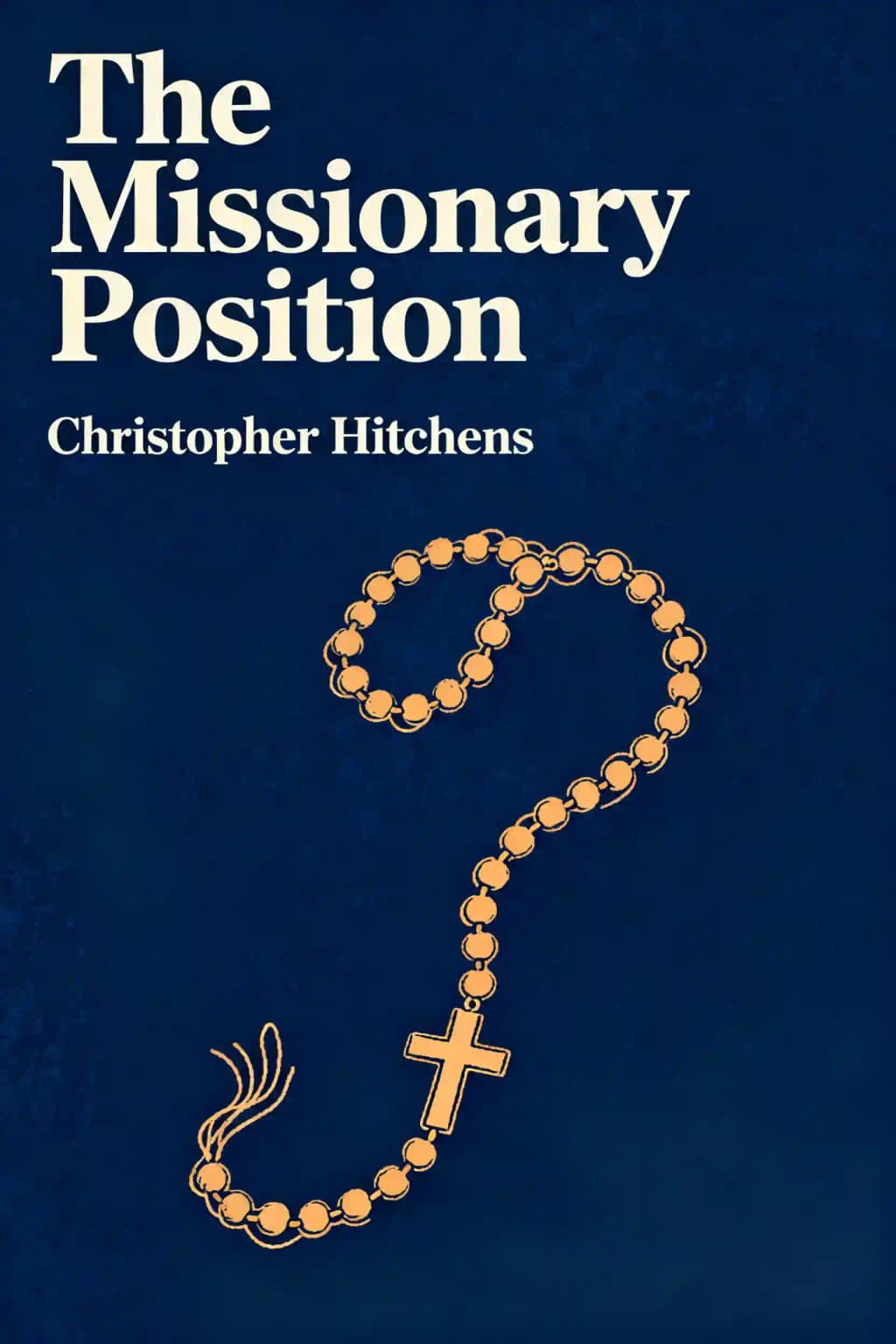
"The Missionary Position" became an instant cultural lightning rod upon publication, challenging what many considered untouchable. Despite fierce criticism, the book has proven remarkably prescient. Celebrities from Princess Diana to Susan Sarandon sought Mother Teresa's blessing, while world leaders competed for photo opportunities with her. Yet behind this carefully cultivated image of selfless service, Hitchens discovered something far more complex: a religious fundamentalist whose primary mission wasn't alleviating suffering but advancing a conservative Catholic agenda. This book invites us to consider what happens when we place anyone-even the most seemingly virtuous-beyond critical examination.
2장
Manufacturing a Miracle: The Creation of an Icon
The transformation of Agnes Bojaxhiu into the globally revered Mother Teresa can be traced to a specific moment in 1969, when British journalist Malcolm Muggeridge visited Calcutta with a BBC film crew. The resulting documentary and book, "Something Beautiful for God," catapulted Mother Teresa to international fame. Central to this narrative was Muggeridge's portrayal of Calcutta as an unbearable "hellhole"-a characterization that misrepresented a vibrant, struggling but dignified city with rich culture and secular-leftist politics. This misrepresentation served to amplify the dramatic contrast of Mother Teresa's work against a backdrop of supposed total despair, though it ignored the city's existing social services, intellectual life, and community support systems.
During filming at Mother Teresa's "Home for the Dying," something unusual happened that would become legendary. The dimly lit facility appeared bathed in a soft, beautiful light on film, creating ethereal footage that seemed to transform the stark reality of the institution. Muggeridge immediately proclaimed it "the first authentic photographic miracle," seizing upon this technical anomaly as divine intervention. The cameraman, Ken Macmillan, later explained it was simply new Kodak film that performed exceptionally well in low light conditions - a technological advancement that allowed for better exposure in challenging lighting situations. Before he could properly credit the technology, Muggeridge had already declared: "It's divine light! It's Mother Teresa!" This manufactured miracle persisted in public consciousness despite its clear technological explanation, becoming part of the growing mythology surrounding Mother Teresa.
What's revealing about my visit to the Missionaries of Charity was Mother Teresa's candid admission about her true mission. After showing me a small, clean orphanage, she stated plainly: "See, this is how we fight abortion and contraception." This statement crystallizes what her work was fundamentally about-not primarily alleviating suffering but waging a religious campaign against family planning. The orphanage served as a living argument against birth control, rather than primarily as a refuge for abandoned children.
In numerous interviews spanning decades, Mother Teresa consistently deflected personal credit while simultaneously claiming a special relationship with Jesus-a curious contradiction for someone supposedly embodying humility. She would often describe detailed conversations with Christ, suggesting an intimate divine connection while maintaining an outward appearance of modesty. When asked about Calcutta's problems, she insisted "God always provides" and that there "can never be enough" children, positions that directly contradict practical approaches to poverty reduction through family planning and resource management. Her own words reveal that helping the poor was merely a vehicle for expressing love for God, not an end in itself. This fundamental distinction-between humanitarian work and religious mission-lies at the heart of understanding who Mother Teresa truly was. Her global image as a pure humanitarian masked a deeper agenda of religious conversion and opposition to modern solutions to poverty.
3장
The Dark Reality: Inside the Houses of the Dying
The gap between Mother Teresa's reputation for compassionate care and the actual conditions in her facilities is stark and disturbing. In 1994, Dr. Robin Fox, editor of the prestigious medical journal The Lancet, visited her Calcutta facility and documented alarming practices: no diagnostic equipment, needles rinsed in cold water and reused, no pain management beyond basic aspirin, and a general philosophy that "Mother Teresa prefers providence to planning." These weren't limitations of resources-they reflected deliberate choices.
Mary Loudon, a volunteer, described conditions resembling a concentration camp: patients with shaved heads lying on stretcher beds, inadequate medical attention, and a refusal to transfer patients to hospitals even when simple treatments could save lives. What makes this particularly troubling is that substantial global donations could have funded proper clinics with modern medical care. Instead, Mother Teresa maintained these primitive conditions by design.
"You are suffering like Christ on the cross. So Jesus must be kissing you," Mother Teresa told one cancer patient writhing in agony. The patient's response-"Then please tell him to stop kissing me"-reveals the hollow comfort such theology offers to those in genuine pain. Yet when Mother Teresa herself fell ill, she sought treatment at "the finest and costliest clinics in the West," a striking double standard.
The testimony of Susan Shields, who spent nine years as a Missionary of Charity nun, reveals the cult-like atmosphere requiring absolute obedience. Mother Teresa rejected practical measures like storing food, installing an elevator for disabled people (even when government-funded), or maintaining basic comforts for the sisters. Former volunteer Elgy Gillespie described the San Francisco HIV hospice where patients were forbidden television, smoking, drinking, or visitors-stripped of basic comforts in their final days.
What emerges is a disturbing picture: these weren't places designed primarily to alleviate suffering through modern medicine and compassionate care. They were theaters of religious virtue where suffering was reframed as spiritual purification. The poor weren't subjects to be helped but objects through which religious devotion could be performed. This fundamentally changes how we should understand Mother Teresa's mission-not as humanitarian work but as religious theater with the poor as unwitting props.
4장
Following the Money: The Hidden Wealth of Poverty
"We give free service to the poor," Mother Teresa frequently claimed. This carefully cultivated image of voluntary poverty masks a financial empire of extraordinary proportions. While the sisters lived in ascetic conditions and the patients received minimal care, the organization accumulated vast wealth that remained largely unaccounted for.
Susan Shields, the former nun, revealed that the Missionaries of Charity maintained approximately $50 million in a single Bronx checking account-and this represented just one of many accounts worldwide. "The money was not being used for the poor," she explained. "It had no effect on our ascetic lives or on the lives of the poor we were trying to help." Sisters were forbidden to discuss these finances, maintaining the facade of poverty while sitting atop enormous resources.
Mother Teresa's prize-collecting activities alone brought in substantial sums: the John XXIII Peace Prize, the Templeton Prize (worth $34,000), the Balzan Prize (worth 250,000 lire), and ultimately the Nobel Peace Prize with its substantial monetary award. Nobody has totaled these funds or tracked their use, though they could have built "the finest teaching hospital in the entire Third World."
Perhaps most damning was her relationship with Charles Keating, convicted of massive fraud in the Savings and Loan scandal that cost American taxpayers billions. Keating donated $1.25 million of stolen money to Mother Teresa and lent her his private jet. When he faced prosecution, she wrote to Judge Lance Ito seeking clemency. Prosecutor Paul Turley responded with a letter explaining that Keating had defrauded 17,000 people of $252 million and challenged her to return the stolen money to its rightful owners. Three years later, Mother Teresa had not replied, nor accounted for the missing funds.
This pattern reveals a profound hypocrisy: while preaching against materialism and glorifying poverty, Mother Teresa's organization amassed enormous wealth that wasn't directed toward improving care for those she claimed to serve. The question isn't whether charity requires poverty-it's about the disconnect between public image and private practice, between stated mission and actual priorities. As Hitchens concludes: "In her dealings with pelf, as in her transactions with power, Mother Teresa reigns in a kingdom that is very much of this world."
5장
The Baptism Deception: Conversion as the Ultimate Goal
What was Mother Teresa's true mission? Behind the public image of humanitarian work lay a primary objective that she occasionally acknowledged: religious conversion. Susan Shields revealed the sisters were taught to secretly baptize dying Hindus and Muslims by pretending to cool their foreheads with wet cloths while performing the sacrament without consent or knowledge. "Sisters were to ask each person in danger of death if he wanted a 'ticket to heaven,'" Shields explained. "An affirmative answer was to mean consent to baptism. The sister was then to pretend that she was just cooling the patient's head with a wet cloth, while in fact she was baptizing him."
This practice reflects a fundamental aspect of Mother Teresa's work that was rarely discussed in Western media: "For Mother, it was the spiritual well-being of the poor that mattered most. Material aid was a means of reaching their souls." This explains why medical care remained primitive despite ample resources-physical suffering was secondary to spiritual salvation as defined by Catholic doctrine.
Born Agnes Bojaxhiu in 1910 to an Albanian Catholic family in Skopje (now North Macedonia), she felt called to missionary work at twelve. At eighteen, she joined the Loreto Sisters, traveling through Dublin to Bengal. Her background reveals complex Balkan politics-her Albanian Catholic identity was tied to regional nationalism that would later influence her activities. After WWII, she maintained connections to Albanian politics, even visiting Communist Albania in 1990 where she paid homage to "Mother Albania" and laid flowers at dictator Enver Hoxha's grave without criticizing the regime's religious suppression.
This mission of conversion explains Mother Teresa's fierce opposition to family planning. At a 1989 International Health Organization meeting, she declared she would never allow couples who had abortions to adopt "her" babies. Her work in Calcutta represented a remnant of the Church's historical imperative of conversion missions, which became entangled with conquest and imperialism. The poor weren't simply people to be helped-they were souls to be harvested, with or without their informed consent.
6장
Beyond Politics: The Strategic Saint
"I never get involved in politics," Mother Teresa often claimed. Yet her interventions reveal a sophisticated understanding of political timing and consistent alignment with conservative causes. Her actions demonstrated careful navigation of complex political landscapes while maintaining a public image of being above partisan concerns. This dynamic played out repeatedly across multiple continents and political crises.
After the 1984 Bhopal disaster where a Union Carbide plant explosion killed thousands and injured hundreds of thousands due to corporate negligence, she immediately flew in and urged victims' families simply to "forgive." This intervention effectively served to contain secular outrage against the corporation rather than seek justice for the victims. Her message of forgiveness, while spiritually framed, had profound political implications in defusing demands for corporate accountability and compensation.
Her political alignments were remarkably consistent across different contexts and countries. In post-Franco Spain, she actively backed clerical forces opposing progressive legislation for divorce, abortion and birth control, lending her moral authority to conservative Catholic positions. In London in 1988, while ostensibly addressing homelessness, she arranged a private meeting with Prime Minister Margaret Thatcher specifically to discuss abortion legislation. When receiving the Presidential Medal of Freedom from Ronald Reagan in 1985, she praised him for "loving the people so tenderly" despite his administration's policies that critics argued significantly impacted the poor through cuts to social programs and welfare services.
In Latin America, her political engagement became particularly evident. In Nicaragua, she publicly admonished the leftist Sandinista government while maintaining strategic silence about CIA-backed contras who were targeting schools, clinics, and civilian infrastructure. During her visit to Guatemala at the height of military repression and mass killings of indigenous peoples, she notably remarked: "Everything was peaceful in the parts of the country we visited. I do not get involved in that sort of politics." Her embrace of Haiti's oppressive Duvalierist regime aligned perfectly with Vatican policy opposing the populist priest Aristide and liberation theology movements.
What makes this pattern particularly significant is not merely that Mother Teresa held political views - which everyone does - but that she actively maintained the image of being "beyond politics" while consistently supporting conservative political causes and regimes. This careful balancing act allowed her to maintain an image of transcendent moral authority while effectively functioning as an influential political operator advancing conservative Catholic positions globally.
The pattern extended prominently to her activities in the Balkans, coinciding with post-Yugoslav religious-nationalist conflicts where Catholic Croatians, Orthodox Serbs and Muslims engaged in brutal ethnic warfare. Albanian nationalists eagerly claimed her as a symbol for their "Greater Albania" cause, while she maintained strategic silence about documented cases of ethnic cleansing when such silence served political interests aligned with her religious priorities. Her selective speaking out and strategic silence became powerful political tools, despite her persistent claims of being above political concerns.
7장
The Suffering Paradox: Pain as Divine Purpose
At the heart of Mother Teresa's theology lies a troubling paradox about human suffering. Rather than seeing pain as something to be alleviated, she frequently glorified it as a spiritual good-a means of connecting with Christ's suffering. "The most beautiful gift for a person is that he can participate in the sufferings of Christ," she declared. This perspective fundamentally shaped how her missions operated, influencing everything from daily care practices to broader organizational policies.
This theology manifested concretely in the primitive medical practices in her facilities. Dr. Fox from The Lancet, during his 1994 visit, observed that pain management was virtually non-existent beyond basic aspirin. Even patients with terminal cancer received minimal pain relief, despite the availability of modern analgesics. When asked about this, Mother Teresa explained: "There is something beautiful in seeing the poor accept their lot, to suffer it like Christ's Passion. The world gains much from their suffering." This statement reveals a profound disconnect from modern medical ethics, which prioritizes pain relief as a fundamental human right and considers unnecessary suffering to be morally unacceptable.
The suffering paradox extended deeply into her views on poverty itself. "I think it is very beautiful for the poor to accept their lot, to share it with the passion of Christ," she told journalists. "I think the world is being much helped by the suffering of the poor people." This perspective frames poverty not as an injustice to be remedied but as a spiritual good to be accepted-even celebrated. In her facilities in Calcutta, this translated into maintaining austere conditions even when resources for improvements were available. Volunteers reported being instructed to reuse needles after merely rinsing them in cold water, and patients often lay on basic cots without proper medical attention.
What makes this perspective particularly troubling is its far-reaching implications for addressing systemic causes of poverty. If suffering is beautiful and divinely purposeful, there's little imperative to address root causes like economic inequality, lack of healthcare access, or political oppression. While Mother Teresa's organization received hundreds of millions in donations, investigations revealed minimal investment in improving facilities or developing sustainable poverty-reduction programs. Instead, the focus remained on basic palliative care that, while providing some comfort, did little to change underlying conditions.
This theology creates a circular logic: the poor suffer because God wills it, their suffering is beautiful because it connects them to Christ, and therefore alleviating their suffering too effectively might interfere with divine purpose. It's a perspective that can justify inaction in the face of remediable suffering while providing spiritual comfort to those who might otherwise feel compelled to address systemic injustice. This approach stood in stark contrast to other religious organizations of the time, such as Liberation Theology movements in Latin America, which actively sought to combat poverty's root causes while providing immediate relief.
The paradox became even more apparent in Mother Teresa's personal practices. While celebrating poverty for others, she herself received advanced medical care at expensive facilities when ill, creating a striking disconnect between her prescribed approach to suffering and her personal choices. This contradiction raised significant questions about the ethical implications of promoting suffering as spiritually beneficial while having access to alternatives.
8장
The Utility of Saints: Why We Create Icons
Why did Mother Teresa achieve such extraordinary global veneration despite the contradictions in her work? The answer lies partly in what she represented to different constituencies. For the Catholic Church, she provided a powerful contemporary symbol of traditional values in an era of declining religious influence, particularly in the West. Her image of selfless service reinforced Catholic doctrine at a time when the Church faced increasing scrutiny over various scandals and modernizing pressures. For Western donors and politicians, she offered absolution-a reassurance that someone was addressing Third World poverty without requiring systemic change or personal sacrifice from themselves.
"Mother Teresa serves as a great white hope," Hitchens argues. Her work addresses "the self-satisfaction of the sponsor and donor, not the needs of the downtrodden." This explains why critical examination of her actual practices was so rare and met with such hostility-she fulfilled an emotional and psychological need for those who supported her from afar. The media's portrayal of her work in Calcutta's slums provided a narrative of redemption through individual charity that resonated deeply with Western audiences, while conveniently avoiding harder questions about global inequality and economic justice.
Intellectuals who defended Mother Teresa as providing "those in the gutter a glimpse of the stars" revealed their own form of snobbery-believing religion is good for controlling the masses while they themselves remain above such superstitions. This connects to Leo Strauss's philosophy that advocates knowledge for elites and religion for commoners, a perspective that treats the poor as fundamentally different from the educated classes. This patronizing view suggests that while sophisticated thinkers might reject religious consolation, it remains necessary for managing social order among the less privileged.
The creation of saints-whether religious or secular-serves social and political purposes beyond the individual being venerated. Mother Teresa became useful to various power structures: conservative religious forces opposing reproductive rights and secular modernization, political leaders seeking moral legitimacy for their policies, and wealthy donors desiring absolution without addressing structural inequality. Her image allowed complex global problems to be reduced to matters of individual charity rather than systemic justice. This simplification proved particularly useful in the 1980s and 1990s, when neoliberal economic policies were increasing global inequality.
This dynamic explains why figures like Ralph Reed of the Christian Coalition invoked her name to deflect criticism of their political agendas, despite their organizations having roots in anti-Catholicism. It explains why her simplistic maxims-like telling the poor to "smile more" or suggesting suffering brings them closer to Jesus-were uncritically celebrated in mainstream media as profound wisdom. The utility of saints lies in their ability to simplify complex moral questions and provide emotional comfort without challenging existing power structures. Mother Teresa's canonization process itself demonstrated this pattern, as evidence of her private spiritual doubts and questionable practices was subordinated to the larger narrative needs of church and society.
9장
Beyond Blind Faith: The Courage of Critical Thinking
The most profound challenge of examining Mother Teresa's legacy is confronting our own reluctance to question those deemed beyond reproach. Why do we resist critical examination of celebrated figures, especially those associated with religion or charity? This resistance reveals something important about human psychology-our desire for moral certainty in an uncertain world.
Mother Teresa's success represents not humility but what Hitchens calls "the exploitation of the simple and humble by the cunning and single-minded." Her carefully cultivated image allowed her to blur the line between sacred and profane, between selfless service and political calculation. The real tragedy is not that one individual failed to live up to her image-it's that we create systems that place certain figures beyond critical examination.
This pattern extends far beyond Mother Teresa. We repeatedly create secular saints whose actual work remains unexamined because of what they symbolize. The danger in this practice is that it substitutes emotional satisfaction for actual assessment of effectiveness. It allows us to feel we're addressing problems without evaluating whether proposed solutions actually work.
The alternative isn't cynicism but a more mature approach to moral evaluation-one that honors good intentions while still examining outcomes. It requires acknowledging that even well-intentioned actions can cause harm if based on flawed premises or executed poorly. It means recognizing that no one should be beyond thoughtful criticism, especially those with enormous influence over vulnerable populations.
Perhaps the most valuable lesson from examining Mother Teresa's legacy is learning to distinguish between the comfort of believing in saints and the harder work of creating effective, evidence-based responses to human suffering. It invites us to move beyond both uncritical veneration and cynical dismissal toward a more nuanced understanding that honors human complexity while still holding powerful figures accountable for their actions and their consequences.
As Edward Gibbon observed about Roman worship being "considered by the people as equally true, by the philosopher as equally false and by the magistrate as equally useful," Mother Teresa embodied all three elements. The challenge for us is developing the moral courage to see beyond the veil of reverence to the complex reality beneath-not to destroy heroes but to understand them as fully human, with all the contradictions that entails.