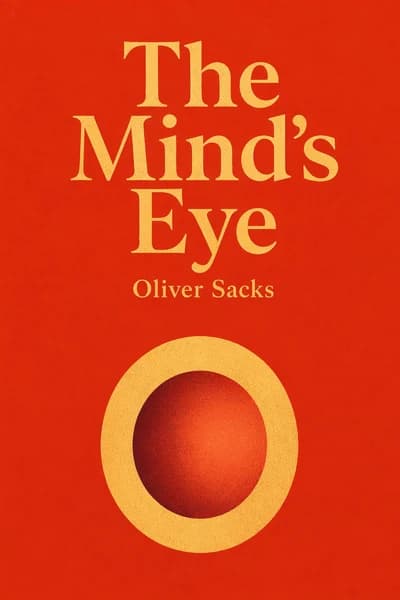
Oliver Sacks explores how our brains adapt when vision fails, sharing his own battle with eye cancer alongside remarkable stories of "Stereo Sue" who gained 3D vision at 48. Nature called it "frank and moving" - a journey into minds unlike our own.
Oliver Wolf Sacks (1933–2015), the bestselling author of The Mind’s Eye, was a British-American neurologist celebrated for transforming complex medical narratives into profound human stories.
A pioneer in narrative medicine, Sacks explored themes of vision, perception, and neuroplasticity in this book, blending clinical case studies with empathetic storytelling—a hallmark of his work honed over decades at institutions like Columbia University and NYU School of Medicine.
His acclaimed titles, including Awakenings (adapted into an Oscar-nominated film) and The Man Who Mistook His Wife for a Hat, have sold millions globally and been translated into over 25 languages.
Dubbed the "poet laureate of contemporary medicine" by The New York Times, Sacks’ contributions extend beyond academia; his TED Talks and essays for The New Yorker bridged science and public understanding.
The Mind’s Eye reflects his lifelong mission to illuminate the brain’s mysteries while honoring patient resilience, solidifying his legacy as one of the 20th century’s most influential science writers.
The Mind's Eye explores how the brain processes vision through neurological case studies, including a pianist who loses the ability to read music, a scientist who gains 3D vision late in life, and Sacks’ own experience with eye cancer. It examines perception, adaptation, and the “inner eye” that persists even when sight fails.
This book is ideal for readers interested in neuroscience, psychology, or Oliver Sacks’ empathetic storytelling. It appeals to both medical professionals and general audiences seeking insights into how the brain compensates for sensory loss, blending scientific rigor with humanistic narratives.
Yes—critics praise Sacks’ ability to weave clinical observation with poignant storytelling. Time called it a “riveting account” of neurological resilience, while Kirkus hailed it as “absorbing.” Its exploration of vision’s fragility and the mind’s creativity makes it a standout in popular science.
After being diagnosed with a retinal tumor, Sacks documents his own journey into partial blindness—including distorted perceptions and hallucinations. This firsthand account adds raw vulnerability to the clinical case studies, blurring the line between observer and subject.
Sacks proposes that even blinded individuals retain vivid mental imagery, suggesting vision extends beyond physical sight. This concept challenges assumptions about perception and highlights the brain’s capacity to construct reality through alternative pathways.
Like The Man Who Mistook His Wife for a Hat, it uses patient narratives to explore neurology. However, The Mind’s Eye uniquely integrates Sacks’ personal medical crisis, offering deeper reflection on vulnerability and adaptation.
Some reviewers note the book focuses more on descriptive case studies than actionable insights. While praised for empathy, it offers limited practical guidance for patients or clinicians managing visual disorders.
As AI and neural implants advance, Sacks’ work remains crucial for understanding organic perception. Its themes of sensory adaptation resonate in an era of VR/AR technologies and increased research into neuroprosthetics.
True to Sacks’ legacy, it combines clinical precision with literary flourish. Patients’ stories are rendered as human dramas rather than cold case studies, exemplifying his trademark blend of science and storytelling.
While not explicitly quoted in sources, key ideas include:
The book is summarized on platforms like BookBrowse, with detailed analyses in medical journals like PMC. Academic discussions often focus on its contributions to neuroplasticity research.
저자의 목소리로 책을 느껴보세요
지식을 흥미롭고 예시가 풍부한 인사이트로 전환
핵심 아이디어를 빠르게 캡처하여 신속하게 학습
재미있고 매력적인 방식으로 책을 즐기세요
To live on a day-to-day basis is insufficient for human beings; we need to transcend, transport, escape; we need meaning, understanding, and explanation; we need to see over-all patterns in our lives.
Color is of the essence.
All is forgiven.
She is the opposite of a victim.
Where am I?
The Mind's Eye의 핵심 아이디어를 이해하기 쉬운 포인트로 분해하여 혁신적인 팀이 어떻게 창조하고, 협력하고, 성장하는지 이해합니다.
The Mind's Eye을 빠른 기억 단서로 압축하여 솔직함, 팀워크, 창의적 회복력의 핵심 원칙을 강조합니다.

생생한 스토리텔링을 통해 The Mind's Eye을 경험하고, 혁신 교훈을 기억에 남고 적용할 수 있는 순간으로 바꿉니다.
무엇이든 물어보고, 목소리를 선택하고, 진정으로 공감되는 인사이트를 함께 만들어보세요.

샌프란시스코에서 컬럼비아 대학교 동문들이 만들었습니다
"Instead of endless scrolling, I just hit play on BeFreed. It saves me so much time."
"I never knew where to start with nonfiction—BeFreed’s book lists turned into podcasts gave me a clear path."
"Perfect balance between learning and entertainment. Finished ‘Thinking, Fast and Slow’ on my commute this week."
"Crazy how much I learned while walking the dog. BeFreed = small habits → big gains."
"Reading used to feel like a chore. Now it’s just part of my lifestyle."
"Feels effortless compared to reading. I’ve finished 6 books this month already."
"BeFreed turned my guilty doomscrolling into something that feels productive and inspiring."
"BeFreed turned my commute into learning time. 20-min podcasts are perfect for finishing books I never had time for."
"BeFreed replaced my podcast queue. Imagine Spotify for books — that’s it. 🙌"
"It is great for me to learn something from the book without reading it."
"The themed book list podcasts help me connect ideas across authors—like a guided audio journey."
"Makes me feel smarter every time before going to work"
샌프란시스코에서 컬럼비아 대학교 동문들이 만들었습니다

The Mind's Eye 요약을 무료 PDF 또는 EPUB으로 받으세요. 인쇄하거나 오프라인에서 언제든 읽을 수 있습니다.
Have you ever misplaced your keys and looked directly at them without seeing? That momentary blindness offers a glimpse into a far more profound reality: vision isn't just about eyes receiving light. It's about the brain making sense of what those eyes transmit. When this delicate system breaks down-whether through stroke, injury, or disease-something extraordinary happens. The brain doesn't simply surrender. Instead, it rewrites the rules entirely, finding pathways we never knew existed. Through intimate portraits of people whose visual worlds have been radically altered, we discover that perception is far more creative, flexible, and mysterious than we ever imagined. These stories challenge our conventional understanding of disability as simply the absence of ability. Instead, they reveal how altered perceptual states can open doors to entirely different ways of experiencing and engaging with the world-ways that might even enrich our collective understanding of human consciousness.