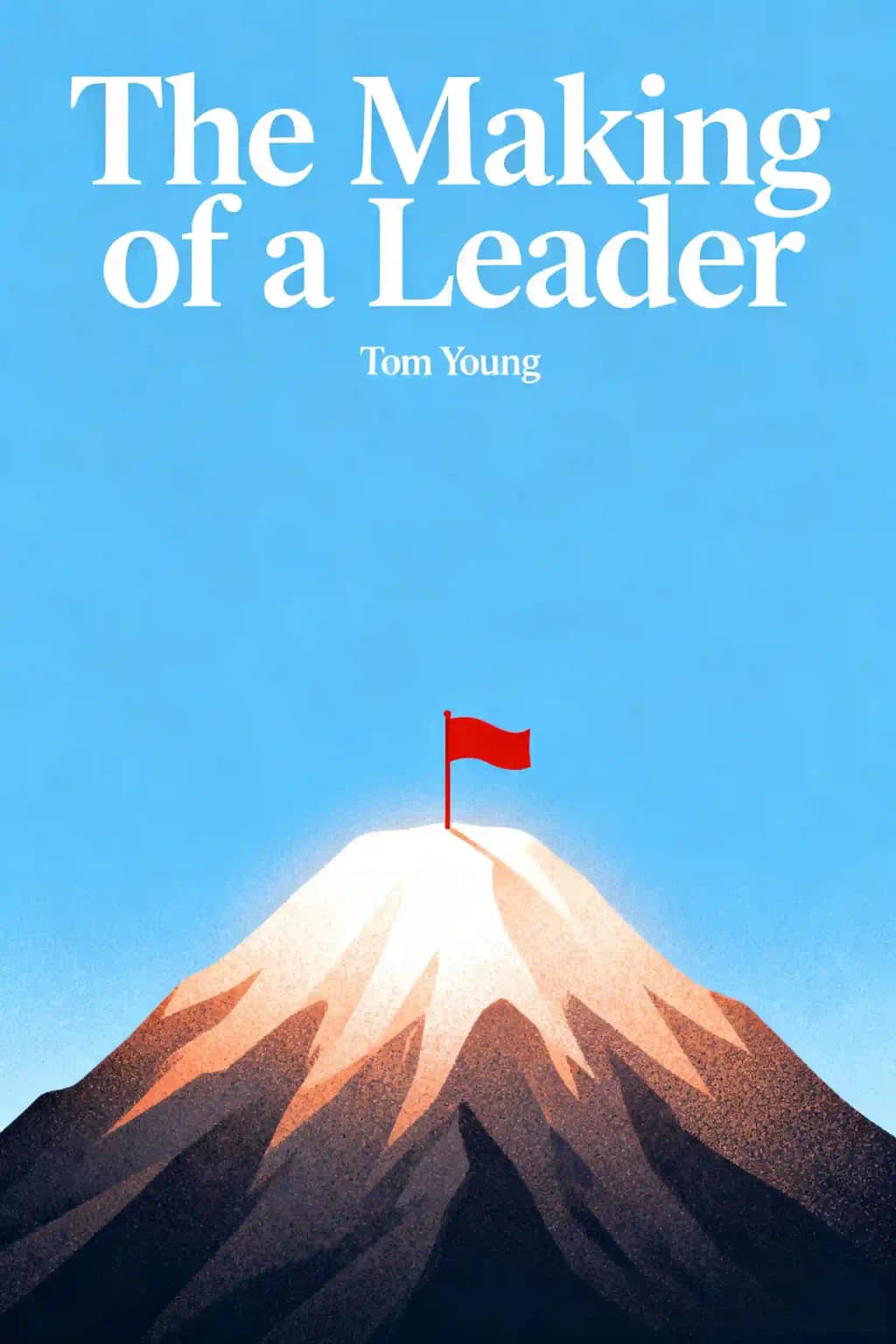
Discover how elite leaders are made in Tom Young's masterclass, endorsed by Adam Grant and sports legends. Drawing from high-performance psychology, it reveals the surprising truth: character trumps talent. What leadership virtue are you missing that's holding your team back?
Tom Young, award-winning author of The Making of a Leader and acclaimed military thriller novelist, draws from decades of combat aviation experience to craft gripping stories of leadership and resilience. A retired Air National Guard flight engineer, Young served in Iraq, Afghanistan, and Bosnia, logging nearly 5,000 flight hours across 40 countries—experiences that infuse his work with visceral authenticity.
His bestselling military thrillers, including The Mullah’s Storm (a Military Writers Society of America Gold Medal winner) and The Renegades (a Publishers Weekly starred pick), explore themes of survival, moral complexity, and duty under fire.
Before his military career, Young honed his storytelling as an Associated Press writer and editor, later transitioning to commercial aviation. His nonfiction work The Speed of Heat chronicles airlift missions in modern conflicts, while his narrative in the anthology Operation Homecoming was featured in The Washington Post’s 2006 best books list.
Young’s novels have earned consistent critical acclaim, with Booklist praising his "precise, evocative prose" that brings war’s human dimensions into sharp focus. A recipient of three Air Medals and the Meritorious Service Medal, he continues to bridge military and literary worlds through adrenaline-fueled storytelling grounded in lived experience.
The Making of a Leader explores leadership principles derived from high-performance sports, blending insights from elite coaches like Stuart Lancaster and Roberto Martinez. It covers developing a leadership philosophy, managing teams, and building resilient cultures under pressure. The book emphasizes practical strategies for translating athletic discipline into organizational success, with real-world examples from rugby, cricket, and soccer.
This book suits professionals, sports coaches, and aspiring leaders seeking actionable strategies for high-pressure environments. Managers aiming to foster resilience, HR professionals designing training programs, and athletes transitioning to leadership roles will find value in its evidence-based frameworks.
Tom Young is a performance psychologist with over 15 years’ experience working with elite athletes and teams, including England’s RFU and Premier League soccer clubs. His expertise in translating sports psychology to organizational leadership lends credibility to the book’s methodologies.
Young outlines frameworks like the High-Performance Cycle, emphasizing goal alignment and feedback loops, and the Resilience Pyramid, which prioritizes emotional regulation under stress. He also adapts sports-specific strategies, such as post-match analysis techniques for business retrospectives.
The book argues that sustainable cultures require psychological safety and ownership mindsets, using examples like England’s 2019 Cricket World Cup win. Young details how leaders can model vulnerability, delegate decision-making, and create “error-friendly” environments to drive innovation.
Young identifies three phases: Foundation (self-awareness and values), Application (skill refinement through challenges), and Legacy (mentoring successors). These stages mirror athletic career arcs, emphasizing adaptability as leaders progress.
Yes, it provides tools like pressure simulation drills for crisis decision-making and values alignment workshops to define team principles. A chapter on communication includes templates for delivering feedback using rugby-inspired “tactical timeout” structures.
Unlike theoretical approaches, Young’s strategies are battle-tested in elite sports, offering concrete tactics like micro-goal setting from soccer coaching and fatigue management from cricket tours. This focus on real-world execution sets it apart.
A key mantra is “Train like you’re second, compete like you’re first,” underscoring preparation humility. Young also adapts rugby’s “next job” philosophy—focusing only on controllable tasks during crises—as a universal leadership tactic.
Absolutely. The book shows how F1 pit-stop communication models improve hospital handovers, and how soccer’s positional play theory enhances corporate project management. Case studies from healthcare and tech validate the cross-industry relevance.
Some reviewers note the sports-heavy examples may require adaptation for non-athletic fields. However, the structured frameworks and interview-based insights counterbalance this niche focus.
Yes. With remote work and AI reshaping leadership demands, Young’s lessons on hybrid team cohesion and rapid decision-making remain critical. Updated examples in later editions address AI-augmented leadership challenges.
While Clinton focuses on spiritual leadership stages, Young’s work is secular and tactical. Both emphasize lifelong development, but Young provides more immediate tools for corporate and athletic leaders.
The appendix compiles insights from 7 elite coaches, including Stuart Lancaster’s culture-building techniques and Roberto Martinez’s conflict resolution models. Key excerpts are available on the publisher’s website.
저자의 목소리로 책을 느껴보세요
지식을 흥미롭고 예시가 풍부한 인사이트로 전환
핵심 아이디어를 빠르게 캡처하여 신속하게 학습
재미있고 매력적인 방식으로 책을 즐기세요
Effective leaders are, first and foremost, good teachers.
Teaching [is] the purest form of coaching.
I don't want them to do it like I used to do it! I want them to do it ten times better.
Resilience [is] massive in football management.
The Making of a Leader의 핵심 아이디어를 이해하기 쉬운 포인트로 분해하여 혁신적인 팀이 어떻게 창조하고, 협력하고, 성장하는지 이해합니다.
The Making of a Leader을 빠른 기억 단서로 압축하여 솔직함, 팀워크, 창의적 회복력의 핵심 원칙을 강조합니다.

생생한 스토리텔링을 통해 The Making of a Leader을 경험하고, 혁신 교훈을 기억에 남고 적용할 수 있는 순간으로 바꿉니다.
무엇이든 물어보고, 목소리를 선택하고, 진정으로 공감되는 인사이트를 함께 만들어보세요.

샌프란시스코에서 컬럼비아 대학교 동문들이 만들었습니다
"Instead of endless scrolling, I just hit play on BeFreed. It saves me so much time."
"I never knew where to start with nonfiction—BeFreed’s book lists turned into podcasts gave me a clear path."
"Perfect balance between learning and entertainment. Finished ‘Thinking, Fast and Slow’ on my commute this week."
"Crazy how much I learned while walking the dog. BeFreed = small habits → big gains."
"Reading used to feel like a chore. Now it’s just part of my lifestyle."
"Feels effortless compared to reading. I’ve finished 6 books this month already."
"BeFreed turned my guilty doomscrolling into something that feels productive and inspiring."
"BeFreed turned my commute into learning time. 20-min podcasts are perfect for finishing books I never had time for."
"BeFreed replaced my podcast queue. Imagine Spotify for books — that’s it. 🙌"
"It is great for me to learn something from the book without reading it."
"The themed book list podcasts help me connect ideas across authors—like a guided audio journey."
"Makes me feel smarter every time before going to work"
샌프란시스코에서 컬럼비아 대학교 동문들이 만들었습니다

The Making of a Leader 요약을 무료 PDF 또는 EPUB으로 받으세요. 인쇄하거나 오프라인에서 언제든 읽을 수 있습니다.
A taxi driver's son from Canberra. A physiotherapist who played football. A groundsman's boy who grew up on cricket pitches. These aren't typical origin stories for world-class leaders, yet they reveal something profound: the leaders who shape championship teams aren't born in boardrooms-they're forged in family kitchens, on neighborhood fields, and through the quiet lessons of everyday life. What if everything we think we know about leadership has it backwards? What if the secret isn't found in MBA programs or management theories, but in the values absorbed at dinner tables and the work ethic witnessed in our parents' daily grind? Michael Maguire, who would go on to coach elite rugby teams, watched his father drive taxis through Canberra's streets with relentless dedication. That image-of a man who never stopped working, never stopped improving-became the blueprint for Maguire's entire coaching philosophy. Roberto Martinez's education came from an even more unusual classroom: watching his father manage a third-tier Spanish football club while simultaneously being his son's parent. Young Roberto didn't just learn tactics; he absorbed how to read people, how to adjust approaches based on personalities, how to motivate without manipulation. Even as he signed his first professional contract, his father kept him anchored, insisting on fitness and education-leading Roberto to earn a physiotherapy degree while exploring the science behind the sport he loved. These stories matter because they demolish the myth of the "natural-born leader." Leadership isn't genetic destiny; it's the accumulation of witnessed values, absorbed principles, and learned responses to challenge. Gary Kirsten's Cape Town upbringing taught him that nothing comes easy and everything has consequences-lessons that would define his coaching style decades later. The thread connecting these diverse backgrounds? Strong family foundations that instilled work ethic, authenticity, resilience, and empathy. Leadership begins long before anyone hands you authority.