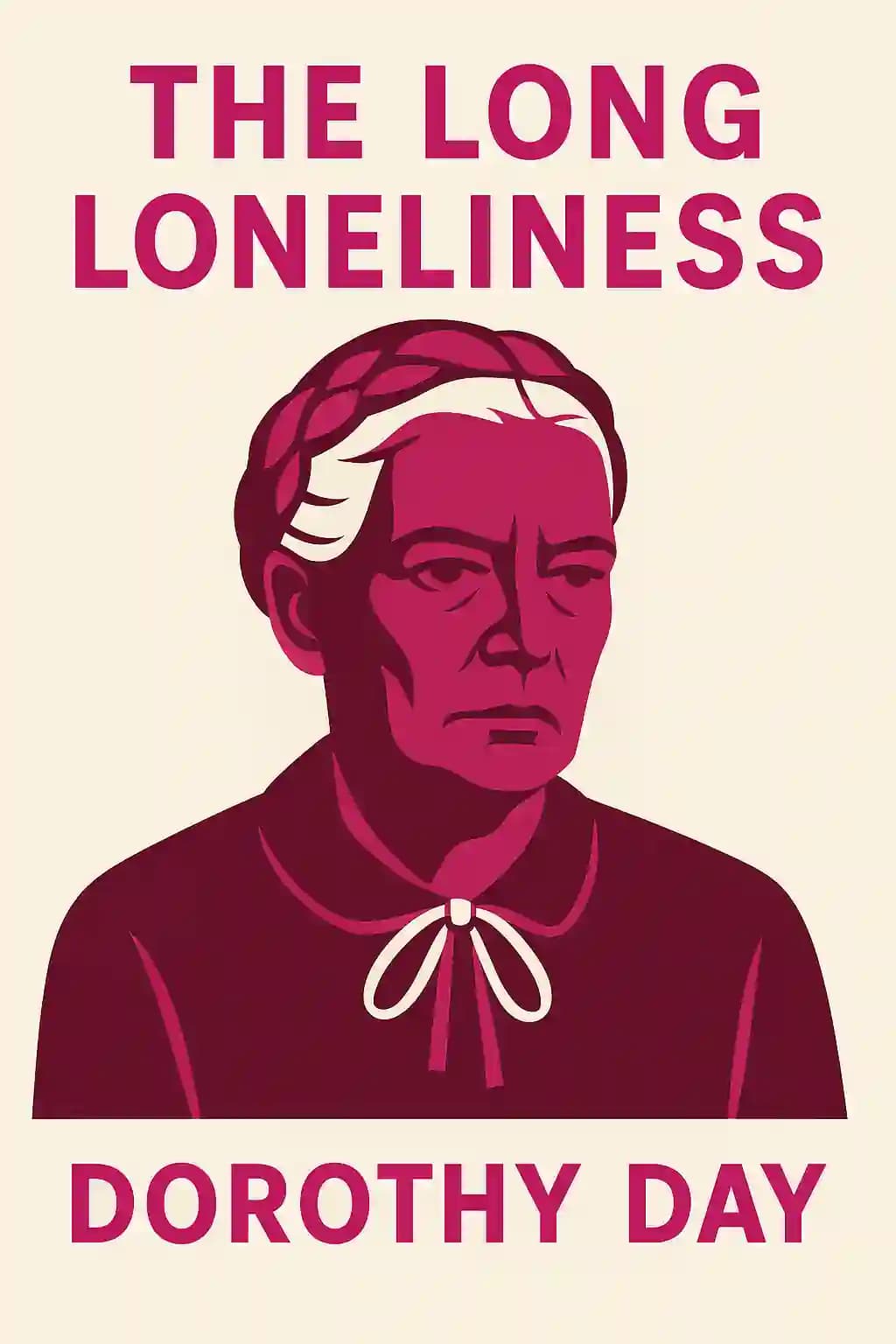
Dorothy Day's radical autobiography chronicles her journey from bohemian journalist to Catholic activist. Compared to St. Augustine's "Confessions," this 1952 spiritual masterpiece reveals how community conquers loneliness. Her unflinching honesty about abortion and poverty still challenges modern social justice movements today.
Dorothy Day (1897–1980), author of The Long Loneliness, was a pioneering social activist and Catholic reformer whose autobiography intertwines spiritual introspection with a lifelong commitment to social justice.
A co-founder of the Catholic Worker Movement and its influential newspaper, Day’s work bridged her devout faith with radical pacifism, labor advocacy, and direct service to the poor. Her writing, including earlier works like From Union Square to Rome and The Eleventh Virgin, reflects her journey from bohemian journalist to one of American Catholicism’s most consequential figures.
Day’s unflinching accounts of her conversion, voluntary poverty, and grassroots organizing stem directly from her lived experiences—from hunger marches to establishing over 200 hospitality houses nationwide. The Long Loneliness remains a cornerstone of spiritual autobiography, lauded for its raw honesty about faith’s tensions with activism.
The Catholic Worker Movement she spearheaded in 1933 still operates globally, a testament to her enduring influence on both religious and social thought.
The Long Loneliness is Dorothy Day’s spiritual autobiography, chronicling her journey from social activism to Catholicism and the founding of the Catholic Worker Movement. It explores her struggles with isolation, her conversion amid personal relationships, and her commitment to poverty alleviation through communal living and pacifism. The memoir intertwines faith with social justice, highlighting her belief that love and community cure existential loneliness.
This book resonates with readers interested in spiritual journeys, social justice, or Catholic teachings. It’s valuable for historians studying 20th-century activism, Catholics seeking to integrate faith with action, and anyone exploring themes of community, sacrifice, and purpose. Day’s candid reflections on loneliness and resilience also appeal to those navigating personal or societal crises.
Yes, for its raw honesty and timeless insights into faith and activism. Day’s prose humanizes systemic struggles while offering a blueprint for compassionate living. The book remains influential in Catholic social thought and provides historical context for modern movements addressing poverty and alienation.
The phrase encapsulates Day’s existential yearning for connection and purpose before finding solace in faith and community. It reflects both personal isolation—like her split from partner Forster Batterham over her conversion—and societal alienation caused by inequality. Day argues that love-in-action through communal solidarity alleviates this loneliness.
Maurin, a French immigrant and Catholic thinker, helped Day merge her activism with Catholic social teaching. Their collaboration birthed the Catholic Worker Movement, which combined direct aid (e.g., hospitality houses) with advocacy for labor rights. Maurin’s vision of “building a new society within the shell of the old” grounded Day’s work in both spiritual and practical realms.
Some argue Day’s prioritization of Catholicism overshadows systemic critique of inequality. Others note her minimal discussion of racial justice, reflecting gaps in early 20th-century Catholic activism. However, the book is widely praised for its emotional depth and influence on religious social ethics.
Day’s emphasis on hospitality houses and anti-war activism mirrors modern efforts to address homelessness, refugee crises, and militarism. Her model of “voluntary poverty” inspires contemporary movements advocating ethical simplicity and community-based aid.
Unlike From Union Square to Rome (focused on her conversion) or Loaves and Fishes (detailing Catholic Worker initiatives), The Long Loneliness offers a holistic view of her spiritual and activist evolution. It’s more introspective, blending personal narrative with theological reflection.
In an era of social fragmentation and inequality, Day’s call for radical empathy and community-driven solutions remains urgent. The book challenges readers to confront isolation through collective responsibility, making it a cornerstone for faith-based and secular activism alike.
저자의 목소리로 책을 느껴보세요
지식을 흥미롭고 예시가 풍부한 인사이트로 전환
핵심 아이디어를 빠르게 캡처하여 신속하게 학습
재미있고 매력적인 방식으로 책을 즐기세요
I have long since come to believe that people never mean half of what they say, and that it is best to disregard their talk and judge only their actions.
We have all known the long loneliness and we have learned that the only solution is love and that love comes with community.
The greatest challenge of the day is: how to bring about a revolution of the heart, a revolution which has to start with each one of us?
People say, what is the sense of our small effort? They cannot see that we must lay one brick at a time, where we can, as we can.
We cannot love God unless we love each other, and to love we must know each other. We know Him in the breaking of bread, and we know each other in the breaking of bread, and we are not alone anymore.
Long Loneliness의 핵심 아이디어를 이해하기 쉬운 포인트로 분해하여 혁신적인 팀이 어떻게 창조하고, 협력하고, 성장하는지 이해합니다.
Long Loneliness을 빠른 기억 단서로 압축하여 솔직함, 팀워크, 창의적 회복력의 핵심 원칙을 강조합니다.

생생한 스토리텔링을 통해 Long Loneliness을 경험하고, 혁신 교훈을 기억에 남고 적용할 수 있는 순간으로 바꿉니다.
무엇이든 물어보고, 목소리를 선택하고, 진정으로 공감되는 인사이트를 함께 만들어보세요.

샌프란시스코에서 컬럼비아 대학교 동문들이 만들었습니다
"Instead of endless scrolling, I just hit play on BeFreed. It saves me so much time."
"I never knew where to start with nonfiction—BeFreed’s book lists turned into podcasts gave me a clear path."
"Perfect balance between learning and entertainment. Finished ‘Thinking, Fast and Slow’ on my commute this week."
"Crazy how much I learned while walking the dog. BeFreed = small habits → big gains."
"Reading used to feel like a chore. Now it’s just part of my lifestyle."
"Feels effortless compared to reading. I’ve finished 6 books this month already."
"BeFreed turned my guilty doomscrolling into something that feels productive and inspiring."
"BeFreed turned my commute into learning time. 20-min podcasts are perfect for finishing books I never had time for."
"BeFreed replaced my podcast queue. Imagine Spotify for books — that’s it. 🙌"
"It is great for me to learn something from the book without reading it."
"The themed book list podcasts help me connect ideas across authors—like a guided audio journey."
"Makes me feel smarter every time before going to work"
샌프란시스코에서 컬럼비아 대학교 동문들이 만들었습니다

Long Loneliness 요약을 무료 PDF 또는 EPUB으로 받으세요. 인쇄하거나 오프라인에서 언제든 읽을 수 있습니다.
Dorothy Day's journey from radical journalist to Catholic activist defies our usual categories. In "The Long Loneliness," she reveals how a passionate search for justice led her to an unexpected spiritual home. Her story resonates across political divides because it speaks to our deepest human longings - for meaning, community, and a faith that demands action. What makes her memoir so compelling is its raw honesty about spiritual struggle. Day never sanitizes her past or presents her conversion as a tidy resolution. Instead, she shows how the same fierce commitment that drove her revolutionary politics ultimately led her to Catholicism. In a world where faith and radical politics are often seen as incompatible, Day's life demonstrates how they can be two expressions of the same underlying passion for a more just world. Her integration of deep Catholic devotion with unwavering commitment to workers and the poor continues to challenge both religious and secular communities to live their values more authentically.
