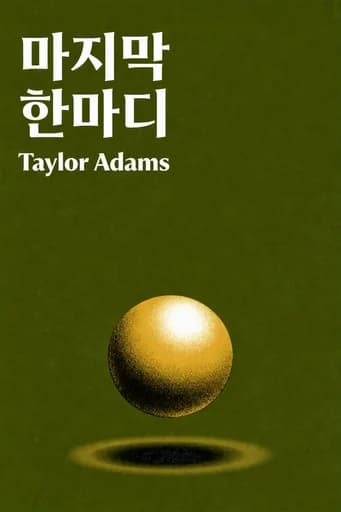
When a one-star review turns deadly: "The Last Word" follows Emma Carpenter's terrifying dance with a vengeful author. This double-starred psychological thriller from Taylor Adams masterfully satirizes publishing culture while delivering what Riley Sager calls "a white-knuckle, read-in-a-sitting thrill ride."
Taylor Adams is the bestselling author of The Last Word and an acclaimed thriller writer known for his gripping, high-stakes psychological suspense. His work combines cinematic pacing with intricate plotting, drawing on his background in screenwriting and film. He graduated from Eastern Washington University with the Excellence in Screenwriting Award and directed the award-winning short film And I Feel Fine.
Adams gained international recognition with No Exit, a claustrophobic thriller that became a Hulu Original film and was published in 32 languages.
His other acclaimed works include Hairpin Bridge, Eyeshot, and Our Last Night, all showcasing his signature blend of edge-of-your-seat tension and complex characters. Based in Washington State, Adams works closely with editor Jen Brell at William Morrow to craft novels that keep readers guessing until the final page. No Exit's worldwide success and film adaptation have established him as one of contemporary thriller fiction's most compelling voices.
The Last Word by Taylor Adams is a psychological thriller about Emma Carpenter, a woman house-sitting in an isolated beachfront home on the Washington coast who posts a negative review of horror author H.G. Kane's novel. After her scathing one-star review, disturbing incidents begin occurring at her remote location, and Emma realizes the author may be stalking her. The novel explores the dangerous consequences of online criticism as Emma fights for survival against an unhinged writer obsessed with revenge.
The Last Word is perfect for thriller enthusiasts who enjoy fast-paced, atmospheric suspense with psychological depth. Fans of home invasion narratives, cat-and-mouse games, and meta-commentary on the horror genre will find this particularly compelling. Readers who appreciated Taylor Adams' previous work like No Exit, as well as fans of Riley Sager and Ruth Ware, will enjoy the razor-sharp pacing and unnerving tension. Book reviewers and bloggers may find the premise especially thought-provoking.
The Last Word is absolutely worth reading for thriller fans seeking an intense, well-crafted suspense novel. Taylor Adams delivers trademark rapid-fire pacing, atmospheric tension, and clever plot twists that keep readers on edge throughout. Critics praise the book's meta approach to horror writing and its skillful execution, with many considering it Adams' best work to date. The novel's unique premise—exploring the dark side of online book reviews—offers fresh commentary while delivering genuinely frightening moments.
The Last Word by Taylor Adams is primarily a psychological thriller with strong elements of horror and suspense. The novel combines home invasion terror with stalker thriller conventions, creating an atmospheric and claustrophobic reading experience. Adams incorporates meta-fiction elements through the book-within-a-book structure, adding literary depth to the genre framework. The story balances pulse-pounding action sequences with psychological manipulation, making it appeal to fans of both traditional thrillers and cerebral suspense fiction.
Laika, Emma's golden retriever in The Last Word, survives the story despite facing serious threats throughout. The antagonist Kane attempts to poison Laika with meat laced with fishhooks and later with poisoned food, creating intensely distressing moments for readers. Emma fights desperately to save her dog, including inducing vomiting after poisoning. While Laika endures frightening situations and temporarily runs away during the climactic confrontation, she ultimately makes it through alive, providing relief for animal-loving readers concerned about the dog's fate.
The real villain in The Last Word is Deek, Emma's seemingly friendly neighbor, not the obvious antagonist H.G. Kane (Howard). Deek orchestrated the entire attack, manipulating Kane into stalking and attempting to murder Emma so he could write a bestselling true crime book called "Murder Beach" to revive his failing literary career. This shocking twist reveals Deek as the mastermind who exploited Kane's instability and Emma's vulnerability. After Kane's death, Deek attempts to stage Emma's suicide by drowning, demonstrating his cold-blooded calculation.
The Last Word features a double twist ending that transforms the entire narrative. First, readers discover that Emma's neighbor Deek, not just Kane, orchestrated the attack to create material for a comeback novel. After Kane's death, Deek poisons Emma's tea and attempts to drown her while making it look like suicide. Emma survives by escaping the water and confronting the police just as Deek calls in a welfare check. The book concludes with Deek's apparent suicide and Emma's reunion with her estranged husband Shawn.
The Last Word shares Taylor Adams' signature rapid-fire pacing and confined settings with No Exit, but offers a more meta, self-aware approach to thriller conventions. While No Exit focuses on strangers trapped during a blizzard discovering a kidnapped child, The Last Word explores isolated home invasion horror with literary commentary about the horror genre itself. Both novels feature strong female protagonists fighting for survival, but The Last Word includes more psychological manipulation and a book-within-a-book structure. Many reviewers consider The Last Word Adams' most accomplished thriller to date.
The book-within-a-book in The Last Word is "Murder Beach," presented as excerpts throughout the narrative describing Emma's attack from the killer's perspective. Initially attributed to antagonist Kane, the manuscript is later revealed to be written by Deek as part of his plan to create a bestselling true crime novel. These interspersed sections provide dual perspectives—Emma's first-person survival story and the cold, calculated planning in "Murder Beach." This meta-fictional device adds literary depth while heightening suspense as readers witness the horror from both victim and perpetrator viewpoints.
The Last Word by Taylor Adams is genuinely frightening, particularly for readers who value isolation and vulnerability as horror elements. The novel creates pervasive dread through its remote setting, stalking sequences, and home invasion scenarios that feel disturbingly plausible. Adams excels at atmospheric tension, making even mundane moments—like someone ringing a doorbell or watching through windows—deeply unsettling. The realistic premise of an angry author seeking revenge on a reviewer adds psychological horror that resonates especially with book bloggers and reviewers, creating an extra layer of personal fear.
The Last Word explores isolation and vulnerability as primary themes, examining how remoteness amplifies danger and fear. Adams critiques toxic author-reader dynamics and the dark side of online review culture, questioning where criticism ends and harassment begins. The novel examines artistic ego and the lengths people pursue for fame and recognition, particularly through Deek's manipulation. Survival instinct and resilience emerge as Emma fights back against her attackers. Meta-commentary on horror fiction itself runs throughout, with Adams deconstructing genre conventions while simultaneously delivering authentic thrills.
The Last Word takes place primarily in an isolated beachfront home on the rainy Washington coast where Emma Carpenter is house-sitting. This remote coastal setting creates claustrophobic tension despite the open landscape, with Emma's nearest neighbor Deek living close by but not close enough to provide immediate help. The Washington state location features gray, stormy weather that amplifies the atmospheric dread throughout the novel. Taylor Adams, who lives in Washington state himself, uses the Pacific Northwest's natural eeriness—fog, isolation, and rugged coastline—to enhance the thriller's unsettling mood.
저자의 목소리로 책을 느껴보세요
지식을 흥미롭고 예시가 풍부한 인사이트로 전환
핵심 아이디어를 빠르게 캡처하여 신속하게 학습
재미있고 매력적인 방식으로 책을 즐기세요
"whatever darkness she senses, she brought it with her"
"She knows she's in H.G. Kane's book, and her grief has left her with little fear of death."
Kane isn't just trying to kill Emma; he's trying to force her into the role of helpless victim in his narrative.
Rime of the Ancient Mariner의 핵심 아이디어를 이해하기 쉬운 포인트로 분해하여 혁신적인 팀이 어떻게 창조하고, 협력하고, 성장하는지 이해합니다.
Rime of the Ancient Mariner을 빠른 기억 단서로 압축하여 솔직함, 팀워크, 창의적 회복력의 핵심 원칙을 강조합니다.

생생한 스토리텔링을 통해 Rime of the Ancient Mariner을 경험하고, 혁신 교훈을 기억에 남고 적용할 수 있는 순간으로 바꿉니다.
무엇이든 물어보고, 목소리를 선택하고, 진정으로 공감되는 인사이트를 함께 만들어보세요.

샌프란시스코에서 컬럼비아 대학교 동문들이 만들었습니다
"Instead of endless scrolling, I just hit play on BeFreed. It saves me so much time."
"I never knew where to start with nonfiction—BeFreed’s book lists turned into podcasts gave me a clear path."
"Perfect balance between learning and entertainment. Finished ‘Thinking, Fast and Slow’ on my commute this week."
"Crazy how much I learned while walking the dog. BeFreed = small habits → big gains."
"Reading used to feel like a chore. Now it’s just part of my lifestyle."
"Feels effortless compared to reading. I’ve finished 6 books this month already."
"BeFreed turned my guilty doomscrolling into something that feels productive and inspiring."
"BeFreed turned my commute into learning time. 20-min podcasts are perfect for finishing books I never had time for."
"BeFreed replaced my podcast queue. Imagine Spotify for books — that’s it. 🙌"
"It is great for me to learn something from the book without reading it."
"The themed book list podcasts help me connect ideas across authors—like a guided audio journey."
"Makes me feel smarter every time before going to work"
샌프란시스코에서 컬럼비아 대학교 동문들이 만들었습니다

Rime of the Ancient Mariner 요약을 무료 PDF 또는 EPUB으로 받으세요. 인쇄하거나 오프라인에서 언제든 읽을 수 있습니다.
Emma Carpenter lives in self-imposed exile, grieving in a remote glass-walled beach house with only her golden retriever Laika for company. Her days consist of reading e-books and playing long-distance Hangman with her elderly neighbor Deek through telescopes. When Emma finishes a ninety-nine-cent horror novel called "Murder Mountain" by H.G. Kane, she's unimpressed by its predictable plot and gratuitous violence. Following her consumer instinct, she leaves a one-star review on Amazon, thinking nothing of it. But Kane responds immediately-first with a polite request to remove the review because it hurts his income, then with increasingly hostile messages when Emma refuses. What begins as a simple act of literary criticism spirals into something far more sinister. Strange occurrences pile up: a bird dies against her window, a shadowy figure appears in her bedroom, mysterious footprints appear in the sand beside her own. The glass walls that offer stunning ocean views now create a fishbowl effect-Emma can see everything outside, but anyone outside can see her too. Is she imagining things, or is someone watching her? The line between grief-induced hallucination and actual danger becomes terrifyingly thin.