1장
The Icarus Paradox: Why Flying Too Low Is More Dangerous Than Soaring High
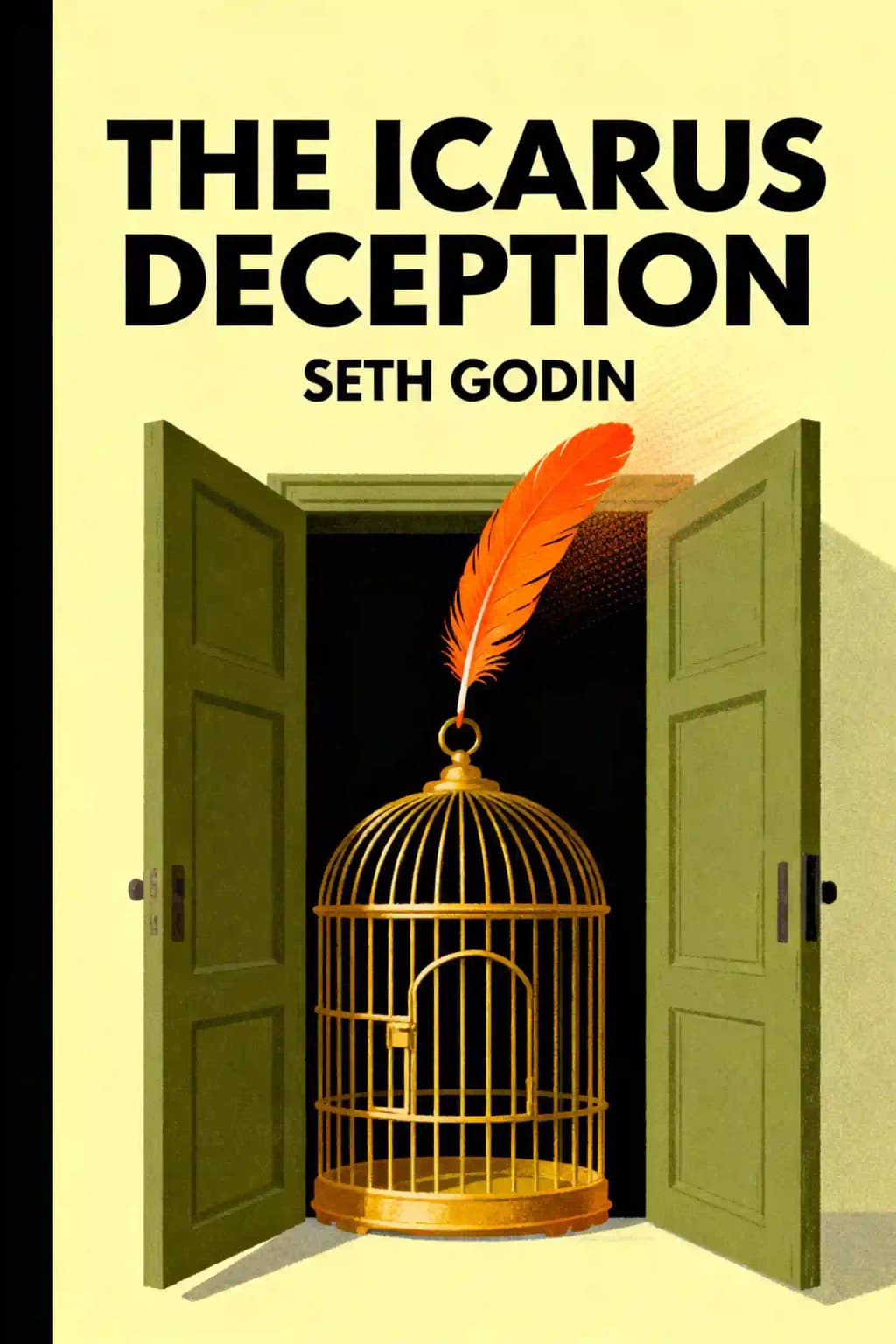
In a world that constantly warns us about the dangers of ambition, Seth Godin's "The Icarus Deception" delivers a revolutionary message: we've been told only half the myth. While everyone remembers Icarus flying too close to the sun, we've forgotten that Daedalus also warned his son not to fly too low, where sea spray would ruin his wings. This powerful metaphor frames Godin's thesis that playing it safe is now riskier than taking bold artistic risks. The book has become a touchstone for entrepreneurs and creatives alike, with figures from Tim Ferriss to Brene Brown citing its influence. Published during the height of the economic uncertainty following the 2008 recession, it challenged conventional wisdom about security and success at a time when many were clinging to outdated industrial-age thinking. Its enduring popularity stems from its timely message: the connection economy demands that we create art, take risks, and fly higher than we've been taught is possible.
2장
The New Definition of Art in a Post-Industrial World
When most people hear "art," they think of Salvador Dali or Jackson Pollock-eccentric figures with special talents. This limited definition is not just wrong; it's dangerous. Art isn't reserved for a special class of people with genetic gifts. Art is what happens when a human being does something generous that creates change, makes connections, and involves emotional risk.
The industrial economy taught us to value compliance, consistency, and following instructions. It rewarded us for fitting in rather than standing out. But that economy is dying, and with it dies the value of being a cog in the machine. The new connection economy rewards something entirely different: art.
This redefinition of art encompasses far more than paintings and sculptures. A doctor who takes the time to truly listen to a patient is creating art. A customer service representative who solves problems with empathy rather than scripts is making art. The middle manager who speaks up in a meeting with a perspective no one else has considered is an artist.
Quality and competence are now merely the price of admission. We assume lights will work when we flip switches and that Wikipedia will have answers. What's scarce-and therefore valuable-is trust, connection, and surprise. These elements come from art.
The industrial age created worker-proof factories where the system, not the individual, ensured quality. Whether assembling pizzas or iPhones, the goal was to remove the "personal" from labor. But we've reached the limits of this approach. When food producers created "pink slime" (boneless lean beef trimmings mixed with ammonium hydroxide), consumers finally drew a line. The two-cent savings wasn't worth the story they'd have to tell themselves about what they were eating.
Art isn't about finding the "right" answer-it's about finding an interesting one. It's about making connections that weren't there before. And most importantly, it's about being human in a world that increasingly tries to make us less so.
3장
The Connection Economy: Where Art Creates Value
The industrial economy is dying, leaving behind its cruft-the engineering term for leftover detritus, useless code, and junk. While this transition causes pain and fear, it also creates unprecedented opportunity for those willing to embrace the connection economy.
Unlike the industrial economy that valued physical labor and tangible goods, the connection economy rewards emotional labor and meaningful connections. The value we create now directly relates to how much valuable information we produce, trust we earn, and how often we innovate.
This shift fundamentally changes what's valuable. In the industrial age, physical resources and effort were scarce. Today, what's scarce is the emotional labor of art-the risk of digging deep to connect and surprise, the patience to build trust, and the courage to say "I made this." These qualities are not only valuable; they scale in ways physical labor never could.
The connection economy transforms most business into show business. Even simple transactions now revolve around stories and connections. The cookie isn't just a sweet crunch but a Girl Scout's journey or a gluten-free wonder. For the first time, most of us can decide what to make and how to deliver it, moving from task to show, from specification to connection.
Real connection isn't about Facebook friends or Twitter followers-it's about being missed when you're gone. It involves a complex exchange of information, expectation, and culture that requires opening ourselves to others in vulnerable moments. It means giving up control over outcomes to allow genuine partnership rather than one-way announcements.
While the industrial age focused on scarcity, the connection economy embraces abundance-of choice, connection, and knowledge. This abundance creates two races: the race to the bottom (delivering more for less) and the race to the top (delivering more for more). The connection economy scales because connections multiply value-friends bring more friends, reputation builds better reputation, and our networks compound in worth while our stuff merely gets cheaper.
Without expensive factories or large workforces as barriers, horizontal connections allow anyone to stand up and make an offer. Though most art gets rejected, the cost of finding what connects is lower than ever imagined, and you can always try again.
4장
The Comfort Zone Versus The Safety Zone
Once, our comfort zone and safety zone were identical - a natural alignment shaped by evolution and experience. We developed instincts about when to push forward and when to retreat, creating boundaries that served us well in a predictable world. But the digital revolution and rapid technological advancement have fundamentally altered this equation-the safety zone has shifted dramatically while our comfort zone remains stubbornly fixed. Those traditional bastions of security-corner offices, prestigious degrees from famous colleges, lifetime employment at blue-chip companies-have lost their guarantees.
The new safety zone exists in previously uncomfortable territory: where creative destruction occurs, where innovation disrupts established patterns, where art challenges conventions, and where constant reinvention is the norm. Like learning to swim in deep water, moving to this new zone triggers our preservation instincts and feels threatening, but it's become essential for survival. The twin pillars of our emerging society-creating ideas that spread virally and connecting previously disconnected people and concepts-both demand the mindset and courage of an artist rather than a worker.
The bad news: artists are never invulnerable to criticism, rejection, or failure. This new safety zone isn't as predictable or comfortable as the industrial system we were conditioned to accept as normal and secure-a system that promised stability but is increasingly revealing its fragility.
In the industrial age, safety was synonymous with productivity and profits. The mantra "keep it moving, efficient, reliable" created the assembly lines, bureaucracies, and standardized processes that defined success. But as the industrial age peaks and contracts, playing it safe-following established rules, avoiding risks, maintaining the status quo-no longer generates growth or leverages our unprecedented interconnectedness. The gatekeepers of the old system will always find someone more compliant, more predictable, and "safer" than you. The only viable path forward diverges from traditional safety toward embracing vulnerability, accepting unpredictability, and learning from repeated failure-essential components of meaningful connection, breakthrough innovation, and genuine human engagement.
The artist's pain stems from possibility, vulnerability, and risk-taking. It's the discomfort of creating something new, of standing out, of potential rejection. Once you stop feeling this creative tension, you forfeit your opportunity to make a meaningful impact. The alternative-seeking refuge in a numbing, conventional job-breeds a different kind of pain: the profound awareness that your unique gifts are being squandered and your future is being dictated by others' priorities. This pain is an inherent part of being fully alive, and art becomes the authentic expression of that lived experience.
Courage in this new paradigm isn't limited to physical heroism or dramatic gestures. It manifests in daily acts of authenticity: speaking truth when silence is easier, challenging accepted wisdom, presenting unfinished work, admitting uncertainty. True courage requires risking vulnerability-opening yourself to criticism, connection, and growth by speaking directly from and to the authentic self.
5장
Pick Yourself: The End of Gatekeepers
The authorities who once "picked" talent have left the building. Oprah's show is gone, Dick Clark can't get you a record deal, and waiting to be discovered is a Hollywood myth. Once you reject the impulse to wait for permission and realize no one is going to select you, you can actually get to work solving problems with the tools and permission you already have.
The myth of being discovered by the CEO is just that-a myth. When we take responsibility, give credit, speak up, and ship our best work, we become the artists we're capable of becoming. No one will pick you. Pick yourself.
The music industry's transformation illustrates the power of self-selection. Before the revolution, virtually no musicians were picked by labels, and of those who were, 98 percent failed. Less than half a percent ever received royalty checks. After the revolution, a musician selling just two copies on iTunes makes more money than from a label selling an entire CD. Now more musicians create more music, reach more people, and earn more money than ever before.
This revolution is happening across all industries-consulting, design, manufacturing, speaking, nonprofits-transforming whatever you care enough to do.
Consider Sarah, who loves musical theater-the energy, flow, and connection with her troupe. Yet she spends 98 percent of her time trying to be picked: casting calls, headshots, facing rejection. She chases the dream of Broadway and prestigious audiences, a dream that serves agents, directors, and producers more than her own joy. But what if she performed for "alternative" audiences? What if she picked herself as an impresario? By choosing herself, she'd unlock her ability to make an impact while exposing herself to judgment on her own terms.
Entrepreneurs are three times more likely to have dyslexia than the general public, and many credit ADHD for their success. Not because these conditions provide secret advantages, but because people with these differences realized early they were less likely to be picked by traditional systems. Having little choice but to pick themselves, self-selection became their habit.
The door to art and connection stands open, but we don't know for how long. Every day on the other side is better than one on this side. Every moment waiting for the "perfect opportunity" is wasted.
6장
The Emotional Labor of Art
While physical labor is respected, today's demand is for emotional labor-the frightening work of facing our shadows. There are no shortcuts or guarantees for emotional labor, which is precisely what makes it labor. Your real work is confronting what scares you.
We've been seduced into avoiding the fear of art, accepting grinding banality instead. But embracing that fear-doing the emotional labor of connection-is thrilling. It's uniquely human work that's different every time. This is who you're meant to be: an artist doing the difficult work of connection.
When we focus only on errors like typos, we've abandoned humanity for mechanical compliance. Yes, let's fix errors, but first let's make a difference. Being interesting matters more than being perfect.
There's an invisible mental line between "I'm an artist willing to face pain and make a ruckus" and "Hide me." This line grounds us and gives leverage. If you're biased toward hiding, art feels elusive. Once you cross over, the only way forward is making more art. Discomfort about this line is the first step to crossing it.
The economy changed, requiring us to move our comfort zones. Being a victim is optional; taking responsibility for making a difference isn't. Everyone you interact with is changed forever-the only questions are how and how much. Who do you want your customers to become? Connection creates change. Zappos, Amazon, Ford, and Apple all transformed their customers. The industrialist focuses on today's needs; the artist obsesses over connection and change.
Don't expect applause. When your work depends on approval, it's no longer yours. There's a vast difference between shallow instant applause and lasting connection. The purpose of art is to connect, not to be praised. If your audience doesn't connect, don't pander-go deeper. The connection that follows appreciated art lasts far longer than applause. Everyone is lonely. Connect.
7장
The Achieving Society: Culture That Celebrates Risk
In 1959, David McClelland published groundbreaking research investigating why certain historical periods experience explosive growth while others remain stagnant. Through extensive cross-cultural studies, he demonstrated that it wasn't race, climate, natural resources, or even charismatic leadership that created transformative breakthroughs like the Renaissance or Silicon Valley-it was the presence of a culture that actively celebrates and rewards achievement.
McClelland's research revealed that societies with high achievement motivation displayed distinct characteristics. Through sophisticated psychological testing, he found that individuals with high "n achievement scores" demonstrated remarkable differences in behavior and performance. These high achievers exhibited superior memory retention, showed greater initiative by volunteering more readily for experimental tasks, and displayed notable resilience against social pressure. Even in seemingly unrelated areas like word puzzles and pattern recognition, they consistently outperformed their peers. These findings suggested that achievement orientation wasn't just about work ethic-it fundamentally altered how people processed information and approached challenges.
As we navigate the transition from an industrial economy that prized compliance and predictability to a connected economy that values innovation and achievement, a crucial question emerges: Are our cultural institutions and social structures actively supporting this shift? Are we creating environments that nurture and encourage meaningful aspirations?
The evolution of career advice over the past century illustrates this dramatic transformation. In 1920, success meant securing a stable factory job at industrial giants like General Electric, maintaining a low profile, and working steadily until retirement. By the 1940s, the path shifted toward college education and middle management positions at corporate behemoths like General Motors and General Electric. Subsequent decades saw emphasis move toward traditional professions-medicine, law, engineering-and later to commercial intellectual roles like marketing strategists and investment bankers.
This progression reveals a clear pattern: each generation moved up the socioeconomic ladder from agricultural work to industrial labor to management to specialized professions. However, the next frontier in this evolution is fundamentally different. It centers on art-not necessarily traditional artistic expression, but the broader ability to create meaningful connections and insights in a world overwhelmed by information yet desperately seeking wisdom and understanding.
While many focus on minor inconveniences and incremental improvements in our privileged society, we risk overlooking a transformative opportunity: the connection revolution has demolished traditional barriers to entry and created unprecedented possibilities for impact. The real challenge isn't optimizing existing systems or refining luxury conveniences; it's seizing this unique historical moment when connecting ideas, people, and opportunities is more accessible than ever before. The most valuable contribution we can make isn't in perfecting established processes but in creating authentic, meaningful work that resonates and connects with others in profound ways.
8장
The Dignity of Art in a Dehumanized World
Connection begins with dignity-recognizing the humanity in everyone we interact with, from flight attendants to postal clerks. When we humanize others instead of treating them as invisible, we create a platform for meaningful interaction. It's impossible to connect with an automaton but worthwhile to connect with someone we've granted dignity.
A century of faith in the industrial system changed our culture, but as its financial rewards falter, we see the deal was sour. Writing checks to charity instead of looking the needy in the eye helps physical needs but shortchanges humanity. Demanding workers race to the bottom with countries working robotically takes something from those we work with. The artist understands a different game is being played-one focused on connection, not just making stuff for less money.
Connection measures whether your work made a difference. When your daring comment at a meeting enables others to respond and build upon it, when your video or idea spreads person-to-person, when people visit your farm stand because they love how you engage-you're creating bridges of connection. Boring and safe rarely connect. Connection happens when humanity asserts itself. Without connection, no art has occurred.
People seek business books for maps and certainty-a legacy of industrial education that taught us success comes from memorizing answers. The connection economy demands the opposite: turning away from maps and the search for sinecures. Your instinct to seek comfort zones is proof of brainwashing. The pull toward compliance isn't rational-it's training. The most rational approach is the irrational work of art. Seek questions, not answers.
Our economy has transformed. Traditional measurements of value fail us as steady, respected white-collar jobs disappear. We have surpluses of choice, quality, and entertainment-big-box stores, storage units, and debt. Yet we remain lonely and bored. The connection economy works because it addresses these fundamental human needs. It embraces individuals rather than mobs, the weird rather than the normal. It revolves around linchpins-artists we can't live without.
9장
The Itch: Our Human Drive to Create
We evolved seeking safety and security, yet we feel an itch-to provoke, risk, and stand out. For some it's a slight buzz of discomfort; for others it overwhelms, putting their souls on the line. This itch has always existed, driving Copernicus, Biko, King, and Gandhi. It's behind our inventions, discoveries, and epic failures.
We're taught to avoid scratching it, to be reasonable and protect what we have. But now our economy aligns with the human instinct to see what happens-uncertain, but worth it.
We don't question teaching reading, spelling, or math. But who's creating brave artists? Artists take leaps and embrace failure-the willingness to fail and try again is both the cost of art and its purpose. Are we avoiding this vital work because it's difficult to teach, or because industrialists who run our system prefer docility?
Traditional education assumed artists and craftspeople would find mentors to learn their craft. Now we've built industrial teaching systems that focus on standardized metrics like SAT scores. We can teach commitment, transparency, and innovation-but we've been systematically unteaching bravery and creativity to produce compliant, competitive zombies who fit industrial needs.
Conceptual art separates craft from art, showing that art isn't just about technical skill but about transformation. From Beckett's Waiting for Godot to Sol LeWitt's wall instructions to John Cage's silent 4'33", art is made by artists-people who do something human that touches others. Art must transform, be generous, and involve risk of rejection. Without risk, it's not art. In today's revolutionary times, we're all potential artists-the only barrier is ourselves.
Art must be personal (reflecting the artist), untested (original), and intended to connect. Art unshared is ultimately pointless. You can't have artistic success without risking failure to connect-they're inseparable, like heads and tails of a coin.
Art isn't limited to luxury items or entertainment. Edison, Ford, Curie, and King were all artists in their fields. Venture capitalists seek CEOs engaged at a human level, not just replacing jobs. The linchpin-the cornerstone person we can't live without-is almost certainly an artist who confronts fear and vulnerability to make essential connections. The invitation to make art is precious; ignoring it invites despair.
10장
If It Doesn't Ship, It's Not Art
Art requires collision with a marketplace-an interaction between giver and recipient. You can plan, sketch, and curse the system endlessly, but without shipping your work, you haven't completed it. Art demands human connection. A notebook filled with ideas means nothing until those ideas touch someone or make a difference. We need to know about the connections you've enabled and impact you've made.
Make connections. Make a difference. Make a ruckus. Make a legacy. The economy no longer guarantees "Do what you're told, play it safe, and make a living." Making a living is harder than ever, and the alternatives are up to you. We've been trained to prefer being right over making a difference, and fitting in over standing out. Now it's your turn to stand up and stand out.
Most people avoid initiating projects, blogs, or unique journeys, especially when not officially in charge. We've been trained to avoid these acts. Yet almost everyone believes they can edit, give feedback, or criticize. Finding people to fix typos is easy; finding someone to say "go" is nearly impossible. The shortage of artists isn't about innate creative ability-it's about believing it's possible and acceptable for you to create. Most people have been brainwashed to copyedit the world rather than design it.
The connection economy has destroyed the value of the status quo while creating opportunity for anyone brave enough to connect. Without expensive factories or large workforces as barriers, horizontal connections allow anyone to stand up and make an offer. Though most art gets rejected, the cost of finding what connects is lower than imagined, and you can always try again. So start.
Physical laborers seek to do less for the same pay because their work doesn't scale beyond available hours. Connection artists embrace doing more because emotional labor scales dramatically-a little more effort compounds as ideas spread and people flock to meaningful art. Connection belongs to those who approach work as something they "get to" do rather than "have to" do.
In Japanese terms, the industrial economy insisted on tariki-being helped like a kitten carried by its mother. The connection economy opens the door for jiriki-self-selection and self-authorized art, like the monkey who saves himself by grabbing onto his mother's back. We're shifting from being rescued to rescuing ourselves.