1장
Unveiling the Cosmic Clock: Where Science Meets Spirit
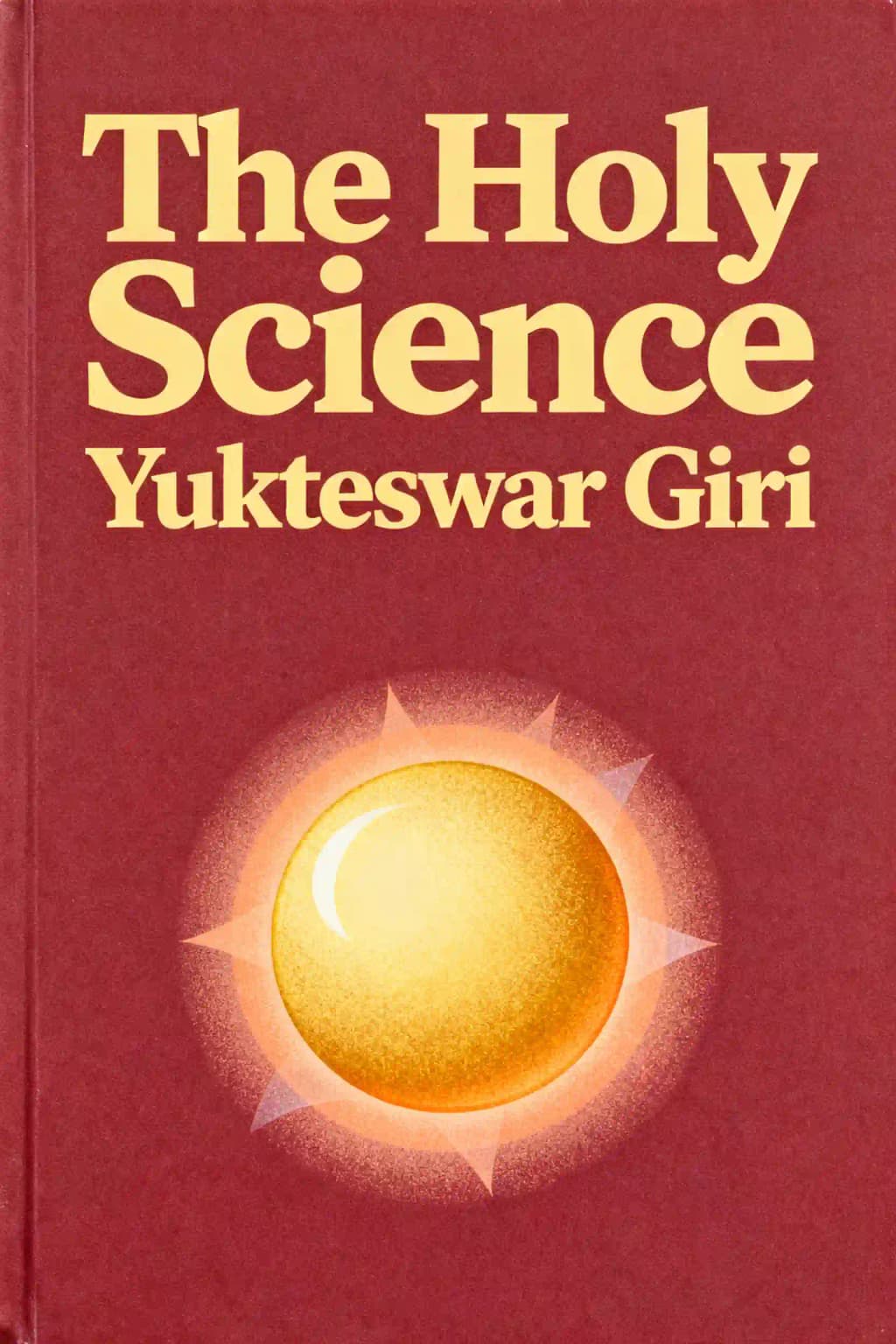
Sri Yukteswar's "The Holy Science" remains one of spirituality's hidden gems, bridging Eastern wisdom and Western thought with mathematical precision. Written at the request of the legendary Mahavatar Babaji (guru of Paramahansa Yogananda's lineage), this slim volume has influenced luminaries from George Harrison to Steve Jobs, who reportedly kept a copy during his spiritual explorations in India. Despite being less than 100 pages, this concise text has been described as containing "the essence of all scriptures in the world." What makes it revolutionary is not just its spiritual insights but its bold scientific claim: our civilization's timeline is dramatically miscalculated, and we're actually in a different cosmic age than commonly believed.
2장
The Cosmic Calendar: Redefining Human History
Imagine discovering that everything you know about historical timelines is fundamentally wrong. This is precisely what Sri Yukteswar proposes in his revolutionary introduction to The Holy Science. According to his calculations, humanity isn't trudging through a 432,000-year dark age (Kali Yuga) as commonly accepted in Hindu tradition. Instead, we're already ascending into a more enlightened era - a revelation that challenges centuries of established spiritual chronology.
The cosmos, Yukteswar explains, operates on a precise 24,000-year cycle as our sun revolves around a grand cosmic center called Vishnunabhi. This celestial dance creates alternating 12,000-year ascending and descending arcs that directly influence human consciousness and spiritual capacity. Each arc contains four yugas or ages of varying lengths: Kali (1,200 years), Dwapara (2,400 years), Treta (3,600 years), and Satya (4,800 years). These periods mirror the ancient Greek concept of ages - golden, silver, bronze, and iron - suggesting a universal understanding of cyclical human development across cultures.
What makes this system remarkable is its scientific precision and correlation with historical events. Yukteswar pinpoints 500 CE as the lowest point of the cycle - the nadir of human consciousness when spiritual understanding was at its darkest. This period coincides with the historical Dark Ages in Europe and similar periods of intellectual decline in other civilizations. From that point, we began the slow ascent back toward enlightenment. By 1894, when the book was written, humanity had already entered Dwapara Yuga, the age of energy awareness - remarkably coinciding with the modern scientific discoveries of electricity, radio waves, and eventually quantum physics. This age is characterized by humanity's growing understanding of energy as the fundamental basis of matter.
The implications are profound and far-reaching. Our current struggles aren't evidence of a continuing dark age but growing pains of an evolving consciousness. The widespread interest in meditation, energy healing, and spiritual awakening isn't accidental - it's cosmically ordained by our position in this grand cycle. We can observe this evolution in numerous ways: the exponential growth of scientific knowledge, increasing global interconnectedness, rising environmental awareness, and a growing integration of Eastern and Western spiritual practices.
This isn't mere philosophical speculation. Yukteswar meticulously traces the source of the traditional timeline's error to the reign of Raja Parikshit, when scholars mistakenly added extra zeros to the yuga calculations. His correction aligns spiritual evolution with observable scientific progress, offering a framework that explains both technological advancement and spiritual awakening as parallel expressions of the same cosmic influence. Modern discoveries in astronomy about the precession of the equinoxes and the solar system's movement through space lend credence to Yukteswar's astronomical basis for these cycles.
The cosmic calendar also provides hope and context for humanity's future development. As we progress further into Dwapara Yuga, Yukteswar predicts an acceleration of both technological innovation and spiritual understanding - a prediction that seems to be bearing out in our rapidly evolving world. This understanding helps us navigate current global challenges with the perspective that we're not declining into chaos but rather experiencing the turbulent but necessary phases of growth toward higher consciousness.
3장
The Divine Essence: Understanding God and Creation
At the heart of The Holy Science lies a profound explanation of the nature of God and creation that harmonizes Eastern metaphysics with Western theology. Yukteswar begins with the fundamental assertion that Parambrahma (God) is the only real substance in the universe - eternal, indivisible, and the source of all that exists. This ultimate reality transcends human comprehension yet manifests itself through various levels of creation, much like sunlight dispersing through a prism into multiple colors.
Why can't we directly perceive this divine reality? Yukteswar explains that God's nature manifests as Shakti (Almighty Force) and Chit (Omniscient Feeling), which give rise to creation through Aum - the primordial vibration Christians call "the Word." This cosmic sound creates the fundamental building blocks of existence: Time, Space, and the Atom, which collectively form Maya, the veil of illusion that obscures spiritual reality. Like waves on an ocean, all creation emerges from and dissolves back into this infinite consciousness, yet remains eternally one with it.
Yukteswar's explanation is remarkable in how it seamlessly connects Eastern concepts with Christian terminology, revealing the universal truth underlying diverse spiritual traditions. The Holy Ghost (Kutastha Chaitanya) illuminates this darkness, while the spiritualized atom forms Chitta (calm mind), which develops into Buddhi (Intelligence) and Manas (Mind) - the realm where the individual soul (Jiva) resides with its sense of separate identity (Ahamkara). This hierarchy of consciousness explains how the infinite becomes finite, how the one appears as many.
This isn't abstract philosophy but a practical map for spiritual evolution. Advanced seekers find a Sat-Guru (spiritual preceptor) who helps them turn their senses inward to the sensorium - the inner gateway where they can perceive the cosmic vibration (Aum) and witness the luminous spiritual body that Yukteswar compares to John the Baptist in Christian tradition. This inner light appears first as stars, then as the moon, and finally as the spiritual sun, marking progressive stages of enlightenment.
Through immersion in this divine sound - symbolically called sacred rivers like Ganga, Yamuna, or Jordan - the seeker experiences the "second birth" of Bhakti Yoga. This spiritual baptism allows direct comprehension of God's kingdom and the understanding that Maya is merely God's play of ideas. The process involves systematic withdrawal of consciousness from external objects and progressive awakening to inner realities. When fully purified, the seeker becomes a Sannyasi (which Yukteswar equates with "Christ the anointed Savior"), baptized in spiritual light and unified with Purusha (the Son of God). The ultimate achievement is Kaivalya - complete unification with God through the sacrifice of separate existence.
What's striking is how Yukteswar reveals the universal spiritual truths behind different religious terminologies. Whether described through Sanskrit terms or Biblical references, the underlying reality remains the same - a progressive awakening to our divine nature and ultimate union with the cosmic consciousness. This understanding bridges the apparent divide between Eastern and Western spirituality, showing that all authentic spiritual paths lead to the same divine destination, though they may use different maps and languages to describe the journey.
The practical implications of this teaching are profound: it suggests that spiritual evolution isn't about acquiring something new but rather about removing the veils that obscure our true nature. Through meditation, devotion, and the guidance of enlightened teachers, seekers can systematically pierce through layers of illusion to realize their eternal unity with the divine.
4장
Liberation: The Heart's Deepest Yearning
Why do we feel perpetually unsatisfied despite material achievements? According to Yukteswar, this discontent reveals our soul's true longing-liberation from Maya's bondage. This freedom represents the ultimate goal of spiritual life and the heart's deepest desire.
The root cause of all suffering is Avidya (Ignorance)-the fundamental misperception that the material world is the only reality while failing to recognize the Eternal Spirit as the only true substance. This ignorance manifests through five troubles that perpetuate suffering: Asmita (egoism), Abhinivesa (tenacious clinging to material existence), Raga (attachment to pleasurable objects), and Dwesha (aversion to painful things).
What we're really seeking, Yukteswar explains, isn't external acquisition but three intrinsic qualities of our own nature: Sat (Existence), Chit (Consciousness), and Ananda (Bliss). These aren't abstract philosophical concepts but the essential properties of our true Self that we instinctively seek to recover.
The path to this liberation begins with finding a genuine spiritual guide. Under the guidance of a Sat-Guru, we learn to direct our attention inward, gradually satisfying the heart's deepest wants and experiencing real contentment-the authentic Bliss (Ananda) that no external circumstance can provide. With a contented heart, we develop the ability to fix our attention on anything and comprehend all its aspects, awakening true Consciousness that perceives all modifications of Nature up to the primal Word (Aum).
Through this process, we recognize our Self as Indestructible and Ever-Existing Real Substance-the realization of Sat (Existence). Having attained Sat, Chit, and Ananda, Ignorance withers away, and all worldly troubles cease permanently. In this perfected state, the heart becomes purified and actively manifests spiritual light rather than merely reflecting it.
The culmination of this journey is what Yukteswar describes as becoming "Christ, the anointed Saviour," entering the kingdom of Spiritual Light as the Son of God. Comprehending oneself as a fragment of the Universal Holy Spirit, one abandons the illusion of separate existence and unifies with the Eternal Spirit-becoming one with God. This unification (Kaivalya) represents the ultimate fulfillment that all souls unconsciously seek.
What makes Yukteswar's explanation so powerful is its universality. Whether expressed through Hindu, Christian, or other spiritual traditions, the essential journey remains the same-the soul's return to its divine source.
5장
The Spiritual Path: Practices for Liberation
How do we actually achieve this lofty state of liberation? Yukteswar outlines practical spiritual disciplines that form a comprehensive path to salvation, beginning with three essential practices: Tapas (equanimity in all conditions), Swadhyaya (deep study of spiritual truth), and Brahmanidhana (meditation on Aum).
The foundation of spiritual progress is the heart's natural love-what Yukteswar calls Sraddha. When cultivated, this love removes mental excitation, cools the system to normal functioning, and invigorates vital powers. Without this love, one cannot follow Nature's guidance and inevitably suffers in body and mind.
This love finds its expression in devotion to the Guru, which means not just physical proximity but holding the teacher's wisdom in one's heart and becoming one with their principles. From this relationship develops Virya (moral courage), which is strengthened through observing Yama (moral self-control) and Niyama (religious rules).
Yama includes five practices that form the ethical foundation of spiritual life: noninjury, truthfulness, nonstealing, continence, and noncovetousness. Niyama comprises purity of body and mind, contentment in all circumstances, and obedience to the guru's instructions. These practices purify both body and mind, removing prejudices and dogmas that narrow understanding.
What distinguishes Yukteswar's approach is his emphasis on natural living as essential to spiritual progress. He provides detailed guidance on selecting proper food, dwelling, and company based not on cultural traditions but on careful observation of human physiology and psychology.
By examining human teeth (which resemble those of frugivorous animals), digestive canal length, and natural sensory reactions, Yukteswar concludes that humans are naturally frugivorous-designed to thrive on fruits, grains, roots, milk, and pure water. He argues that unnatural foods cannot be properly assimilated and accumulate in the body, causing disease and premature death.
Similarly, he recommends dwelling in fresh air-on mountaintops, in fields, gardens, or dry places under trees with good ventilation. For spiritual company, we should seek those whose magnetism affects us harmoniously, who invigorate our vitality, develop our natural love, and bring peace.
As moral courage becomes firmly established, eight obstacles to salvation are removed: hatred, shame, fear, grief, condemnation, race prejudice, pride of family, and smugness. Their removal awakens Viratwam (magnanimity), making one fit to practice the higher yogic disciplines of Asana (steady posture), Pranayama (control of life force), and Pratyahara (withdrawal of senses from external objects).
Through Pranayama, one gains control over involuntary nerves, preventing bodily decay and allowing periodic rest for the entire nervous system. This conscious "dying daily" refreshes the body and eventually gives the yogi control over life and death itself, allowing them to remain in one physical form as long as needed to work out karma.
The practice of Pratyahara-turning the senses inward rather than outward toward objects of desire-brings immediate satisfaction to the heart. This inward focus helps fulfill worldly desires efficiently, allowing one to eventually work through all earthly longings and become free from desire, thus ending the cycle of reincarnation.
6장
The Seven Spheres: Mapping the Spiritual Journey
One of The Holy Science's most fascinating contributions is its detailed map of spiritual evolution through seven progressive spheres or lokas. These aren't merely metaphysical concepts but represent actual stages of consciousness that the soul traverses on its journey back to God.
The seven spheres are:
1. Bhuloka: The realm of gross matter-our physical world
2. Bhuvarloka: The world of fine matters and electric attributes
3. Swarloka: The sphere of magnetic poles and electricities
4. Maharloka: The realm of magnets and atoms-the doorway between material and spiritual creation
5. Janaloka: The kingdom of Spiritual Reflections and Sons of God
6. Tapoloka: The realm of the Holy Ghost or Universal Spirit
7. Satyaloka: The abode of God-Eternal Substance
The first three spheres comprise the material creation (Maya), the last three form the spiritual creation (Light), with Maharloka serving as the threshold between them.
As the soul evolves, it progresses through five states of the human heart that correspond to these spheres:
In the dark state, man misconceives reality, believing only the gross material world exists. This state corresponds to the Sudra (servant) class in traditional Hindu society, whose natural duty is to serve higher classes as preparation for advancement. When this consciousness predominates in a solar system, it creates Kali Yuga, the Dark Age.
As enlightenment begins, the heart becomes propelled to discover truth. In this Kshatriya (warrior) state, one's natural duty is to struggle for knowledge. Following spiritual guidance, the seeker learns to concentrate on the sensorium, perceiving the luminous body and hearing the holy Sound (Aum).
Through spiritual baptism, one becomes "twice-born" (Dvija), withdrawing from the material world to enter Bhuvarloka. This steady heart state corresponds to Dwapara Yuga, where one comprehends internal electricities and understands that external existence is merely the union of fine internal objects with sense organs.
In the devoted state, one withdraws further to Swarloka, comprehending Chitta (Heart)-the spiritualized Atom that is part of Maya. Understanding Chitta enables comprehension of all creation. This state corresponds to the Vipra (nearly perfect) class and Treta Yuga.
Finally, through true repentance, one rises to Maharloka, freed from Maya's influence. The heart becomes clean, void of external ideas, and comprehends Spiritual Light. This state corresponds to the Brahmana (spiritual) class and Satya Yuga.
Beyond these, when the heart is fully purified, it manifests Spiritual Light and becomes Christ-like. One rises above Darkness into Janaloka (Kingdom of God), becoming Jivanmukta (liberated while living). Comprehending oneself as merely an idea resting on the Holy Spirit, one sacrifices separate existence, reaching Tapoloka and ultimately Satyaloka-complete unification with God.
This comprehensive map not only describes individual spiritual evolution but also explains collective consciousness shifts throughout cosmic cycles. It offers a framework for understanding both personal transformation and the broader evolution of human consciousness throughout history.
7장
The Revelation: Attaining Spiritual Adeptship
The Holy Science culminates with a comprehensive revelation of how spiritual adeptship is achieved through the systematic purification of man's three distinct bodies. The material body is purified through natural means including proper diet, exercise, and lifestyle choices. The electric body, which governs our vital energy, requires cultivation of unwavering patience in all circumstances - both pleasant and challenging. The magnetic body (chitta), repository of thoughts and impressions, is purified through precise breath regulation techniques.
The practice of proper breath regulation, when undertaken under the guidance of an enlightened spiritual teacher, leads to a profound transformation. The holy Word (Pranava or Aum) spontaneously manifests and becomes internally audible to the practitioner. This sacred vibration serves multiple purposes - it naturally regularizes the breath patterns, arrests bodily deterioration, and manifests in increasingly subtle forms as one progresses in spiritual purification. The sound evolves from initial gross manifestations to increasingly refined variations, each corresponding to deeper states of consciousness.
Yukteswar meticulously outlines three progressive stages of discipleship, each marked by distinct characteristics and achievements:
1. Pravartaka (initiate): At this foundational stage, the seeker cultivates natural love for the Divine and successfully obtains guidance from a qualified spiritual teacher. This phase is marked by sincere aspiration and the beginning of systematic spiritual practice.
2. Sadhaka (true disciple): Through consistent ethical practices and spiritual disciplines, the practitioner gradually overcomes the eight meannesses of human nature - hatred, shame, fear, grief, condemnation, race prejudice, pride of family, and smugness. These are replaced by genuine magnanimity and expanding consciousness.
3. Siddha (divine personage): At this advanced stage, the practitioner progresses steadily in godliness while maintaining constant awareness of the internal Aum sound. The individual ego gradually merges with the holy stream of cosmic consciousness.
In the elevated state of Bhakti Yoga, the devoted seeker naturally withdraws attention from the external world and begins to perceive Spirit manifesting as seven distinct spiritual lights or "stars" in the body's primary spiritual centers: the brain (sahasrara), medulla oblongata (ajna), and five spinal centers (corresponding to the vishudha, anahata, manipura, swadhisthana, and muladhara chakras of yogic tradition). As the soul systematically passes through these centers, it gains progressive understanding of the universe's true nature and enters increasingly sublime states of consciousness.
The culmination of this spiritual journey is marked by the attainment of the "eight ascetic majesties" (aiswaryas) - supernatural powers that demonstrate mastery over material nature: the ability to become infinitely small (anima) or infinitely large (mahima), completely weightless (laghima) or infinitely heavy (garima), the power to obtain anything desired (prapti), complete control over material elements (prakamya), the ability to fulfill all desires through will alone (isitva), and supreme lordship over all creation (vasitva).
Through perfect comprehension of the cycles of evolution, manifestation, and dissolution, the realized soul gains complete freedom from Maya's cosmic delusion. Having mastered these spiritual powers, one directly perceives the Eternal Spirit as the Perfect Whole and recognizes one's individual Self as merely a divine idea resting upon a fragment of Infinite Spiritual Light. Finally, abandoning all notion of separate existence, the soul achieves Kaivalya - complete unification with God - which represents the ultimate goal of spiritual evolution.
8장
The Power of Love: The Path to Freedom
The Holy Science concludes with a profound meditation on love as the fundamental force of spiritual evolution. Sri Yukteswar presents love not merely as poetic sentiment or emotional attachment, but as the very essence of divine reality - Love is God itself. This cosmic force, naturally implanted in every human heart, serves as the ultimate key to transcending Maya's delusive darkness and realizing our true nature.
Through the systematic development of love, the spiritual journey unfolds in distinct stages. First, we are drawn to discover our Spiritual Preceptor, whose presence catalyzes our inner awakening. This divine connection leads to baptism in the holy stream of cosmic consciousness, where the devotee experiences preliminary glimpses of spiritual reality. The path then demands the supreme sacrifice - the offering of our limited ego-self before God's altar - culminating in complete unification with the Eternal Father.
Sri Yukteswar emphasizes that even brief contact with an enlightened being can trigger profound transformation. He cites the ancient sage Shankaracharya's teaching that momentary company with a divine personage can bring salvation, much as a spark can ignite a massive forest fire. This principle explains why proximity to saints has traditionally been considered so vital in spiritual traditions worldwide.
His own life served as a living testament to these teachings. In his final days, sensing his approaching transition, he shared a poignant message with his foremost disciple Paramahansa Yogananda: "My task on earth is now finished; you must carry on." This simple statement carried the weight of centuries of guru-disciple tradition. After entering mahasamadhi on March 9, 1936, Sri Yukteswar demonstrated the ultimate triumph over death by appearing to Yogananda in resurrected form - not as a vision or spirit, but in a fully materialized body. During this extraordinary encounter, he revealed profound truths about cosmic creation, the nature of the causal world, and the soul's journey through various spheres of existence.
"Grieve not for me," he instructed Yogananda, "Rather broadcast everywhere the story of my resurrection. New hope will be infused into the hearts of misery-mad, death-fearing dreamers of the world." This message carried revolutionary implications, challenging both religious dogma and scientific materialism with direct experiential proof of life's continuity beyond physical death.
Through his life, wisdom, death, and transcendent resurrection, Sri Yukteswar left humanity an extraordinary legacy - a sublime vision of our inherent divinity as immortal children of the one God. The Holy Science stands as his enduring gift - a masterful bridge spanning East and West, science and spirituality, ancient wisdom and modern understanding. Its comprehensive framework illuminates the grand cycles of cosmic evolution, the precise mechanics of spiritual development, and the transformative power of divine love. This remarkable synthesis continues to inspire and guide seekers worldwide, offering clear direction for the journey from human consciousness to cosmic awareness, from temporary existence to eternal life.