1장
When Technology Rewrites the Rules of Professional Work
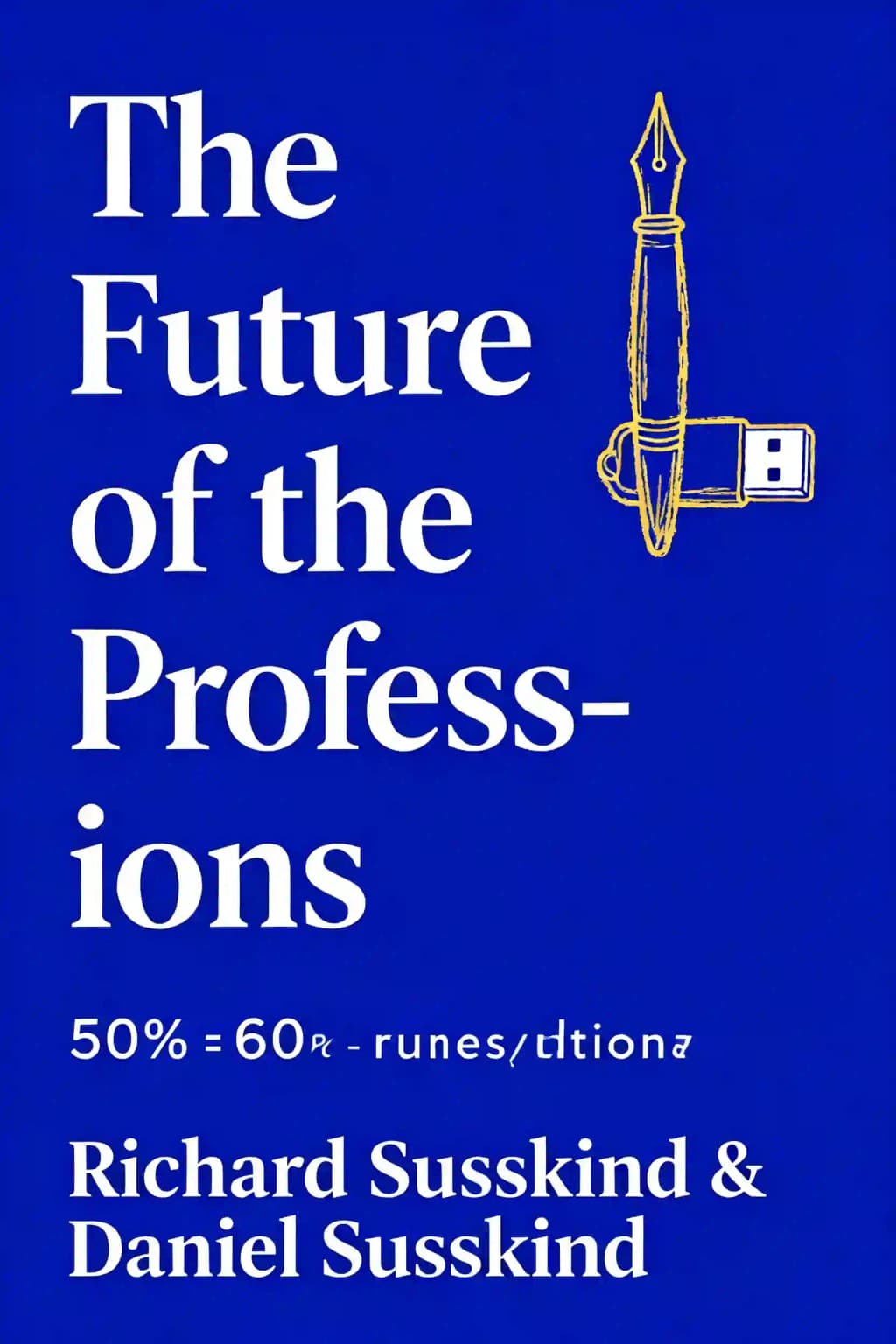
The future has arrived, but it's not evenly distributed yet. While Harvard University took 377 years to educate its first 400,000 students, its online courses attracted that many learners in just one year. WebMD now receives more monthly visits than all American doctors combined see patients. The eBay online dispute resolution system handles 60 million disagreements annually-three times more than the entire US court system. These aren't isolated anomalies but early indicators of a fundamental transformation reshaping our professional landscape. Richard and Daniel Susskind's groundbreaking work examines how increasingly capable machines, working either independently or with non-specialists, are poised to take on tasks historically reserved for highly trained professionals. This father-son collaboration brings complementary perspectives-Richard's three decades transforming legal services and Daniel's government policy experience-to show how technology is dismantling the traditional professions. Their work has been praised by thought leaders across industries and has become required reading in professional schools worldwide, offering a provocative yet evidence-based roadmap for how expertise will be produced and distributed in our technology-based Internet society.
2장
The Grand Bargain Under Threat
For centuries, society has maintained what the Susskinds call a "grand bargain" with the professions. We grant them exclusive rights to practice in specific domains in exchange for their expertise, experience, judgment, and ethical conduct in matters of great human importance. As Atul Gawande notes about physicians: "The public has granted us extraordinary dispensation to administer drugs, to cut people open...because we do so on their behalf." This bargain has positioned professions as gatekeepers of knowledge fundamental to our social and economic lives, from lawyers interpreting complex legal frameworks to architects designing our built environment.
However, this long-standing arrangement now faces unprecedented challenges. The professions are failing us in six critical ways: economically (most people cannot afford first-rate professional services, with legal fees often exceeding $500 per hour), technologically (professional work relies on antiquated knowledge-sharing techniques, such as paper-based systems and in-person consultations), psychologically (professions disempower people by discouraging self-help and creating dependency), morally (withholding expertise that could be more widely shared through digital platforms), qualitatively (world-class standards remain available only to the privileged few, creating a two-tier system of service), and in terms of transparency (professional services remain unacceptably inscrutable, with pricing and processes often hidden from clients).
The problem isn't a scarcity of expertise but of experts themselves. Our current delivery model requires face-to-face interaction, limiting how many people can access professional knowledge. It's like we've created a "Rolls-Royce service for the well-heeled minority, while everyone else is walking." This limitation exists despite the fact that professional knowledge could be made available on entirely different terms in our technology-based Internet society. For example, while a single doctor can only see 20-30 patients per day in person, online platforms could potentially reach thousands with basic medical advice and triage services.
Most theories about professions have focused on their exclusivity-how and why they've isolated vast areas of knowledge to exclude non-professionals except as recipients. Some scholars frame this as a natural response to knowledge asymmetry in society, while others view it through more critical lenses of class systems, elitism, or self-preservation. Sociologists like Abbott and Freidson have documented how professions systematically create barriers to entry through lengthy education requirements, strict licensing, and complex terminology that keeps knowledge inaccessible to outsiders. More extreme "conspiracy theorists" follow George Bernard Shaw's view that professions are "conspiracies against the laity," systematically mystifying knowledge to maintain expert "tyranny."
What's remarkable is how most theorists have ignored technology's potential to transform professional work. Even in the 1980s when professionals were already using computers for word processing and database management, or the 1990s when the Web emerged as a revolutionary information-sharing platform, social scientists studying professions failed to predict technology's transformative potential. They overlooked how artificial intelligence, machine learning, and online platforms could democratize professional knowledge and disrupt traditional service models - a fundamental shortcoming the Susskinds aim to correct through their analysis of how technology will reshape professional services in the coming decades.
3장
The Transformation Already Underway
Across all professional fields, technological disruption is already evident. In healthcare, IBM's Watson helps with cancer diagnoses by processing medical literature published every 41 seconds, while computerized systems at Elizabeth Wende Breast Clinic reduced false negatives by 39%. Robots fill prescriptions with perfect accuracy (compared to 37 million yearly human errors), telemedicine connects specialists with distant patients, and mobile health apps turn smartphones into sophisticated medical devices. Genomic testing has dropped from $10 million to just $99 per test, while nanomedicine has developed tiny robots that can swim through bodies, delivering targeted drugs with unprecedented precision.
Education is being revolutionized through "hybrid" or "blended" learning schools where students spend 75% of their day with teachers and 25% using personalized online platforms that tailor content, approach, and pace to individual needs. Khan Academy offers 5,500 instructional videos (watched 450 million times) with 10 million monthly visitors-exceeding England's entire school population. Harvard's online courses attracted more students in one year than attended the university in its 377-year history.
Even religious authorities face disruption as their traditional role as gatekeepers between worshippers and sacred texts diminishes. Today, virtually all sacred texts are freely available online. Religious services now stream online, allowing worshippers to attend virtually from anywhere. Some faiths have established entirely digital congregations-from Presbyterian virtual churches to Anglican cathedrals in Second Life with daily worship, Bible study, and counseling.
The legal profession, despite centuries of relatively unchanged practices, is seeing traditional lawyers increasingly replaced by advanced systems, less costly workers supported by technology, standardized processes, or self-help tools for lay people. Systems like Lex Machina and intelligent search technologies now outperform human lawyers in document review and predicting court outcomes.
Journalism has been transformed through social media platforms and mobile devices, with half of users sharing news content with each other. The BBC Breaking News Twitter profile alone has more followers (13.9 million) than the entire British print daily-paper circulation (7.5 million). Algorithms now write earnings reports, sports stories, and breaking news about earthquakes-often indistinguishable from human-written content.
Architecture still carries vestiges of its historical reputation as a "gentleman's pastime," but digital tools have revolutionized the field. Traditional hand-drawing has been replaced by Computer Aided Design (CAD) software, computational design approaches enable architects to model entire families of buildings through adjustable parameters, and 3D printing has revolutionized construction-from DUS Architects' printed house to WinSun's achievement of printing ten houses in a day.
4장
From Bespoke Service to Technological Liberation
Four major trends characterize the end of the professional era as we've known it. First, professional work is moving from bespoke service (handcrafted, made-to-measure) toward standardization and systematization. Traditional personalized services, like custom legal documents or individualized financial plans, are being replaced by templated solutions and automated systems. Work that remains for humans is increasingly handled collaboratively in teams rather than by individual craftspeople, with specialists focusing on specific aspects while technology handles routine tasks. For example, modern law firms now employ teams of paralegals, technology specialists, and lawyers working together on cases rather than individual attorneys handling matters end-to-end.
Second, traditional gatekeepers are being bypassed as competition comes from multiple directions. Accountants are expanding into legal services through tax advisory work, while management consultants offer strategic guidance traditionally provided by lawyers. New specialists like data scientists and process analysts bring fresh perspectives and methodologies. Perhaps most disruptively, "communities of experience" have emerged where service recipients share knowledge directly online - from medical support groups to DIY legal forums - challenging professionals' traditional monopoly on expertise.
Third, professional work is shifting from reactive to proactive. Traditional professional work operates reactively-the client initiates engagement and the professional responds. This creates a paradox where inexpert clients must recognize when expert help is needed. The transformation toward proactive service is particularly evident in healthcare, where wearable devices and AI systems monitor vital signs and predict potential health issues before they become serious. Similar shifts are occurring in legal services, with software that monitors regulatory compliance, and in accounting, where real-time financial monitoring replaces annual audits.
Fourth, professionals face the "more-for-less challenge"-intense cost pressure combined with increased demand for professional services. This drives two primary responses: the "efficiency strategy" (cutting costs of professional work through automation and standardization) and the "collaboration strategy" (users sharing service costs through group purchasing or cooperative arrangements). For instance, small businesses might share legal services through subscription models, while medical practices form networks to share expensive diagnostic equipment.
Technology's impact on professions manifests in both automation and innovation. Automation streamlines existing processes - like document review software for lawyers or automated diagnostic tools for doctors. Innovation, however, creates entirely new service delivery models. The ATM exemplifies this distinction - it didn't simply automate teller tasks but created a new banking paradigm. Similarly, telehealth platforms don't just digitize doctor visits; they fundamentally reshape how healthcare is delivered.
As professional work is decomposed into constituent tasks, these tasks are increasingly allocated to the most cost-effective providers. This includes offshore teams handling routine legal research or medical image analysis, para-professionals using technology to perform tasks once reserved for full professionals, and flexible self-employed professionals working through digital platforms. Knowledge communities, built by service recipients themselves, are becoming increasingly sophisticated, creating valuable repositories of practical experience that rival traditional professional expertise in some areas. For example, patient communities have become powerful sources of practical knowledge about managing chronic conditions, while small business networks share legal and accounting expertise through online forums and collaborative platforms.
5장
The Information Revolution and Professional Knowledge
The "information substructure"-the dominant means by which information is stored and communicated-fundamentally shapes how practical expertise is created and shared. Drawing on Walter Ong's insights, the Susskinds identify four historical phases: orality, script, print, and information technology. Each phase represents not just a technological shift, but a complete transformation in how societies organize, preserve, and transmit knowledge across generations.
In oral communities, expertise was severely limited by human memory capacity, making vast, detailed knowledge repositories impossible. Knowledge was preserved through repetition, rhythm, and rhyme - think of ancient epic poems and oral traditions. Social structures were built around memory specialists like tribal elders, shamans, and bards who served as living repositories of cultural and practical knowledge. With the development of script around 3500 BC, human memory could be augmented by writing, allowing for more complex and accurate record-keeping. This revolution enabled the rise of early bureaucracies, legal codes, and systematic knowledge compilation.
Print brought further transformation through standardization and mass distribution of knowledge. The printing press democratized learning, though printing itself remained a specialist activity requiring heavy equipment and skilled operators until recently. This led to the emergence of modern professional classes, as printed materials became the primary medium for professional education and certification. Libraries, universities, and professional associations grew around this print-based knowledge infrastructure.
Information technology and the Internet have fundamentally transformed how humans create, seek, and disseminate information. While the Internet enables unprecedented access to vast content, we're still in a transitional phase between print-based industrial society and technology-based Internet society. This transition is marked by hybrid systems where digital tools supplement rather than replace traditional professional practices. During this transition, traditional professionals remain necessary intermediaries, but as we fully progress, new technologies will increasingly help with interpretation and decision-making, making traditional professionals less dominant.
The explosive growth in processing power, following Moore's Law, is transforming technology at an unprecedented pace. Since 1965, processing power has doubled roughly every two years, with some suggesting it now doubles every eighteen months. This exponential growth has profound implications: By 2020, an average desktop may have the processing power of a human brain, and by 2050, a $1,000 computer could exceed the processing power of all human brains combined. This computational power enables increasingly sophisticated artificial intelligence applications in professional domains.
Our systems and machines are becoming increasingly capable-this is the most significant technological development for professionals. More tasks that once required human expertise are now performed more productively, cheaply, quickly, and to higher standards by various systems, with no apparent finishing line. These increasingly capable systems are demonstrated through developments like Big Data analytics that can process millions of legal documents, IBM's Watson making medical diagnoses, advanced robotics performing precise surgeries, and affective computing systems that can recognize and respond to human emotions. These developments are not just automating routine tasks but are beginning to handle complex professional judgments once thought to require human intuition and expertise.
6장
Seven New Models for Producing and Distributing Expertise
Knowledge has four special characteristics that make it fundamentally different from physical goods: it's non-rival (using it doesn't diminish what's available to others), tends toward non-excludability (difficult to prevent sharing), is cumulative (grows more valuable with use), and can often be digitized (converted to electronic form). These characteristics create unique dynamics in the digital age - for instance, a doctor's diagnosis can be shared infinitely without degradation, legal precedents become more valuable as they build upon each other, and medical knowledge can be distributed globally through digital platforms. These properties explain why the shift to a technology-based Internet society is fundamentally transforming professional work across all sectors.
Professional work is evolving through four main stages: craft, standardization, systemization, and externalization. Market forces and technology are driving this evolution away from bespoke craftsmanship toward more systematized approaches. For example, tax preparation has evolved from individual accountants crafting custom solutions, to standardized forms and procedures, to automated software systems, and finally to AI-powered platforms. For any professional service, work can be decomposed into constituent tasks, each allocated to the most appropriate delivery method - from human experts to automated systems.
Based on their findings, the Susskinds identify seven distinct models for producing and distributing practical expertise in society:
1. The traditional model features human professionals delivering customized expertise through real-time, face-to-face interactions charged by time spent. Examples include conventional law firms, medical practices, and consulting engagements where professionals provide bespoke solutions through direct client interaction.
2. The networked experts model features professionals who cluster via online platforms rather than physical organizations, forming virtual teams of specialists and freelancers who convene temporarily to solve specific problems. Platforms like Upwork for freelancers or telemedicine networks exemplify this approach, allowing expertise to be assembled on-demand.
3. The para-professional model involves less specialized individuals delivering expert services with the help of systems created by specialists, empowered by procedures and systems to perform work traditionally reserved for experts. This includes nurse practitioners handling routine medical cases or paralegals managing standard legal procedures under supervision.
4. The knowledge engineering model transforms practical expertise into online self-help systems, delivering expertise on a one-to-many basis through online platforms, allowing users to navigate decision trees via question-and-answer interactions. TurboTax for tax preparation and WebMD for medical information demonstrate this approach.
5. The communities of experience model creates collaborative repositories of practical expertise built by past service recipients and non-experts who've solved problems themselves, transforming one-to-one advice into many-to-many shared resources. Stack Overflow for programming questions and patient support communities exemplify this model.
6. The embedded knowledge model integrates practical expertise directly into machines, systems, processes, or physical objects, allowing automatic application without separate invocation. Examples include smart contracts automatically executing legal agreements or medical devices with built-in diagnostic capabilities.
7. The machine-generated model represents the final frontier where practical expertise originates from machines rather than humans, using Big Data, artificial intelligence, or intelligent search. This includes AI systems making medical diagnoses, automated financial trading systems, and machine learning algorithms generating legal documents.
These models aren't mutually exclusive - many professional services combine multiple approaches to deliver optimal results. The evolution between these models is driven by technological advancement, changing client expectations, and the need for greater efficiency and accessibility in professional services.
7장
The Future Beyond Traditional Professions
Many professionals resist the Susskinds' vision due to several common biases. The "status quo bias" manifests as special pleading-claiming their particular field is immune to change while others aren't. "Technological myopia" underestimates tomorrow's applications by evaluating them using today's technologies. The "AI fallacy" mistakenly assumes systems must replicate human thinking processes to perform expert-level tasks, when in fact systems increasingly excel by exploiting distinctive technological capabilities.
Critics raise several objections to this transformation. The "trust objection" suggests that without professional gatekeepers, we'd be vulnerable to exploitation by unscrupulous quacks. However, emerging examples show trusted relationships forming outside traditional professions-students relying on Khan Academy rather than qualified teachers, readers following verified journalists on social media rather than established newspapers.
The "lost-craft objection" stems from fear that moving from bespoke production of expertise to more commoditized processes will eliminate valued professional skills. While this tension between valuing professional crafts and improving outcomes isn't illusory, the authors favor improving outcomes over preserving processes, arguing that the widespread lack of affordable legal advice, education, and healthcare means protecting craft for its own sake is an indulgence we cannot afford.
The "becoming-expert objection" questions how future professionals will develop expertise if routine work traditionally used for training is outsourced or automated. The authors propose three alternative training approaches: reinstating genuine apprenticeship where novices work alongside masters, requiring trainees to perform samples of outsourced tasks for learning purposes, and leveraging advanced e-learning, particularly sophisticated simulations of professional activities.
Looking toward a future with increasingly capable machines, the authors identify twelve emerging professional roles, including craftspeople (exceptional experts for bespoke work), para-professionals (generalists who perform specialist-level work with system support), knowledge engineers (designing online services that encode expertise), and data scientists (analyzing large datasets for insights).
The authors predict technological unemployment in the professions will occur gradually, not overnight. While professional tasks will likely increase due to economic growth and latent demand for expertise, machines will increasingly gain advantage in performing most types of tasks. The best and brightest professionals will survive longest, but armies of professionals won't remain in gainful employment.
In the long run, increasingly capable machines will transform professional work, creating new ways to share practical expertise in society. The authors predict an incremental transformation characterized as the industrialization and digitization of professions, routinization of professional work, and disintermediation of professionals. Traditional professions will be dismantled, with most professionals replaced by less expert people and high-performing systems.
The authors conclude that failing to share expertise more widely would constitute a profound "sin of omission." Society now has both the means and the moral obligation to make professional knowledge more accessible worldwide. While technological advancement seems inevitable, how we use technology remains in our hands, requiring moral consideration about what decisions should remain human and who should control practical expertise in a technology-based society.
8장
The Moral Imperative of Accessible Expertise
When practical expertise moves online, knowledge can be profoundly liberated from professional gatekeepers. This liberation exists on a spectrum with distinct levels of accessibility and control. Minimal liberation occurs when expertise is available through subscription services where professionals still control access, such as medical journals behind paywalls or legal databases with restricted access. Partial liberation happens when content is free but users remain passive recipients, exemplified by educational YouTube channels or health information websites. Full liberation emerges when expertise becomes a commons resource owned and controlled outside the professions, available for further development, like Wikipedia or open-source medical protocols.
The feasibility question raises two fundamental concerns: ensuring incentives exist for people to produce expertise, and ensuring they have financial ability to do so. Without these conditions, production of practical expertise might dry up. The grand bargain historically granted professions exclusivity over expertise so they can profit from their efforts, cover costs, and maintain incentives for continued investment. This creates a complex trade-off between sharing expertise widely today and ensuring its sustained production tomorrow. For instance, pharmaceutical research requires significant investment, traditionally funded through patent protection and exclusive rights.
Critics argue that without exclusivity provided by the grand bargain, there would be no incentive to produce and share expertise. However, this view overlooks the diverse motivations driving human behavior. Wikipedia exemplifies this, attracting millions of voluntary contributions and donations without requiring payment. Many professionals, particularly in public services like teaching and healthcare, are driven by objectives beyond profit - including social impact, personal fulfillment, and professional recognition. For profit-seeking professionals, large "latent demand" might incentivize providing expertise at lower costs to previously unserved populations, as demonstrated by successful telehealth platforms and online legal services.
If the commons model proves less feasible than expected, some degree of exclusivity might be needed to incentivize production of practical expertise. However, this wouldn't necessarily return us to the grand bargain's professional monopolies. Instead, only the minimum level of exclusivity needed to incentivize providers would be required. Any new exclusivity should be based on exceptional quality or reliability rather than artificial regulation, allowing providers to thrive through demonstrated value rather than competitor exclusion. Examples include certification systems for online educational content or peer-review processes for open-access medical information.
The authors conclude that society now has both the technological means and the moral obligation to make professional knowledge more accessible worldwide. The potential sins of omission in restricting expertise are "too profound to ignore," particularly in areas like healthcare, education, and legal services where access gaps create significant social inequities. While technological advancement seems inevitable, how we use technology remains in our hands, requiring careful moral consideration about what decisions should remain human and who should control practical expertise in a technology-based society. This includes balancing automation with human judgment, ensuring equitable access while maintaining quality, and developing new models for sustainable expertise production that serve global needs rather than just profitable markets.