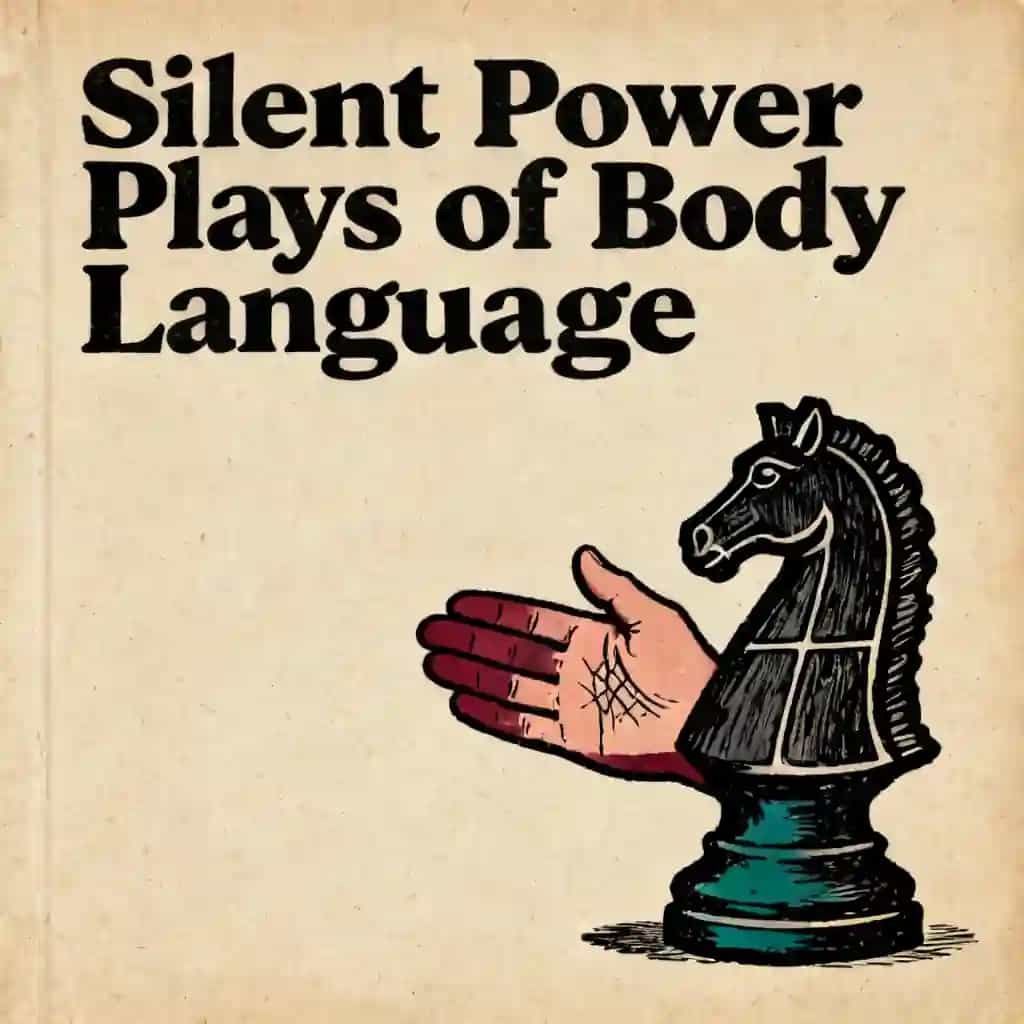
1장
The Silent Language That Speaks Volumes
In a world where words can deceive, our bodies never lie. This fundamental insight transformed Allan Pease's life when, as an eleven-year-old selling rubber sponges door-to-door, he discovered he could predict customer intentions by watching their hands and posture. This skill propelled him from teenage pot salesman to record-breaking life insurance agent by his twenties, all by reading what people's bodies revealed while their words concealed.
"The Definitive Book of Body Language" has become a cultural phenomenon since its publication, selling millions of copies worldwide and changing how business executives, politicians, and everyday people understand human interaction. Celebrities from Oprah Winfrey to Tony Robbins have praised its insights, while Fortune 500 companies incorporate its teachings into negotiation training. What makes this work so compelling is its blend of evolutionary science, practical observation, and surprising revelations about how little control we have over our nonverbal signals - and how much they influence every relationship we form.
2장
The Fundamental Truth About Human Communication
When we communicate face-to-face, the impact comes overwhelmingly from nonverbal signals. Albert Mehrabian's groundbreaking research found that only 7% of message impact comes from words themselves, while 38% derives from voice tone and a staggering 55% from body language. This explains why email and text messages so frequently lead to misunderstandings - they strip away the majority of communication cues.
Our bodies evolved to communicate emotions long before we developed speech. While modern humans pride themselves on sophisticated verbal abilities, our ancient limbic brain still controls our body language, often contradicting our carefully chosen words. This creates what psychologists call "incongruence" - when someone says they're open to your proposal while crossing their arms and legs, their primitive brain is broadcasting the truth their words attempt to hide.
Women possess a distinct advantage in this realm. Brain scans reveal females have 14-16 areas dedicated to evaluating others' behavior compared to men's 4-6 areas. This explains women's legendary "intuition" - they're processing vastly more nonverbal information. In studies where participants watched silent films of interactions, women correctly identified relationships 87% of the time versus men's 42%. This difference appears innate - baby girls smile more than boys by eight weeks of age.
Fortune-tellers exploit this natural ability. Through "cold reading" - careful observation of reactions to statements - skilled practitioners achieve 80% accuracy when reading strangers. Most fortune-tellers are women who leverage their naturally stronger nonverbal reading abilities, often becoming convinced of their own psychic powers when actually employing sophisticated body language interpretation.
To accurately read body language, three fundamental rules must be followed. First, read gestures in clusters rather than isolation - like words forming sentences, individual gestures can have multiple meanings depending on context. Second, look for congruence between verbal and nonverbal signals - when they conflict, trust the nonverbal message. Third, always interpret gestures within context - crossed arms might indicate defensiveness in a meeting but simply mean someone is cold at a winter bus stop.
3장
The Power of Hands and Palms in Human Interaction
Our hands contain more neural connections to the brain than any other body part except the face, making them our most expressive communication tools. Throughout history, open palms have symbolized truth, honesty and submission. Like a dog exposing its throat in surrender, humans show their palms to demonstrate they're unarmed and non-threatening.
When people are being honest or open, they instinctively display their palms while speaking, giving listeners an intuitive sense of truthfulness. Conversely, liars often hide their palms - children behind their backs, men in pockets or crossed arms, while women tend to avoid the subject entirely while keeping busy with other activities.
The human palm conveys silent authority through three main positions. The Palm-Up position appears submissive and non-threatening, like a beggar's plea. The Palm-Down position projects immediate authority. The Palm-Closed-Finger-Pointed is perceived as the most aggressive and irritating. In experiments with lecturers using different hand gestures during presentations, those using mostly Palm-Up positions received 84% positive feedback from audiences. This dropped to 52% when using Palm-Down positions with the same content, and plummeted to only 28% positive response with the Finger-Pointed position.
Handshaking originated from ancient tribal customs of showing empty palms to prove no weapons were concealed. The modern interlocking palms emerged in the nineteenth century as a way for men of equal status to seal commercial transactions. Today, handshakes subconsciously transmit one of three attitudes: dominance, submission, or equality. Dominance is communicated by turning your palm downward in what's called the Upper Hand position. A study of 350 senior executives revealed that 88% of males and 31% of females used this dominant handshake technique.
Touch has extraordinary persuasive power. In the "Phone Booth Test" experiment, researchers placed a coin in a phone booth and approached people who found it. Without touching, only 23% of subjects returned the coin when asked. When researchers lightly touched subjects on the elbow for three seconds while making the same request, 68% admitted having the coin and returned it. This technique works because the elbow is considered public space, a light touch creates a momentary bond, and touching influences compliance across cultures.
4장
The Magic of Smiles and Their Evolutionary Purpose
Smiling evolved as a submission signal among primates. While humans smile when happy, research with chimpanzees shows deeper evolutionary purposes. Chimps have two types of smiles: the "fear face" (showing submission to dominants) and the "play face" (resembling human laughter). Both communicate non-threatening intentions. This explains why dominant individuals like Vladimir Putin or Clint Eastwood rarely smile - they avoid appearing submissive.
Smiles trigger automatic reciprocation, even when fake. Professor Ulf Dimberg's research demonstrated that people cannot fully control their facial muscles - they involuntarily mirror expressions they see. Professor Ruth Campbell suggests this happens because of "mirror neurons" in the brain that automatically copy observed facial expressions. This explains why regular smiling is crucial in your body-language repertoire - it directly influences others' attitudes and responses.
Contrary to popular belief, liars typically smile less when deceiving others, as they realize smiles are associated with lying. A liar's smile appears more quickly, is held longer, and is often asymmetrical - stronger on the left side of the face due to brain hemisphere differences. In genuine smiles, both brain hemispheres direct facial muscles to act symmetrically, creating a balanced expression.
Research for Australian Customs revealed that contrary to assumptions, liars decrease their smiling frequency when being deceptive. Innocent people, however, increase smiling as a submission signal to appease accusers. This explains why we instinctively smile when a police car pulls up beside us even when we've done nothing wrong - the presence of authority triggers submission signals.
Laughter positively affects every bodily organ - quickening breathing, increasing oxygen in blood, improving circulation, lowering heart rate, dilating arteries, and burning calories. Neurologist Henri Rubenstein found one minute of solid laughter provides up to forty-five minutes of relaxation, while Professor William Fry discovered a hundred laughs equals a ten-minute rowing workout.
Human laughter differs fundamentally from primate laughter. Chimps laugh in a panting manner, making only one sound per breath cycle. When humans evolved to walk upright, it freed our upper bodies from weight-bearing functions and allowed better breath control, enabling us to modulate exhalation to produce both language and laughter - capabilities our primate cousins physically lack.
5장
The Revealing Nature of Arms, Legs, and Defensive Postures
Our arms serve as natural barriers that we instinctively use to protect ourselves from threats, a behavior that evolves from childhood hiding to more sophisticated adult gestures. When we feel threatened or defensive, we unconsciously fold our arms across our chest to shield our vital organs - a behavior also seen in monkeys and chimps.
Research shows alarming results about crossed arms. In studies with lecture attendees, those who kept their arms folded retained 38% less information and developed more negative opinions about the presenter than those with unfolded arms. This demonstrates that arm-crossing not only generates negative thoughts about the speaker but also reduces attention to the message.
People often claim they cross their arms for comfort, but any gesture feels comfortable when it matches your attitude. With defensive feelings, crossed arms feel natural; in relaxed social situations, they feel awkward. Remember that body language is interpreted by the receiver as well as the sender - while you might feel "comfortable," studies show others perceive crossed arms negatively.
The farther body parts are from the brain, the less awareness we have of them. While we consciously control facial expressions, we're largely unaware of our legs and feet, making them reliable indicators of true attitudes and intentions. Research shows people dramatically increase unconscious foot movements when lying. While liars control facial expressions and hand gestures, they rarely monitor their feet.
Human legs evolved for two purposes: moving toward food and away from danger. Since our brains are hardwired for approach or avoidance, leg and foot positions reveal where someone wants to go. Open leg positions indicate openness or dominance, while crossed positions signal closed attitudes or uncertainty. A disinterested woman crosses her arms and legs away from a man, while an interested woman opens her posture toward him.
As people become comfortable in groups, they progress through predictable body language shifts. Starting with fully crossed arms and legs (showing uncertainty), they gradually open up: first uncrossing legs into the Attention Position, then freeing one arm while the other forms a Single-Arm-Barrier. Eventually both arms unfold, with one gesturing or resting on the hip or in a pocket. The final acceptance stage shows in the Foot-Forward Position directed toward others, signaling complete openness and rapport.
6장
The Truth Behind Deception and Evaluation Signals
The most reliable indicators of lying are involuntary gestures people make automatically, as they have minimal control over these responses. Words are the least dependable signs because they can be rehearsed. Studies show most people lie regularly - one study found 62% of participants told 2-3 lies every ten minutes, while another survey revealed 91% of Americans lie regularly both at home and work.
The three monkeys who "hear no evil, see no evil, and speak no evil" demonstrate the fundamental hand-to-face gestures humans use when encountering deception. When we see, hear, or speak lies, we instinctively attempt to cover our mouth, eyes, or ears with our hands. These gestures become more subtle as we age but remain detectable.
The face is our primary tool for concealing lies, yet it paradoxically reveals the most truth. While we consciously manipulate our facial expressions with smiles and nods, incongruent body signals expose our true feelings. Fleeting microexpressions - lasting just a split second - can reveal concealed emotions before we have time to mask them, such as a momentary sneer when mentioning someone we claim to like.
Women excel at deception due to their superior emotional intelligence and ability to read others. This advantage begins in infancy, with baby girls able to cry sympathetically with other babies and even trigger crying in others at will. Research shows women craft more complex, sophisticated lies compared to men's simpler deceptions.
The most revealing deception gestures include: The Mouth Cover, where the hand subconsciously tries to suppress deceitful words; The Nose Touch, caused by increased blood flow to nasal tissues during lying (the "Pinocchio Effect"); The Eye Rub, attempting to block out deceit or avoid looking at the person being deceived; The Ear Grab, symbolically blocking unwanted information; The Neck Scratch, indicating doubt or uncertainty; The Collar Pull, resulting from increased perspiration when a liar fears detection; and Fingers-in-Mouth, an unconscious reversion to childhood security-seeking behavior when under pressure.
True evaluation is shown by a closed hand resting on the chin or cheek with the index finger pointing upward. When interest wanes but politeness remains, the palm begins supporting the head - a telltale sign of feigned attention. Genuine interest appears when the hand lightly touches the cheek without head support. Critical thinking is revealed when the index finger points vertically up the cheek with the thumb supporting the chin, sometimes accompanied by eye rubbing.
7장
The Hidden Language of Personal Space and Territories
Like animals, humans carry a portable "air bubble" around them, with its size determined by population density where they grew up. Personal space is culturally determined - Japanese people are accustomed to crowding, while others prefer greater distance. Research shows prison inmates have larger personal space needs than average, explaining why they become aggressive when approached and calm in solitary confinement.
Humans establish four distinct spatial zones by age twelve: The Intimate Zone (six to eighteen inches) - the most guarded zone that only emotionally close people may enter; The Personal Zone (eighteen to forty-eight inches) - maintained at social gatherings; The Social Zone (four to twelve feet) - kept with strangers and acquaintances; The Public Zone (over twelve feet) - used when addressing large groups.
Our Intimate Zone is typically entered only by close relations or potential attackers. Invasion by strangers triggers physiological fight-or-flight responses - increased heart rate and adrenaline - even when we smile politely. The golden rule for making others comfortable is maintaining appropriate distance, gradually decreasing as relationships develop.
In crowded situations where Intimate Zone invasion is unavoidable, people follow unwritten "masking" rules: no talking, avoiding eye contact, maintaining expressionless faces, pretending to be engrossed in reading material, minimizing movement, and watching floor numbers change. The blank expressions often misinterpreted as unhappiness are actually defensive mechanisms against the discomfort of spatial invasion in public places.
Cultural differences in personal space create misunderstandings. Southern Europeans maintain intimate distances of only 8-11 inches compared to others' 18 inches, leading to misinterpretations of intentions. When people from different spatial cultures interact, they often appear to "dance" - one advancing while the other retreats - creating impressions of pushiness or coldness.
We fiercely defend our territories - homes, offices, cars - just as we protect our personal bubbles. These spaces have clear boundaries and often contain subterritories: a favorite kitchen, conference seat, or chair. We mark these areas with personal possessions to signal ownership. Studies show leaving a book reserves a library desk for seventy-seven minutes; a jacket over a chair reserves it for two hours.
8장
The Fascinating Science of Courtship Signals
When people encounter potential mates, their bodies automatically make subtle adjustments to appear more attractive. These changes include increased muscle tone, reduced facial sagging, chest protrusion, stomach tightening, more erect posture, and a more youthful, energetic walking style. Men stand taller, protrude their jaws, and expand their chests to appear dominant, while interested women emphasize their breasts, tilt their heads, touch their hair, and expose their wrists to appear submissive.
Though most men believe they initiate courtship, studies consistently show women are the initiators 90 percent of the time through subtle eye, body, and facial signals. Men who approach women without receiving these green light signals have lower success rates - they're simply playing a numbers game. The courtship dance appears male-initiated only because men physically move across the room, but this movement almost always follows the woman's invitation through body language.
Human courtship follows a predictable five-stage sequence that begins with eye contact, where a woman spots a man she fancies and holds his gaze for about five seconds before looking away. This must typically happen three times before most men notice. Next comes smiling - a fleeting half-smile signaling interest. The third stage involves preening behaviors where both parties adjust their posture and appearance to appear more attractive. In the fourth stage, the man approaches with conversation, often using cliches to break the ice. Finally, touch is initiated, usually by the woman lightly touching the man's arm, with each level of touch repeated to confirm comfort with the intimacy level.
Women employ thirteen common courtship signals, becoming more likely to use them during ovulation. These include the Head Toss and Hair Flick to draw attention and release pheromones; Wet Lips and Pouting to emphasize femininity; Self-Touching to suggest intimate possibilities; the Limp Wrist as a submission signal; Fondling Cylindrical Objects as phallic symbolism; Exposed Wrists to show delicate skin; Sideways Glance Over Raised Shoulder to mimic breast curves; Rolling Hips to highlight female pelvic structure; and the Pelvic Tilt to showcase the ideal 70% waist-to-hips ratio that men find most attractive.
Men are biologically wired to be attracted to women displaying healthy reproductive ability and sexual availability. While both genders prefer athletic body shapes, men are particularly drawn to childlike facial features - large eyes, small noses, and full lips - which trigger protective instincts. The good news is that availability signals matter more than physical beauty; women don't need to be naturally beautiful to attract men if they can effectively display availability cues.
9장
The Power of Mirroring in Building Rapport
Mirroring is how we assess others and build rapport by unconsciously matching their body language. This ancient bonding technique helps us fit into groups and learn through imitation. People who feel similar emotions naturally synchronize their body language and expressions, creating what we call "good vibes." This begins in the womb when our bodily rhythms match our mother's.
Women are four times more likely to mirror other women than men are to mirror men. Women readily mirror men's body language, but men rarely mirror women unless in courtship. Women's superior ability to "see" disagreement comes from noticing when someone's body language is out of sync with the group. While women typically use six facial expressions in a ten-second listening period to reflect the speaker's emotions, men make fewer than a third as many expressions, maintaining control with an emotionless mask despite feeling emotions just as strongly.
Long-term couples often begin resembling each other from constantly mirroring facial expressions, which builds muscle definition in the same facial areas. Even facially dissimilar couples appear alike in photographs through identical smiles. Research shows marriages are more likely to fail when one partner doesn't mirror the other's expressions of happiness but instead shows contempt.
Research shows mirroring follows hierarchy - leaders adopt gestures first, then subordinates copy in order of importance. Leaders typically walk first through doorways and prefer end seats rather than center positions. In meetings, people "take sides" through mirroring, revealing voting alliances. When working with couples, watching who mirrors whom reveals where decision-making power lies.
The significance of mirroring is one of the most important body-language lessons you can learn because it clearly signals when others agree with or like us. We can deliberately use mirroring to influence others by matching their positive gestures and posture, putting them in a receptive frame of mind. However, relationship context matters - a subordinate mirroring a boss's dominant posture could be perceived as arrogance.
10장
Strategic Positioning for Maximum Impact
Where you sit relative to others powerfully influences cooperation and reveals attitudes. When choosing where to sit at a rectangular table with another person, most people instinctively select: the Corner Position for job interviews, allowing clear view without appearing competitive or overly familiar; the Cooperative Position when helping with tasks; the Competitive/Defensive Position for adversarial activities like chess; and the Diagonal Position in places like libraries to communicate independence and non-involvement.
Research shows desk placement significantly affects perception. Only 10% of patients felt at ease when doctors sat behind desks, rising to 55% without desks. In our study, 76% of senior managers positioned desks between themselves and subordinates, compared to 50% of lower managers. Managers without desk barriers were perceived as fairer, better listeners, and less likely to show favoritism.
At rectangular tables, position A commands the most influence even among equals, unless their back faces the door - then position B gains power. Research shows people at the head position are chosen more often as leaders, especially if perceived as higher class. Position B has the second most authority, followed by D (often an emotional leader concerned with relationships), then C. This knowledge allows strategic seating arrangements to control meeting dynamics.
University of Oregon research found people retain three times more information from their right visual field than their left. Teachers look straight ahead 44% of the time, to their left 39%, and right only 17%. Students sitting on the teacher's left perform better and are picked on less. Similarly, salespeople close more deals sitting to a customer's left. The lesson: children should sit on the teacher's left, while adults should position themselves on their boss's right for perceived power.
Our research on audience participation and information retention confirmed Robert Sommer's findings: there's a "Funnel Effect" in classroom-style seating where the most engaged participants sit in a funnel-shaped zone extending down the center and across the front row. These attendees participate most, interact best with presenters, and have highest recall. Those sitting in back or side areas participate least, tend to be more negative or confrontational, and remember less.
Height has historically signified status in human interactions. We use language that reinforces this: referring to royalty as "Your Highness," calling criminals "low" or "lowlifes," and positioning authority figures physically higher (judges on raised benches, speakers on platforms). People demonstrate subordination by lowering their bodies - curtsying to royalty, removing hats, or bowing.
Research consistently shows taller people are more successful, healthier, and live longer. Dr. Bruce Ellis found taller men have greater reproductive success due to higher testosterone levels and women's preference for taller partners who appear more protective. Height correlates strongly with career advancement - studies show each inch of height above company average adds nearly $683 to a manager's salary, regardless of gender.