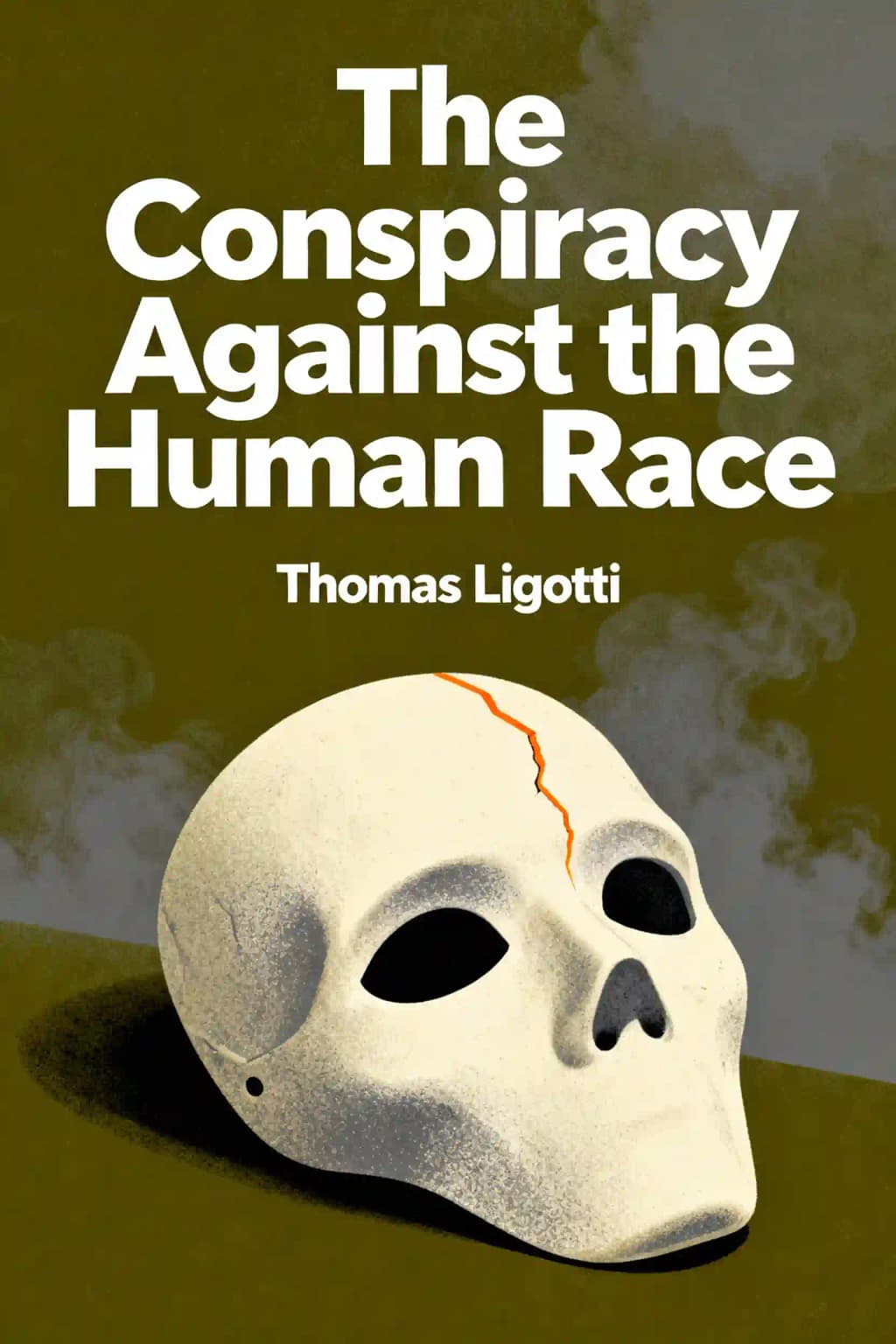
Ligotti's nihilistic masterpiece that inspired True Detective's Rust Cohle, outsold Ayn Rand, and sparked plagiarism controversy. Can any philosophical work be more terrifying than facing the truth - that consciousness itself might be humanity's greatest cosmic joke?
Thomas Ligotti is the author of The Conspiracy Against the Human Race and a cult figure in contemporary horror fiction renowned for his philosophical pessimism. Born in 1953, this American writer and lay philosopher explores themes of cosmic dread, nihilism, and existential horror through dense, literary prose.
Ligotti's acclaimed fiction includes Songs of a Dead Dreamer, Teatro Grottesco, and The Nightmare Factory, which won the Bram Stoker Award. His novella My Work Is Not Yet Done delves into corporate horror with a distinctly bleak worldview.
In 2015, Penguin Classics republished his early collections, placing him among only ten living American writers in their catalog alongside literary giants like Thomas Pynchon and Don DeLillo. The Washington Post called Ligotti "the best kept secret in contemporary horror fiction," a reputation enhanced by critical acclaim from The New York Times Book Review and The New Yorker following his Penguin Classics debut.
The Conspiracy Against the Human Race by Thomas Ligotti is a 2010 philosophical non-fiction book exploring pessimism, nihilism, and antinatalism. Ligotti argues that consciousness itself is a tragic blunder that causes suffering, and that humanity would be better off not existing. The book examines how people cope with life's meaninglessness through various delusions and distractions, drawing on philosophers like Peter Wessel Zapffe and Emil Cioran to support his dark worldview.
Thomas Ligotti is an American horror fiction author born in 1953, best known for his cosmic horror short stories. In The Conspiracy Against the Human Race, Ligotti ventures into philosophical non-fiction to articulate the pessimistic worldview that permeates his fiction. Having built a cult following through his literary horror collections, Ligotti uses this book to directly examine the philosophical foundations of existence, consciousness, and suffering that inform his dark aesthetic.
The Conspiracy Against the Human Race appeals to readers interested in philosophical pessimism, existential philosophy, and dark intellectual explorations of consciousness. It's ideal for fans of Ligotti's horror fiction seeking to understand his worldview, philosophy students exploring antinatalism and nihilism, and those drawn to thinkers like Schopenhauer, Cioran, and Zapffe. The book requires tolerance for bleak perspectives and dense philosophical arguments about suffering and meaninglessness.
The Conspiracy Against the Human Race is worth reading for those seeking intellectually rigorous examinations of pessimistic philosophy, though it demands comfort with profoundly dark ideas. The book uniquely blends philosophical analysis with literary horror sensibilities, offering insights into consciousness, suffering, and existential dread. However, readers should approach it understanding that Ligotti presents unrelentingly bleak arguments about existence without offering optimistic counterpoints or solutions beyond voluntary extinction.
"Malignantly useless" is Thomas Ligotti's signature phrase in The Conspiracy Against the Human Race, describing the fundamental nature of existence and consciousness. The term captures Ligotti's view that the world is both actively harmful ("malignantly") and devoid of inherent purpose or meaning ("useless"). This phrase encapsulates his argument that consciousness forces awareness of life's horrifying meaninglessness, making existence a cruel condition that serves no beneficial function.
Thomas Ligotti's main argument in The Conspiracy Against the Human Race is that consciousness is a tragic evolutionary mistake that creates inevitable suffering. He contends that being aware of life's meaninglessness and horror forces humans to constantly suppress this knowledge through various psychological mechanisms and cultural distractions. Ligotti concludes that the only true escape from this predicament is either ego death or humanity's voluntary extinction, though he acknowledges neither outcome is likely.
The Conspiracy Against the Human Race draws heavily from Norwegian philosopher Peter Wessel Zapffe's essay "The Last Messiah," Romanian philosopher Emil Cioran, and German philosopher Philipp Mainländer. Ligotti also references Arthur Schopenhauer's concept of "Will" as a puppeteer controlling human actions. These pessimistic thinkers provide the philosophical foundation for Ligotti's arguments about consciousness as tragedy, determinism, suffering as life's fundamental condition, and antinatalism as a logical response to existence.
Thomas Ligotti employs the puppet metaphor in The Conspiracy Against the Human Race in two interconnected ways. First, he describes humans as "meat puppets" with no free will, controlled by Schopenhauer's impersonal "Will" rather than conscious choice, illustrating his deterministic worldview. Second, puppets represent soulless, lifeless entities that create horror through their uncanny resemblance to humans, symbolizing how consciousness makes us aware of our own mechanistic, meaningless nature.
In The Conspiracy Against the Human Race, Thomas Ligotti argues that consciousness is an evolutionary blunder and the root of all human suffering. He describes consciousness as a mystery that forces awareness of existence's horrifying meaninglessness, creating a paradox where humans must constantly distract themselves from this knowledge. Ligotti adopts Zapffe's view that consciousness creates the false notion of self and that humans are "hunks of spoiling flesh on disintegrating bones" forced into self-awareness.
The Conspiracy Against the Human Race faces criticism for its unrelentingly bleak perspective that offers no alternative viewpoints or counterarguments to philosophical pessimism. Critics note that Ligotti's arguments rely on accepting his starting premise that "being alive is not all right," which many readers reject. The book is also challenged for presenting voluntary human extinction as a logical conclusion while simultaneously acknowledging that most humans don't accept pessimistic philosophy, creating a tension in his reasoning.
The Conspiracy Against the Human Race presents antinatalism as a logical conclusion of philosophical pessimism, arguing against bringing new conscious beings into existence. Thomas Ligotti contends that having children represents a futile attempt at genetic immortality that only perpetuates suffering. Drawing on Peter Zapffe's philosophy, Ligotti asserts that humans possess only one genuine right—the right to die—and that creating new life condemns beings to inevitable suffering and death.
Peter Wessel Zapffe's essay "The Last Messiah" provides a foundational framework for The Conspiracy Against the Human Race, particularly his view that human existence is fundamentally tragic. Ligotti adopts Zapffe's concept that consciousness developed through blind evolutionary mutations without purpose, creating beings over-equipped for survival who must cope with existential awareness. Zapffe's ideas about humans possessing only the right to die and consciousness creating false notions of self permeate Ligotti's philosophical arguments throughout the book.
저자의 목소리로 책을 느껴보세요
지식을 흥미롭고 예시가 풍부한 인사이트로 전환
핵심 아이디어를 빠르게 캡처하여 신속하게 학습
재미있고 매력적인 방식으로 책을 즐기세요
Human consciousness itself is the ultimate cosmic horror.
Consciousness became our existential catastrophe.
We lost our residence in the universe.
We survive only through self-deception.
People are fundamentally either pessimists or optimists.
The Conspiracy against the Human Race의 핵심 아이디어를 이해하기 쉬운 포인트로 분해하여 혁신적인 팀이 어떻게 창조하고, 협력하고, 성장하는지 이해합니다.
The Conspiracy against the Human Race을 빠른 기억 단서로 압축하여 솔직함, 팀워크, 창의적 회복력의 핵심 원칙을 강조합니다.

생생한 스토리텔링을 통해 The Conspiracy against the Human Race을 경험하고, 혁신 교훈을 기억에 남고 적용할 수 있는 순간으로 바꿉니다.
무엇이든 물어보고, 목소리를 선택하고, 진정으로 공감되는 인사이트를 함께 만들어보세요.

샌프란시스코에서 컬럼비아 대학교 동문들이 만들었습니다
"Instead of endless scrolling, I just hit play on BeFreed. It saves me so much time."
"I never knew where to start with nonfiction—BeFreed’s book lists turned into podcasts gave me a clear path."
"Perfect balance between learning and entertainment. Finished ‘Thinking, Fast and Slow’ on my commute this week."
"Crazy how much I learned while walking the dog. BeFreed = small habits → big gains."
"Reading used to feel like a chore. Now it’s just part of my lifestyle."
"Feels effortless compared to reading. I’ve finished 6 books this month already."
"BeFreed turned my guilty doomscrolling into something that feels productive and inspiring."
"BeFreed turned my commute into learning time. 20-min podcasts are perfect for finishing books I never had time for."
"BeFreed replaced my podcast queue. Imagine Spotify for books — that’s it. 🙌"
"It is great for me to learn something from the book without reading it."
"The themed book list podcasts help me connect ideas across authors—like a guided audio journey."
"Makes me feel smarter every time before going to work"
샌프란시스코에서 컬럼비아 대학교 동문들이 만들었습니다

The Conspiracy against the Human Race 요약을 무료 PDF 또는 EPUB으로 받으세요. 인쇄하거나 오프라인에서 언제든 읽을 수 있습니다.
Have you ever felt that unsettling sensation - that beneath our daily routines and social niceties lies a disturbing truth we collectively refuse to acknowledge? Thomas Ligotti's cult philosophical work "The Conspiracy Against the Human Race" tears away this comforting veil with surgical precision. This isn't just another philosophical treatise; it's an unflinching journey into the darkest corners of human existence that has influenced everything from HBO's "True Detective" to contemporary horror literature. The central premise is both simple and devastating: human consciousness itself is the ultimate cosmic horror, and our entire civilization functions as an elaborate conspiracy to hide this unbearable truth from ourselves.