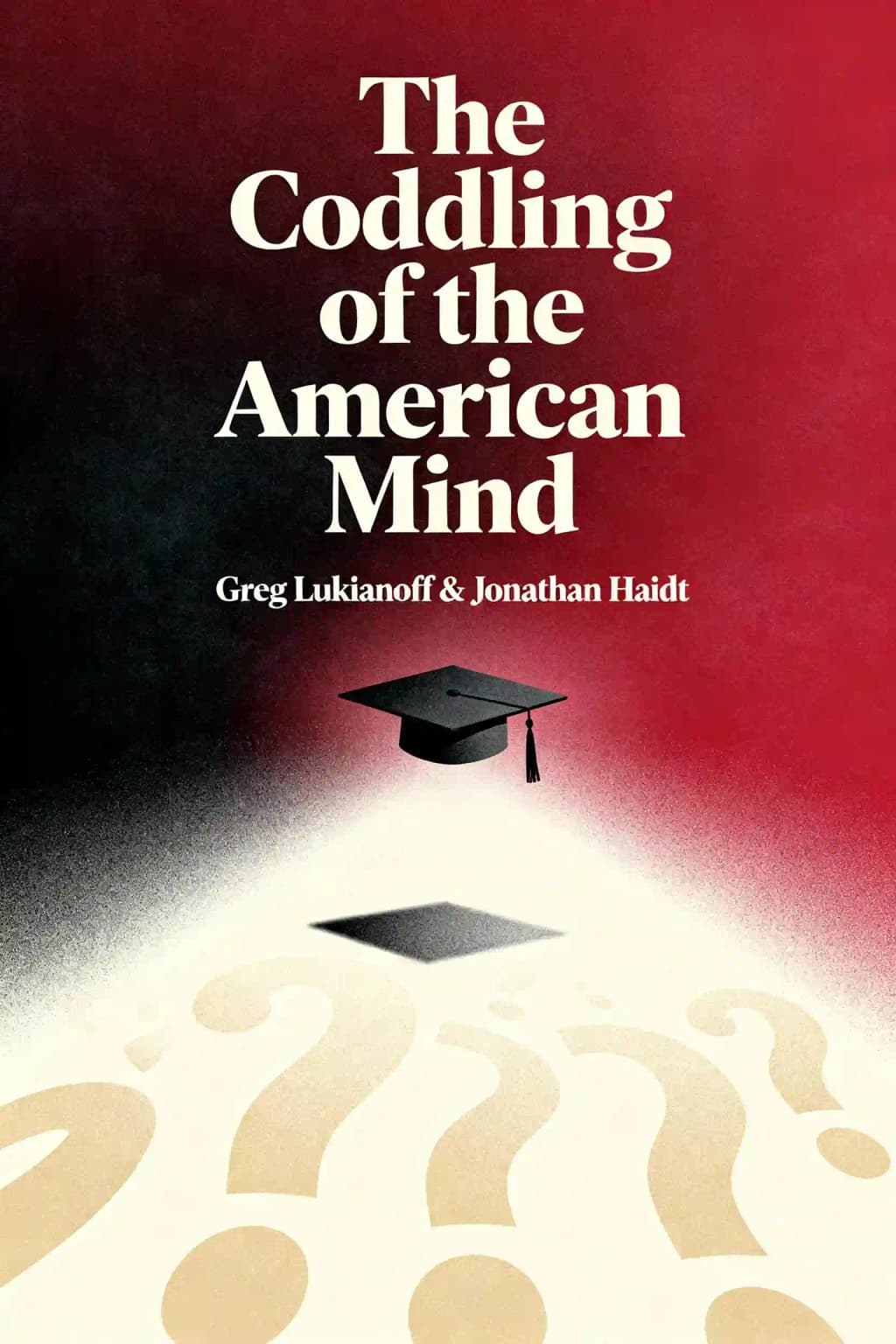
How are good intentions destroying an entire generation? "The Coddling of the American Mind" - a New York Times bestseller praised by President Obama - reveals how overprotection and "safetyism" are undermining resilience on college campuses. Learn why Bloomberg ranked it #1 book of 2018.
Greg Lukianoff and Jonathan Haidt are the bestselling authors of The Coddling of the American Mind: How Good Intentions and Bad Ideas Are Setting Up a Generation for Failure, a seminal work blending psychology, education, and cultural analysis. Lukianoff, a First Amendment expert and president of the Foundation for Individual Rights in Education (FIRE), brings decades of legal advocacy for free speech on college campuses.
Haidt, a renowned social psychologist and NYU Stern professor, is celebrated for his research on moral psychology and civic discourse. Their collaboration merges Haidt’s academic rigor with Lukianoff’s frontline experience defending constitutional rights.
The book, expanding on their viral 2015 Atlantic essay, critiques modern trends in education and parenting through the lens of three "Great Untruths," drawing from ancient philosophy and contemporary research. Haidt’s prior works, including The Righteous Mind and The Happiness Hypothesis, explore morality and human flourishing, while Lukianoff’s Unlearning Liberty and Freedom From Speech examine free expression in academia. Translated into over 20 languages and adapted into documentary films, The Coddling of the American Mind has sparked global debates on mental health, intellectual diversity, and societal resilience.
The Coddling of the American Mind examines how overprotection and "safetyism"— prioritizing emotional safety over intellectual growth—harm youth resilience and free speech. Authors Greg Lukianoff and Jonathan Haidt identify three damaging ideologies: fragility ("what doesn’t kill you makes you weaker"), emotional reasoning ("always trust your feelings"), and us-vs-them thinking. They argue these untruths fuel anxiety, depression, and campus censorship.
This book is essential for educators, parents, policymakers, and mental health advocates. It offers insights into combating rising youth anxiety, fostering resilience, and addressing campus free-speech challenges. Readers interested in societal trends, cognitive behavioral therapy (CBT), or cultural critiques will find its research-backed analysis valuable.
Yes—it’s a critically acclaimed, research-driven exploration of modern cultural shifts. Despite its controversial title, the book provides actionable solutions to counteract fragility and promote viewpoint diversity. Praised for its clarity, it ranks 9/10 by reviewers and remains relevant in 2025 debates on education and mental health.
Lukianoff and Haidt trace these beliefs to rising mental health issues and polarized discourse.
Safetyism—shielding individuals from emotional discomfort—stifles critical thinking and escalates conflict. The authors argue it fosters fragility, as seen in campus demands for trigger warnings and speech restrictions. This culture undermines intellectual development and democratic dialogue.
The book challenges "helicopter parenting" and risk-averse childhoods, linking them to the Untruth of Fragility. Overprotecting kids from setbacks, it claims, prevents them from building coping skills. Instead, it advocates for "free-range parenting" to nurture resilience.
These emphasize resilience over coddling.
Critics argue the title oversimplifies complex issues and that some campus examples are anecdotal. Others contend it overlooks systemic factors in mental health crises. However, most agree its core message about resilience remains vital.
Cognitive Behavioral Therapy (CBT) principles underpin the book’s solutions. By challenging distorted thinking (e.g., catastrophizing), individuals can reject the Three Untruths. The authors urge schools to teach CBT-inspired emotional resilience strategies.
It critiques trigger warnings, safe spaces, and speech policing as counterproductive. Case studies show how suppressing debates on race, gender, or politics exacerbates division. The authors advocate for open dialogue and intellectual humility.
While The Righteous Mind explores moral psychology, Coddling focuses on youth mental health and cultural shifts. Both emphasize tribal thinking’s dangers, but Coddling offers more pragmatic solutions for institutions.
With rising Gen Z anxiety and campus speech debates ongoing, its warnings about fragility and polarization remain urgent. The book’s framework helps navigate conflicts over AI, identity politics, and free expression in academia.
저자의 목소리로 책을 느껴보세요
지식을 흥미롭고 예시가 풍부한 인사이트로 전환
핵심 아이디어를 빠르게 캡처하여 신속하게 학습
재미있고 매력적인 방식으로 책을 즐기세요
Therefore, we offer three Great Untruths that seem to have spread widely in recent years, all of which contradict ancient wisdom.
The first of these Untruths is: What doesn’t kill you makes you weaker.
The second Untruth is: Always trust your feelings.
The third Untruth is: Life is a battle between good people and evil people.
What doesn't kill me makes me stronger?
The Coddling of the American Mind의 핵심 아이디어를 이해하기 쉬운 포인트로 분해하여 혁신적인 팀이 어떻게 창조하고, 협력하고, 성장하는지 이해합니다.
The Coddling of the American Mind을 빠른 기억 단서로 압축하여 솔직함, 팀워크, 창의적 회복력의 핵심 원칙을 강조합니다.

생생한 스토리텔링을 통해 The Coddling of the American Mind을 경험하고, 혁신 교훈을 기억에 남고 적용할 수 있는 순간으로 바꿉니다.
무엇이든 물어보고, 목소리를 선택하고, 진정으로 공감되는 인사이트를 함께 만들어보세요.

샌프란시스코에서 컬럼비아 대학교 동문들이 만들었습니다
"Instead of endless scrolling, I just hit play on BeFreed. It saves me so much time."
"I never knew where to start with nonfiction—BeFreed’s book lists turned into podcasts gave me a clear path."
"Perfect balance between learning and entertainment. Finished ‘Thinking, Fast and Slow’ on my commute this week."
"Crazy how much I learned while walking the dog. BeFreed = small habits → big gains."
"Reading used to feel like a chore. Now it’s just part of my lifestyle."
"Feels effortless compared to reading. I’ve finished 6 books this month already."
"BeFreed turned my guilty doomscrolling into something that feels productive and inspiring."
"BeFreed turned my commute into learning time. 20-min podcasts are perfect for finishing books I never had time for."
"BeFreed replaced my podcast queue. Imagine Spotify for books — that’s it. 🙌"
"It is great for me to learn something from the book without reading it."
"The themed book list podcasts help me connect ideas across authors—like a guided audio journey."
"Makes me feel smarter every time before going to work"
샌프란시스코에서 컬럼비아 대학교 동문들이 만들었습니다

The Coddling of the American Mind 요약을 무료 PDF 또는 EPUB으로 받으세요. 인쇄하거나 오프라인에서 언제든 읽을 수 있습니다.
Imagine walking onto a college campus where students demand protection not just from physical threats but from challenging ideas. Where words are equated with violence and disagreement with harm. How did we arrive here? Greg Lukianoff and Jonathan Haidt's investigation began when Lukianoff, having benefited from cognitive behavioral therapy for depression, recognized troubling patterns in campus discourse that mirrored the very cognitive distortions therapists work to dismantle. What if our well-intentioned efforts to protect young minds are actually making them more fragile? The book identifies three "Great Untruths" that have infiltrated our culture: that humans are fragile and must be protected from challenge; that feelings are always reliable guides to reality; and that life is a battle between good people and evil people. These ideas contradict ancient wisdom and modern psychological science, yet they've gained remarkable traction, particularly among the generation born after 1995 (dubbed "iGen"). The consequences extend far beyond campus walls. As these young adults enter the workforce and political life, they bring with them habits of mind that make democratic discourse and collaborative problem-solving increasingly difficult. What's particularly alarming is how these untruths become self-reinforcing - creating exactly the fragility, emotional reasoning, and binary thinking they presuppose.