1장
Dancing Through Darkness: How Freedom Begins in the Mind
When Captain Jason Fuller enters my El Paso office in 1980, I immediately sense danger. Though physically present, this tall, athletic man appears wooden-rigid body, distant blue eyes, frozen jaw, completely silent. As he sits stiffly on my white couch, I search for a way to reach him through his catatonic state. Taking command, I declare: "We're going for a walk. Captain, we will take Tess to the park-now." Though panicked, the good soldier stands. "Yes, ma'am."
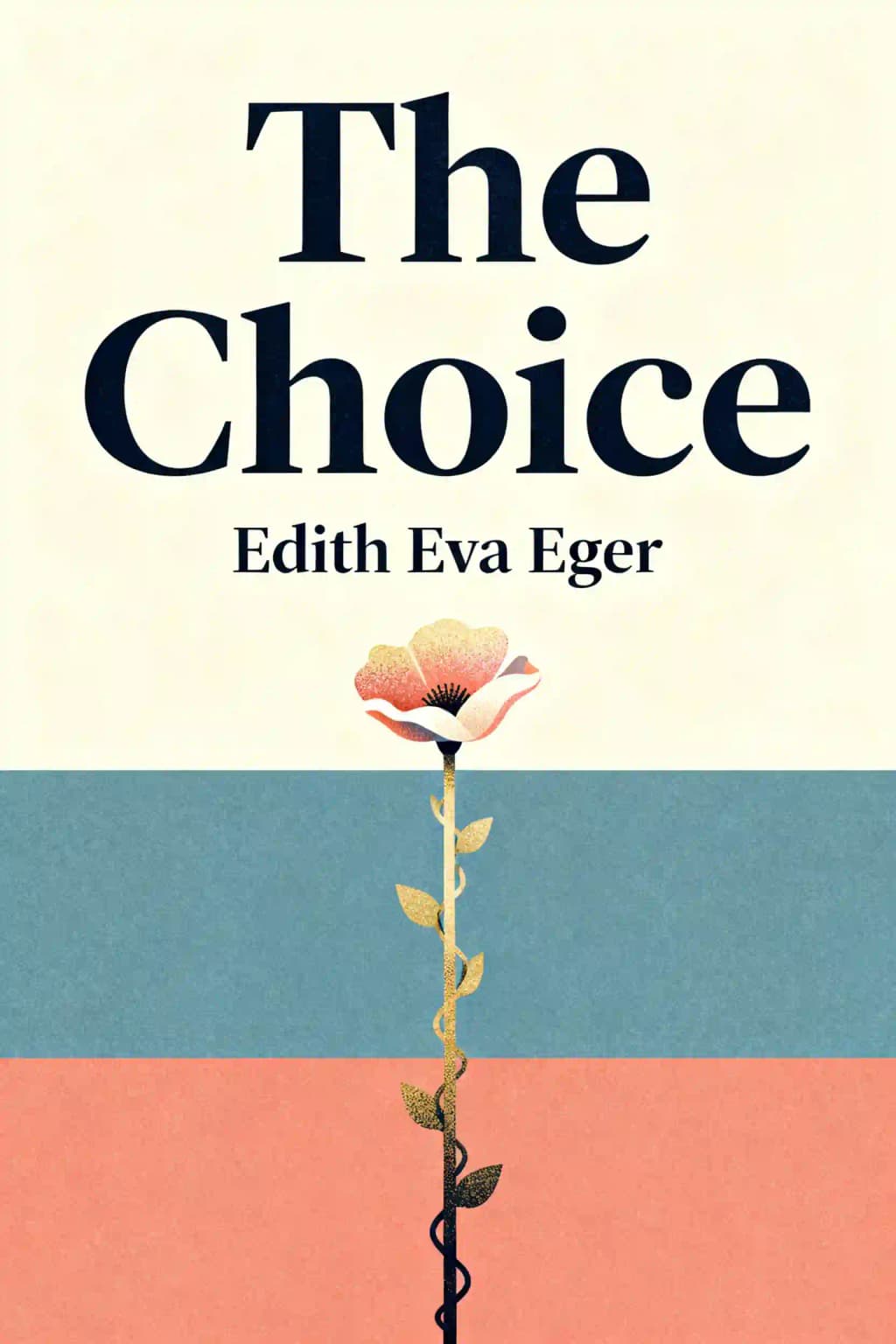
This moment exemplifies what Oprah Winfrey later called "one of the most important books I've ever read" after featuring Edith Eva Eger on her show. Since its 2017 publication, "The Choice" has become a global phenomenon, translated into more than thirty languages and embraced by celebrities from Viola Davis to Prince Harry. Beyond its critical acclaim, the book has sparked a movement in trauma psychology, challenging the notion that our past must dictate our future. As Eger often says, "The opposite of depression is expression"-a philosophy that has made her a sought-after speaker well into her nineties, bringing her wisdom to military personnel, corporations, and universities worldwide.
2장
The Four Questions That Changed Everything
If I could distill my entire life into one moment, it would be this: three women in dark wool coats waiting, arms linked, in a barren yard. My mother, my sister Magda, and me-exhausted, dusty, standing in line at Auschwitz. This is our last moment together, though we don't know it yet.
Growing up Jewish in Czechoslovakia made us double minorities-ethnic Hungarians in a Czech country, and Jews. When Hungary annexed Kosice in 1938, we celebrated, not understanding that Admiral Horthy's arrival marked the beginning of growing antisemitism. By 1939, Hungarian Nazis had evicted us from our apartment. While other Jewish families fled Europe, we didn't talk about leaving.
Even in 1940, when I'm thirteen and the nyilas begin rounding up Jewish men for forced labor camps, we use denial as protection. We're made to wear yellow stars but try to hide them under our coats. I focus on ballet, gymnastics, and my book club, where I meet Eric. Our love blossoms amid growing restrictions-we sneak out without our stars to see American films and make plans for our future together.
In 1943, my father is taken to a forced labor camp. After seven months, he returns just before Passover, while I'm devastated after being removed from the Olympic training team because of my "background." I vow revenge through perfection, planning to train my replacement flawlessly.
On Passover 1944, we learn that Germans are beginning to round up Jews. My parents argue bitterly-my mother for returning to Kassa, my father lamenting missed opportunities to flee. As I recite the traditional question "Why is this night different from all other nights?" my father circles the table, kissing each of us while crying. Before dawn breaks, we'll know the answer when soldiers pound on our door.
3장
When Freedom Lives Only in the Mind
They come for us in the dark, ordering us to pack one suitcase for all four of us. While my mother frantically gathers practical supplies-flour, chicken fat, blankets-I choose to wear my thin blue silk dress, the one Eric kissed me in. Despite the April chill, I want to be desirable, protected by this memory of love.
We're loaded onto wagons and taken to the Jakab brick factory, joining nearly twelve thousand imprisoned Jews. We sleep on floors, hunger becomes constant, and people are beaten for minor offenses. I find Eric in the camp, and we meet daily, dreaming of our future together. After a month, our section is evacuated. Eric calls to me through the truck slats: "I'll never forget your eyes. I'll never forget your hands." This becomes my survival mantra.
The cattle car journey is hellish-a hundred people per car, one bucket for waste, one loaf per eight people. My father grows despondent while my mother withdraws inward, offering me crucial advice: "No one can take away from you what you've put in your mind."
When we arrive at Auschwitz, Dr. Mengele separates us-sending my mother left while pushing Magda and me right with false assurances we'll see her after she "takes a shower." A prisoner in a striped dress approaches me, yanks my coral earrings from my ears, and when I ask about seeing my mother, she points to the smoking chimney: "Your mother is burning in there. You better start talking about her in the past tense."
In this moment, I discover what my ballet master meant when he said "all your ecstasy in life is going to come from the inside." As Magda stares at the chimney where our mother was sent, I can't process the incomprehensible reality. I focus only on surviving each moment with my sister as my anchor.
We endure the humiliation of being stripped, shorn of our hair, and left naked for hours awaiting uniforms. When Magda asks how she looks without hair, I find the one truth that won't wound: "Your eyes are so beautiful. I never noticed them when they were covered up by all that hair." In this moment, I realize we have a choice-to focus on what we've lost or what we still have.
4장
Dancing on the Edge of Death
When Dr. Mengele enters our barracks seeking entertainment, other inmates push me forward as a trained dancer. As "The Blue Danube" plays, I dance in my ill-fitting uniform, hearing him discuss with officers which girls will be killed next. I close my eyes and escape into my mind, transforming the barracks floor into the Budapest opera stage. In this transcendent moment, I realize Mengele is more imprisoned than I am-I'm free in my mind while he must live with his atrocities. My performance earns me a loaf of bread, which I share with Magda and our bunkmates.
We learn survival rules: steal from guards but never inmates; cooperation trumps competition; commit to someone outside yourself. For me, that's Magda and the hope of seeing Eric again. We create inner sanctuaries through imagination-cooking elaborate meals in our minds while starving, hosting beauty pageants in our gray dresses, discussing marriage and love.
One day in the showers, Mengele himself appears, calling me "my little dancer" and leading me naked into his office. As he examines me and begins unbuttoning his coat, I focus only on staying alive inside my mind, repeating "yes I can, yes I can." When a phone call interrupts him, I flee. The fear never leaves me, but I keep my inner mantra: "I survived today. Tomorrow I will be free."
In summer 1944, Magda and I notice no more Hungarian Jews are arriving at Auschwitz. One winter morning, we stand in line to be tattooed. When my turn comes, the officer grabs my wrist but then shoves me aside, saying "I'm not going to waste the ink on you." I'm pushed into "the death line," but notice Magda has been placed in another line.
Without planning, I begin doing cartwheels across the yard, hands to earth, feet to sky, expecting a bullet any second. A guard stares but doesn't shoot-he even seems to wink at me. In those precious seconds of distraction, Magda runs across to join my line. This spontaneous act of defiance saves both our lives.
5장
The Fragile Thread of Survival
Soon we're evacuated from Auschwitz by cattle car. A Wehrmacht soldier with kind eyes tells us, "You have to eat. No matter what they do, remember to eat, because you might get free, maybe soon." We're taken to what appears to be a children's summer camp in Germany, where we work in a thread factory that slices our hands despite the leather gloves we wear.
One night in the kitchen, we laugh as we secretly toast potato peels I've hidden in my underwear. "We've escaped the gas chamber, but we'll die eating potato peels," someone jokes. This laughter, this camaraderie becomes our sustenance.
After weeks, we're forced onto the tops of ammunition trains as human shields against British bombs. When bombs hit our train, I jump and run toward the forest-freedom just footsteps away. But I don't see Magda. In that split second, I choose to return rather than escape alone. I find her in a ditch with a dead girl in her lap, blood streaming from Magda's chin.
We continue marching for days or weeks as the snow melts, watching our numbers dwindle from exhaustion, exposure, fever, and hunger. When we spot a farm, Magda darts away while the guards smoke, desperate to find food. I watch her zigzag toward the garden fence, then lose sight of her when gunshots ring out. I pray to my mother for help. Magda returns safely but empty-handed.
In March, I fall ill with fever at an ammunition factory. Magda hides me under a coat while she works. During my feverish sleep, bombs hit and set the factory on fire. When I regain consciousness, I see the burning bridge to the factory. Magda appears through the flames-she's crossed the burning bridge to return to me rather than escaping. "You idiot," I tell her, "you could have run."
By April, as spring brings green grass, we continue marching. When Magda begins to lose hope during another night without food, I slip out of our sleeping quarters despite warnings that anyone leaving will be shot. I scale a garden wall and pull carrots from the earth. As I jump back down, a Wehrmacht soldier catches me. He points his gun at my chest, and I prepare to die. Instead, he marches me back inside. The next morning, he returns-not to punish me, but to bring me a loaf of dark rye bread. "You must have been very hungry to do what you did," he says, his eyes full of kindness.
6장
The Moment Between Life and Death
At Mauthausen, we sleep on the stairs, awaiting what feels like certain death. Rumors circulate: "We die in the morning." I struggle with my final thoughts, not wanting them to be despondent or cliched. I think of Eric, of physical desire, lamenting that I'll die a virgin without experiencing what my body was meant to know. I mourn not just what I've lost-mother, father, sister, boyfriend, country, home-but what I'll never know: the future, my potential, children I'll never have.
This becomes the Death March from Mauthausen to Gunskirchen. Of two thousand girls, only one hundred will survive. When I stumble, girls form a human chair to carry me, one recognizing me as the girl who shared bread at Auschwitz.
Gunskirchen Lager is a worse hell than anything we've experienced-a camp built for hundreds now housing eighteen thousand. Disease ravages our bodies: typhus, dysentery, white lice, open sores. We sleep three deep, with the dead beneath us. The camp has only one twenty-hole latrine; those who soil themselves are shot. The earth is a mud pit of excrement.
I collapse with what I'll later learn is a broken back. I lie among corpses, hallucinating my family while witnessing horrors-a man eating human flesh, a pregnant woman forced to labor with her legs tied together, a child used for target practice.
When starvation overwhelms me, I choose to eat grass rather than human flesh. "This is what it means to choose. To eat or not eat. To eat grass or to eat flesh." Days blur until cries awaken me: "The Americans have arrived!" I see jeeps, soldiers with American flags emblazoned with the number 71. When they call for survivors to raise their hands, I can barely move.
A Black American soldier finds me, pressing colorful chocolate candies into my hand-the first sweetness I've tasted in so long. As he works to free me from the pile of bodies, I feel thankfulness "prickling all across my skin." Eventually, he places me on the grass where Magda joins me. We have survived the final selection. We are alive. We are together. We are free.
7장
The Long Journey Home
Freedom isn't the jubilant celebration I once imagined. We're a "silent river" of barely-alive skeletons flowing from Gunskirchen toward the nearest town. I ride a squeaking cart with Magda walking beside me, my body wracked with pain I'd previously had no luxury to acknowledge. We're a "slow-moving parade of ghouls" with jutting bones and hollow faces.
The GIs bring Magda and me to a German family's home, where I'm placed in a wooden crib, weighing just seventy pounds, barely able to think beyond pain and need. One night, two drunk American soldiers burst into our room. One tries to assault me while his friend keeps watch. Too weak to fight, I can only manage a warble when I try to scream. The soldier pulls his gun, but then leaves without harming me. He returns the next morning, weeping and repeating "Forgive me," bringing army rations that he spoon-feeds me. For six weeks, he visits daily, helping me relearn to walk despite my burning back pain.
The journey home is bittersweet. On the train from Wels to Vienna, Magda and I scratch at our lice-ridden bodies, caught between hope and grief. "Home. We are going home," I think, immediately followed by the crushing realization that returning means confronting our losses anew. We know our mother, father, and grandparents are dead. We learn that of fifteen thousand deportees from our hometown, only seventy survived.
Boarding another train toward Prague, we face immediate antisemitism-"Nasa lude," sneers a Slovak man, forcing Jews to ride atop the train car. In Prague, I'm overwhelmed by the normalcy of city life-bakeries, shops, perfume-proof that ordinary existence continued while we suffered. Then a miracle: I spot a concert poster featuring my sister Klara with her violin.
Arriving in Kosice, now part of Czechoslovakia instead of Hungary, we walk toward our old apartment and suddenly Klara appears, carrying her violin. She drops it, embraces me, and becomes instantly maternal. She's been surviving by playing violin concerts, living in disguise. Through it all, I remember our mother's wisdom: "When you can't go in through a door, go in through a window."
8장
The Choice to Begin Again
By June's end, still suffering from back pain and chest congestion, I'm diagnosed with typhoid fever, pneumonia, pleurisy, and a broken back. I also receive devastating news: Eric died at Auschwitz the day before liberation. When my condition worsens, I'm sent to a tuberculosis hospital in the Tatra Mountains. There I meet Bela, a gruff older man who initially dismisses me but later visits my room to make me laugh despite doctors' warnings that laughter would cause pain.
I decide to marry Bela-not out of love like with Eric, but as a step back into life. Klara objects, calling us "two cripples," which only strengthens my resolve. We marry on November 12, 1946, at Kosice city hall with just eight people present.
While my sisters continue life in Kosice, I begin an unexpected life of luxury in the Eger mansion in Presov. Bela introduces me to Presov's elite, and I mimic their behaviors-drinking cognac, smoking cigarettes with a silver holder Bela buys me-feeling like an elegant parrot. We don't discuss our wartime experiences, maintaining a conspiracy of silence, convinced that locking away the past will keep us safe and happy.
In early spring, I discover I'm pregnant. Despite the family doctor warning that I'm too weak and should abort, I refuse, determined to "give life." As my pregnancy progresses, my confidence grows along with my body. In September, I give birth to a daughter we name Marianne.
Meanwhile, political threats emerge as Bela refuses a Communist Party position. On May 19, 1949, I return home to find Mariska weeping-the Communists have arrested Bela. After bribing the warden with my diamond ring, we escape by train. In Vienna, we take refuge at the Rothschild Hospital with thousands of other refugees. Our plan has been to join friends in Israel, where our fortune awaits in a boxcar. But I discover papers from the American consulate offering us rare immigration opportunity. The catch: Bela's tuberculosis history would disqualify him.
I make the hardest decision of my life, telling Bela I'm taking Marianne to America with or without him. After agonizing deliberation, he abandons our Israel plans and fortune, choosing us over security. With Csicsi posing as Bela for the medical examination, we secure our visas through deception.
9장
America: The Second Liberation
October 28, 1949 feels like the most optimistic day of my life as we approach New York harbor. Standing on deck with Marianne, I point out Lady Liberty, telling her "We're in America. The land of the free." For twenty precious minutes, I believe the past can't touch us here.
I board a city bus in Baltimore heading to the clothing factory where I earn 7 per dozen cutting threads from boys' boxer shorts. The factory's clattering machines remind me of Germany's thread factory after Auschwitz. We live with Bela's bitter brother George in a cramped Baltimore apartment. One day on the bus, I forget to pay my fare the American way. When the driver shouts "Pay or get off!" I collapse in terror, experiencing what I'll later understand as a flashback-my first of many.
Bela falls ill with tuberculosis, leaving me terrified for Marianne who visits him daily. An aptitude test reveals he's suited to be an orchestra conductor or accountant. With Bela training as an accountant's assistant, I change jobs repeatedly seeking better pay and belonging. At an insurance company, I'm promoted only to hear a colleague warn, "Don't ever sit next to the Jews at lunch. They smell." At a luggage company, my Jewish boss humiliates me for answering phones: "No greener will represent this company."
I give birth to Audrey in 1954, named after Audrey Hepburn. Bela fails his CPA test and is told his accent and stutter will prevent employment regardless. In summer 1955, we load our old gray Ford and leave Baltimore for El Paso, Texas. Bela's cousin Bob has promised better opportunities in this border town where immigrants are less marginalized.
10장
Breaking the Prison of Silence
In January 1969, Bela and I tell our children we're separating. My choice to divorce Bela stems from complex realizations about my mother's life and my own. My mother had abandoned her career and independence to marry my father, choosing the life expected of her rather than the one she wanted. With Bela, I feared I'd done the same-exchanging my dreams for security.
At forty-the age my mother was when she died-I felt cheated of essential experiences. My youth had been stolen by war, camps, and denial. I'd become a mother before grieving my own mother's death. I blamed Bela for my stuckness, though it wasn't his fault I'd chosen to hide my true self.
Unexpectedly, Viktor Frankl himself reached out after someone sent him my essay "Viktor Frankl and Me." His letter-"From one survivor to another"-began a correspondence and friendship exploring why we survived and how to make meaning from suffering.
After my divorce from Bela, I initially felt relief-my migraines disappeared and I embraced a new social life. But soon a gray fog settled over me. Even on my college graduation day, I couldn't attend the ceremony, trapped by my own belief that "I don't deserve to have survived." I had become my own jailor.
When Bela unexpectedly invited me to dinner and asked if we might have "more to build together," I realized the emptiness I'd felt wasn't about our marriage but the void I carried within. Two years after our divorce, at age forty-four, we remarried in a Jewish ceremony. Our love became "as stable as the mountain range, as enveloping and fluid as a sea."
11장
The Healing Path
Viktor Frankl wrote, "It did not really matter what we expected from life, but rather what life expected from us." After being named Teacher of the Year in El Paso in 1972, I still felt I hadn't discovered my true calling. When I mentioned pursuing a doctorate in psychology to my principal, I hesitated: "By the time I finish school I'll be fifty." He simply replied, "You're going to be fifty anyhow."
Taking his wisdom to heart, I earned an MA in educational psychology in 1974 and a PhD in clinical psychology in 1978. My academic journey introduced me to influential thinkers like Martin Seligman, whose research helped answer a question that had haunted me since liberation: Why did so many inmates return to the camps after being freed?
Seligman's concept of "learned helplessness" explained why liberated prisoners returned to camps-when we believe nothing we do can improve our circumstances, we stop taking action on our own behalf. Albert Ellis taught me how our negative core beliefs drive harmful behaviors. From Carl Rogers, I learned the power of unconditional positive regard.
In 1975, I traveled to Israel with Bela to interview Holocaust survivors for my dissertation on Richard Farson's calamity theory of growth. I wanted to understand how people create joyful, purposeful lives despite trauma, and how suffering itself might catalyze positive change. My research confirmed my clinical touchstone: We can choose to be our own jailors, or we can choose to be free.
12장
Return to the Heart of Darkness
At fifty-three, I've transformed from an orphaned refugee into Dr. Edith Eva Eger, a respected psychologist who helps others heal from trauma. Yet despite my professional success, I haven't returned to Germany since the war. When invited to speak at Berchtesgaden, Hitler's former retreat, I'm torn. My daughter Marianne warns me about a Danish couple who suffered heart attacks after revisiting Auschwitz.
Bela challenges me: "If you don't go to Germany, then Hitler won the war." His words hit hard, forcing me to recognize that avoiding Germany means staying trapped on an emotional seesaw with my past. I realize that true freedom requires confronting what terrifies me.
Standing where Hitler once stood, I listen for echoes of evil but hear only silence. Instead, I feel the pulse of spring melting winter's grip. "I release you!" I shout to my old sorrow. The next morning, I address the chaplains with "Tempora mutantur, et nos mutamur in illis"-times change and we change with them.
Lying in Goebbels's bed at Berchtesgaden, I realize I need to perform the rite of grief that has eluded me my whole life. I decide to return to Auschwitz. Though embassy officials initially resist due to labor riots across Poland, I persuade them with my survivor story, and Bela and I receive visas.
At Auschwitz, Bela and I stand before the wrought-iron sign: ARBEIT MACHT FREI. The landscape is dominated by relentless fences, crumbling barracks, and the geometry of systematic death. Most haunting is the absence of birds-no birds live here, even now.
Alone at Birkenau, I'm transported back. In memory, I relive the moment with Dr. Mengele when he asked if the woman beside me was my mother or sister. I answered "Mother"-the word I've spent my life trying to banish from consciousness. He sent her left, to death, while pushing me right, toward life. I call to her across the years, begging forgiveness for not saying "sister," which might have saved her.
I take a small gray stone-in Jewish tradition, stones placed on graves signify the dead live on in our hearts. This stone represents my enduring love and the guilt I came to face. I leave it where my barracks once stood, saying goodbye to my parents and thanking Auschwitz for teaching me I was hurt but not broken, victimized but not a victim.
13장
The Dance of Freedom
At the Third World Congress on Logotherapy in 1983, Viktor Frankl and I danced together-two aging survivors who had learned to thrive. Through our decades-long friendship and my work with patients, I've discovered that painful experiences aren't liabilities but gifts that provide perspective and meaning. Though healing follows no universal template, there are learnable steps in the dance of freedom.
The first step is taking responsibility for our feelings-noticing, accepting, checking, and staying with them rather than avoiding or blaming others. I taught Captain Jason Fuller to manage his emotions with this mantra, helping him identify primary feelings (sad, mad, glad, scared) and respond rather than react.
The second step in the dance of freedom is learning to take necessary risks for true self-realization. My own journey required returning to Auschwitz despite external warnings and internal fear. Taking risks doesn't mean reckless endangerment, but embracing our fears so they don't imprison us.
Time doesn't heal. It's what you do with the time. Healing becomes possible through three choices: taking responsibility, taking risks, and finally releasing the wound by letting go of the past or grief. When I worked with parents who lost their son to suicide, I confronted the mother directly: "Who's dead? Jeremy? Or you?" I explained that perpetual mourning becomes a victim's mentality that prevents true healing.
In summer 2010, I addressed an Army unit returning from Afghanistan with high suicide rates. During my speech, I experienced a profound realization-I was addressing the 71st Infantry, the very unit that liberated me on May 4, 1945. Overcome with emotion, I shifted from asking "Why me? Why did I survive?" to "Why not me?" I thanked these soldiers, telling them their sacrifice has meaning, ending with my signature high kick that declares "I made it!"
My message remains: You can't change what happened or what was done to you, but you can choose how you live now. You can choose to be free.