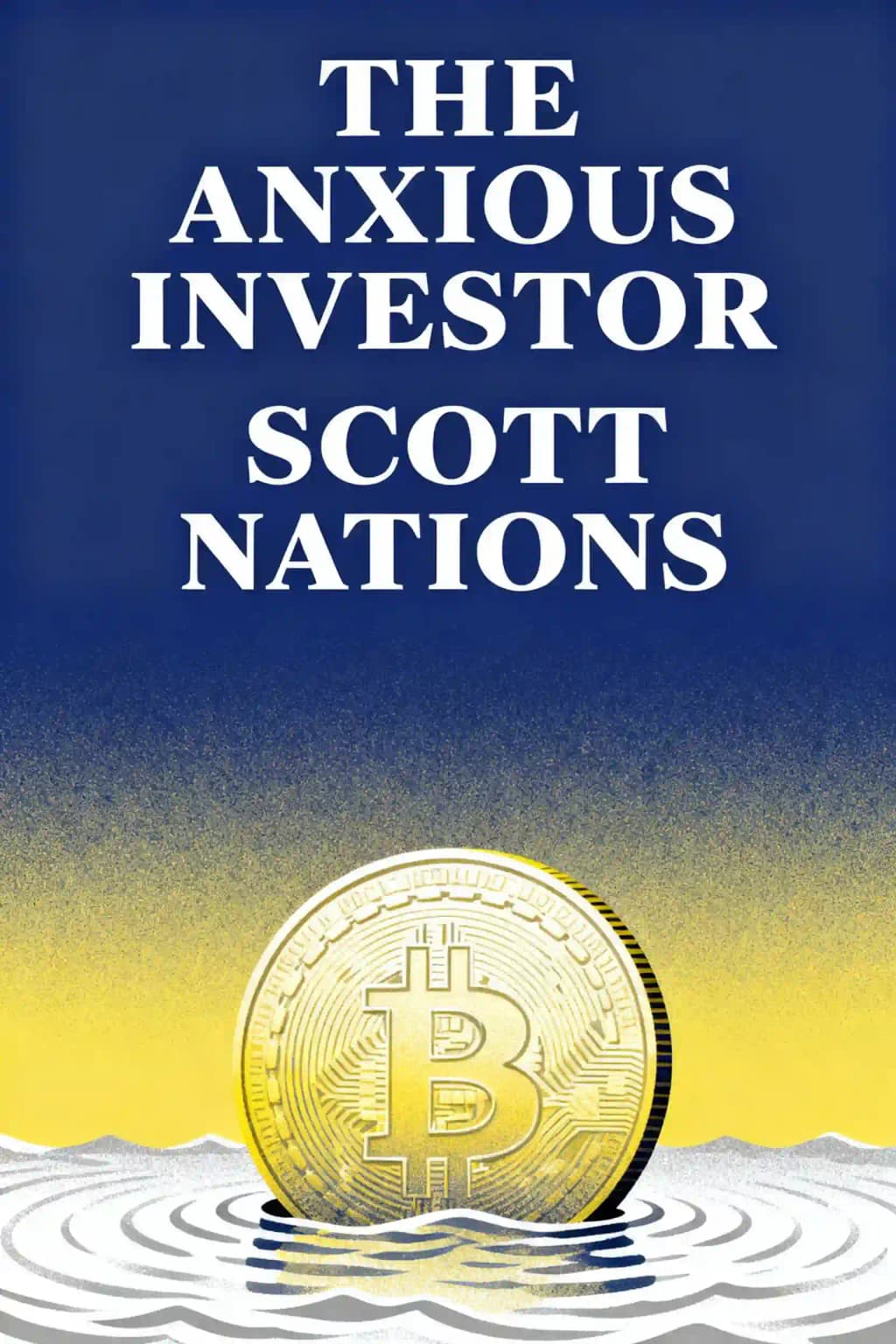
The Anxious Investor reveals how fear, greed, hope, and ignorance - "the four horsemen of investment apocalypse" - sabotage your portfolio. Endorsed by CNBC's Joshua Brown, this psychological roadmap helps you profit when others panic, turning market volatility into your greatest advantage.
Scott Nations is the bestselling author of The Anxious Investor and a renowned financial engineer specializing in market psychology and volatility strategies.
As president of Nations Indexes, he designs institutional-grade investment tools like VolDex® (licensed by NASDAQ) and TailDex®, which track market risks and tail events.
His book merges finance with behavioral science, exploring how cognitive biases drive investor decisions during crises—a theme informed by his 35+ years trading derivatives at the Chicago Mercantile Exchange and managing floor operations for major index options firms.
Nations frequently analyzes markets on CNBC and authored the critically acclaimed A History of the United States in Five Crashes (HarperCollins, 2017), which dissects financial panics from 1907 to 2010. His earlier works, Options Math for Traders and The Complete Book of Option Spreads and Combinations, remain essential reads for quantitative finance professionals.
Nations’ volatility indexes are used by hedge funds and asset managers worldwide to navigate turbulent markets.
The Anxious Investor by Scott Nations provides strategies to manage investment anxiety and make rational decisions during market turbulence. It combines behavioral psychology, historical market crash analysis (including the 2008 recession and COVID-19 crash), and practical frameworks for navigating normal, crash, and recovery phases. The book emphasizes overcoming emotional biases like the "lizard brain" response to achieve long-term financial goals.
This book is ideal for everyday investors seeking to manage market volatility, retirees protecting savings, or behavioral finance enthusiasts. It’s also valuable for those intimidated by economic uncertainty or prone to impulsive decisions during crashes. Scott Nations’ accessible approach suits both novice and experienced investors.
Yes—The Wall Street Journal highlights its timely lessons for turbulent markets. Nations’ blend of historical analysis, behavioral insights, and actionable strategies offers a unique guide to staying disciplined. The focus on psychological pitfalls and recovery frameworks makes it a standout in personal finance literature.
Scott Nations outlines strategies for:
The book examines cognitive biases like overconfidence and loss aversion, explaining how the brain’s "lizard brain" triggers fear-driven decisions during crashes. Nations offers techniques to counter these biases, such as pre-planning for volatility and focusing on long-term goals.
Nations dissects the Great Recession (2008), the COVID-19 crash (2020), and the dot-com bubble (early 2000s). He highlights their causes, recovery patterns, and lessons for modern investors, emphasizing how panic exacerbates losses.
Key strategies include:
The "lizard brain" refers to primal instincts that drive fear-based decisions. Nations suggests countering it through mindfulness practices, historical market context, and automated investing systems to reduce emotional interference.
The VolDex® (VOLI), developed by Scott Nations’ firm, measures market volatility more accurately than traditional indexes like the VIX. It helps investors gauge risk and make informed decisions during turbulence.
Both explore behavioral finance, but Nations’ book focuses specifically on crisis management and tactical responses to crashes, while Morgan Housel’s work emphasizes broader money mindsets. The Anxious Investor offers more structured frameworks for volatile markets.
With ongoing geopolitical and economic uncertainties, Nations’ strategies for navigating AI-driven market shifts, inflation, and recession risks remain critical. The book’s emphasis on psychological resilience aligns with 2025’s complex investment landscape.
저자의 목소리로 책을 느껴보세요
지식을 흥미롭고 예시가 풍부한 인사이트로 전환
핵심 아이디어를 빠르게 캡처하여 신속하게 학습
재미있고 매력적인 방식으로 책을 즐기세요
Silver would become as common as iron.
The market just didn't know it yet.
When will the internet Bubble burst?
Please God, just get me back to even and I'll get out.
The Anxious Investor의 핵심 아이디어를 이해하기 쉬운 포인트로 분해하여 혁신적인 팀이 어떻게 창조하고, 협력하고, 성장하는지 이해합니다.
The Anxious Investor을 빠른 기억 단서로 압축하여 솔직함, 팀워크, 창의적 회복력의 핵심 원칙을 강조합니다.

생생한 스토리텔링을 통해 The Anxious Investor을 경험하고, 혁신 교훈을 기억에 남고 적용할 수 있는 순간으로 바꿉니다.
무엇이든 물어보고, 목소리를 선택하고, 진정으로 공감되는 인사이트를 함께 만들어보세요.

샌프란시스코에서 컬럼비아 대학교 동문들이 만들었습니다
"Instead of endless scrolling, I just hit play on BeFreed. It saves me so much time."
"I never knew where to start with nonfiction—BeFreed’s book lists turned into podcasts gave me a clear path."
"Perfect balance between learning and entertainment. Finished ‘Thinking, Fast and Slow’ on my commute this week."
"Crazy how much I learned while walking the dog. BeFreed = small habits → big gains."
"Reading used to feel like a chore. Now it’s just part of my lifestyle."
"Feels effortless compared to reading. I’ve finished 6 books this month already."
"BeFreed turned my guilty doomscrolling into something that feels productive and inspiring."
"BeFreed turned my commute into learning time. 20-min podcasts are perfect for finishing books I never had time for."
"BeFreed replaced my podcast queue. Imagine Spotify for books — that’s it. 🙌"
"It is great for me to learn something from the book without reading it."
"The themed book list podcasts help me connect ideas across authors—like a guided audio journey."
"Makes me feel smarter every time before going to work"
샌프란시스코에서 컬럼비아 대학교 동문들이 만들었습니다

The Anxious Investor 요약을 무료 PDF 또는 EPUB으로 받으세요. 인쇄하거나 오프라인에서 언제든 읽을 수 있습니다.
Picture Isaac Newton-the man who decoded gravity, invented calculus, and unlocked the mathematical secrets of the universe-sobbing over a financial catastrophe. In 1720, after wisely selling his South Sea Company shares for a handsome profit, Newton watched prices soar even higher. Unable to bear the agony of missing out, he dove back in at double his selling price, just weeks before the bubble exploded. His losses exceeded 20,000-roughly $20 million today. "I can calculate the motions of the heavenly bodies," he later confessed, "but not the madness of the people." If genius couldn't save Newton from financial ruin, what chance do the rest of us have? The uncomfortable truth is that intelligence offers zero protection against the psychological forces that hijack our investment decisions. Fear, greed, overconfidence, and the irresistible pull of the crowd transform even brilliant minds into reckless gamblers. Understanding these forces-and recognizing them in ourselves-becomes the difference between building wealth and watching it vanish.