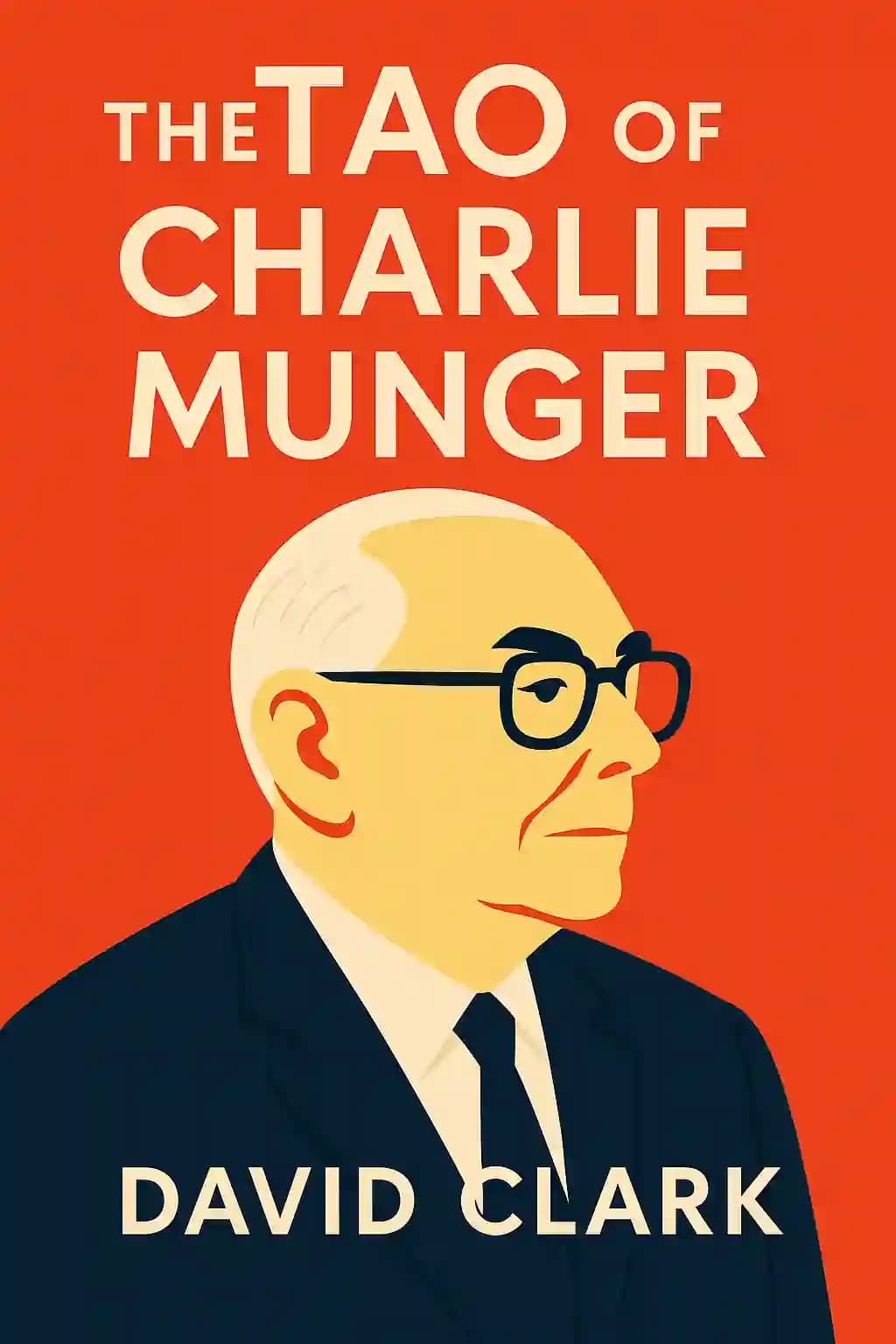
The tao of Charlie Munger
a compilation of quotes from Berkshire Hathaway's vice chairman on life, business, and the pursuit of wealth
The tao of Charlie Munger 개요
Dive into Warren Buffett's right-hand genius with "The Tao of Charlie Munger" - the investment bible Andrew Wilkinson read "20 times" and calls "better than any MBA." Discover why multidisciplinary thinking and concentrated investments outperform conventional wisdom in just 3 hours.
The tao of Charlie Munger의 핵심 주제
- mental models
- circle of competence
- value investing philosophy
- multidisciplinary thinking
- long-term wealth preservation
The tao of Charlie Munger의 명언
Using leverage is like driving a car with a dagger on the steering wheel pointed at your heart.
People are trying to be smart-all I am trying to do is not to be idiotic.
The big money is not in the buying and selling, but in the waiting.
The big money is made when you can act when others are paralyzed by fear.
The tao of Charlie Munger의 등장인물
- Charlie MungerVice chairman of Berkshire Hathaway and subject
- David ClarkAuthor and compiler of Munger's wisdom
저자 소개
The tao of Charlie Munger의 저자 소개
David Clark, author of Tao of Charlie Munger, is a world-renowned expert on Warren Buffett’s investment philosophies (Buffettology) and co-author of the international bestseller The Tao of Warren Buffett. A finance and law graduate from Omaha, Nebraska—Warren Buffett’s hometown—Clark grew up alongside Buffett’s family, fostering a lifelong passion for value investing. His seven collaborative works with Mary Buffett, including The New Buffettology and Warren Buffett and the Interpretation of Financial Statements, distill complex financial strategies into accessible frameworks.
Clark’s writing focuses on practical investment wisdom, behavioral economics, and long-term wealth building, themes rooted in his decades of studying Buffett and Charlie Munger. As a lecturer and managing director of an Omaha-based investment partnership, he bridges academic theory and real-world application. His insights have been quoted in the New York Times and leveraged by investors globally.
The Tao of Charlie Munger extends Clark’s legacy of decoding investment giants’ mental models. His works have become essential reading for investors worldwide and have been translated into multiple languages, solidifying his authority in value investing.
The tao of Charlie Munger 요약 다운로드
The tao of Charlie Munger 요약을 무료 PDF 또는 EPUB으로 받으세요. 인쇄하거나 오프라인에서 언제든 읽을 수 있습니다.
이 책에 대한 FAQ
The Tao of Charlie Munger distills the investment philosophy and life principles of Warren Buffett’s longtime business partner. It compiles Munger’s wisdom on rational decision-making, long-term value investing, and avoiding cognitive biases, using quotes and anecdotes to illustrate concepts like durable competitive advantages and "sitting on your ass" investing. The book emphasizes patience, continuous learning, and psychological discipline as keys to financial and personal success.
Aspiring investors, business professionals, and anyone seeking to improve decision-making will benefit. Clark’s concise format appeals to readers wanting actionable insights without dense financial theory. Fans of Warren Buffett or behavioral psychology will find it especially relevant, as will those interested in mental models and avoiding common cognitive pitfalls.
Yes—it’s praised for condensing decades of Munger’s wisdom into digestible lessons, making complex ideas accessible. Critics note some repetitive commentary, but the core principles on investing, rationality, and life philosophy remain highly valued. For those new to Munger, it’s an ideal primer; seasoned readers may prefer deeper dives into his methodologies.
- Focus on quality: Invest in businesses with durable competitive advantages (e.g., strong brands, pricing power).
- Long-term patience: Hold investments for decades to leverage compounding.
- Avoid idiocy: Minimize impulsive decisions by recognizing cognitive biases like overconfidence.
- Concentrated portfolios: “Buy one or two great businesses, not many”.
Munger identifies 18 common mental traps (e.g., confirmation bias, social proof) that sabotage decisions. The book advocates using checklists and multidisciplinary thinking to counteract them. Clark underscores Munger’s belief that avoiding stupidity trumps seeking brilliance, illustrated by examples like overpaying for “hot” stocks.
- Continuous learning: “Acknowledging what you don’t know is the dawning of wisdom”.
- Integrity: Surround yourself with trustworthy people and maintain honesty in dealings.
- Frugality: Live below your means to avoid financial desperation.
- Rationality: Base decisions on logic, not emotion.
Both books (co-authored by David Clark) explore Berkshire Hathaway’s philosophies, but Munger’s focuses more on psychology and multidisciplinary thinking, while Buffett’s emphasizes value investing metrics. Clark’s deep expertise on both figures ensures complementary insights for readers.
Some reviewers argue Clark’s commentary repeats Munger’s points without adding new analysis. Others note the book’s brevity (150 pages) may oversimplify complex topics. However, most praise it as a highly quotable introduction to Munger’s ideology.
Munger advocates for decades-long holding periods, using Berkshire’s stakes in Coca-Cola and See’s Candy as examples. The book stresses that time allows compounding to work and reduces transaction costs/taxes. Clark contrasts this with Graham’s fear-driven, short-term value approach.
Munger views crashes as opportunities to buy quality assets at discounts. The book advises preparing cash reserves in advance and avoiding debt to capitalize on volatility. Clark highlights how this strategy helped Berkshire thrive in 2008.
Clark connects investing principles to life: patience in relationships, compounding knowledge through reading, and avoiding toxic influences mirror portfolio management. Munger’s mantra of “inversion” (solving problems backward) is framed as a tool for career and personal decisions.
Its lessons on adapting to economic uncertainty and navigating AI-driven markets resonate today. The focus on psychological discipline counters algorithmic trading’s short-termism, while Munger’s skepticism of hype (e.g., crypto) aligns with current risk-averse trends.