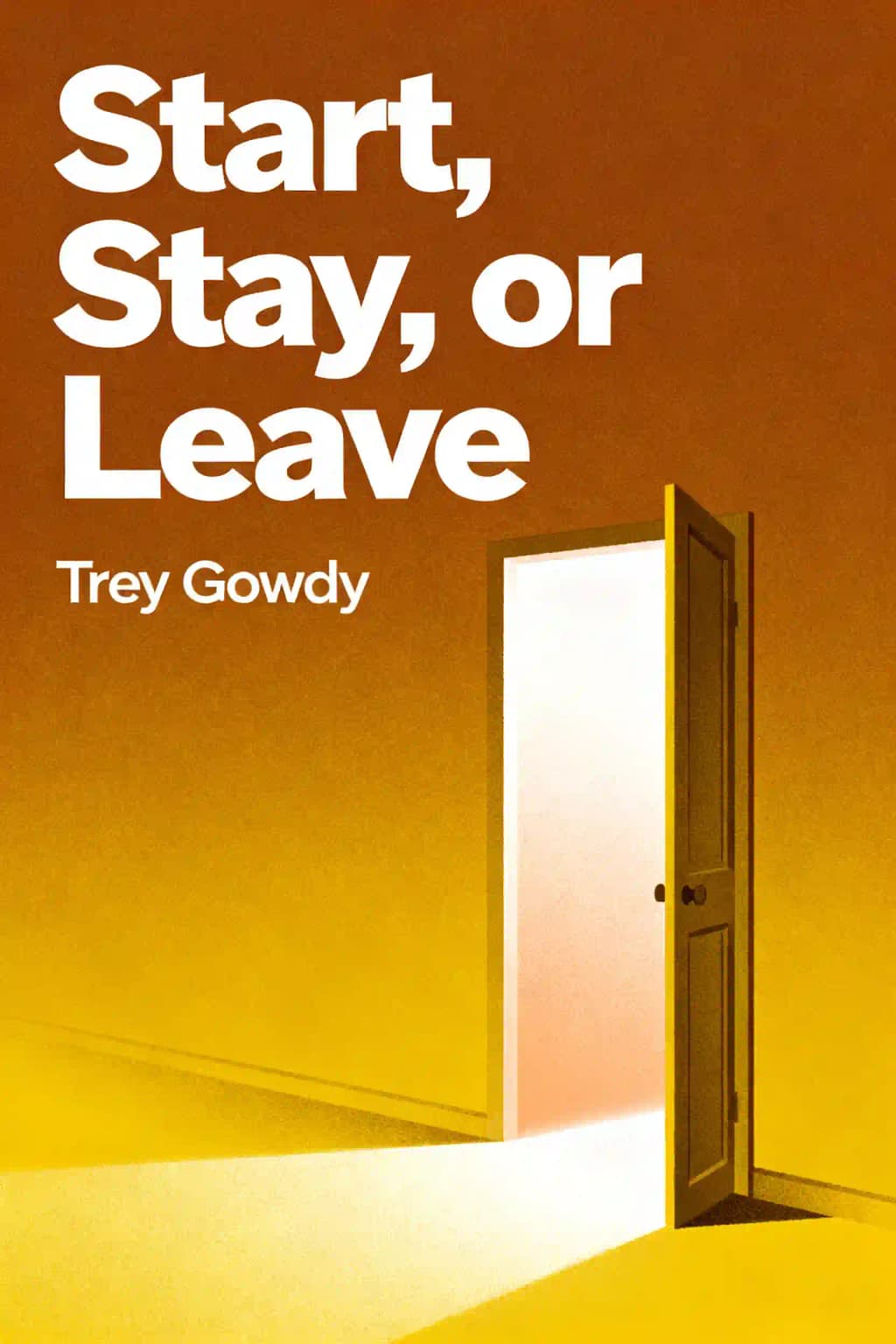
Former prosecutor Trey Gowdy's NYT bestseller simplifies life's toughest choices into three options. Endorsed by Dana Perino, who calls it "the best guide I've read," this book's backward-planning approach has readers asking: why waste years on decisions you could make today?
Trey Gowdy, #1 New York Times bestselling author of Start, Stay, or Leave: The Art of Decision Making, is a former federal prosecutor, four-term U.S. Congressman, and Fox News host known for his sharp legal analysis and principled leadership.
A Spartanburg, South Carolina native, Gowdy’s career spans high-stakes courtroom battles as a prosecutor (including landmark cases on public corruption and violent crime) and congressional oversight roles investigating national security matters. His decision-making expertise stems from 25+ years navigating complex legal, political, and personal crossroads – experience he channels into this practical guide for life-altering choices.
Gowdy’s earlier works include Doesn’t Hurt to Ask (a communication playbook blending courtroom tactics) and Unified (co-authored with Senator Tim Scott). As host of Fox News’ Sunday Night in America and The Trey Gowdy Podcast, he dissects policy and culture through a legal lens. His books have collectively sold millions of copies, with Start, Stay, or Leave debuting at #1 on multiple nonfiction charts.
Start, Stay, or Leave provides a decision-making framework for life’s pivotal choices, using Trey Gowdy’s experiences as a prosecutor and congressman. The book teaches readers to evaluate options through three actions—starting, staying, or leaving—while balancing logic, emotion, and long-term goals. Practical advice includes crafting a vision of success and seeking trusted counsel.
This book suits professionals navigating career shifts, leaders managing teams, or anyone facing major life decisions. Gowdy’s insights resonate with those seeking strategies for relationships, investments, or personal growth. Its storytelling approach appeals to readers who prefer relatable anecdotes over abstract theory.
Yes—readers praise its actionable framework, humor, and real-world examples. Gowdy blends courtroom drama with personal stories, offering tools to approach decisions confidently. The “start at the end” method helps clarify priorities, making it valuable for career planners and life strategists.
Gowdy’s framework simplifies decisions into three choices:
Gowdy shares candid anecdotes, like losing a high-profile case as a prosecutor, to illustrate resilience. He discusses leaving Congress to prioritize family, showing how the framework applies to personal and professional crossroads. These stories create a conversational tone, akin to advice from a trusted mentor.
Yes. Gowdy urges readers to redefine success, learn from regrets, and embrace adaptable dreams. He argues failure stems from inaction, not poor outcomes, and emphasizes perseverance through setbacks like career stagnation or unmet goals.
Dreams should guide decisions but adapt as circumstances change. Gowdy advises assessing whether a dream’s cost (time, relationships, ethics) justifies pursuit. Letting go of outdated aspirations, he argues, is wiser than clinging to them at all costs.
Gowdy recommends:
Yes. Gowdy stresses consulting mentors who “tell you what you need to hear,” not what you want. He warns against unsolicited opinions and advises creating a “trusted council” for pivotal decisions, as seen in his congressional career.
Some may find the framework oversimplified for complex dilemmas, but reviewers praise its practicality. Gowdy openly admits poor past decisions, adding authenticity. Critics are rare, with most highlighting its relatable storytelling.
It teaches assessing a job’s alignment with long-term goals, weighing sacrifices like work-life balance, and knowing when to pivot. Gowdy uses his transition from prosecutor to congressman as a case study in applying the “stay or leave” calculus.
Absolutely. The framework helps evaluate relationships by asking:
저자의 목소리로 책을 느껴보세요
지식을 흥미롭고 예시가 풍부한 인사이트로 전환
핵심 아이디어를 빠르게 캡처하여 신속하게 학습
재미있고 매력적인 방식으로 책을 즐기세요
I have found that people generally Start, Stay, or Leave for one of three reasons: people, purpose, or paycheck.
Some risks are just plain stupid.
Accomplishment requires intent, purpose, and foresight.
Your reasons to start something new shouldn't depend on anyone you can't see clearly in your mirror.
Start, Stay, Leave의 핵심 아이디어를 이해하기 쉬운 포인트로 분해하여 혁신적인 팀이 어떻게 창조하고, 협력하고, 성장하는지 이해합니다.
생생한 스토리텔링을 통해 Start, Stay, Leave을 경험하고, 혁신 교훈을 기억에 남고 적용할 수 있는 순간으로 바꿉니다.
무엇이든 묻고, 학습 스타일을 선택하고, 나에게 맞는 인사이트를 함께 만들어보세요.

샌프란시스코에서 컬럼비아 대학교 동문들이 만들었습니다
"Instead of endless scrolling, I just hit play on BeFreed. It saves me so much time."
"I never knew where to start with nonfiction—BeFreed’s book lists turned into podcasts gave me a clear path."
"Perfect balance between learning and entertainment. Finished ‘Thinking, Fast and Slow’ on my commute this week."
"Crazy how much I learned while walking the dog. BeFreed = small habits → big gains."
"Reading used to feel like a chore. Now it’s just part of my lifestyle."
"Feels effortless compared to reading. I’ve finished 6 books this month already."
"BeFreed turned my guilty doomscrolling into something that feels productive and inspiring."
"BeFreed turned my commute into learning time. 20-min podcasts are perfect for finishing books I never had time for."
"BeFreed replaced my podcast queue. Imagine Spotify for books — that’s it. 🙌"
"It is great for me to learn something from the book without reading it."
"The themed book list podcasts help me connect ideas across authors—like a guided audio journey."
"Makes me feel smarter every time before going to work"
샌프란시스코에서 컬럼비아 대학교 동문들이 만들었습니다

Start, Stay, Leave 요약을 무료 PDF 또는 EPUB으로 받으세요. 인쇄하거나 오프라인에서 언제든 읽을 수 있습니다.
Have you ever stood at a crossroads so significant that you felt frozen, unable to move forward or back? Perhaps it was a job offer that meant relocating your family, a relationship that demanded a clear commitment, or a career path that required abandoning years of investment. These moments-when we must decide whether to start something new, stay where we are, or leave what we've built-define the architecture of our lives. Yet most of us navigate these critical junctures with little more than gut feelings and the conflicting advice of well-meaning friends. What if there was a more thoughtful way to approach life's most consequential decisions? What if we could learn from someone who's faced these crossroads repeatedly-from courtroom prosecutor to congressman-and developed a framework that transforms paralyzing uncertainty into purposeful action? The answer lies not in finding perfect clarity, but in understanding how to structure our thinking when everything feels like it matters. Because it does.
Most decisions focus on immediate concerns - salary, convenience, momentary feelings. But powerful decisions start with the end. Picture yourself decades from now: What do you want people to say about you? What do you hope you've accomplished? This isn't morbid - it's strategic. Consider Ricky Samuel, a young man with minor legal troubles who cooperated with federal authorities to avoid a five-year sentence. After successfully helping catch a drug dealer, he was murdered execution-style by a man posing as a neighborhood preacher - someone who spent weeks gaining his trust before having him kneel in prayer and shooting him twice in the head. Standing at that murder scene, thinking of Ricky's mother and the failed promises of protection, something crystallized: every decision needs to begin with the closing argument and work backward from there. This approach transforms decision-making. When young people seek career advice, the question isn't "What job pays well?" but "What do you want accomplished by the end of your life?" It's the difference between "doing" things and "accomplishing" them. One person studies history because they have AP credits. Another chooses philosophy to develop critical thinking for their ultimate purpose of helping crime victims. Same action, vastly different accomplishments. For years, success looked like building a pyramid - each achievement narrowing toward distinction. Federal prosecutor. Political office. Television appearances. Each credential was another "point of differentiation." But this model has a fatal flaw: it's built entirely on external validation. You're forever adding layers, forever proving yourself, forever exhausted. There's another trap: the ladder model, where each rung represents incremental achievements. Some aim for the absolute top - president of the United States - despite astronomical odds. Of roughly 545 million Americans throughout history, only forty-five different men have held that office. The ladder depends on outperforming others, which means most people are "unsuccessful" by definition. In 2015, an opportunity arose to run for Speaker of the House. The pyramid mentality screamed "go for it." But something had shifted. Success had been redefined: not by what others thought, but by what reflected back from people who truly mattered - and most importantly, from yourself. Here's what liberation looks like: someone who judges you by character rather than accomplishments. Even more liberating is when you finally listen to them. Most liberating of all is becoming that someone for yourself.
When facing major decisions, one question dissolves paralysis: What's the worst thing that could happen? Not "what are the risks?" - that's too abstract. This forces you to confront actual consequences rather than vague anxieties. The follow-up matters even more: Do I have a plan for dealing with the worst if it does happen? This isn't reckless optimism - it's strategic realism. If you can plan for disaster, everything short of disaster becomes manageable. If you can't handle the worst-case scenario, you probably shouldn't proceed. Consider a seventeen-year-old at church, eyeing the most radiant girl there - someone who'd never noticed him. "I think I'm going to ask her to make my lunch for the choir tour," he announces. His friends laugh. His response: "What's the worst thing that can happen?" Just rejection - and since they're at church, even a "no" would likely be kind. She said yes. Thirty-two years of marriage followed. This framework acknowledges fear while seeking security. Analyze thoroughly: Will this endanger my family? Can I recover from failure? But don't wait for complete certainty. Our legal system only requires "beyond reasonable doubt," not absolute certainty. If "firmly convinced" suffices for capital murder trials, it should be enough for your master's program or dream business.
We like to think we're rational, but anyone agonizing over a 3 AM decision knows better. Fear creeps in. Intuition whispers warnings. Emotions surge. The question isn't whether to involve your head, heart, and gut-they're already involved. It's how to balance them. Think of it like government's three branches: logic drives decisions, intuition navigates, and emotions provide the soundtrack. Logic keeps you on course, but relying solely on it makes for a lonely journey. Your intuition-often manifesting as fear-can be valuable when it makes you pause. The key is making fear a passenger, not the driver. To tame fear: separate possibilities from probabilities. Yes, you could fail spectacularly-but what are the actual odds? Apply reason through numbers. Develop worst-case scenarios while recognizing you'll likely never need them. Another powerful antidote: focusing on others. We're most courageous when defending someone we care about. During the pandemic, while some obsessed over mortality graphs, others helped students and checked on neighbors. When we focus outward through compassion, fear becomes a companion rather than a controller. As for emotions-those powerful feelings that override rational thought-treat them as witnesses, not judges. Cross-examine their testimony. Enthusiasm confirms good choices, uncertainty warns of ignored problems. Let emotions inform your decisions, not control them.
Deciding to stay isn't declining a different path-it's taking inventory of your current position and giving your initial decisions time to mature. In a culture obsessed with reinvention, staying put can feel like failure. But sometimes perseverance yields rewards that jumping ship never could. Picture showing up for what you thought was a bowling class in college-perfect timing, convenient location, easy grade. You arrive at the Student Union Building's bowling alley to find it empty. Turns out "BL" doesn't stand for bowling. It stands for ballet. You walk into a room of leotard-clad dancers, mortified. The instructor convinces you to stay with the promise of an "A." That class becomes a source of lifelong memories and important lessons about not fleeing when things don't turn out as expected. There's no guarantee the next option will meet your expectations either. Persevering builds invaluable experience-something you can't acquire by wishing for it. Consistency signals dependability, a trait that employers and partners recognize instantly. Before leaving, ask yourself: Are you escaping external problems or avoiding internal changes? Have you become addicted to starting fresh? Sometimes no change is the best decision-you're building something that will live beyond you.
No matter how thoroughly we analyze decisions, we're often too close to see the whole picture. That's why we need trusted people who can spot obstacles we've missed. Everyone needs a Nathan-someone with courage to speak uncomfortable truth. In the Bible, Nathan confronted King David after his adultery with the powerful words "You are the man!" Shortly after being elected, a judgeship opportunity arose offering eight years of security. Despite having just asked voters for their trust, the rationalization seemed reasonable. A father's visit brought uncharacteristic directness: "You cannot do this. It's not right or fair to those who helped elect you." A risk-taking friend agreed-while he understood the appeal, taking the judgeship would be like putting on handcuffs. Look for three traits in your Nathans: people who have your best interest in mind, who know you well including your strengths and weaknesses, and who are honest enough to speak difficult truths. To benefit, you must be humble enough to listen without becoming defensive. Just as important is identifying who shouldn't advise you. The opposite of a Nathan isn't an enemy but someone who only wants your momentary happiness without challenging you. But sometimes even the best advisers can't save us from ourselves. The hardest departures are from positions that once represented your greatest aspirations-because leaving feels like betraying yourself. By 2009, prosecuting violent crimes had taken a devastating spiritual toll. As a prosecutor, immersing yourself in humanity's darkest aspects isn't optional-it's the job. The most effective prosecutors force themselves to experience what victims felt, to be their voice. This meant constantly dwelling on scenes of malice and terror. One case haunts still: an elderly couple murdered in their bed by someone they had helped. The image of the husband's broken body reaching toward his wife in death-love trying but failing against depravity-remains etched in memory. Reconciling these horrors with faith became impossible. Sitting in church hearing about God's love, the platitudes couldn't be squared with crime scene photographs. The job was exacting too steep a price on family. A daughter sleeping on the floor after overhearing conversations about "bad people." That Mother's Day, both wife and mother independently concluded it was time to leave. The solution: running for Congress as an honorable exit from a job that could no longer be done. Leaving wasn't failure. It was survival.
After Trump's 2016 election, a call came about serving on the Fourth Circuit Court of Appeals - the very court once dreamed of joining. Everything aligned: Republican president and Senate, supportive senators, two openings. But something had shifted. The toughest mountain had been scaled - letting go of others' expectations. Standing in the kitchen, the truth was clear: who you worked with now meant more than what you did. When the White House called a third time, the answer was absolute: "I do not want this anymore." Understanding your motivation is liberating. About half the world seeks success; the other half avoids failure. Fear has influenced decisions an entire lifetime, but peace with fear is possible - letting it look and edit, but not write your life's closing chapter. Your decisions determine your success, but first you must decide what success means to you. Define it by what you control - your words, mindset, and effort. Small daily choices matter: respectful language during disagreements, maintaining optimism, choosing reading over television, showing care to loved ones. To turn regret into remembrance: be honest about what happened; reflect on what you learned; replace "if only" with "next time." Make decisions with confidence, guided by your own definition of success rather than someone else's scorecard. People will forget your titles, but they'll remember your character. Fair and funny - that's enough. Your story is yours to write. Make it count.