1장
The Five-Day Formula That Solves Big Problems
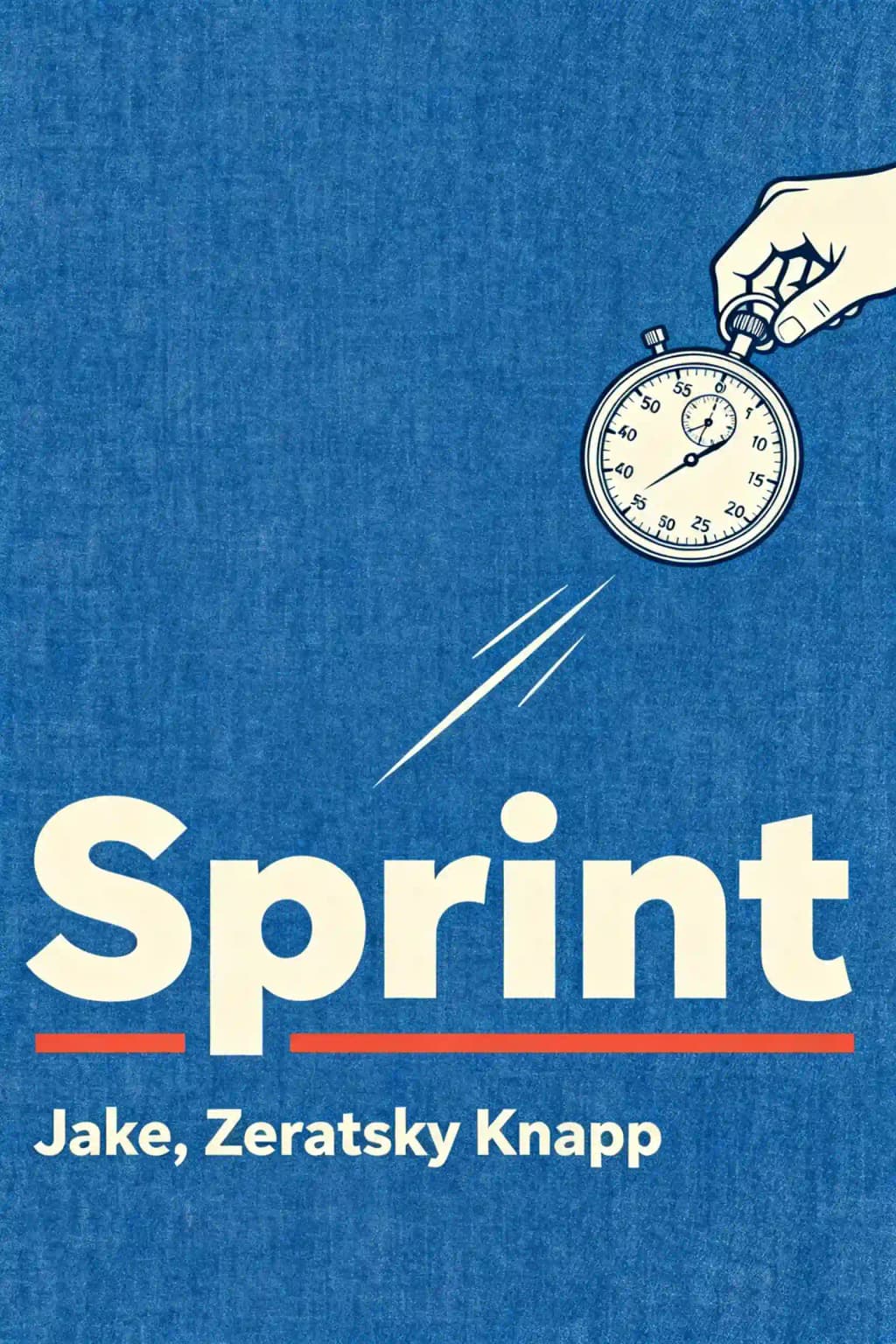
Have you ever wondered how some of the world's most innovative companies consistently create breakthrough products? What if you could compress months of work into just five days? In 2007, Jake Knapp was working at Google when he made a startling discovery: the best ideas weren't coming from brainstorming sessions but from individuals working in moments of quiet focus. This revelation, combined with tight deadlines on projects like Gmail Priority Inbox, led to the development of the "Sprint" method-a five-day process now used by hundreds of companies worldwide to solve critical business challenges. The Sprint book has become required reading at Stanford's d.school and Harvard Business School, with Airbnb's CEO Brian Chesky calling it "a practical guide to answering critical business questions." From Silicon Valley startups to Fortune 500 companies, organizations have used this method to launch new products, improve medical care, and even name companies-all in just one workweek.
2장
From Problem to Prototype: The Sprint Framework
The Sprint process compresses months of work into a single week, eliminating endless debate cycles and providing reliable data through realistic prototypes. This "superpower" allows teams to time-travel to the future, seeing how customers react to a finished product before making significant resource commitments.
The process begins by identifying a substantial challenge where something valuable is at stake. In 2014, the robot startup Savioke faced exactly this kind of challenge. They had developed Relay, a one-meter-tall autonomous delivery robot for hotels, but worried about how guests would react to a robot messenger. With a pilot test at a Starwood hotel just weeks away, the timing was perfect for a sprint.
For Blue Bottle Coffee, the challenge was different. Founded by former professional clarinetist James Freeman, the company needed to translate their renowned in-store experience to their online shop. During their sprint, they discovered that baristas typically asked customers, "How do you brew coffee at home?" to recommend specific varieties. This insight led them to create three different website prototypes, including one that organized coffees by brewing method. When tested with real customers, this approach resonated strongly, with users commenting, "These people know coffee." Months later, Blue Bottle launched their redesigned website and doubled their online sales.
The ideal sprint team resembles the crew from "Ocean's Eleven"-a carefully selected group with complementary skills. The most crucial role is the "Decider," the person with final authority (typically a founder, CEO, or VP). The optimal team size is seven or fewer people, including those who normally work on the product (engineers, designers) plus specialists with diverse perspectives. Key roles include financial, marketing, customer, technology/logistics, and design experts. It's also valuable to include the "troublemaker"-that intelligent person with opposing views who might make the team uncomfortable but provides valuable perspective.
3장
Monday: Mapping the Challenge
Monday establishes the direction for the entire sprint week. The day begins with "starting at the end" and setting a long-term goal. The team then creates a map of the challenge, consults with company experts to gather their knowledge, and finally chooses an ambitious but manageable target that can be solved in one week.
Like the Apollo 13 mission, when facing a significant problem, it's crucial to establish a clear plan and priorities before jumping to solutions. The sprint begins with an exercise called "Starting at the end," which involves looking toward the future to set goals and key questions. The team first defines a long-term goal by asking: "Why are we doing this project? Where do we want to be in six months, a year, or five years?" This discussion might take anywhere from thirty seconds to half an hour, but reaching a clear consensus is essential as it will guide the entire sprint.
After establishing the optimistic goal, the team adopts a pessimistic perspective, imagining a future where the project has failed, to identify underlying dangerous hypotheses and convert them into concrete questions. These "sprint questions" are recorded and will serve as a guide throughout the week and for evaluating results after Friday's test.
Just as the map in "The Lord of the Rings" helps readers navigate Tolkien's complex narrative, a simple map of the business challenge provides clarity during the sprint. This diagram represents how customers interact with a product or service, simplifying complexity into words and arrows. For Flatiron Health, which was developing software to match cancer patients with clinical trials, the team created a simple map showing the flow from diagnosis to trial participation, identifying all key actors in the process.
After creating the map, it's crucial to gather knowledge distributed among different experts. As they learned at one company, even CEOs don't know everything; information is asymmetrically dispersed throughout the organization. To capture ideas effectively during conversations with experts, the team uses the "How Might We...?" (HMW) technique. Each member writes individual notes in the form of questions that begin with this phrase on yellow sticky notes. Although it might initially seem artificial, this method forces people to look for opportunities rather than focusing on problems.
4장
Tuesday: Sketching Solutions
Tuesday is dedicated to solutions. After defining the challenge and choosing a target on Monday, the team now seeks inspiration from existing ideas to mix and improve them, and then each person creates sketches following a four-step system that prioritizes critical thinking over art.
Great innovations don't emerge from nothing but combine existing ideas with a new vision, like Melitta Bentz did when creating the paper coffee filter in 1908. In a sprint, teams should follow this example: mix and improve, never literally copy. Inspiration can come from similar problems in different environments, as happened with Blue Bottle Coffee, which found in a circular flavor scale from a chocolate bar the inspiration to describe their coffee beans. Solutions can also be found within the company itself, as Savioke did by rescuing an unfinished eye design for their robot that conveyed a friendly personality without promising a conversation.
The afternoon is dedicated to seeking individual solutions through sketches, not through noisy brainstorming. Working on paper puts everyone on the same level: anyone can express ideas with simple words and drawings. Sketches don't have to be artistic, just explanatory. Blue Bottle Coffee's sprint showed how a solution called "The Mentalist," created by Byard Duncan (who initially feared he couldn't draw), turned out to be the winner in tests with real customers. This solution organized the online store as a barista would when talking to a customer, guiding them through questions about how they brew coffee at home.
Sketches transform abstract ideas into concrete solutions that can be critically and fairly evaluated. When ideas remain abstract, it's easy to undervalue good ideas or overvalue bad ones (especially if they come from the boss). By putting ideas on paper with concrete details, they can be objectively evaluated on their real merits.
Individual work generates better solutions than group brainstorming because it offers time to reflect, research, and focus, while individual responsibility motivates maximum effort. However, working alone is difficult, so sprints follow specific steps to help progress. The team works in parallel following the same process, generating competitive ideas without groupthink. It's "individual work in a group": each person develops independent solutions that will later be evaluated collectively.
5장
Wednesday: Deciding Without Debate
Traditional meetings are often inefficient, with endless debates that don't reach clear conclusions. On Wednesday, the sprint organizes a structured process to view and evaluate each solution, following a script that might seem unnatural but is highly efficient. The goal is to make the most of the team's experience while accommodating human limitations of memory and decision-making energy.
The sprint decision process consists of five steps involving adhesive elements: 1) Art Museum: posting sketches on the wall; 2) Heat Map: silently evaluating using stickers to mark interesting parts; 3) Speed Critique: briefly discussing the highlights using sticky notes; 4) Silent Voting: each member chooses one solution with a sticker; 5) Supervote: the Decider makes the final decision. This method avoids endless debates and compensates for short-term memory limitations.
Contrary to what would be natural, creators don't present or explain their solutions. This prevents factors like charisma or reputation from influencing the evaluation. In the real world, creators can't explain their ideas to the public, so sketches must speak for themselves. The heat map is an exercise where each team member places stickers on the parts they like best of each sketch, creating a visual "map" showing the most popular ideas.
During the speed critique process, the team analyzes each sketch following a strict script. The Facilitator narrates the sketch, highlights ideas with the most stickers, and the team points out outstanding ideas. A Scribe notes these ideas on sticky notes that are stuck on the sketch. Only at the end does the creator reveal their identity and clarify any misunderstandings. This method avoids redundancies and allows for honest debate, maintaining a positive tone focused on the best ideas.
When multiple winning ideas are incompatible with each other, it's not necessary to choose just one. Instead of compromising with an intermediate solution, the team can create multiple prototypes to pit them against each other in a "Street Fight." This happened at Slack, where two different prototypes were created: "Robot Team" and "Guided Tour." This strategy allows obtaining real data on both options before committing to a specific project.
6장
The Storyboard: Your Prototype Blueprint
By Wednesday afternoon, with Friday's pressure approaching, it's tempting to jump straight into designing the prototype. However, without a clear plan, the team would get stuck with unresolved questions. The solution is to create a detailed storyboard of 10-15 panels that connect the winning sketches into a coherent story. Similar to what Pixar does before animating, this process allows identifying problems and confusions before creating the prototype, saving valuable time for Thursday.
The storyboard begins in the upper left corner, representing customers' first contact with the prototype. The initial scene must provide context for customers to react naturally. The best options include web search results, magazines with ads, store shelves, App Store, press articles, social media, or daily routines like checking email or entering a store. It's advisable to present the solution alongside its competitors, as Slack did by creating a fictitious New York Times article that introduced both Slack and its invented competitor "Gather."
Once the initial scene is chosen, the "artist" draws it in the first panel while the team discusses each step. Sticky notes from the winning sketches are used, pasting them on the board when possible. Blank spaces are only filled if critical for testing, preferably using elements from existing sketches or the current product. To finish on time, the team must work with the ideas they already have, avoid writing texts as a group, include all possible details, let the Decider have the final word, and when in doubt, risk innovative solutions. The complete story should not extend beyond 15 minutes for Friday's test.
7장
Thursday: Faking It to Make It
Thursday is the day of illusion. Instead of investing weeks, months, or years building a complete solution, the team creates a convincing fake in a single day. Like the facades of a Western town in a Hollywood movie, the prototype only needs to look real enough for customers to react authentically during Friday's tests. The key is to create an illusion convincing enough for users to forget the environment and immerse themselves in the experience.
Creating a prototype requires temporarily changing philosophy: from "perfect" to "just right," from "long-term quality" to "temporary simulation." This mindset is based on four simple ideas: 1) You can prototype anything if you're optimistic and creative; 2) Prototypes are disposable, we shouldn't fall in love with them; 3) We create only to learn, not to have a final product; 4) The prototype must seem real to get authentic reactions, not feedback.
The ideal prototype has "Goldilocks quality": neither too high (we'd work all night without finishing it) nor too low (people wouldn't believe it's real). We need just the right quality to provoke sincere reactions, not feedback. This quality varies according to the product, as demonstrated by FitStar, Slack, Foundation Medicine, and other teams that created convincing prototypes in a single day. Foundation Medicine created realistic but not real cancer reports for oncologists to evaluate honestly, while Savioke used a remote control to operate their robot, an iPad as a screen, and sound effects to simulate the robot's personality.
For choosing the right tools, we consider the product type: for screens (web, apps), we use Keynote or PowerPoint; for paper (reports, brochures), Keynote or word processors; for services, we write scripts and use the team as actors; for physical spaces, we modify existing spaces; and for physical objects, we modify existing objects, use 3D printers, or create advertising prototypes.
8장
Friday: Testing with Customers
Tests with real users can reveal insights that experts overlook. Like when Nigel Newton gave his eight-year-old daughter Alice the first pages of Harry Potter, a manuscript rejected by eight publishers. Alice's enthusiastic reaction ("it's the best of the best") showed Newton the potential of the book that would later become a worldwide phenomenon. During Friday's sprint, the team experiences the same time jump: seeing how target customers react to new ideas before committing to a huge launch expense.
Jakob Nielsen, a pioneer in web usability, discovered after analyzing 83 studies that 85% of a product's problems are found with just five interviews. Testing with more people doesn't offer significantly more solutions, just adds work. This number is also convenient because it allows conducting five one-hour interviews in a single day, with breaks between each one and a final meeting. Face-to-face interviews provide meaningful results in a day and offer something that large-scale data cannot: the "why" behind users' reactions.
Michael Margolis, an analyst partner at Google Ventures, has perfected the art of interviewing customers over more than 25 years. His methods are adapted to be fast and manageable for any professional. The structure he uses, the "Five-Act Interview," helps the customer feel comfortable and ensures that the prototype is properly analyzed.
The structured interview consists of five parts: a warm initial welcome, open contextualizing questions about the customer, presentation of the prototype, detailed tasks for the customer to react to, and a brief final summary. Interviews are conducted with the Interviewer and the customer in a room, while the team observes through cameras. No special technology is required, just a laptop with a webcam and videoconferencing software.
Although it's tempting to dissolve the team on Friday and let everyone return to their "superpower," it's crucial that everyone observe the interviews together. When only the Interviewer conducts the tests, the process unnecessarily lengthens: recording interviews, reviewing them days later, preparing reports, and finally gathering the team to present results. By the time this happens, momentum has been lost and credibility issues arise. The simple solution: observing interviews together allows absorbing results simultaneously, getting better conclusions with seven brains working at once, and making informed decisions while everything is fresh in memory.
9장
Learning from Success and Failure
At the end of all interviews, the team gathers around the board to read the notes in silence for a few minutes. Each person notes the patterns they identify, especially those that repeat in three or more customers. Then they share their findings, noting all patterns on another board and indicating whether they are positive, negative, or neutral.
The best thing about a sprint is that you can't lose: you always win the opportunity to learn if your ideas are on the right track. Results can range from efficient failures (like Slack's "Robot Team" that saved months of work) to partial successes that need refinement (like the "Guided Tour" that improved in a second sprint) or outright successes (like the ideas for Savioke's robot). Other examples include Blue Bottle Coffee, which combined elements from two partially successful prototypes; Flatiron, whose partial success gave them confidence to continue developing their software; and Medium, which used sprint results as a starting point for larger-scale testing.
Listening to customers reminds the team why they work so hard. Each interview brings the team closer to the people they want to help. With persistence, the day will come when the gap disappears, and they'll see that people understand the idea, believe it will improve their lives, and want to buy it. That moment of triumph is comparable to great cinematic victories and represents the best use of work time: building something that matters to real people.
The Wright brothers, with their perseverance through failures and successes, exemplify the spirit of the sprint. They began with an ambitious goal, sought answers to key questions, studied existing ideas, and progressed through successive prototypes to overcome specific obstacles. Although they didn't formally use sprints, their method was similar: asking questions, building prototypes, and testing them repeatedly. Sprints can create similar habits in a company, changing work dynamics to convert discussions into testable hypotheses and quickly solve big questions. We shouldn't be ashamed of having ambitious goals, because with these techniques we can ensure that our time and effort focus on work that truly matters.
10장
Sprints in Practice: A Step-by-Step Guide
Like baking a cake, following all the sprint steps is essential for success, especially the first time. For a successful sprint, it's fundamental to choose an important challenge where something valuable is at stake or when the team is stuck. You need a Decider with final authority, a team of seven people or fewer with diverse skills, and additional experts for brief consultations. A Facilitator must manage the time and process. It's recommended to reserve five complete workdays and a room with two whiteboards, eliminating distractions like electronic devices and maintaining a strict schedule with planned breaks.
Essential materials include large whiteboards (preferably wall-mounted), abundant yellow rectangular sticky notes, thick-tip black whiteboard markers, green and red markers for notes, fine-tip black markers for sketches, sheets of paper, adhesive tape, small and large round stickers for voting, timers to control time, and healthy snacks to maintain the team's energy during sessions.
Monday begins with introductions and explanation of the sprint, establishing an optimistic long-term goal and developing pessimistic questions that will be attempted to answer during the week. A process map is drawn with customers and final goal, followed by expert consultations. The team performs the "How Might We...?" exercise to convert problems into opportunities, organizing and voting for the best ideas. The day concludes by choosing a specific target, focusing on starting at the end, recognizing that no one has all the answers, and turning problems into opportunities.
Tuesday is dedicated to seeking solutions through quick demonstrations of existing ideas, followed by a four-step sketching process: taking individual notes, developing basic ideas, creating quick variations (Crazy 8s), and finally developing a detailed and anonymous storyboard. The importance of mixing and improving existing ideas is emphasized, that everyone can sketch, that concrete beats abstract, and that individual work is more effective than group brainstorming. In parallel, someone should be in charge of recruiting customers for Friday's tests.
Wednesday implements "Sticky Decision" to select the best solutions through five steps: creating an Art Museum with sketches, generating a Heat Map with stickers to mark preferred ideas, conducting a Speed Critique discussing the strengths of each solution, making an individual Silent Vote, and finally allowing the Decider to use their Supervotes to definitively select the solutions that will become a prototype.
Thursday is dedicated to creating the prototype. It begins by choosing tools that prioritize speed over quality, dividing work among specific roles (Creator, Stitcher, Writer, Asset Collector, and Interviewer) and distributing scenes from the storyboard. During the afternoon, all parts are assembled, a rehearsal is conducted to detect errors, and the prototype is finalized. In parallel, the Interviewer prepares the script for Friday's tests, and customer attendance is confirmed. The key is to maintain the "prototype mindset": build just enough to learn, with sufficient quality to get sincere reactions.
Friday conducts customer interviews in an improvised laboratory with two rooms connected by video. Five customers (the "magic number" to identify patterns) are interviewed following a five-act structure: warm welcome, contextualizing questions, prototype presentation, task observation, and final summary. The complete team observes the interviews, takes notes, and, at the end of the day, identifies patterns and draws conclusions. The sprint always produces a valuable result, whether an "efficient failure" or a "partial success," because it provides the necessary learning for the next step.
11장
Beyond the Sprint: Building a Culture of Innovation
The sprint method isn't just a one-time exercise but can fundamentally change how teams approach problems. By creating a habit of turning discussions into testable hypotheses, organizations develop a more efficient approach to innovation. Companies like Google, Facebook, Slack, and Blue Bottle Coffee have incorporated sprint thinking into their DNA, using the process repeatedly to solve different challenges.
The sprint process works across industries and company sizes because it addresses universal human tendencies in business: the tendency to talk instead of deciding, to start with complex solutions instead of simple ones, and to jump to conclusions without sufficient data. By providing a structured framework that counteracts these tendencies, sprints help teams focus on what matters most.
Perhaps the most valuable aspect of sprints is how they reconnect teams with the humans they're trying to serve. In our digital age, it's easy to lose sight of the real people using our products and services. The sprint's Friday testing session brings teams face-to-face with actual users, creating empathy and understanding that can't be gained from analytics alone. This human connection often becomes the most memorable and motivating part of the entire process.
As you consider implementing your first sprint, remember that ambition isn't something to be ashamed of. With these techniques, you can ensure that your time and effort focus on work that truly matters-creating solutions that make a difference in people's lives. Whether you're launching a startup, improving an existing product, or tackling social challenges, the sprint provides a proven path to turning your biggest questions into testable prototypes and actionable insights-all in just five days.