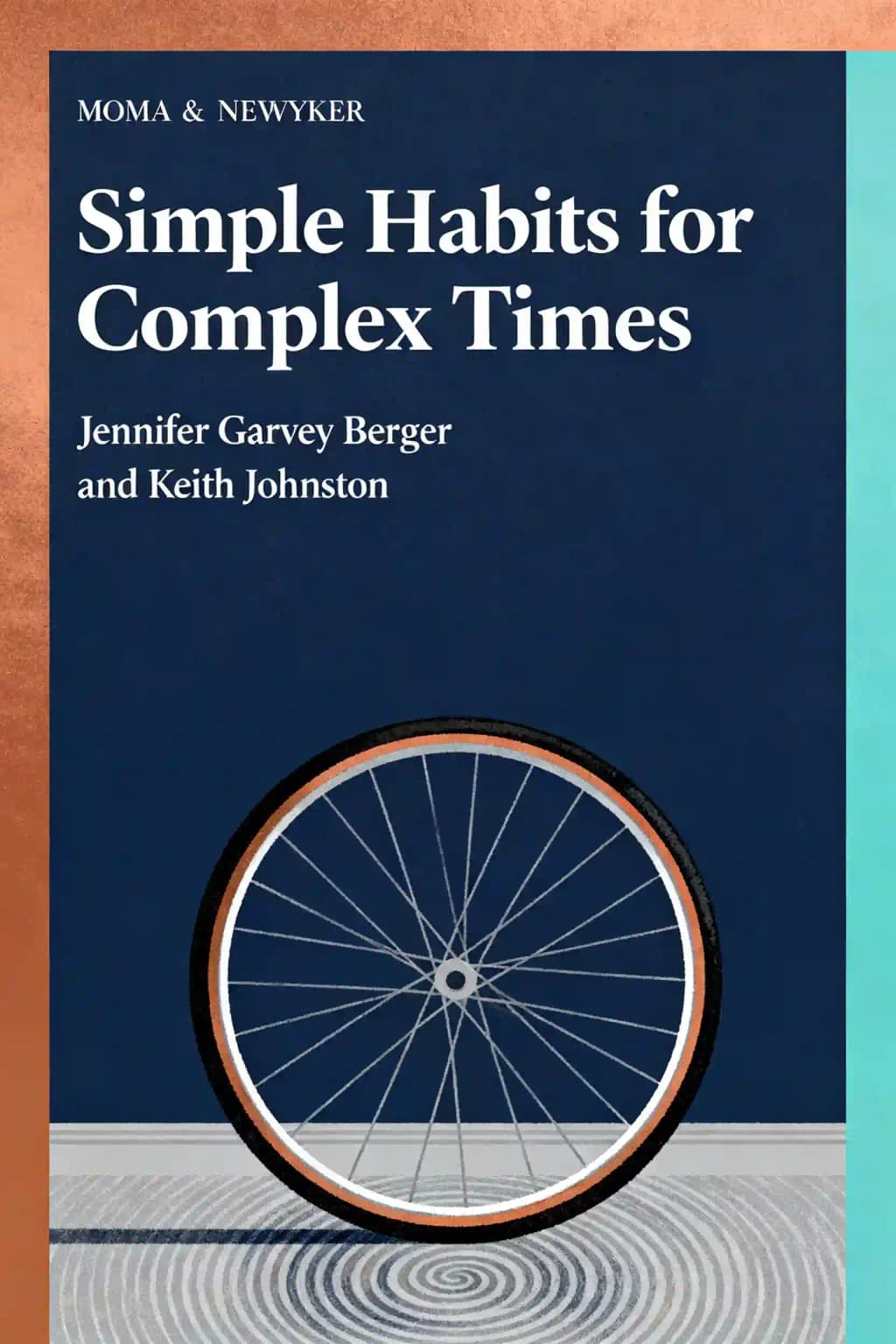
Simple habits for complex times
powerful practices for leaders
Simple habits for complex times 개요
Navigate complexity with three transformative habits that revolutionize leadership. Praised by Oxfam's Executive Director and embraced by Google and Microsoft, this book asks: What if uncertainty isn't your enemy? Discover why William Torbert calls it "an invitation into lifelong learning that transforms organizations."

Simple habits for complex times의 핵심 주제
- vuca environment
- complexity of mind
- systems thinking
- questioning assumptions
- adaptive leadership
Simple habits for complex times의 명언
We must prepare for jobs and futures that don't yet exist.
Traditional forecasting methods prove increasingly inadequate.
Leaders must develop comfort with ambiguity.
Effective questioning also involves timing and context.
Embracing uncertainty [is] a source of possibility.
Simple habits for complex times의 등장인물
- Jennifer Garvey BergerAuthor and leadership expert
- Keith JohnstonAuthor and leadership expert
- Yolanda MurphyDirector of a Family and Children's Services Div
- DougDeputy to Yolanda Murphy
저자 소개
Simple habits for complex times의 저자 소개
Jennifer Garvey Berger and Keith Johnston, authors of Simple Habits for Complex Times: Powerful Practices for Leaders, are globally recognized leadership experts and founding partners of Cultivating Leadership, a consultancy advising organizations like Microsoft and Wikimedia Foundation.
Berger, a Harvard-trained Ph.D. in adult development and protegé of Robert Kegan, is celebrated for her work on adaptive leadership in volatile environments, exemplified in her earlier books Changing on the Job and Unlocking Leadership Mindtraps.
Johnston brings decades of experience from senior roles at Oxfam International and the New Zealand government, combining behavioral science with real-world organizational challenges. Their collaboration merges Berger’s research on complexity-conscious leadership with Johnston’s systemic change expertise.
The book, translated into 12 languages and integrated into Stanford and INSEAD MBA curricula, has been endorsed by thought leaders like Microsoft CTO Eric Passmore. Berger’s popular “Growth Edge” coaching framework and Johnston’s government advisory work reinforce their authority in designing resilience strategies for Fortune 500 CEOs and public sector leaders alike.
Simple habits for complex times 요약 다운로드
Simple habits for complex times 요약을 무료 PDF 또는 EPUB으로 받으세요. 인쇄하거나 오프라인에서 언제든 읽을 수 있습니다.
이 책에 대한 FAQ
Simple Habits for Complex Times offers leaders three practices—asking different questions, taking multiple perspectives, and seeing systems—to navigate uncertainty and complexity. Instead of relying on rigid plans, it teaches agility and adaptive thinking to thrive in volatile environments like corporate, nonprofit, or government sectors.
Leaders facing rapid change, such as CEOs, managers, or team leads in tech, NGOs, or government, will benefit most. It’s ideal for those seeking frameworks to solve interconnected problems, foster innovation, or guide teams through ambiguity.
Yes—it’s praised for blending academic rigor (based on adult development theory) with actionable habits. Its focus on VUCA (volatility, uncertainty, complexity, ambiguity) makes it relevant for modern challenges like remote work, AI disruption, and global crises.
The authors reframe VUCA as an opportunity, not a threat. By shifting focus from predicting outcomes to building adaptive capacity, leaders learn to embrace uncertainty, spot patterns, and make decisions without perfect data.
- Ask different questions: Probe assumptions vs. seeking “correct” answers.
- Take multiple perspectives: Challenge biases by considering stakeholders’ views.
- See the system: Map interconnected forces shaping challenges
Berger’s Harvard training under Robert Kegan (adult development theory) informs its focus on mental complexity. Her consultancy work with Google, Microsoft, and NGOs grounds concepts in real leadership struggles.
A method Berger developed to help leaders identify their “growth edge”—the boundary between current capabilities and untapped potential. It’s used to apply the book’s habits through reflective questioning and feedback.
Yes, it features anonymized cases from Berger’s coaching practice, like guiding a tech firm through a merger and helping a nonprofit pivot during a funding crisis. These illustrate habit application across industries.
Unlike Atomic Habits’ focus on individual routines, Simple Habits targets collective adaptability in teams. Compared to Leaders Eat Last’s empathy-driven approach, it adds systemic thinking tools for complexity.
Some note its abstract concepts require patience to apply. It’s less prescriptive than traditional leadership books, which may frustrate readers seeking step-by-step fixes.
Absolutely. For example, seeing the system helps diagnose communication breakdowns in distributed teams, while taking multiple perspectives fosters inclusivity across time zones.
- “Complexity isn’t a problem to solve—it’s a landscape to explore.”
- “The best leaders don’t have all the answers; they cultivate better questions.”
Both emphasize curiosity over control in uncertain times.
It operationalizes Kegan’s stages of mental complexity, showing how leaders evolve from relying on rules (“Socialized Mind”) to embracing ambiguity (“Self-Transforming Mind”).