1장
The Ding! That Changes Everything
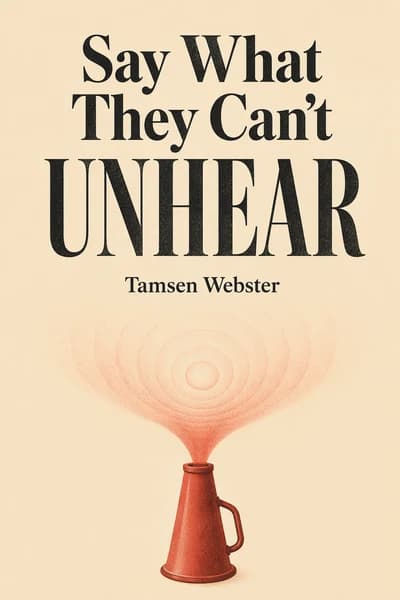
Have you ever experienced that moment when something just clicks in your mind? That "Ding!" of clarity that cuts through all the noise and changes everything? Tamsen Webster's groundbreaking work "Say What They Can't Unhear" explores this phenomenon, revealing the science and art behind creating messages so resonant they become impossible to ignore. As a Harvard Business Review recommended read and favorite of influential leaders like Seth Godin, this book has transformed how organizations approach change management. Webster draws from her remarkable background spanning theater direction, marketing leadership at Harvard Medical School, and executive producing TEDx Cambridge to deliver a masterclass in persuasion that respects human psychology. Unlike manipulative tactics that create temporary compliance, Webster's approach builds genuine buy-in by aligning with what people already want and believe. Her nine principles have helped hundreds of companies raise millions, enter new markets, and shift entrenched perceptions-all by understanding one crucial insight: lasting change happens when people can't unhear your message.
2장
The Reaction That Drives Transformation
Change isn't just about taking action-it's fundamentally about how people react to the possibility of doing something different. This principle becomes starkly clear in the contrasting approaches of Dr. Ignaz Semmelweis and Florence Nightingale. In 1847 Vienna, Semmelweis discovered that doctors' maternity wards had five times the mortality rate of midwives' wards because doctors were transferring fatal particles from autopsies to deliveries. His handwashing solution dramatically reduced deaths, yet his colleagues rejected it because it contradicted their beliefs about disease and their self-image as naturally clean gentlemen. Seven years later, Nightingale succeeded where Semmelweis failed by aligning handwashing with existing beliefs rather than challenging doctors directly.
This historical example illustrates a crucial truth: sustainable change requires intrinsic motivation-when people continue behaviors because they align with their identity and values. While you can't directly create intrinsic motivation, your approach dramatically affects whether change resonates enough to inspire it. People need to see a clear connection between your proposed action and their desired outcome while working through their existing beliefs and emotions.
Trust forms the foundation of change. People assess trust based on your capability and intent-they need to believe you're both competent and acting for the right reasons. We're instinctively attuned to others' intentions through "honest signals" that aren't consciously controlled. When people perceive manipulation or coercion, they assume bad intent, making a "yes" more likely to become a "no."
The greatest risk is "reactance"-when people resist change because they feel forced into it, they'll do anything to regain control, including rejecting things they actually want. Unlike Semmelweis's tragic experience, it's nearly impossible to recover from a "no," making it essential to avoid triggering reactance at all costs.
While you can't control where someone starts on the continuum from antagonist to advocate, you control your approach-what information you present, whose perspective you argue from, and your true intentions. Successful change begins with changes in your approach and understanding that every decision someone makes has a story behind it.
3장
The Stories Behind Our Decisions
Have you ever gone to IKEA with a $200 budget for dishes but left with $300 of unplanned purchases? This common experience-supported by research showing 60% of IKEA purchases are unplanned-illustrates how our decisions aren't purely rational but guided by stories we tell ourselves.
What we consider rational-a logical assessment of pros and cons-is actually a story created after our brain has already decided. Like traditional stories that argue for particular actions through cause and effect, these internal narratives establish logical relationships between actions and outcomes. However, they aren't truly rational because they're based on beliefs shaped by perceptions and crafted unconsciously before rational processing occurs.
These story-arguments help our brains make sense of why something has happened, is happening, or should happen. When people decide to act, it's because they've unconsciously accepted their brain's internal argument for how a particular action will deliver a desired outcome. People will change an action only if the story supporting it changes first.
What doesn't work internally will never work externally. Even when people's internal arguments aren't objectively rational, they feel rational because they follow their own logic. True arguments for change include not just the action and outcome but also the assumptions creating the logical connection between them. As Aristotle noted, someone will agree with a conclusion only if they agree with the principles leading to it.
Unfortunately, most persuasion messaging leaves out the silent assumptions that make internal arguments work, including only the action and outcome. Without the connecting logic, people will either dismiss the argument outright or fill in gaps with their existing beliefs-usually concluding not to change. To change what people do, you must change how they see the situation by articulating all elements their story-building brain requires.
Although you can't know exactly what story someone is telling themselves, you can rely on that story being the driving force behind their actions. When crafting a case for change, go beyond simple explanations or edicts. Make it an actual argument people would build themselves. The more closely your argument aligns with stakeholders' internal logic, both in content and structure, the more directly you're uploading your case into their brain's story processors.
4장
The Patterns That Guide Our Lives
Our deep-seated beliefs about the world shape not just our actions but what we even perceive as possible. These primal beliefs become so ingrained that we treat them as universal truths guiding our behavior. When your argument is based on principles the other person doesn't share, they literally cannot agree with your conclusion, no matter how logical your reasoning. The story you're telling will only resonate when your principles and those of your audience align.
Once you see the value of making a change, it can be hard to understand why someone else doesn't see that value too. But if someone doesn't see the world the way you do, they can't see the value the way you do. Their opinion will change only if their outlook changes, which is unlikely at the primal level. Rather than hammering someone with your perspective (which activates reactance), you must change your perspective to see the world their way.
People's brains are too efficiency-oriented to invent new stories for every decision. Instead, they rely on pre-existing beliefs and principles encoded into behavior. These hidden principles also exist at the organizational level as "deep rules" that affect patterns of behavior. Deep beliefs determine which stories, arguments, and actions someone will agree with-whether consciously or unconsciously.
Our innate tendency to assume others share our worldview-the "false consensus effect"-is the primary obstacle to understanding others' principles. Beliefs are not just rational conclusions but are often deeply emotional and tied to a person's identity. Challenging these beliefs can trigger reactance because people perceive it as questioning their very self.
Inspiring change lies not merely in what you say and do, but in how both connect to the underlying beliefs of stakeholders. Instead of imposing your outlook, work to understand theirs. When you look for, acknowledge, and respect people's deepest principles, you forge paths to agreement that are embraced, not enforced. To say something they can't unhear, begin with what they already want and believe.
5장
The Power of Identity in Persuasion
When someone feels smart, capable, and good in your eyes, they often think you must be smart, capable, and good too-simply because you see them that way. This builds trust essential for sustained relationships. However, problems arise when you believe another person's current course of action is rooted in ignorance or that yours is the only "good" option.
The relationship between action and identity is a reinforcing loop. We see our own beliefs as universal truths and act accordingly, using our behavior as evidence for what the right action is. People don't do what's right because it's universally right-they judge actions as "right" simply because they're already doing them; their desired self-identity doesn't allow for their definition of right to be wrong.
There's a reason leveraging identity in persuasion is so effective: it's the only extrinsic motivation approaching intrinsic motivation's power. Yet it's delicate-suggesting flawed methods can make someone agree initially to appear smart, capable and good, but they may later stall when they realize you didn't already see them that way. This erodes trust. As Nietzsche noted, "'I did that,' says my memory. 'I could not have done that,' says my pride, and remains inexorable. Eventually-the memory yields."
Even subtle nuances in how you present change can impact its reception. Your honest signals-words, tone, and nonverbal cues-may contradict your message if you don't truly believe the other person is smart, capable, and good. Using jargon can make people feel unintelligent, while presenting incomplete arguments makes it impossible for someone to fully understand or judge if they're capable of implementing a change.
To inspire lasting change, see and reinforce people's inherent intelligence, capability, and goodness. This helps understand where stakeholders might be open to change and what principles would support it. In every interaction, actively seek and affirm the smart, capable, and good qualities in their current practices and beliefs. The goal isn't empty praise but giving people a better story about themselves-one where their identities remain intact even as their actions change.
6장
The Challenge of Shifting Deep Beliefs
When deeply held beliefs clash with proposed changes, transformation becomes extraordinarily challenging. This was powerfully illustrated at a heated community meeting about school funding, where a veteran teacher shifted the conversation from hostile political accusations to shared values of quality education and equal opportunities. By focusing on deeper beliefs that supported the proposed changes rather than attacking opposing positions, the teacher transformed antagonism into productive dialogue. Similar examples can be found in workplace reorganizations, where successful leaders focus on shared commitments to excellence rather than defending specific structural changes.
Our tendency toward belief consistency is both the greatest obstacle and opportunity in persuasion. The longer someone believes something, the stronger that belief becomes, creating neural pathways that become increasingly resistant to change. This is evident in political discussions, religious convictions, and even professional methodologies. Attacking deep-rooted principles rarely results in agreement and typically triggers reactance, damaging relationships essential for sustainable change. However, someone may have equally strong or stronger beliefs that would support your change if surfaced - like how environmental skeptics often become advocates when conservation is framed in terms of resource stewardship and economic efficiency.
Cognitive inertia-our tendency to cling to existing beliefs-presents a major challenge to change. This manifests in various ways, from resistance to new technologies in the workplace to reluctance to adopt new teaching methods in education. Conventional approaches either challenge limiting beliefs directly or offer new ones, but neuroscience works against both techniques. Challenging beliefs triggers fight-or-flight responses, turning people into antagonists whose brains can't consider new perspectives. Meanwhile, new beliefs struggle against cognitive inertia, lacking the weight of history and experience that make existing beliefs compelling.
When you understand how ingrained beliefs work, you can avoid common pitfalls that trigger negative responses. Research shows that people's brains process opinions they agree with in the same way they process facts, making it counterproductive to challenge these beliefs directly. This is particularly evident in organizational change initiatives, where even data-driven arguments often fail against entrenched viewpoints. Even with shared perspectives, using them "against" someone ("If you really believed in education, you'd support these changes!") violates their desire to be seen as smart, capable, and good.
The key is to exchange beliefs rather than challenge them. When you identify and leverage beliefs that are as strong or stronger than those opposing change, you create an equally strong foundation for new behaviors. For instance, a company's shift to remote work succeeded by emphasizing shared beliefs in work-life balance and trust rather than battling resistance to change. This transforms change from confrontation into collaboration. Rather than dismantling someone's framework of understanding, you're connecting with and building on deeply held principles you share, creating a bridge to new possibilities while maintaining psychological safety and respect.
7장
The Pain Threshold of Sustainable Change
When we attempt change, we often focus solely on the goal without considering the discomfort and resistance along the journey. But how you change is as important as what you change. The key is limiting or avoiding pain whenever possible, while still maintaining progress toward meaningful transformation. Understanding this delicate balance is crucial for any lasting change initiative.
Humans naturally avoid pain, whether emotional, physical, or psychological. This avoidance is deeply wired into our survival instincts and decision-making processes. Painful changes rarely stick because sustaining discomfort contradicts our basic nature. While harmful behaviors may continue until they become painful enough to stop, abrupt changes (like quitting sugar cold turkey, switching to a radically different work process, or implementing sweeping organizational changes) often fail because the immediate discomfort outweighs distant benefits. The solution lies in the problem: the less painful a change is, the more sustainable it becomes. This principle applies equally to personal habits, team dynamics, and organizational transformations.
People more readily adopt behaviors aligned with their previous actions and beliefs due to "behavioral consistency." When a new process feels like a small step from current practices, teams are less likely to reject it. For example, rather than completely overhauling a department's workflow, starting with minor adjustments to existing processes creates less resistance. Breaking significant changes into smaller, more comfortable steps eases transitions and builds confidence gradually. This approach makes behavioral consistency work for you rather than against you, creating a series of achievable victories that compound over time.
Much persuasion advice focuses on creating pain or discomfort to motivate action - the "burning platform" approach. While pain may drive quick movement, no human will continue something that feels emotionally, physically, or mentally painful long-term. Eventually, all attention turns to stopping the pain. For instance, using fear of job loss to drive performance improvements might yield short-term results but often leads to decreased morale, higher turnover, and reduced long-term productivity. The very levers people pull to persuade in the moment-especially those violating the smart-capable-good aspiration-often ensure actions won't last.
For lasting change, focus on reducing pain rather than introducing it. Lower discomfort levels increase the probability of long-term success. This might mean implementing new software systems in phases, allowing teams to gradually adapt to new tools while maintaining productivity. This doesn't mean avoiding acknowledgment of someone's current pain-recognizing their struggles builds credibility and rapport. But there's a crucial difference between describing pain someone already experiences versus leveraging pain you've created to force action. Adjusting the actions you request doesn't diminish the significance of change; it reduces dissonance and makes it easier for people to start and maintain their journey. The goal is to create a path of least resistance toward desired outcomes while maintaining momentum and engagement.
Consider change initiatives like a dimmer switch rather than an on/off button. Gradual adjustments allow people to acclimate and adapt while moving steadily toward the desired state. This approach respects both the need for progress and human nature's resistance to sudden, painful transitions.
8장
The Productive Power of Cognitive Dissonance
All change involves choice between competing values, creating cognitive dissonance that demands resolution. This dissonance, unlike other forms of pain, is necessary for transformation-a sharp but fleeting pinprick that clarifies rather than erodes identity. When two beliefs conflict, our brains quickly choose one to resolve the discomfort, making decisions based on what feels most aligned with our aspired identity and principles. This mental mechanism serves as a natural catalyst for personal growth, pushing us toward coherence in our belief systems.
Cognitive dissonance-the discomfort felt when conflicting beliefs challenge our understanding-creates the mental spark that turns contemplation into action. It's like Aristotle's "anagnorisis," a moment of critical discovery essential to transformation. Consider how a health-conscious person might experience dissonance upon realizing their daily habits contradict their wellness goals, spurring them to make meaningful changes. Though this seems to contradict the previous principle about pain, cognitive dissonance is the rare ally-sharp but fleeting, dissolving once a decision resolves the conflict.
When two opposing ideas directly compete, one inevitably proves stronger. Consider De Beers' "A Diamond Is Forever" campaign, which created cognitive dissonance by challenging the simple metal ring as the ultimate symbol of commitment. The conflict wasn't just between ring types but about what truly represents "forever." Similar cognitive battles play out in environmental campaigns that contrast immediate convenience with long-term sustainability, or in health initiatives that pit short-term pleasure against future wellbeing. By anchoring arguments in deep-seated values, you can create productive dissonance that resolves in favor of your desired change.
Our values shift contextually like chameleons, creating situational hypocrisy we rarely recognize. We maintain personal values (principles forming our identity) and relational values (shaping our social connections), both varying in importance depending on circumstances. For instance, a person might strictly adhere to vegetarianism at home but make exceptions at important social gatherings to avoid offending hosts. This explains why someone might prioritize honesty at work but tell white lies socially. When your case surfaces these hidden conflicts, avoid explicitly calling out inconsistencies-people resist being labeled hypocrites.
The resolution of cognitive dissonance often follows predictable patterns. People typically either change their beliefs to match their actions, change their actions to match their beliefs, or add new justifying beliefs to bridge the gap. For example, someone who believes in environmental protection but drives a gas-guzzling car might justify it by emphasizing their other eco-friendly practices or by planning to switch to an electric vehicle in the future.
Sustainable change remains a personal journey centered on individual battles of belief. Your role is crafting narratives that highlight inner conflicts while respecting others' agency to deliberate and decide. This might involve presenting information that creates productive tension without forcing conclusions, allowing people to discover their own path to resolution. When change aligns with someone's core self, transformation becomes lasting. Your job is simply to show-not lead-the way, understanding that the most powerful changes come from within, catalyzed by well-placed moments of cognitive dissonance.
9장
The Fundamental Alignment of Desire
We've all experienced the frustration of a customer service representative desperately offering increasingly extravagant deals when we simply want to cancel a service. This scenario perfectly illustrates a fundamental principle of change: no matter how compelling your case, you cannot want a change more than the person you're trying to persuade.
Change happens only when someone believes it will deliver something they already want through means they believe in. If you can't legitimately connect your desired change to an outcome someone truly values, they simply won't make the change voluntarily. Only "Actives" and convinced "Ambivalents" truly own lasting change because they genuinely desire the outcome.
All stories begin with desire, and in the stories people tell themselves, they're the main character seeking their happy ending. To say something people can't unhear, anchor it in something they won't unwant. People are naturally attuned to information that helps them achieve what they already desire, making it crucial to link your change to something they actively seek.
Benefit bombing-listing every possible advantage of your idea hoping something sticks-is the biggest pitfall. When you introduce multiple arguments, weak points dilute your overall case, sinking it to its lowest level. Overpromising appears disingenuous and overwhelms people with irrelevant information. One client, a robotics startup for farmers, initially packed their product with advanced AI features that farmers didn't need. The complexity increased costs and made the robots harder to use. Only when they stripped down to the essentials-focusing solely on what farmers truly needed-did interest grow.
Remove the neutral position when applying this principle. Frame your message as the response to an urgent question your stakeholders actively want answered. The robotics startup might say: "Our simple robots help you close the gap between the work you have and the workers you have." This forces farmers to engage with the idea rather than remain indifferent. When you show how a change solves a problem someone actively wants resolved, they can't remain neutral.
10장
The Resonance That Creates Lasting Change
While buyer's remorse comes from hasty decisions or impulse purchases, there's no such thing as "believer's remorse." When someone believes their decision was right and it resonates with their identity, they won't regret it-even if implementation is difficult or outcomes fall short. The key is making change feel right by connecting new ideas to familiar concepts, as Steve Jobs did with "a thousand songs in your pocket" for the iPod, or how Dan O'Bannon pitched "Alien" as "Jaws in space." These messages generated billions by making something unfamiliar feel familiar through elements audiences already knew and valued.
Unlike buyer's remorse that follows hasty decisions, believer's remorse doesn't exist. When someone truly believes a decision aligns with their identity, they won't regret it even if implementation proves difficult. For a change to feel right, it must satisfy someone's internal story, align with their identity and deep beliefs, and result from a decision made with full agency. Most importantly, it must make sense to them.
The most common mistake in persuasion is starting from a perspective clear to you but alien to your audience. This "turn-by-turn problem" occurs when you provide detailed directions without first establishing where you're going. Like navigation systems that show an overview map before turn-by-turn directions, effective communication first establishes the destination. Apple's "1,000 songs in your pocket" iPod tagline brilliantly showed where people were going rather than describing technical specifications.
The sweetest words in any negotiation are "That's right"-not "You're right." When someone says "That's right," they've assessed and embraced your point as their own with full agency, creating an indelible scene in their personal story. Every outcome, assumption, and piece of evidence you present offers an opportunity for someone to exercise their agency and agree that "This change is right for me."
Like an orchestra tuning to an oboe's "A" note-chosen because every string instrument has an "A" string-alignment creates maximum resonance. When your change message is tuned to what people want and believe, one simple idea can resonate strongly enough to inspire lasting transformational change.