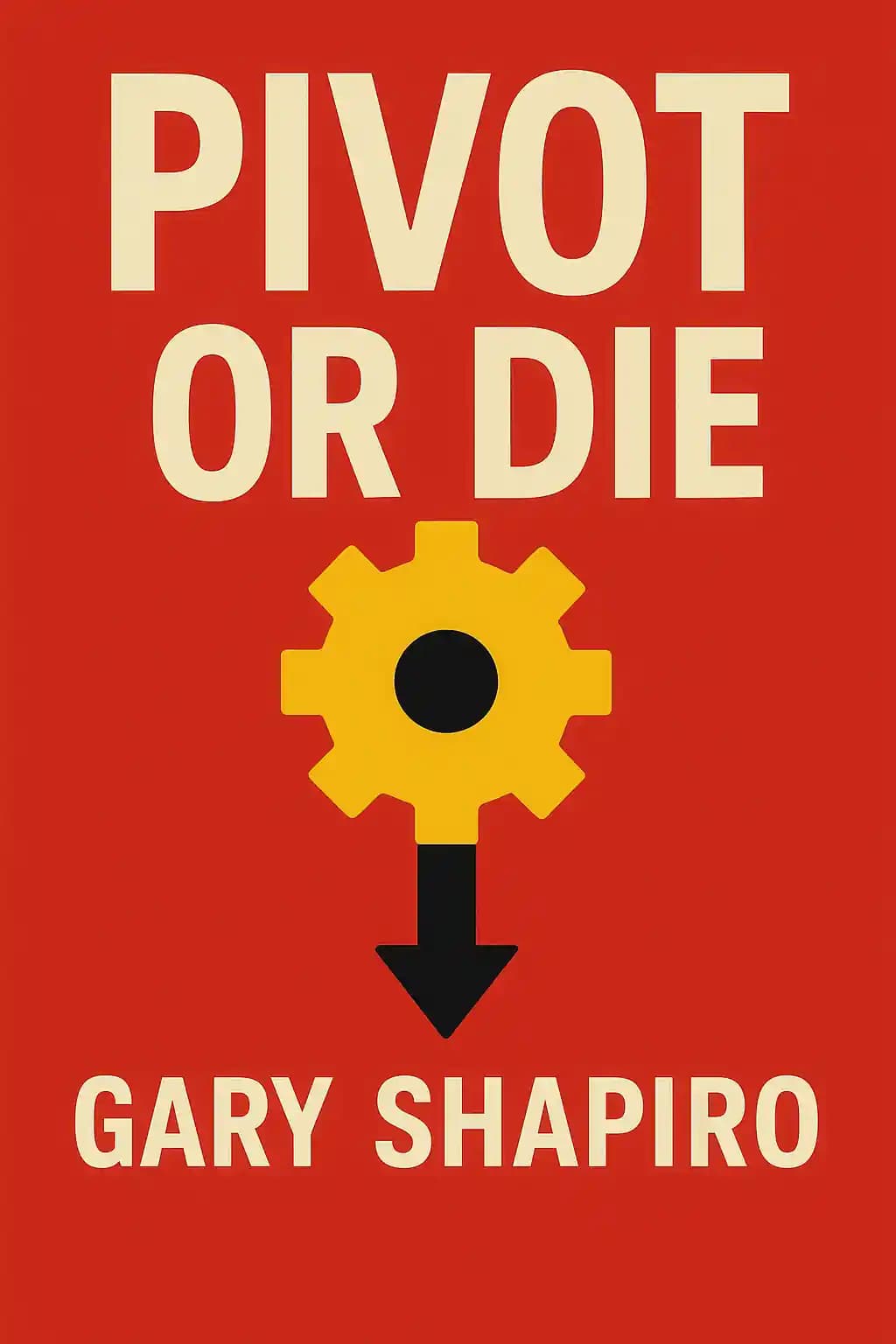
In "Pivot or Die," CES chief Gary Shapiro reveals how industry titans like Amazon and Walmart mastered strategic pivots. What transformation secret did Delta's CEO Ed Bastian praise as "invaluable" for today's leaders facing unprecedented threats? Your survival toolkit awaits.
Gary Shapiro, New York Times bestselling author of Pivot or Die: How Leaders Thrive When Everything Changes, is a leading authority on innovation and business strategy. As CEO of the Consumer Technology Association (CTA) for over 35 years, Shapiro has shaped global tech policy and championed transformative technologies through events like CES®. His expertise in navigating disruption stems from decades of advising Fortune 500 companies and testifying before Congress on critical issues like AI regulation and intellectual property rights.
Shapiro’s earlier works, including Ninja Innovation and The Comeback, established him as a visionary voice on adaptive leadership in fast-changing markets. With over 1,200 opinion pieces in The Wall Street Journal, The New York Times, and The Washington Post, he translates complex technological shifts into actionable insights for executives.
A Georgetown Law graduate and recipient of France’s Legion of Honor, Shapiro combines legal acumen with entrepreneurial pragmatism to help organizations thrive in uncertainty. His books have become essential reading for leaders seeking strategies to future-proof their businesses.
Pivot or Die outlines a four-part framework for business adaptability: startup pivots (disrupting industries), forced pivots (responding to crises), failure pivots (learning from mistakes), and success pivots (outmaneuvering competitors). Shapiro uses tech industry case studies and economic theory to show how leaders can drive innovation during rapid change.
Executives, entrepreneurs, and managers in fast-paced industries like tech, retail, or manufacturing will benefit most. The book’s practical examples on leading organizational change make it particularly valuable for decision-makers facing market disruptions or innovation challenges.
Yes—the book offers actionable strategies backed by real-world examples from companies like Walmart and Samsung. Shapiro’s dual perspective as a tech industry leader and policy advocate provides unique insights into balancing innovation with fiscal responsibility.
Shapiro portrays leadership as the ability to anticipate change, foster organizational curiosity, and make bold strategic shifts. He emphasizes that successful leaders view pivots not as emergencies but as essential business practices.
The titular mantra “Pivot or Die” encapsulates Shapiro’s core argument: adaptability determines organizational survival. He argues companies must institutionalize pivoting as a regular strategy rather than a last-resort tactic.
Some reviewers note the book focuses more on corporate case studies than practical implementation tools. However, most praise its timely analysis of adaptability in fast-moving sectors like AI and sustainable tech.
The book addresses current challenges like AI disruption, supply chain volatility, and remote workforce management. Shapiro’s framework helps leaders navigate post-pandemic economic shifts and rapid tech adoption trends.
While both books focus on innovation, Pivot or Die provides a structured framework for organizational change, whereas Ninja Future explores broader tech trends. They complement each other—one tactical, one strategic.
Yes, the forced pivot chapter specifically addresses personal reinvention. Shapiro analyzes how professionals like Delta CEO Ed Bastian adapted their leadership approaches during industry transformations.
Yes, featuring detailed analyses of Amazon’s market expansions, Panasonic’s tech shifts, and Samsung’s product strategy overhauls. Shapiro also examines mid-sized companies navigating regulatory changes.
The 256-page book balances theoretical frameworks with digestible case studies. Reviewers note its concise structure makes complex concepts accessible for busy executives.
저자의 목소리로 책을 느껴보세요
지식을 흥미롭고 예시가 풍부한 인사이트로 전환
핵심 아이디어를 빠르게 캡처하여 신속하게 학습
재미있고 매력적인 방식으로 책을 즐기세요
Pivot isn't abandoning your identity—it's intentional change.
Failure fuels ingenuity by forcing us to think differently.
Success can breed complacency, but failure fuels ingenuity.
The technology industry has perfected the modern pivot.
Adapt or fade into irrelevance.
Pivot or Die의 핵심 아이디어를 이해하기 쉬운 포인트로 분해하여 혁신적인 팀이 어떻게 창조하고, 협력하고, 성장하는지 이해합니다.
Pivot or Die을 빠른 기억 단서로 압축하여 솔직함, 팀워크, 창의적 회복력의 핵심 원칙을 강조합니다.

생생한 스토리텔링을 통해 Pivot or Die을 경험하고, 혁신 교훈을 기억에 남고 적용할 수 있는 순간으로 바꿉니다.
무엇이든 물어보고, 목소리를 선택하고, 진정으로 공감되는 인사이트를 함께 만들어보세요.

샌프란시스코에서 컬럼비아 대학교 동문들이 만들었습니다
"Instead of endless scrolling, I just hit play on BeFreed. It saves me so much time."
"I never knew where to start with nonfiction—BeFreed’s book lists turned into podcasts gave me a clear path."
"Perfect balance between learning and entertainment. Finished ‘Thinking, Fast and Slow’ on my commute this week."
"Crazy how much I learned while walking the dog. BeFreed = small habits → big gains."
"Reading used to feel like a chore. Now it’s just part of my lifestyle."
"Feels effortless compared to reading. I’ve finished 6 books this month already."
"BeFreed turned my guilty doomscrolling into something that feels productive and inspiring."
"BeFreed turned my commute into learning time. 20-min podcasts are perfect for finishing books I never had time for."
"BeFreed replaced my podcast queue. Imagine Spotify for books — that’s it. 🙌"
"It is great for me to learn something from the book without reading it."
"The themed book list podcasts help me connect ideas across authors—like a guided audio journey."
"Makes me feel smarter every time before going to work"
샌프란시스코에서 컬럼비아 대학교 동문들이 만들었습니다

Pivot or Die 요약을 무료 PDF 또는 EPUB으로 받으세요. 인쇄하거나 오프라인에서 언제든 읽을 수 있습니다.
In January 2020, as a mysterious quarantine in Wuhan, China made headlines, few could have predicted how this moment would trigger cascading changes affecting every aspect of life and business worldwide. This pivotal moment serves as the perfect backdrop for understanding the central message of "Pivot or Die" - the ability to adapt isn't just a business skill; it's the fundamental difference between thriving and becoming obsolete in our rapidly changing world. Just look at once-dominant retailers like Blockbuster, Circuit City, and Sears that collapsed when they failed to evolve, while others transformed themselves to meet shifting consumer needs. What makes this concept particularly powerful is that we've all just lived through one of history's most significant forced pivots during the pandemic. The question isn't whether change will come - it's whether you'll recognize the moment when adaptation becomes essential for survival.