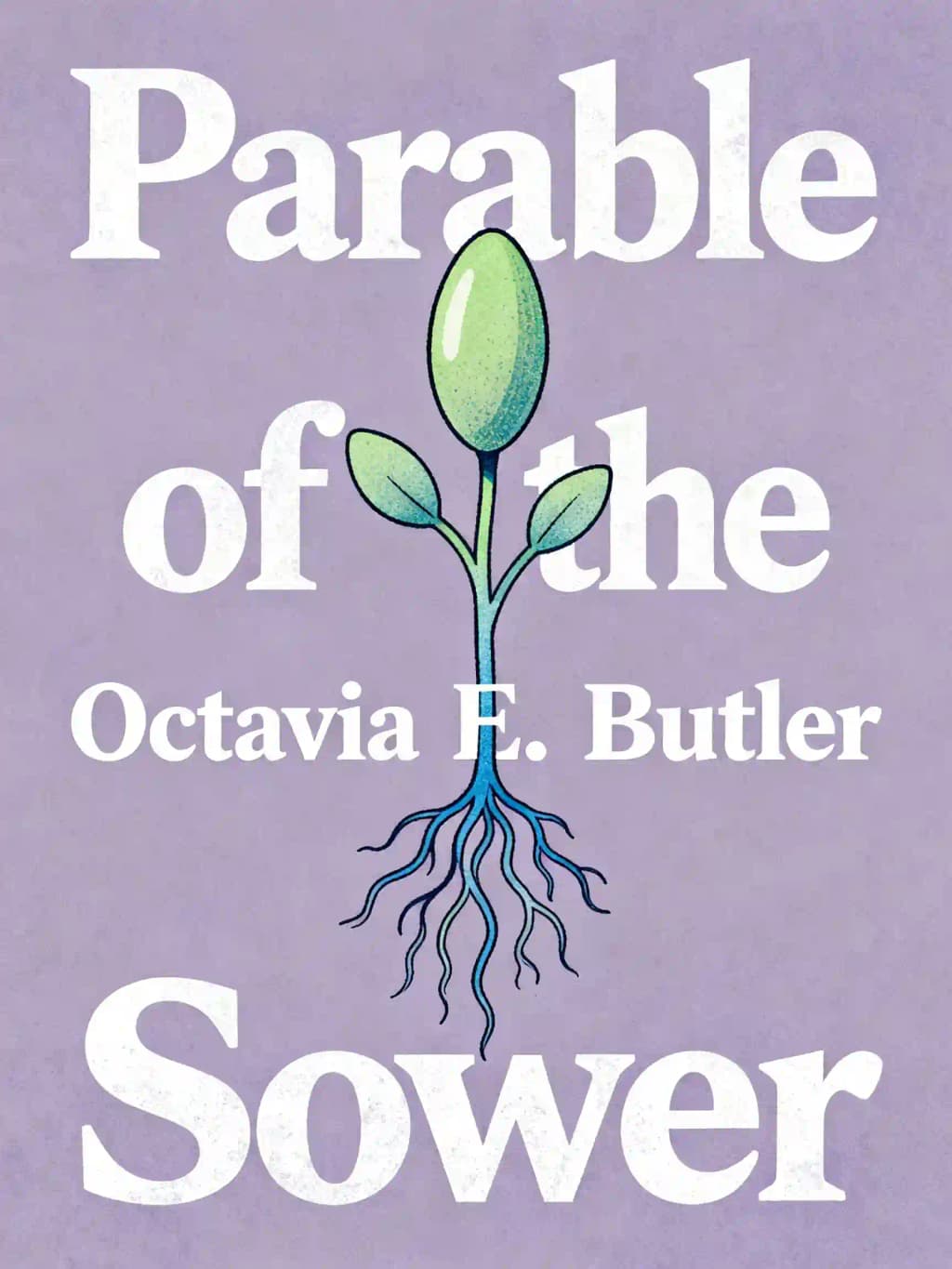
In Butler's eerily prescient 1993 dystopia set in 2024, a hyperempathic teenager navigates societal collapse. Finally hitting NYT bestsellers in 2020, this haunting vision of climate crisis and inequality asks: how will you survive when everything you know crumbles?
Octavia Estelle Butler (1947–2006), author of Parable of the Sower, was a groundbreaking Hugo and Nebula Award-winning science fiction pioneer, celebrated for weaving African American perspectives into speculative narratives. A MacArthur Fellow—the first sci-fi writer to receive the "genius grant"—Butler explored themes of dystopian collapse, resilience, and societal rebirth through her work, drawing from her experiences growing up in segregated Pasadena and her studies during the Black Power movement.
Parable of the Sower (1993), her seminal climate-fiction novel, examines themes of community survival and incremental hope amid environmental and economic collapse, reflecting Butler’s lifelong engagement with systemic inequality. Her other influential works include Kindred (1979), a time-travel exploration of slavery, and the Patternist series, which established her early career.
Butler’s prescient storytelling, particularly her Earthseed philosophy in the Parable duology, continues to resonate in academic and Afrofuturist circles. Translated into over 20 languages, her works remain staples in literature curricula and have seen renewed relevance for their unflinching analysis of climate crises and corporate dystopia.
Parable of the Sower (1993) is a dystopian novel set in a near-future 2024 America collapsing due to climate disasters, wealth inequality, and societal chaos. It follows Lauren Olamina, a young Black woman with hyperempathy syndrome, as she flees her destroyed community and founds "Earthseed," a belief system centering adaptability and interstellar human survival. Themes include resilience, communal rebirth, and the power of proactive change.
Fans of dystopian fiction (e.g., The Handmaid’s Tale) and readers exploring climate fiction, social justice, or Afrofuturism will find this novel compelling. It’s also relevant for those interested in philosophical frameworks for societal transformation, as Earthseed’s teachings blend pragmatism with spiritual growth.
Yes—Butler’s prescient exploration of climate collapse, inequality, and community-building resonates deeply in 2025. While some critics note its bleak tone, the novel’s emphasis on resilience and collective action offers actionable insights for navigating crises.
Key themes include:
Earthseed is Lauren’s belief system, framing change as divine and humanity’s destiny as interstellar colonization. Its core tenet—“God is Change”—urges proactive adaptation rather than passive acceptance of suffering.
Butler critiques climate denial, corporate greed, and systemic inequality. The walled community of Robledo mirrors modern gated suburbs, while privatized cities like Olivar highlight exploitative capitalism.
Lauren’s hyperempathy—a genetic condition causing her to feel others’ pain and joy—reflects the dual burdens of marginalized groups: deep emotional labor paired with societal exploitation.
Butler uses biblical parables (e.g., Noah’s Ark) to parallel Lauren’s journey, framing societal collapse as both destruction and opportunity for ethical renewal.
Lauren’s group establishes “Acorn,” a farming commune, and plants oak trees to symbolize rebirth. The closing Bible parable underscores the need to nurture hope in “good ground”.
Its depiction of climate migration, corporate exploitation, and grassroots organizing mirrors 2025 challenges, making it a vital read for activists and futurists.
Some reviewers argue the novel’s unrelenting grimness overshadows its hopeful themes, while others find Earthseed’s philosophy underdeveloped.
Unlike passive protagonists in classics like 1984, Lauren actively builds alternatives, blending survivalist pragmatism with visionary idealism. This makes the story uniquely actionable.
저자의 목소리로 책을 느껴보세요
지식을 흥미롭고 예시가 풍부한 인사이트로 전환
핵심 아이디어를 빠르게 캡처하여 신속하게 학습
재미있고 매력적인 방식으로 책을 즐기세요
All that you touch You Change. All that you Change Changes you. The only lasting truth Is Change. God Is Change.
In order to rise From its own ashes A phoenix First Must Burn.
God is Change.
God exists to be shaped.
The Destiny of Earthseed is to take root among the stars.
Parable of the Sower의 핵심 아이디어를 이해하기 쉬운 포인트로 분해하여 혁신적인 팀이 어떻게 창조하고, 협력하고, 성장하는지 이해합니다.
Parable of the Sower을 빠른 기억 단서로 압축하여 솔직함, 팀워크, 창의적 회복력의 핵심 원칙을 강조합니다.

생생한 스토리텔링을 통해 Parable of the Sower을 경험하고, 혁신 교훈을 기억에 남고 적용할 수 있는 순간으로 바꿉니다.
무엇이든 물어보고, 목소리를 선택하고, 진정으로 공감되는 인사이트를 함께 만들어보세요.

샌프란시스코에서 컬럼비아 대학교 동문들이 만들었습니다
"Instead of endless scrolling, I just hit play on BeFreed. It saves me so much time."
"I never knew where to start with nonfiction—BeFreed’s book lists turned into podcasts gave me a clear path."
"Perfect balance between learning and entertainment. Finished ‘Thinking, Fast and Slow’ on my commute this week."
"Crazy how much I learned while walking the dog. BeFreed = small habits → big gains."
"Reading used to feel like a chore. Now it’s just part of my lifestyle."
"Feels effortless compared to reading. I’ve finished 6 books this month already."
"BeFreed turned my guilty doomscrolling into something that feels productive and inspiring."
"BeFreed turned my commute into learning time. 20-min podcasts are perfect for finishing books I never had time for."
"BeFreed replaced my podcast queue. Imagine Spotify for books — that’s it. 🙌"
"It is great for me to learn something from the book without reading it."
"The themed book list podcasts help me connect ideas across authors—like a guided audio journey."
"Makes me feel smarter every time before going to work"
샌프란시스코에서 컬럼비아 대학교 동문들이 만들었습니다

Parable of the Sower 요약을 무료 PDF 또는 EPUB으로 받으세요. 인쇄하거나 오프라인에서 언제든 읽을 수 있습니다.
What happens when everything you've feared becomes reality? Lauren Olamina knows the answer intimately. At fifteen, she's already writing scripture for a religion she calls Earthseed, centered on a radical premise: "God is Change." While her Baptist minister father preaches salvation and her neighbors cling to normalcy, Lauren sees their California neighborhood for what it truly is-a fragile island in a sea of chaos, waiting to drown. Her philosophical preparations aren't abstract teenage angst; they're survival manuals for a world already collapsing. Published in 1993 but set in the 2020s, Octavia Butler's vision has become disturbingly prophetic, resonating with readers facing climate crisis, wealth inequality, and social breakdown. Through Lauren's journey from sheltered visionary to community founder, we witness not just dystopian warning but profound meditation on adaptation, hope, and what it takes to build something new from civilization's ashes.