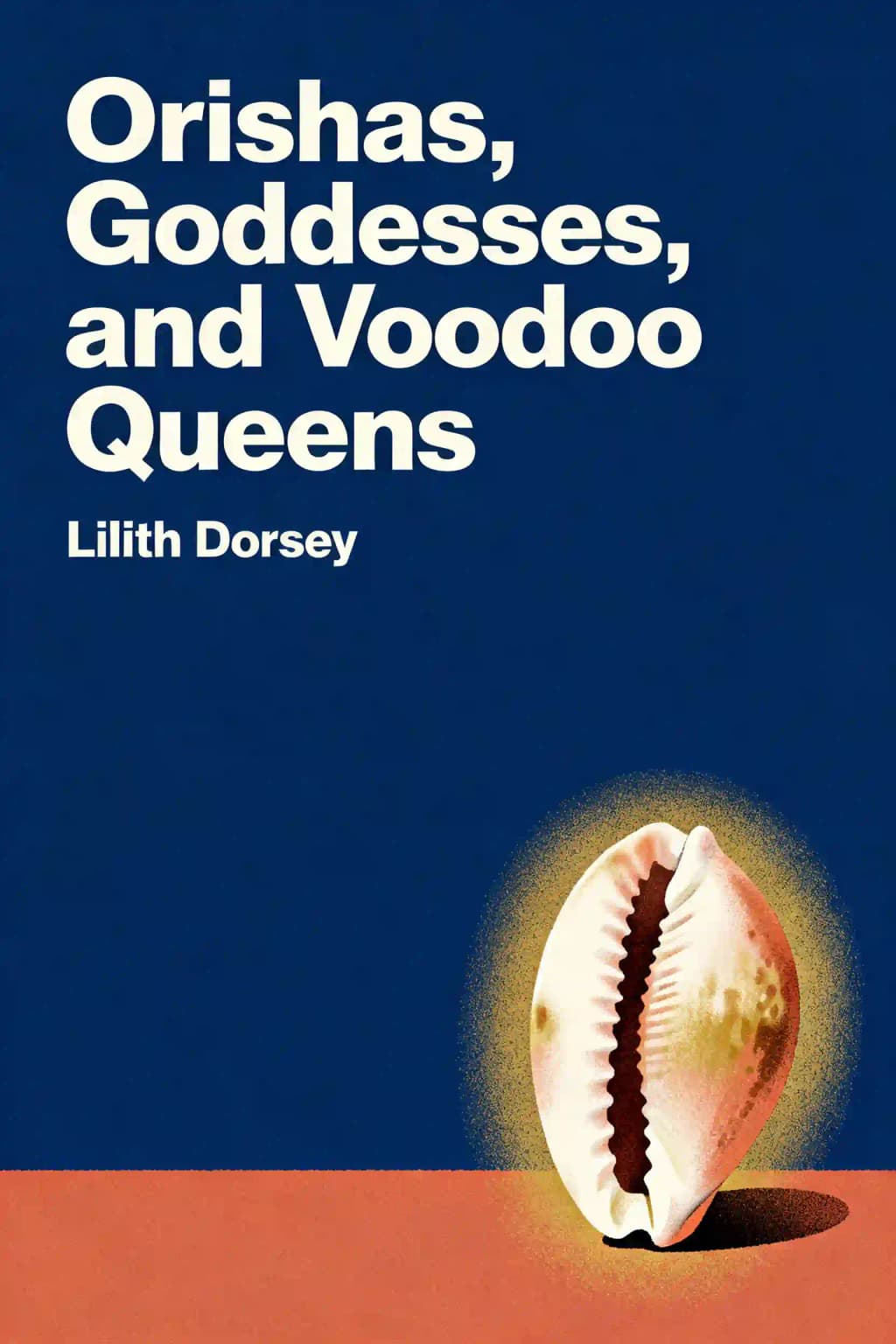
Bestselling "Orishas, Goddesses, and Voodoo Queens" invites you into African divine feminine traditions through the eyes of initiated Voodoo priestess Lilith Dorsey. What ancient wisdom have mainstream publications like The New York Times discovered in these powerful, once-hidden spiritual practices?
Lilith Dorsey, M.A., is the bestselling author of Orishas, Goddesses and Voodoo Queens and a respected Voodoo Priestess specializing in African Traditional Religions and Afro-Caribbean spiritual practices. Drawing from initiations in Santeria (Lucumi), Haitian Vodoun, and New Orleans Voodoo, Dorsey brings authentic lived experience to this exploration of divine feminine power across African diaspora traditions.
Their academic background in Plant Science, Anthropology, and Film from the University of Rhode Island, New York University, and the University of London grounds their work in rigorous research and cultural sensitivity.
Dorsey has been practicing magick professionally since 1991 and serves as editor/publisher of Oshun-African Magickal Quarterly. They are also a filmmaker, choreographer for jazz legend Dr. John's "Night Tripper" Voodoo Show, and author of eight books including the COVR award-winning Water Magic, Love Magic, and Tarot Every Witch Way.
Their work has been featured in The New York Times and The Village Voice, establishing them as a leading voice in making African Traditional Religions accessible and respected in contemporary spiritual discourse.
Orishas, Goddesses, and Voodoo Queens explores the divine feminine in African religious traditions, including Yoruba (Ifa), Santeria, Haitian Vodoun, and New Orleans Voodoo. The book combines historical accounts, cultural narratives, and practical guidance for connecting with goddesses, orishas, loas, and historical Voodoo queens like Marie Laveau. It includes recipes, rituals, offerings, and altar-building instructions designed to help readers celebrate and cultivate the strengths of these powerful spiritual entities.
Lilith Dorsey, M.A., is a Voodoo Priestess and published Black author with initiations in Lucumi (Santeria), Haitian Vodoun, and New Orleans Voodoo since 1991. Dorsey holds academic degrees in Plant Science, Anthropology, and Film from URI, NYU, and University of London. They serve as editor/publisher of Oshun-African Magickal Quarterly and have authored multiple books on African traditional religions, committed to providing accurate and respectful information about these sacred practices.
Orishas, Goddesses, and Voodoo Queens is ideal for goddess worshippers, spiritual seekers interested in African traditional religions, and practitioners of Santeria, Vodoun, or Voodoo. The book serves both beginners seeking an introduction to Afro-Diaspora traditions and experienced practitioners wanting practical guidance on rituals and offerings. It's particularly valuable for women seeking empowerment through divine feminine spirituality and anyone interested in understanding the connections between different African-derived spiritual paths.
Orishas, Goddesses, and Voodoo Queens receives generally positive reviews for its informative content, practical recipes and rituals, and the author's authentic knowledge from personal initiation and experience. Readers praise its accessibility, organization, and combination of historical context with actionable spiritual practices. Some reviewers note it can feel rushed or overwhelming for complete beginners, desiring more depth on individual deities. Overall, it's considered an excellent introduction and reference guide for African traditional religions and divine feminine spirituality.
Orishas, Goddesses, and Voodoo Queens covers orishas from Yoruba tradition, loas from Haitian Vodoun, and historical Voodoo queens including Marie Laveau and Nanny of the Maroons. Specific entities discussed include Erzulie in her various incarnations, La Siren, Mami Wata, and other divine feminine figures from African and Afro-Caribbean spiritual traditions. Each deity receives descriptions of their attributes, domains, representations related to love, beauty, water, death, and other aspects of life.
Orishas, Goddesses, and Voodoo Queens provides recipes, rituals, offerings, prayers, and shrine-building instructions specific to each deity. The book includes botanical elements, food offerings appropriate for different goddesses, and detailed guidance on how to honor and connect with these spiritual entities. Readers appreciate the actionable nature of the content, with many planning to return to the recipes and ritual instructions repeatedly. The book also features a glossary and practical combinations for spiritual work.
Orishas, Goddesses, and Voodoo Queens can be read without initiation, though some reviewers found the ritual-heavy content overwhelming without formal training or spiritual claiming. The book is written for both uninitiated seekers wanting to learn about these traditions and initiated practitioners seeking practical guidance. Author Lilith Dorsey's own initiations lend authenticity, but the book functions as both an educational resource and a practical manual depending on the reader's spiritual journey and involvement.
Critics of Orishas, Goddesses, and Voodoo Queens note the book feels rushed and could provide more depth on individual deities, particularly Erzulie's multiple incarnations and the distinctions between similar entities like La Siren and Mami Wata. Some readers wanted more thorough exploration of different lwa incarnations and clearer distinctions between various Afro-Diaspora traditions. A few found the ritual focus overwhelming without proper context or initiation, causing confusion rather than clarity for spiritual exploration.
Orishas, Goddesses, and Voodoo Queens empowers readers by teaching them to celebrate and cultivate the traits of African goddesses and Voodoo queens, drawing upon their strengths for personal power. The book emphasizes women's empowerment, intersectionality, and reclaiming ancestral spiritual practices, particularly for women of color. By providing practical methods to connect with divine feminine forces through rituals and offerings, readers learn to invoke these powerful entities for support in various life aspects including love, protection, and transformation.
Orishas, Goddesses, and Voodoo Queens explores Yoruba/Ifa, Santeria (La Regla Lucumi), Haitian Vodoun, and New Orleans Voodoo, clarifying how these Afro-Diaspora traditions interlock and differ. The book helps readers understand the connections and distinctions between various African traditional religions, from their African origins to their evolution in the Caribbean and Americas. Lilith Dorsey draws on personal initiations and extensive research to present these traditions from multiple perspectives with cultural sensitivity and accuracy.
Orishas, Goddesses, and Voodoo Queens serves as an excellent introduction for beginners interested in African traditional religions and divine feminine spirituality, with readers praising its accessibility and organization. The book provides foundational knowledge many wished existed when they first started practicing in the 1990s. However, some complete beginners found the ritual-heavy content overwhelming without prior context or mentorship. The book works best as both an introductory text and reference guide that readers return to as their practice deepens.
Orishas, Goddesses, and Voodoo Queens stands out through its specific focus on divine feminine entities across multiple African traditions, written by a Black author with authentic initiations since 1991. The book uniquely combines historical accounts of both deities and historical Voodoo queens with practical recipes and rituals. Lilith Dorsey's consideration of current politics and culture integrated with spirituality, plus their commitment to accurate, respectful information about African traditional religions, distinguishes this work from purely academic or appropriative texts.
저자의 목소리로 책을 느껴보세요
지식을 흥미롭고 예시가 풍부한 인사이트로 전환
핵심 아이디어를 빠르게 캡처하여 신속하게 학습
재미있고 매력적인 방식으로 책을 즐기세요
Prayer itself carries magical power through its spiritual frequency.
Don't wait for special occasions when spiritual work is needed.
Oshun's sacred energy resides in rivers-liminal spaces where earth meets water.
Yemaya embodies the ocean's power-both nurturing and potentially destructive.
Orishas, Goddesses, and Voodoo Queens의 핵심 아이디어를 이해하기 쉬운 포인트로 분해하여 혁신적인 팀이 어떻게 창조하고, 협력하고, 성장하는지 이해합니다.
생생한 스토리텔링을 통해 Orishas, Goddesses, and Voodoo Queens을 경험하고, 혁신 교훈을 기억에 남고 적용할 수 있는 순간으로 바꿉니다.
무엇이든 묻고, 학습 스타일을 선택하고, 나에게 맞는 인사이트를 함께 만들어보세요.

샌프란시스코에서 컬럼비아 대학교 동문들이 만들었습니다
"Instead of endless scrolling, I just hit play on BeFreed. It saves me so much time."
"I never knew where to start with nonfiction—BeFreed’s book lists turned into podcasts gave me a clear path."
"Perfect balance between learning and entertainment. Finished ‘Thinking, Fast and Slow’ on my commute this week."
"Crazy how much I learned while walking the dog. BeFreed = small habits → big gains."
"Reading used to feel like a chore. Now it’s just part of my lifestyle."
"Feels effortless compared to reading. I’ve finished 6 books this month already."
"BeFreed turned my guilty doomscrolling into something that feels productive and inspiring."
"BeFreed turned my commute into learning time. 20-min podcasts are perfect for finishing books I never had time for."
"BeFreed replaced my podcast queue. Imagine Spotify for books — that’s it. 🙌"
"It is great for me to learn something from the book without reading it."
"The themed book list podcasts help me connect ideas across authors—like a guided audio journey."
"Makes me feel smarter every time before going to work"
샌프란시스코에서 컬럼비아 대학교 동문들이 만들었습니다

Orishas, Goddesses, and Voodoo Queens 요약을 무료 PDF 또는 EPUB으로 받으세요. 인쇄하거나 오프라인에서 언제든 읽을 수 있습니다.
African traditional religions have preserved what many Western spiritual traditions lost-the divine feminine in all her complex glory. These powerful female deities aren't meek or one-dimensional; they embody the full spectrum of feminine power, from nurturing to fierce, sensual to wrathful. As Beyonce has brought Oshun into mainstream consciousness and practitioners from New Orleans to New York create altars based on these traditions, we're witnessing a renaissance of feminine spiritual power. Unlike Western religions that often separate the sacred from everyday life, these traditions integrate spiritual practice into daily existence. Creating sacred space forms the foundation of connecting with these energies-through altars that serve as temporary workspaces for manifesting change and shrines that provide permanent homes for honoring specific divinities. Both function as portals where the human and divine worlds meet.
Oshun's energy flows like the rivers she governs - sweet, life-giving, and powerful. In sacred lore, she defeated powerful witches when other orishas failed, using sensual dances and sweet energy to become their queen. As the orisha of rivers - where earth meets water - she creates divine crossroads of spiritual power. Her sweet waters represent healing vehicles that make life possible, symbolizing the world's amniotic fluid. Oshun governs love, beauty, fertility, and dance. Her movements are coquettish and seductive, performed in yellow and gold. During a terrible famine, she transformed into a vulture and flew to Olofi (the creator) who had abandoned humans. Moved by her compassion when she brought him food, he directed her to the farmer orisha who fed the starving people. For this mercy, they crowned her queen. To connect with Oshun's energy, create a ritual table with the four elements: river water with rose water, yellow candles, ritual herb incense, and amber or riverside sand. Include her favorite foods, yellow flowers, mirrors, and honey - honoring the orisha who demonstrates that sensuality and sweetness are forms of tremendous power.
Yemaya embodies the ocean - nurturing yet potentially destructive. Her name means "mother whose children are the fish of the sea," reflecting her role as divine mother of all living things. While often compared to the Virgin Mary, Yemaya's power runs deeper. The ocean doesn't ask permission to be powerful; neither does she. Artists celebrate her essence through music like Celia Cruz's "Canto a Yemaya" and visual art such as Yasmin Hernandez's "Yemaya y Ochun" and San Francisco's MaestraPeace Mural. Oya represents air and transformation - a warrior goddess with electric sparks from her spiky hair. She governs both the breath of life and transitions between worlds from her cemetery domain. A legendary shape-shifter, Oya can become animals like buffalo or gazelle. In one sacred story, she appeared as a deer, transformed into a striking woman, and caught Chango's eye. He stole her deerskin, compelling her to marry him. Despite their tumultuous relationship, they remained powerful battle allies. To invoke these energies, create sacred spaces with their elements: for Yemaya, use her sacred number (7), blue and white colors, seashells and ocean water; for Oya, use rainwater, cypress oil, and marigolds.
Some feminine energies transcend time itself. Nana Buruku, among the oldest orishas, exists beyond temporal boundaries, carrying sacred inspiration across ages. Her wooden weapons predate the Bronze Age. She embodies our ancestral women's deep wisdom and engages with mortal affairs only when truly necessary. Mami Wata, a creator deity from central and coastal Africa dating to the fifteenth century, appears as a beautiful woman with a fish's tail. She offers primal wisdom while remaining both seductive and potentially dangerous. Her fluidity allows her to exist across various cultures. Her iconic double-tailed mermaid image often features flowing hair symbolizing wealth and power. To connect with Mami Wata, create a new moon ritual bath with sea and river water, cowrie shells, seaweed, salt, and essential oils. For a shrine, use a blue cloth with Florida Water, her statue, various waters, and seashells. These ancient mothers remind us that feminine wisdom has sustained communities for generations, offering guidance that transcends modern limitations.
The loas called Erzulie in Haitian Vodou traveled on enslaved people's backs from Africa, manifesting in countless forms that represent love and feminine power. Erzulie Freda Dahomey embodies compassion, crying for humanity's suffering, while Erzulie Danto stands as a fierce warrior protecting children and abused women. Both incarnations channel the waterfall's spirit. Haitian Vodou art intertwines with spiritual practice through veves - sacred ground drawings made with cornmeal or flour around the center pole. Blessed with rum and Florida Water, these designs are danced upon during ceremonies. Erzulie's veves typically feature hearts, with Freda's incorporating latticework symbolizing boundless love and Danto's including daggers. Devotees offer Erzulie Freda baby's breath, perfume, and pink roses, while Danto receives rum, daggers, dolls, and unfiltered cigarettes. Working with these loas reveals love's complexity - from tender devotion to fierce protection. These manifestations show how feminine divine power spans the full emotional spectrum, offering different aspects of love as situations demand.
The divine feminine manifests through powerful women who channel these energies. Marie Laveau, America's most famous Voodoo queen (born c.1794-1801), combined beauty, entrepreneurship and spiritual power. She performed public ceremonies at Congo Square that attracted all social classes, and as a hairdresser, gained strategic access to influential people. Her essence still permeates New Orleans. Queen Nanny, a Jamaican Maroon leader practicing Obeah, was equally formidable. Born in Ghana around 1865, she led the Windward Maroons (1728-1740) and freed nearly a thousand slaves. Her legendary powers included catching bullets and using a mysterious "boiling" cauldron that lured enemy soldiers to their deaths. Modern crossroads deities continue this tradition. Pomba Gira embodies unabashed sexuality and power - the wild woman who spins the world. Santa Muerte, the "lovely face of death worship," has approximately twelve million devotees globally. These crossroads queens represent liminal spaces where transformation occurs, showing us that boundaries between worlds remain permeable.
These powerful feminine forces have sustained communities through slavery, persecution, and eradication attempts. Their persistence reflects our enduring need for divine feminine energy-encompassing creation and destruction, nurturing and fierceness, sensuality and wisdom. As these traditions attract followers across cultures, they offer ways to reclaim feminine aspects often suppressed in mainstream religions. How might your life transform by connecting with Oshun's sweetness, Oya's transformative energy, Yemaya's oceanic depths, or Erzulie's complex love? The divine feminine isn't one-dimensional-she embodies the full spectrum of power, from gentle nurturing to radical transformation. These goddesses don't ask permission for their power. They simply are powerful. They invite us to recognize that same strength within ourselves, waiting to be awakened through ritual, offering, and devotion. The sacred feminine never disappeared-she has been preserved in these traditions, awaiting those ready to receive her wisdom and embody her strength in a world needing balance.