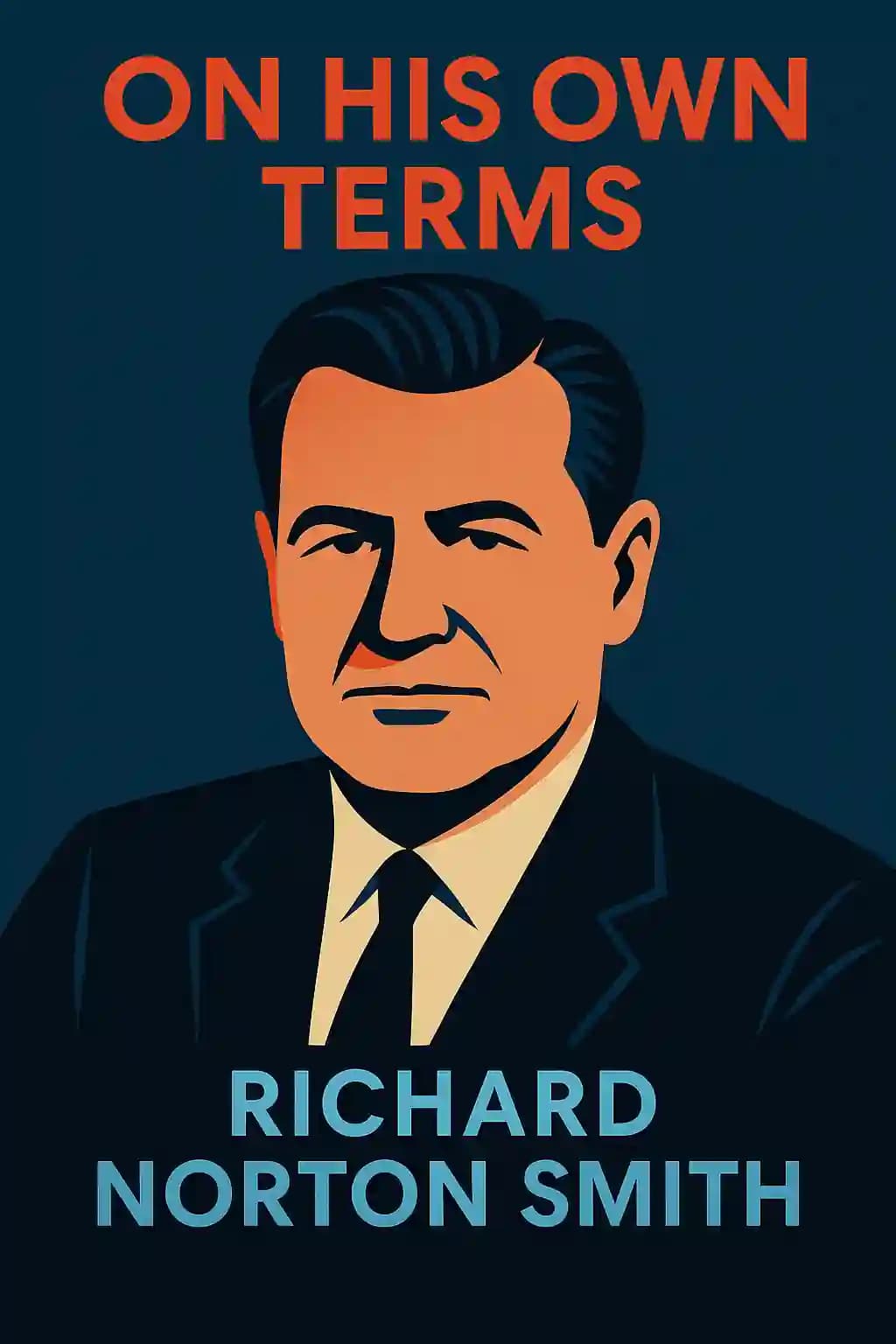
Meticulously crafted over 14 years, this definitive Rockefeller biography reveals how dyslexia couldn't stop a man who reshaped American politics. "The greatest cradle-to-grave biography in fifty years," says historian Michael Beschloss - with shocking details about Rockefeller's scandalous death that history textbooks omit.
Richard Norton Smith, acclaimed presidential historian and author of On His Own Terms: A Life of Nelson Rockefeller, is a leading authority on American political leadership. Specializing in meticulously researched biographies, Smith has directed multiple presidential libraries, including those of Herbert Hoover, Dwight Eisenhower, and Ronald Reagan, cementing his expertise in presidential legacies.
His Pulitzer Prize-finalist debut, Thomas E. Dewey and His Times, set the standard for political biography, followed by notable works like The Colonel: The Life and Legend of Robert R. McCormick (Goldsmith Prize winner) and An Ordinary Man: The Surprising Life and Historic Presidency of Gerald R. Ford.
A frequent commentator on C-SPAN and The NewsHour, Smith blends scholarly rigor with narrative flair. On His Own Terms, hailed by historian Douglas Brinkley as “one of the greatest cradle-to-grave biographies of the past 50 years,” reflects 14 years of exhaustive research, including unprecedented access to Rockefeller’s inner circle. The book was named among Amazon’s “Twenty Big Books in Biography and Memoir” for its revelatory portrait of the four-term New York governor and vice president.
On His Own Terms is a comprehensive biography of Nelson Rockefeller, chronicling his political career as a four-term New York governor, vice president under Gerald Ford, and his role as a progressive Republican. Richard Norton Smith explores Rockefeller’s policy achievements, personal struggles, and legacy, emphasizing his efforts to redefine the Rockefeller name through public service and philanthropy.
This book appeals to political history enthusiasts, readers interested in 20th-century American leadership, and those studying progressive Republicanism. It’s ideal for anyone seeking insights into Rockefeller’s complex persona, his impact on New York politics, or the challenges of bridging wealth and public service.
Yes. Praised as “one of the greatest cradle-to-grave biographies” (Douglas Brinkley), Smith’s 14-year research effort offers a nuanced portrait of Rockefeller’s ambitions, policy innovations, and personal contradictions. Its blend of political depth and personal drama makes it a standout in political biography.
Rockefeller reshaped New York through progressive policies on civil rights, education, and infrastructure. Nationally, he symbolized moderate Republicanism but faced resistance from his party’s conservative shift. His vice presidency under Ford, though short-lived, highlighted his resilience in navigating political marginalization.
As governor (1959–1973), Rockefeller expanded the state university system, championed civil rights legislation, and launched large-scale infrastructure projects. His use of bond financing for public works, though controversial, transformed New York’s urban landscape.
Smith details Rockefeller’s frustrating tenure as vice president (1974–1977), where he clashed with Ford loyalists like Donald Rumsfeld. Despite his influence as governor, Rockefeller struggled with limited power in Washington, culminating in Ford dropping him from the 1976 ticket.
The biography examines Rockefeller’s divorce and swift remarriage, which damaged his presidential aspirations, alongside his complex relationship with his family’s wealth. Smith also highlights his extramarital affairs, portraying a man driven by both idealism and impulsivity.
Smith balances admiration for Rockefeller’s policy vision with candid analysis of his flaws. He frames Rockefeller as a tragic figure—a progressive increasingly out of step with his party yet committed to public service until his death in 1979.
Unlike shorter accounts, Smith’s 900-page work combines exhaustive archival research with narrative flair. It stands out for its focus on Rockefeller’s state-level impact and his symbolic struggle to modernize the Republican Party.
Key themes include the tension between wealth and public accountability, the decline of moderate Republicanism, and the personal costs of political ambition. Smith also underscores Rockefeller’s belief in government as a force for social good.
Some reviewers note the book’s length and dense policy details. However, most praise Smith’s ability to humanize Rockefeller while contextualizing his era, calling it the definitive account of his life.
Rockefeller’s efforts to address inequality through public-private partnerships and his battles with party polarization mirror modern debates. His career offers lessons on leadership during societal transformation.
A presidential historian and former library director, Smith leverages unmatched access to archives and firsthand accounts. His expertise in institutional history enriches the analysis of Rockefeller’s governorship and Washington dealings.
저자의 목소리로 책을 느껴보세요
지식을 흥미롭고 예시가 풍부한 인사이트로 전환
핵심 아이디어를 빠르게 캡처하여 신속하게 학습
재미있고 매력적인 방식으로 책을 즐기세요
"Nelson needs art more than any man I know."
Art provided both escape and expression.
He remained fundamentally unknowable.
He spent his career trying to prove he was more than just a name.
On His Own Terms의 핵심 아이디어를 이해하기 쉬운 포인트로 분해하여 혁신적인 팀이 어떻게 창조하고, 협력하고, 성장하는지 이해합니다.
On His Own Terms을 빠른 기억 단서로 압축하여 솔직함, 팀워크, 창의적 회복력의 핵심 원칙을 강조합니다.

생생한 스토리텔링을 통해 On His Own Terms을 경험하고, 혁신 교훈을 기억에 남고 적용할 수 있는 순간으로 바꿉니다.
무엇이든 물어보고, 목소리를 선택하고, 진정으로 공감되는 인사이트를 함께 만들어보세요.

샌프란시스코에서 컬럼비아 대학교 동문들이 만들었습니다
"Instead of endless scrolling, I just hit play on BeFreed. It saves me so much time."
"I never knew where to start with nonfiction—BeFreed’s book lists turned into podcasts gave me a clear path."
"Perfect balance between learning and entertainment. Finished ‘Thinking, Fast and Slow’ on my commute this week."
"Crazy how much I learned while walking the dog. BeFreed = small habits → big gains."
"Reading used to feel like a chore. Now it’s just part of my lifestyle."
"Feels effortless compared to reading. I’ve finished 6 books this month already."
"BeFreed turned my guilty doomscrolling into something that feels productive and inspiring."
"BeFreed turned my commute into learning time. 20-min podcasts are perfect for finishing books I never had time for."
"BeFreed replaced my podcast queue. Imagine Spotify for books — that’s it. 🙌"
"It is great for me to learn something from the book without reading it."
"The themed book list podcasts help me connect ideas across authors—like a guided audio journey."
"Makes me feel smarter every time before going to work"
샌프란시스코에서 컬럼비아 대학교 동문들이 만들었습니다

On His Own Terms 요약을 무료 PDF 또는 EPUB으로 받으세요. 인쇄하거나 오프라인에서 언제든 읽을 수 있습니다.
Nelson Rockefeller lived a life of spectacular contradictions. Born into America's most famous fortune in 1908, he spent his career trying to prove he was more than just his grandfather's billions. This was a man who could casually give away millions yet chase down staffers over $10 expense discrepancies. Time magazine called him "the most liberal Republican in America," yet he ordered the bloody retaking of Attica prison that left 39 dead. He possessed boundless charm that connected instantly with voters, yet remained fundamentally unknowable even to his own children. His childhood unfolded in almost unimaginable privilege-in Manhattan's largest private home with a $500,000 "Playhouse" complex-yet his parents instilled strict values, requiring meticulous accounting of modest allowances and creating what Nelson remembered as "an ongoing seminar in public responsibility." Behind his confident smile and easy manner lay a complex man driven by both insecurity and ambition, whose life would shape American politics for decades.