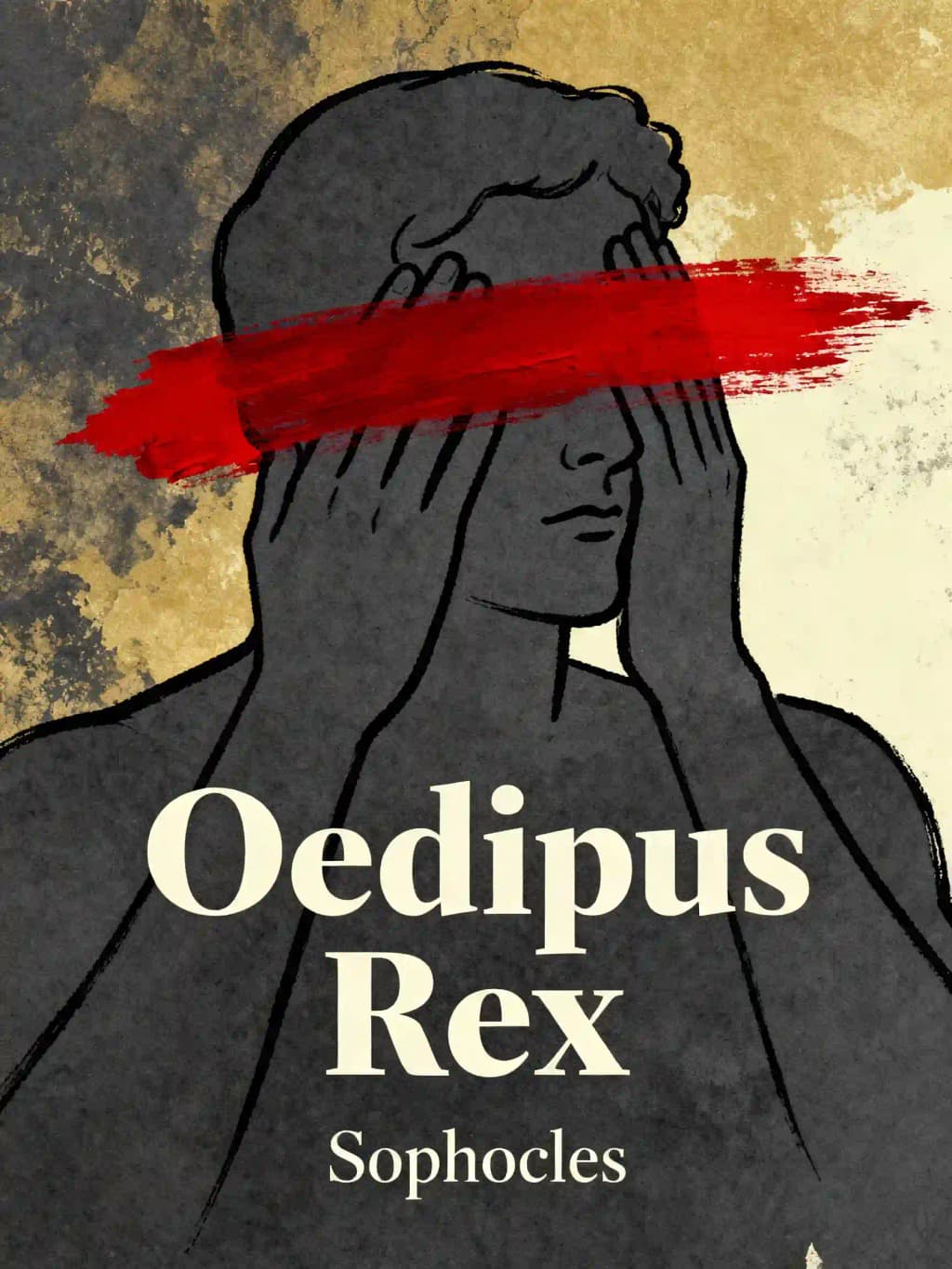
Ancient Greece's most perfect tragedy, "Oedipus Rex" follows a king who unknowingly fulfills a prophecy of patricide and incest. So profound, Aristotle praised it as flawless while Freud built an entire psychological theory around its haunting themes of fate versus free will.
Sophocles (c. 496–406 BCE) was the revered ancient Greek tragedian and author of Oedipus Rex. He crafted one of Western literature’s most enduring explorations of fate, free will, and human suffering.
A master of Athenian drama, Sophocles dominated Greece’s theatrical competitions, winning 24 of 30 City Dionysia festivals. He introduced groundbreaking innovations like the third actor to enhance dramatic tension. His works, including Antigone, Electra, and Ajax, dissect moral paradoxes and divine vs. mortal agency through psychologically complex characters.
Oedipus Rex anchors his Theban Plays trilogy, which examines the cursed lineage of King Oedipus with unflinching emotional intensity. As a state treasurer and military leader in 5th-century Athens, Sophocles bridged political acumen with artistic genius, shaping tragedy into a vehicle for probing societal and existential truths.
His seven surviving plays (of 120+ written) remain cornerstones of classical education and global theater, with Oedipus Rex alone inspiring adaptations by Freud, Cocteau, and Stravinsky.
Oedipus Rex is a Greek tragedy exploring King Oedipus’s quest to uncover the truth behind a plague ravaging Thebes, only to discover he unknowingly killed his father and married his mother. The play examines themes of fate, free will, and the consequences of hubris, culminating in Oedipus’s tragic self-blinding and exile.
This play appeals to readers interested in classical literature, Greek tragedy, and existential themes like fate versus free will. Students of drama, philosophy, or psychology will find its exploration of human limitations and self-discovery deeply relevant.
Yes, it remains a cornerstone of Western literature for its masterful storytelling and timeless themes. Its exploration of irony, destiny, and human frailty offers profound insights into the human condition, making it essential for literary enthusiasts and scholars alike.
The play interrogates whether humans control their destinies or are bound by prophecy. Oedipus’s attempts to defy his fate—killing his father and marrying his mother—ironically fulfill it, underscoring the tension between agency and predestination in Greek thought.
Physical and metaphorical blindness symbolize knowledge and ignorance. While the prophet Tiresias is physically blind but sees the truth, Oedipus gains insight only after gouging his eyes, highlighting the paradox of self-awareness.
The plague represents moral decay and divine punishment for Oedipus’s unwitting sins. It reflects the interconnectedness of individual actions and communal suffering, emphasizing the need for justice and purification.
The crossroads where Oedipus kills Laius symbolizes pivotal choices and their irreversible consequences. It underscores the theme of fate, as this seemingly random act seals Oedipus’s tragic destiny.
Oedipus’s overconfidence in his intellect and refusal to heed warnings—like Tiresias’s prophecies—lead to his downfall. His hubris blinds him to the truth until it’s too late, illustrating Greek warnings against arrogance.
Some critics argue the play overemphasizes fate, reducing human agency. Others question its portrayal of women, as Jocasta’s role is largely passive. However, its exploration of existential themes continues to garner praise.
Its themes of self-discovery, the limits of knowledge, and societal accountability resonate in modern discussions of identity and ethics. The play’s psychological complexity and moral questions remain universally compelling.
While Sophocles’ Antigone and Oedipus at Colonus further explore themes of justice and legacy, Oedipus Rex stands out for its tight narrative structure and devastating exploration of fate. It remains his most studied tragedy.
저자의 목소리로 책을 느껴보세요
지식을 흥미롭고 예시가 풍부한 인사이트로 전환
핵심 아이디어를 빠르게 캡처하여 신속하게 학습
재미있고 매력적인 방식으로 책을 즐기세요
O, O, O, they will all come, all come out clearly!
I'll bring it all to light myself.
Oedipus himself is the murderer and the source of Thebes' pollution.
Oedipus Rex의 핵심 아이디어를 이해하기 쉬운 포인트로 분해하여 혁신적인 팀이 어떻게 창조하고, 협력하고, 성장하는지 이해합니다.
Oedipus Rex을 빠른 기억 단서로 압축하여 솔직함, 팀워크, 창의적 회복력의 핵심 원칙을 강조합니다.

생생한 스토리텔링을 통해 Oedipus Rex을 경험하고, 혁신 교훈을 기억에 남고 적용할 수 있는 순간으로 바꿉니다.
무엇이든 물어보고, 목소리를 선택하고, 진정으로 공감되는 인사이트를 함께 만들어보세요.

샌프란시스코에서 컬럼비아 대학교 동문들이 만들었습니다
"Instead of endless scrolling, I just hit play on BeFreed. It saves me so much time."
"I never knew where to start with nonfiction—BeFreed’s book lists turned into podcasts gave me a clear path."
"Perfect balance between learning and entertainment. Finished ‘Thinking, Fast and Slow’ on my commute this week."
"Crazy how much I learned while walking the dog. BeFreed = small habits → big gains."
"Reading used to feel like a chore. Now it’s just part of my lifestyle."
"Feels effortless compared to reading. I’ve finished 6 books this month already."
"BeFreed turned my guilty doomscrolling into something that feels productive and inspiring."
"BeFreed turned my commute into learning time. 20-min podcasts are perfect for finishing books I never had time for."
"BeFreed replaced my podcast queue. Imagine Spotify for books — that’s it. 🙌"
"It is great for me to learn something from the book without reading it."
"The themed book list podcasts help me connect ideas across authors—like a guided audio journey."
"Makes me feel smarter every time before going to work"
샌프란시스코에서 컬럼비아 대학교 동문들이 만들었습니다

Oedipus Rex 요약을 무료 PDF 또는 EPUB으로 받으세요. 인쇄하거나 오프라인에서 언제든 읽을 수 있습니다.
Imagine a story so powerful it has shaped human understanding for over two millennia. In the sun-drenched theaters of ancient Athens, amid plague and war, Sophocles unveiled a tale that would become the blueprint for all tragedy that followed. "Oedipus Rex" tells the story of a brilliant man who, in trying to escape his fate, runs directly into its embrace. The tale begins with a city in crisis-Thebes is ravaged by plague, and its citizens turn to their king, Oedipus, for salvation. He has saved them before by solving the Sphinx's riddle, and they believe he can do so again. Oedipus learns from the oracle that the plague will end only when the murderer of the previous king, Laius, is found and punished. With characteristic determination, he vows to solve this mystery, declaring, "I'll bring it all to light myself." The dramatic irony is exquisite-for in seeking the criminal who pollutes Thebes, Oedipus is hunting himself. This is not merely a detective story but an excavation of identity, where the investigator and perpetrator are one and the same. What makes us return to this ancient tale? Perhaps it's because we recognize ourselves in Oedipus-brilliant yet blind, confident yet vulnerable, masters of our destiny yet shaped by forces we barely comprehend.