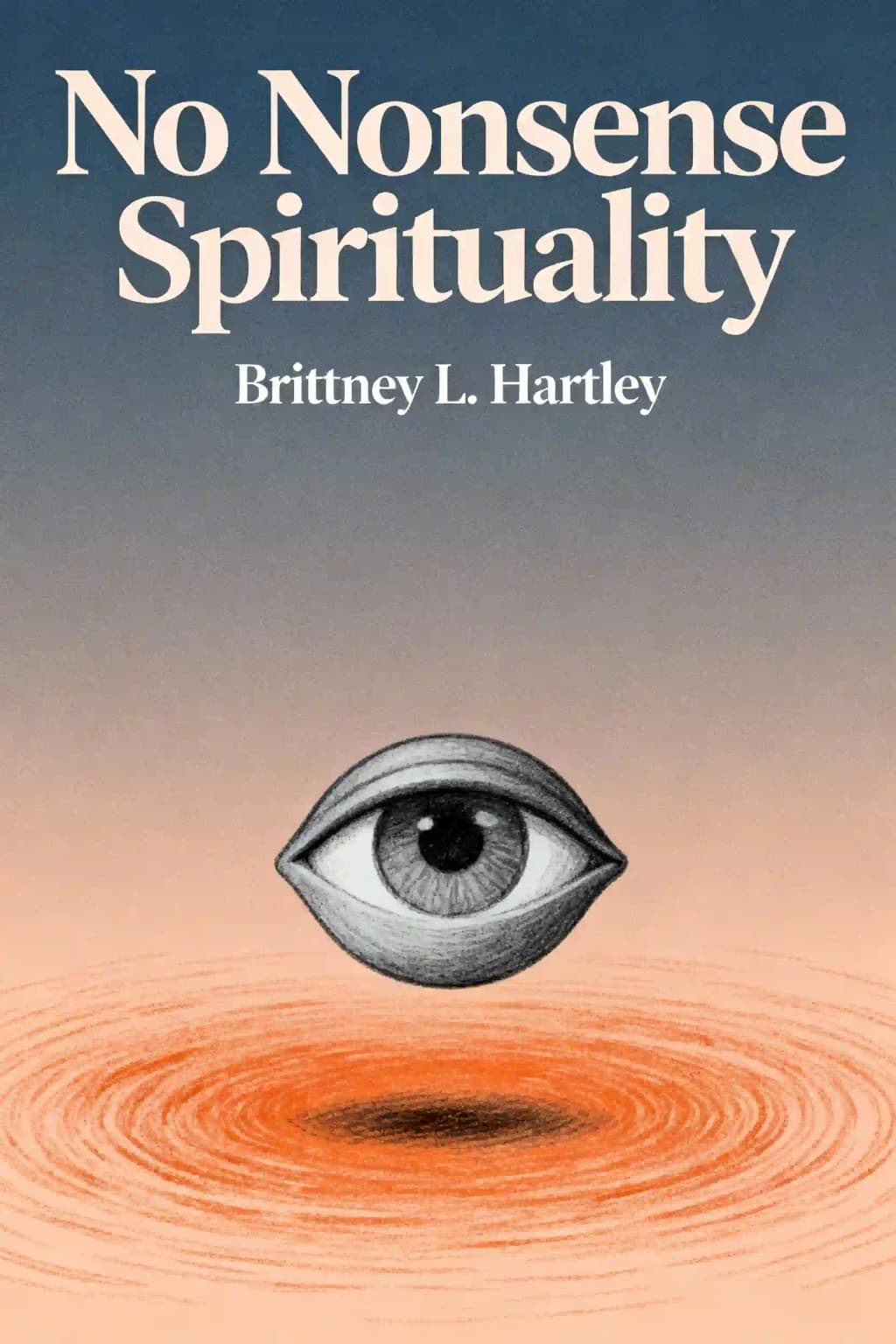
"No Nonsense Spirituality" strips away ritual to deliver authentic mindfulness for the modern seeker. Featured on ZDoggMD, Hartley's controversial approach blends secular wisdom with feminine mysticism. Can spirituality exist without religion? This book answers with refreshing clarity.
Brittney L. Hartley, author of No Nonsense Spirituality: All the Tools, No Faith Required, is an atheist spiritual director and secular spirituality advocate known for blending rational inquiry with existential meaning-making.
A former Mormon with a Master’s Degree in theology, Hartley draws on her faith deconstruction journey and decades studying philosophy, religion, and history to guide readers toward evidence-based spiritual practices.
Her work as a certified meditation teacher, Enneagram coach, and founder of the Boise Post Mormon Group informs the book’s exploration of secular ritual, morality, and connection. Hartley’s insights have reached audiences through her Mormon Stories Podcast appearances and her website NonNonsenseSpirituality.com, where she offers tools for reconstructing meaning after religious disillusionment.
Her approach—praised for its balance of academic rigor and accessible storytelling—has established her as a leading voice in post-religious spirituality, helping thousands navigate existential questions without dogma.
No Nonsense Spirituality by Brittney L. Hartley provides a secular framework for spiritual fulfillment, blending awe, ritual, community, and transcendent experiences without religious dogma. It offers tools like contemplative practices, secular morality, and personalized rituals to cultivate meaning, purpose, and connection in a post-religious context.
This book is ideal for atheists, skeptics, or former religious adherents seeking meaning beyond dogma. It appeals to those interested in secular mysticism, feminist spirituality, or rational approaches to awe, morality, and community-building.
Yes—Hartley combines academic rigor with practical exercises, making it valuable for readers navigating existential questions post-religion. Its focus on individualized spirituality, feminist perspectives, and evidence-based rituals offers fresh alternatives to nihilism.
Core ideas include:
Hartley defines spirituality as mindful connection—to oneself, others, and the world—without requiring belief in the supernatural. She emphasizes being "awake" during everyday acts like parenting or chores, transforming them into spiritual practices.
Yes. Each chapter ends with reflection questions, such as designing personal rituals, identifying awe-inspiring experiences, or aligning daily actions with secular virtues like justice and compassion.
Hartley advocates for creating communities through shared purpose, collective rituals (e.g., secular gatherings), and collaborative projects. She highlights love and connection as antidotes to modern isolation.
Intuition is framed as a tool for self-discovery, guided by reason. Hartley encourages exploring practices like meditation or artistic expression to access inner wisdom while avoiding pseudoscientific claims.
The book promotes virtues like fairness, kindness, and integrity rooted in human well-being. Hartley argues moral behavior emerges naturally from empathy and social cooperation, not divine authority.
It uniquely merges rational inquiry with mystical experiences, offering structured practices (e.g., archetypal storytelling, secular rituals) while rejecting both religious dogma and anti-spiritual skepticism.
She separates spirituality from supernatural beliefs, focusing on measurable benefits like increased resilience and connection. Practices like mindfulness or nature immersion provide transcendent experiences without requiring faith.
Yes. The book addresses fears of meaninglessness by providing frameworks to create purpose through creativity, community service, and embracing life’s impermanence as a catalyst for growth.
저자의 목소리로 책을 느껴보세요
지식을 흥미롭고 예시가 풍부한 인사이트로 전환
핵심 아이디어를 빠르게 캡처하여 신속하게 학습
재미있고 매력적인 방식으로 책을 즐기세요
Finally, someone talking about spirituality without making me roll my eyes.
Nihilism left me adrift-unable to make decisions, find purpose, or justify continued existence.
True belonging requires first belonging to yourself.
Freedom, paradoxically, terrifies us.
No Nonsense Spirituality의 핵심 아이디어를 이해하기 쉬운 포인트로 분해하여 혁신적인 팀이 어떻게 창조하고, 협력하고, 성장하는지 이해합니다.
No Nonsense Spirituality을 빠른 기억 단서로 압축하여 솔직함, 팀워크, 창의적 회복력의 핵심 원칙을 강조합니다.

생생한 스토리텔링을 통해 No Nonsense Spirituality을 경험하고, 혁신 교훈을 기억에 남고 적용할 수 있는 순간으로 바꿉니다.
무엇이든 물어보고, 목소리를 선택하고, 진정으로 공감되는 인사이트를 함께 만들어보세요.

샌프란시스코에서 컬럼비아 대학교 동문들이 만들었습니다
"Instead of endless scrolling, I just hit play on BeFreed. It saves me so much time."
"I never knew where to start with nonfiction—BeFreed’s book lists turned into podcasts gave me a clear path."
"Perfect balance between learning and entertainment. Finished ‘Thinking, Fast and Slow’ on my commute this week."
"Crazy how much I learned while walking the dog. BeFreed = small habits → big gains."
"Reading used to feel like a chore. Now it’s just part of my lifestyle."
"Feels effortless compared to reading. I’ve finished 6 books this month already."
"BeFreed turned my guilty doomscrolling into something that feels productive and inspiring."
"BeFreed turned my commute into learning time. 20-min podcasts are perfect for finishing books I never had time for."
"BeFreed replaced my podcast queue. Imagine Spotify for books — that’s it. 🙌"
"It is great for me to learn something from the book without reading it."
"The themed book list podcasts help me connect ideas across authors—like a guided audio journey."
"Makes me feel smarter every time before going to work"
샌프란시스코에서 컬럼비아 대학교 동문들이 만들었습니다

No Nonsense Spirituality 요약을 무료 PDF 또는 EPUB으로 받으세요. 인쇄하거나 오프라인에서 언제든 읽을 수 있습니다.
What happens when the foundation of your entire identity shatters? Picture sitting in church at sixteen, publicly marked as unclean, barred from sacrament for the sin of being human. This wasn't rebellion-it was the beginning of a twenty-year odyssey through the ruins of certainty. The journey from Orthodox Mormonism to angry atheism to paralyzing nihilism reveals something profound: we're living in a spiritual no-man's-land, caught between the suffocating certainty of religion and the cold emptiness of pure rationalism. Most of us exist in this uncomfortable middle ground-too intellectually honest for supernatural fairy tales, yet too human to accept that life is just meaningless atoms bumping around. We've outgrown the old stories, but what replaces them? Think of spirituality as three distinct doorways, each promising answers but delivering something different. Religion offers the comfort of absolute certainty-follow these rules, believe these stories, and you'll be saved. It's no accident that humans evolved religious tendencies; our ancestors who saw patterns and agency everywhere survived better than those who didn't. When lightning struck, believing an angry god caused it motivated you to seek shelter. Religion hijacks our pattern-seeking brains, offering structure in a chaotic universe. But that certainty comes at a cost: shame, exclusion, and the constant terror of getting it wrong. The second door leads to the occult-tarot cards, astrology, crystals, and manifestation. This path exploded during the pandemic, with one in five Americans now consulting mediums or using divination tools. It's the "Christianity-to-witch pipeline," filling the gaps left by patriarchal religions with feminine energy and intuitive wisdom. There's real value here-these practices tap into something genuine about human psychology and our need for ritual. But when intuition becomes mistaken for objective truth, when Mercury retrograde explains away our failures, we've simply traded one set of unfalsifiable claims for another. The third door is atheism-the intellectual high ground that rejects all supernatural claims. Statistically, it's the safest bet. Throughout history, supernatural explanations have been consistently replaced by natural ones, never the reverse. Yet atheism's fundamental limitation is devastating: it only tells you what isn't true. It tears down but builds nothing. Standing in the rubble of deconstructed faith, surrounded by the debris of meaning systems that no longer work, atheism offers no blueprint for reconstruction. This is where the real crisis begins-not in losing God, but in facing the terrifying freedom that follows.